DRIFT AUDIO
Listen to this story
Choose a voice, then press play.
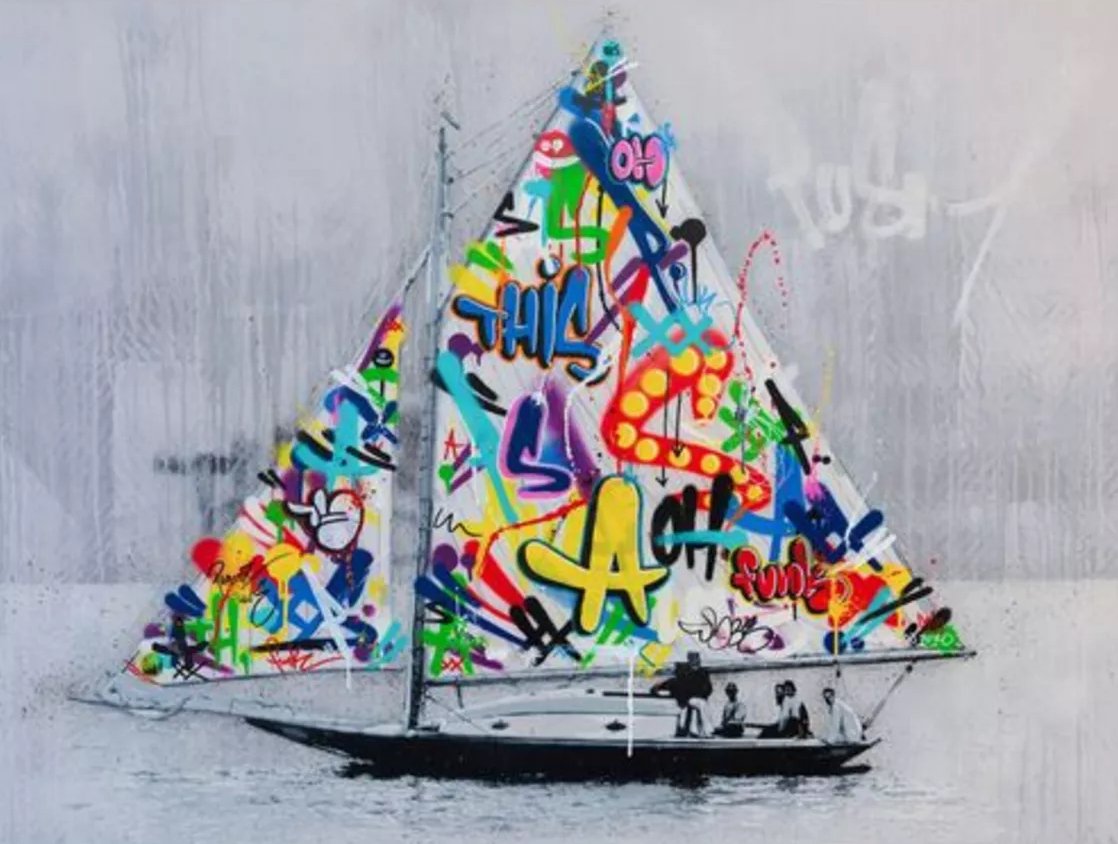
Martin Whatson, the acclaimed Norwegian contemporary artist, is renowned for his ability to merge urban graffiti with classical compositions, creating dynamic works that challenge perceptions of street art and fine art. His 2020 piece, Sail Boat #2, exemplifies this innovative approach, blending serenity and chaos, precision and spontaneity in a way that captivates and intrigues.
A First Look: The Tranquil Yet Complex Imagery
At first glance, Sail Boat #2 presents itself as a peaceful seascape, portraying a sailboat gliding effortlessly over calm waters. The blue hues of the ocean, carefully composed, evoke a sense of serenity and stillness, reminiscent of traditional maritime paintings. However, as the viewer looks closer, the signature Whatson graffiti elements begin to emerge, transforming the piece into something far more layered and dynamic.
Whatson’s work has always thrived on contrast, and Sail Boat #2 is no exception. The structured stencil technique, which has become a hallmark of his style, offers precision, while the bold, free-flowing graffiti strokes introduce an element of urban spontaneity. This juxtaposition between traditional beauty and rebellious street art is central to Whatson’s artistic vision.
The Artistic Techniques That Define Sail Boat #2
The Signature Stencil Technique
One of the defining characteristics of Martin Whatson’s work is his expert use of stencils, allowing him to achieve a level of sharp detail and intricate layering that gives his artwork a sense of depth and realism.
- The sailboat itself is executed with clean, precise stenciling, making it stand out against the chaotic urban graffiti elements.
- The contrast between the structured foreground and the expressive background creates a visual tension that draws the viewer in.
Graffiti as a Narrative Tool
While graffiti is often associated with rebellion and defiance, Whatson integrates it as a vital narrative element rather than mere decoration. The vibrant splashes of paint, chaotic brushstrokes, and layered colors inject movement into the piece, ensuring that the viewer’s eye continues to explore beyond the central subject.
- The graffiti portions reflect the spontaneity of street art, juxtaposed against the carefully planned composition of the sailboat.
- These elements might symbolize the unpredictability of life and nature, reinforcing the theme of chaos versus tranquility.
The Contrast of Color and Texture
Color plays a crucial role in Sail Boat #2, with cool blues dominating the composition, evoking a sense of calm and open space. However, the bold, multicolored graffiti bursts create sharp contrasts, ensuring that the piece remains visually dynamic and engaging.
- The delicate textures of the ocean provide a sense of stillness, while the rough, layered textures of the graffiti disrupt this calmness, offering a fascinating interplay between natural and urban aesthetics.
- The graffiti’s bright palette almost appears as if it’s emerging from within the boat, suggesting an interplay between the traditional and the contemporary, the classical and the rebellious.
The Deeper Meaning: What Sail Boat #2 Represents
Whatson’s work often encourages viewers to question preconceived notions of urban art, and Sail Boat #2 is a perfect encapsulation of this artistic challenge. The piece invites a deeper reflection on society, art, and the tension between order and disorder.
The Intersection of Nature and Urban Culture
By merging a timeless maritime scene with modern graffiti, Whatson highlights the coexistence of the natural and the man-made. The ocean and the boat represent tranquility and tradition, while the graffiti-infused details bring in elements of contemporary city life.
- This speaks to the broader global dialogue between nature and urbanization, encouraging us to consider how the two influence and reshape one another.
Challenging the Perception of Graffiti
Graffiti is often dismissed as vandalism, yet in Sail Boat #2, Whatson proves that it can be elevated to fine art, seamlessly integrated into a thought-provoking and visually striking composition.
- By incorporating street art techniques into a refined setting, Whatson questions why certain artistic expressions are considered “legitimate” while others are marginalized.
- The presence of graffiti on the sailboat—a traditional, often romanticized subject in art—forces viewers to reconcile these two worlds, sparking conversations about modern artistic evolution.
The Symbolism of 2020: A Year of Contrast
The year 2020 was marked by global upheaval, from the COVID-19 pandemic to social and cultural movements. In many ways, Sail Boat #2 reflects the emotional duality of that year:
- Calmness vs. chaos—just as the world experienced periods of stillness (lockdowns, isolation), it also saw bursts of protest, activism, and change.
- Traditional vs. modern—as people stayed home, they reconnected with nature and classic pastimes, while simultaneously engaging with digital, urban, and cultural shifts.
This piece serves as a reminder of art’s resilience, offering an escape, a commentary, and a reflection of the world at large.
Whatson’s Mastery of Fusion Art
Few artists manage to seamlessly merge fine art and street art without one overpowering the other. Whatson’s work retains the integrity of both styles, ensuring that neither the sailboat’s elegance nor the graffiti’s energy is lost.
A Timeless and Modern Appeal
While Sail Boat #2 feels deeply contemporary, it also carries a timeless essence that allows it to appeal to a broad range of audiences—from traditional art lovers to urban art enthusiasts.
A Statement on the Power of Contrast
By juxtaposing opposing elements—stillness vs. movement, realism vs. abstraction, structure vs. spontaneity—Whatson crafts a piece that is not just visually compelling but also conceptually rich.
Impression
Martin Whatson’s Sail Boat #2, 2020, stands as a testament to his ability to challenge, engage, and inspire. Through its expert layering, dynamic contrasts, and symbolic depth, the piece encourages us to look beyond first impressions, embracing the complexity and beauty of both traditional and modern forms of expression.
In a world that often tries to separate fine art from street art, chaos from tranquility, and history from contemporary culture, Whatson reminds us that true artistry lies in the fusion of contrasts. His work continues to reshape the landscape of contemporary art, proving that the unexpected can be just as beautiful as the familiar.
Related Articles
Modigliani’s Limestone ‘Tête’
Carved from a single block of limestone in Montparnasse more than a century ago, one of Modigliani's rare stone heads goes to auction for the first time…