DRIFT AUDIO
Listen to this story
Choose a voice, then press play.
rethink
There are art exhibitions, and then there are provocations—experiential questions posed to culture, history, and the audiences who walk through the door. Mercer Labs’ Maestros and the Machines belongs firmly to the latter category. Running through November 30 with extended hours Monday through Sunday, the exhibition asks a deceptively simple question: what would the greatest creative minds in history have made if they had the tools of today? The answer arrives not in the form of replicas or digital nostalgia but in a series of immersive, technologically augmented installations that feel alive, breathing, and provocatively contemporary.
Mercer Labs positions itself at the intersection of myth and circuitry, bridging centuries to produce something that bends time rather than simply referencing it. Mozart, Da Vinci, Hokusai, and other historical titans appear not as relics but as collaborators. The result is an exhibition that treats technology not as spectacle but as a partner in re-articulating genius. This is not about machines replacing the artist—it is about machines extending the imagination.
the exhibition
At its core, Maestros and the Machines is an experiment in creative reincarnation. It is also a philosophical challenge to the classical idea of a “masterpiece.” Many of the world’s most iconic works were made under the constraints of their time: quill pens, oil pigments, primitive musical instruments, slow methods of reproduction. Mercer Labs flips this paradigm. What if constraints were replaced with computational abundance? What if the artists we revere had access to real-time rendering, spatial scanning, algorithmic sound modelling, or infinite digital canvases?
The installation does not attempt to simulate what these creators would have literally built. Instead, it frames each gallery as a conversation between lineage and possibility. Time becomes porous. A melody begins in 1784 and ends in 2025. Brushstrokes emerge from a screen, dissolve into particles, and rebuild themselves inside a simulated architectural space. Famous motifs appear and vanish like memories reforming themselves.
Mercer Labs leverages motion capture, projection mapping, procedural animation, large-scale LED ecosystems, and AI-augmented creative coding not as gimmicks but as interpretive language. The machines do not exist to “modernize” the past—they help viewers sense the inner mathematics, rhythms, and sophisticated mechanics that were always present but previously invisible.
View this post on Instagram
imagine
One of the defining moments of the exhibition occurs in the gallery dedicated to Leonardo da Vinci, a singular figure whose legacy straddles both art and engineering. Da Vinci’s notebooks, often described as a Renaissance forerunner to digital mind-mapping, explode across the room as spatial projections. Pages fold and unfold like origami in mid-air. Machines he once sketched now animate themselves as if assembled from invisible code.
Mercer Labs’ interpretation does not romanticize the past. It interprets da Vinci as a thinker whose natural habitat would have been a laboratory lined with LIDAR rigs, robotic joints, and neural processors. Visitors walk through a constantly shifting architecture of sketches, prototypes, and speculative machines. The experience becomes a study in how technology might expose—not distort—the restless multidisciplinarity that defined Leonardo. The room suggests that he would not merely have used modern tools; he would have expanded them.
mozart
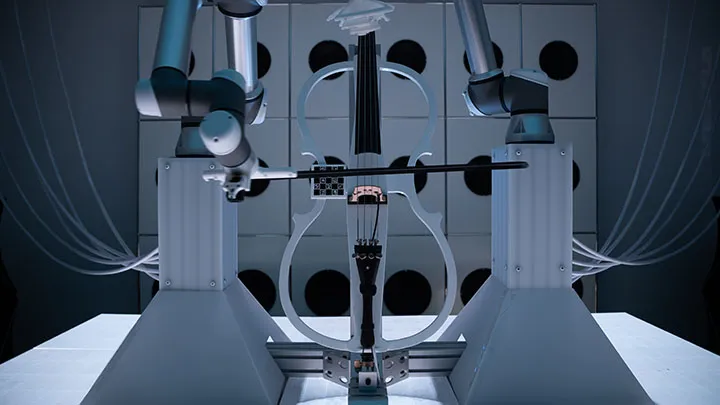
The musical arm of Maestros and the Machines approaches Wolfgang Amadeus Mozart not through preservation but through variation. Within a custom-built acoustic chamber, compositions evolve in real time as algorithmic structures interact with Mozart’s original motifs. You can hear fragments from The Marriage of Figaro transform into cascading digital arpeggios, while harmonic stacks bend and modulate according to real-time visitor movement.
In this room, the body becomes an instrument. Sensors track shifts in proximity, tempo, and silhouette. A slow step across the floor can dissipate a chord like smoke. A sudden turn can multiply a theme into fractal counterpoint. Mozart’s genius, often mythologized as divine spontaneity, is reframed as something computationally elegant. Mercer Labs’ system doesn’t imitate him—it allows his underlying structures to regenerate endlessly.
The goal here is not to “update” classical music. Rather, it is to free it from the rigidity of sheet notation, revealing its mathematical vitality. Mozart becomes a living force again, not a historical figure sealed behind museum glass.
flow
Few images carry the weight of Katsushika Hokusai’s The Great Wave off Kanagawa. Mercer Labs reimagines his iconic woodblock print not as a static composition but as a dynamic physics engine. In one of the most visually arresting rooms, a full 360º wave crashes, reforms, and dissolves at a scale impossible for traditional media. Brushstrokes liquify into pure motion. The wave becomes a simulation of historical imagination meeting computational capability.
This is not a looping animation. The wave is generated anew each cycle, responding to environmental conditions inside the room: sound vibrations, body heat, even the density of people present. The effect transforms Hokusai’s image into something closer to a natural phenomenon. For the first time, visitors sense the turbulence, chaos, and sublime fear that the original print implied but could not fully manifest.
The machine does not “modernize” Hokusai. Instead, it reveals that the artist was already studying the physics of nature. The technology simply takes the baton.
err
One of the exhibition’s core intellectual achievements is its redefinition of time as the main medium. The show resists nostalgia and resists futurism. Every gallery exists somewhere in the liminal space between then and now. Visitors are not asked to imagine the past through modern eyes or imagine the future through historical aesthetics. Instead, they are invited into a temporal fabric where artists and machines collaborate outside linear chronology.
The walls of one hallway ripple with generative murals that evolve according to real-world data sets: tides, weather patterns, astronomical shifts. Another room features portraits that reconstitute themselves differently each time a visitor blinks, responding to micro-expressions and luminance changes. The artwork can never truly be seen twice. It is a continuous becoming.
This approach destabilizes the historical assumption that a masterpiece must be fixed and unchanging. Mercer Labs suggests that the future of art may lie in works that accept impermanence as virtue—works that shift, break, rebuild, and respond like living ecosystems.
idea
A critical nuance of the exhibition is its refusal to frame technology as superior to traditional modes of creation. The machines in Maestros and the Machines do not compose new symphonies, invent new aesthetics, or generate revolutionary concepts on their own. They act as extensions of human imagination. The creative teams behind the exhibition—coders, sound designers, engineers, digital artists—operate as interpreters rather than originators.
Mercer Labs is careful to balance reverence with reinvention. It avoids the trap of technological determinism. Machines here are tools that reveal the skeleton of genius, the patterns and structures that were historically invisible. They amplify artists’ minds rather than overshadow them.
What emerges is a vision of creativity where humanity and computation are intertwined. Art becomes less about handcraft and more about ecosystems of intelligence—biological and digital working in tandem.
phil
It would be easy to regard the exhibition as a triumph of digital wizardry. But Mercer Labs pushes the conversation deeper. Maestros and the Machines interrogates who gets to define creativity in an age of computational power. The show’s quiet message is that genius has always been a product of tools. Renaissance painters depended on pigment-making advancements. Composers relied on evolving musical instruments. Mathematicians needed precise instruments of measurement.
Today, the toolset happens to be digital. The medium may differ, but the creative impulse remains recognizably human. Mercer Labs’ exhibition becomes a reminder that great artists were always technologists. They experimented, hacked, and pushed the limits of materials available to them. The machines in this exhibition simply extend that lineage.
still
The question at the heart of Maestros and the Machines is ultimately not about da Vinci or Mozart. It is about us. How will future generations interpret the creative works of today? What will survive when the materials of this era become obsolete? Mercer Labs hints at a world where artistic heritage is not preserved but perpetually regenerated.
The exhibition challenges visitors to consider a future where museums become dynamic laboratories rather than quiet repositories. Art becomes something you participate in rather than observe. Creativity becomes a continuum rather than a fixed point in history.
fin
By the time visitors exit the final gallery, the temporal dissonance begins to make sense. The exhibition does not ask us to decide whether machines improve or corrupt creativity. Instead, it invites us to acknowledge that art has always been hybrid. The past and future are not opposite directions—they are endpoints of the same spectrum.
Mercer Labs has produced an exhibition that feels both reverent and rebellious, intimate yet expansive, historical but decisively futuristic. Maestros and the Machines is less a display of technological might and more a meditation on possibility.
Through November 30, the museum offers audiences the rare chance to witness an alternate timeline where the world’s greatest creators meet the tools they never lived to see. It is an encounter beyond time, a dialogue across centuries, and a testament to the evolving, restless nature of creative thought.
If masterpieces were once bound by the limits of their era, Mercer Labs insists that the future of art lies in liberating creation from time itself.
Related Articles
Modigliani’s Limestone ‘Tête’
Carved from a single block of limestone in Montparnasse more than a century ago, one of Modigliani's rare stone heads goes to auction for the first time…