
DRIFT AUDIO
Listen to this story
Choose a voice, then press play.
In December 2024, archaeologists made a remarkable discovery at the ancient hot springs of San Casciano dei Bagni in Tuscany, Italy. Among the artifacts unearthed was a mysterious half-body bronze statue, shedding new light on the religious practices of the Etruscan and Roman civilizations.
The Discovery
The excavation at San Casciano dei Bagni, a site renowned for its thermal waters, revealed a sanctuary dating back to the 3rd century BCE. This sacred space was later developed by the Romans into the spa complex known as Balnea Clusinae. The half-body statue, along with other bronze figures and votive offerings, was found submerged in the hot, mineral-rich waters of the spring.
Significance of the Half-Body Statue
The half-body statue is believed to represent a deity or a revered individual, reflecting the syncretic religious practices of the time. The preservation of the statue in the thermal waters has provided scholars with invaluable insights into the artistic techniques and religious iconography of the Etruscan and Roman periods.
Context of the Find
San Casciano dei Bagni has long been recognized for its healing waters, attracting worshippers seeking cures for ailments. The discovery of the half-body statue, along with other artifacts such as bronze body parts and organs, suggests that the site functioned as a healing sanctuary where devotees offered representations of afflicted body parts in hopes of divine intervention.
This discovery challenges previous assumptions about the relationship between the Etruscan and Roman civilizations, indicating a more integrated cultural and religious exchange than previously thought. The artifacts from San Casciano dei Bagni provide tangible evidence of the continuity and adaptation of religious practices across these ancient societies.
Impression
The exceptional preservation of the half-body statue and accompanying artifacts offers a unique opportunity for further study. Conservation efforts are underway to ensure these relics are protected, allowing for ongoing research that may uncover additional insights into the spiritual and cultural dynamics of ancient Italy.
The unearthing of the half-body statue at San Casciano dei Bagni not only enriches our understanding of Etruscan and Roman religious practices but also underscores the significance of archaeological endeavors in uncovering the complexities of human history.
Related Articles
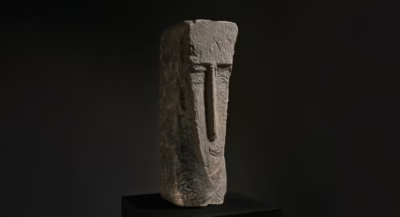
Modigliani’s Limestone ‘Tête’
Carved from a single block of limestone in Montparnasse more than a century ago, one of Modigliani's rare stone heads goes to auction for the first time…