DRIFT AUDIO
Listen to this story
Choose a voice, then press play.
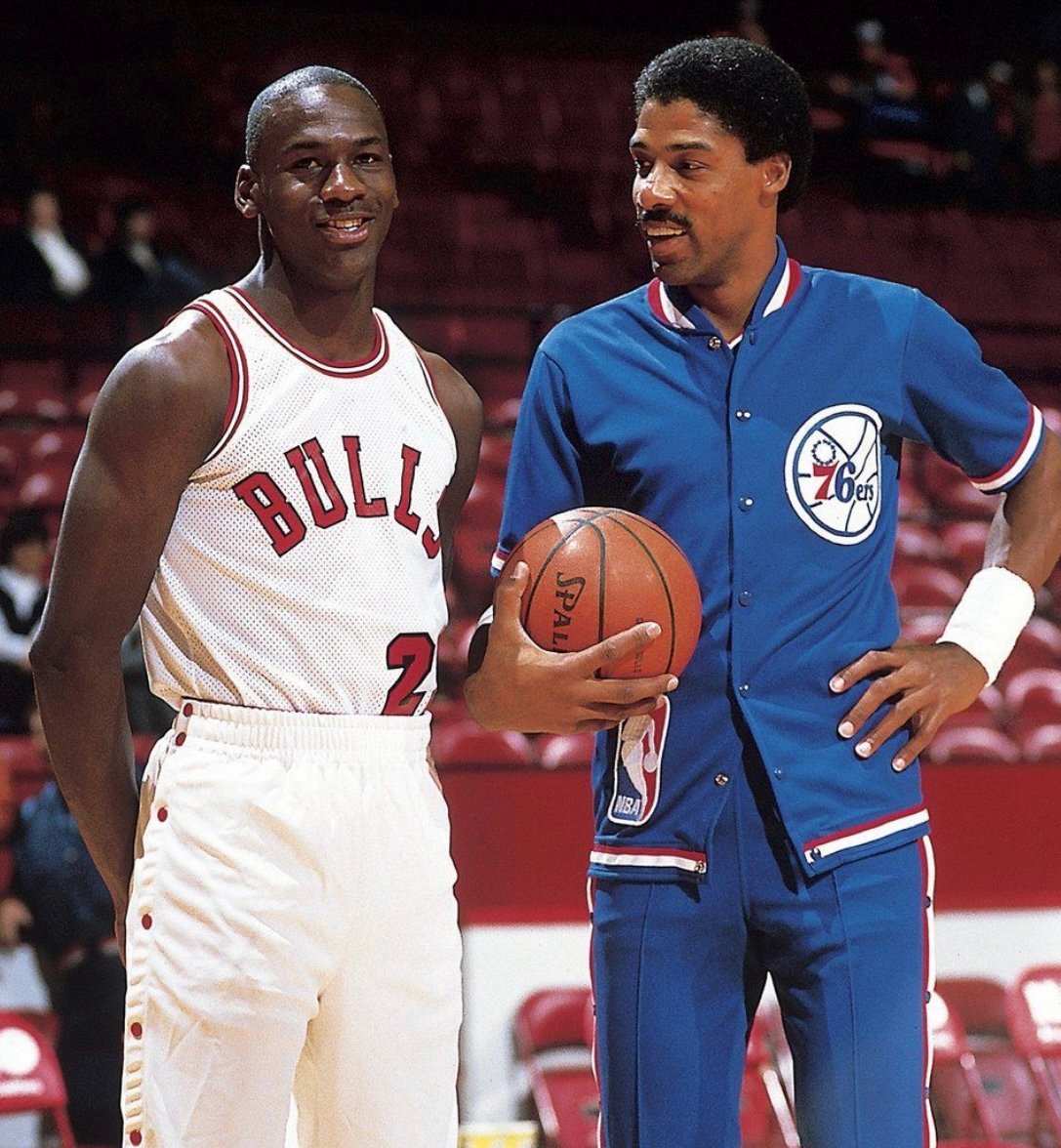
In the world of sports, few images carry the same weight as those that bring together legends from different eras. Recently, a simple yet powerful post on Instagram by Philadelphia 76ers legend Julius Erving, featuring none other than Michael Jordan, sparked a wave of reactions from NBA fans across the globe. The photo, which encapsulated the meeting of two of the greatest basketball players of all time, symbolized more than just a moment of camaraderie between two icons; it became a catalyst for discussions about basketball’s evolving history, legacy, and the eternal debate about greatness.
Julius Erving, known as Dr. J, and Michael Jordan, often hailed as the GOAT (Greatest of All Time), represent two distinct eras in basketball, each with its own unique cultural and athletic landscape. Erving’s post, seemingly a casual snapshot, is much more than just an image; it is a meeting of minds, an intersection of two extraordinary legacies, and a visual representation of the mutual respect between players from different generations. In this critical blog, we’ll explore the significance of this moment, dissect the fan reactions, and dive into the broader cultural implications of Erving’s post.
Julius Erving: The Trailblazer Who Changed the Game
To truly understand the weight of Julius Erving’s Instagram post, it is essential to recognize the profound impact that Erving had on the game of basketball. Erving’s career spanned both the ABA (American Basketball Association) and the NBA, and he was instrumental in shaping the modern style of basketball. Known for his high-flying dunks, acrobatic plays, and effortless charisma on the court, Erving brought a new level of flair and athleticism to the game that had rarely been seen before. His style of play, particularly his iconic dunks, was not just about scoring points; it was about creating moments that left an indelible mark on the audience.
Erving’s impact transcended his individual achievements. He was one of the first players to make the case that basketball could be both an art form and a sport. His elegance on the court was matched by his ability to play within the team system, making him a well-rounded player who could not only score but also defend, pass, and lead. In the ABA, Erving was the face of the league, and after the ABA-NBA merger, he continued to shine, winning an NBA championship with the 76ers in 1983.
Beyond his athletic achievements, Erving’s legacy is tied to his role as a trailblazer for future generations of players. His influence on the game is undeniable, particularly in terms of how he helped to popularize the above-the-rim style of play that would later define players like Michael Jordan. Erving’s dunks and his ability to soar through the air were precursors to the high-flying athleticism that became a hallmark of the NBA in the 1980s and beyond. In many ways, Julius Erving laid the foundation for what basketball would become in the Jordan era, and his place in basketball history is cemented as one of the great innovators of the game.
Michael Jordan: A Global Icon Who Redefined Greatness
On the other side of the photo is Michael Jordan, whose name is synonymous with basketball excellence. Jordan, who entered the NBA in 1984, quickly became the face of the league and would go on to dominate the 1990s with six championships, five MVP awards, and countless other accolades. What set Jordan apart was not just his extraordinary talent—his unmatched scoring ability, his lockdown defense, or his unrelenting competitiveness—but his ability to transcend the sport and become a global icon. Jordan didn’t just redefine what it meant to be great in basketball; he redefined what it meant to be a global superstar.
Jordan’s influence on the game was monumental. His competitive fire, combined with his unmatched skill set, made him one of the most feared and respected players in the league. The “Jordan Era” was defined by his ability to perform in the biggest moments, most notably in his six NBA Finals appearances, where he never lost a series. Jordan’s legacy is built not only on his athletic achievements but also on the cultural impact he had on basketball and sports as a whole. His Air Jordan brand revolutionized the sneaker industry, and his global appeal helped to popularize the NBA in markets around the world.
Jordan was not just a basketball player; he was a phenomenon. His presence on the court was electrifying, and he became the benchmark for greatness in the sport. For many fans, Jordan is the GOAT, the standard by which all other players are measured. His post-retirement influence has only grown, as he has transitioned into a successful businessman and owner, continuing to shape the sport from off the court.
Impression: A Meeting of Two Legends
When Julius Erving posted the photo of himself with Michael Jordan, fans immediately recognized the significance of the moment. The image captured two of the most important figures in the history of basketball—Erving, the trailblazer who helped popularize the game and bring flair to the court, and Jordan, the icon who took the game to unprecedented heights both in terms of global popularity and on-court success.
The Instagram post prompted a flood of reactions from fans, many of whom expressed awe at seeing two legends from different eras in the same frame. The comments section was filled with messages of respect, admiration, and nostalgia. For older fans, the photo brought back memories of watching Erving and Jordan in their primes, while for younger fans, it was a reminder of the enduring legacy these two players have left on the game.
One of the most common themes in the fan reactions was the notion of “passing the torch.” While Erving and Jordan didn’t directly overlap in their primes, Erving’s influence on Jordan is well-documented. Jordan has often spoken about how he admired Erving’s game and how Dr. J was one of the players he looked up to as a young player. In this sense, the photo represents a symbolic passing of the torch from one generation to the next, from Erving to Jordan, and ultimately to the players of today who continue to push the game forward.
The GOAT Debate Reignited
Whenever Michael Jordan is involved in any basketball conversation, the GOAT (Greatest of All Time) debate is never far behind. Erving’s Instagram post was no exception. Fans quickly began discussing the legacies of both players, comparing their careers, accolades, and impact on the game. While Jordan is widely regarded as the GOAT, especially by fans who grew up watching him dominate the 1990s, there is always room for debate, especially when comparing players across eras.
For some, Julius Erving’s influence on the game is just as important as Jordan’s, particularly because of his role in popularizing a style of play that paved the way for Jordan’s high-flying antics. Erving’s role as a trailblazer cannot be understated—he was one of the first players to make basketball a spectacle, a game of athleticism and grace. In that sense, Erving’s contributions to the game laid the foundation for players like Jordan, who took the game to new heights in terms of athleticism and cultural impact.
On the other hand, Jordan’s sheer dominance on the court and his ability to win championships in an era filled with Hall of Fame talent is often cited as the reason he stands alone as the GOAT. Jordan’s six championships, five MVP awards, and 10 scoring titles are unmatched, and his perfect record in the NBA Finals is often used as the ultimate trump card in GOAT discussions.
While the GOAT debate may never be settled, what the Instagram post between Erving and Jordan highlights is the respect that exists between players from different generations. Both Erving and Jordan have spoken about their admiration for each other, and this mutual respect transcends the debates that fans engage in. For Erving and Jordan, greatness is not something that needs to be debated; it is something that is earned through hard work, dedication, and a commitment to excellence.
A Celebration of Basketball’s Legacy
Beyond the GOAT debate, Erving’s Instagram post is a celebration of basketball’s rich history and legacy. The sport has evolved significantly since Erving’s playing days in the 1970s and 1980s, and players like Jordan were instrumental in taking the game to new heights in the 1990s and 2000s. Today’s NBA is built on the shoulders of giants like Erving and Jordan, and their contributions continue to influence the game and its players.
For many fans, seeing Erving and Jordan together is a reminder of the continuity of the game. Basketball is a sport that connects generations—players learn from those who came before them, and each generation adds something new to the game. Erving’s high-flying dunks inspired Jordan, and Jordan’s relentless competitiveness has inspired a new generation of players, from LeBron James to Kobe Bryant and beyond.
In this sense, the Instagram post is more than just a snapshot of two legends; it is a representation of the legacy of basketball itself. It is a reminder that the game is always evolving, but its foundations are built on the contributions of those who came before. Erving and Jordan are two of the most important figures in that legacy, and their meeting in the photo is a celebration of everything they have done to elevate the sport.
A Moment of Reflection and Celebration
Julius Erving’s Instagram post featuring Michael Jordan is a moment that transcends the typical social media post. It is a meeting of two of the greatest basketball players of all time, a celebration of the sport’s history, and a reminder of the influence these two legends have had on the game. The photo has sparked a wave of reactions from fans, reigniting debates about greatness, celebrating the legacy of both players, and reflecting on how basketball has evolved over the years.
Ultimately, the post is a testament to the enduring impact of Julius Erving and Michael Jordan. Their contributions to basketball are immeasurable, and their influence continues to be felt by players and fans alike. In a world where sports often feel fleeting, where players come and go and moments are quickly forgotten, Erving’s post is a reminder that some legacies are timeless.
Related Articles

Nike’s Mind 001
A cream shade Nike has used only as a supporting tone on two women's Mind 001 pairs takes over the whole mule in January 2027, with pink nodes underfoot.