DRIFT AUDIO
Listen to this story
Choose a voice, then press play.
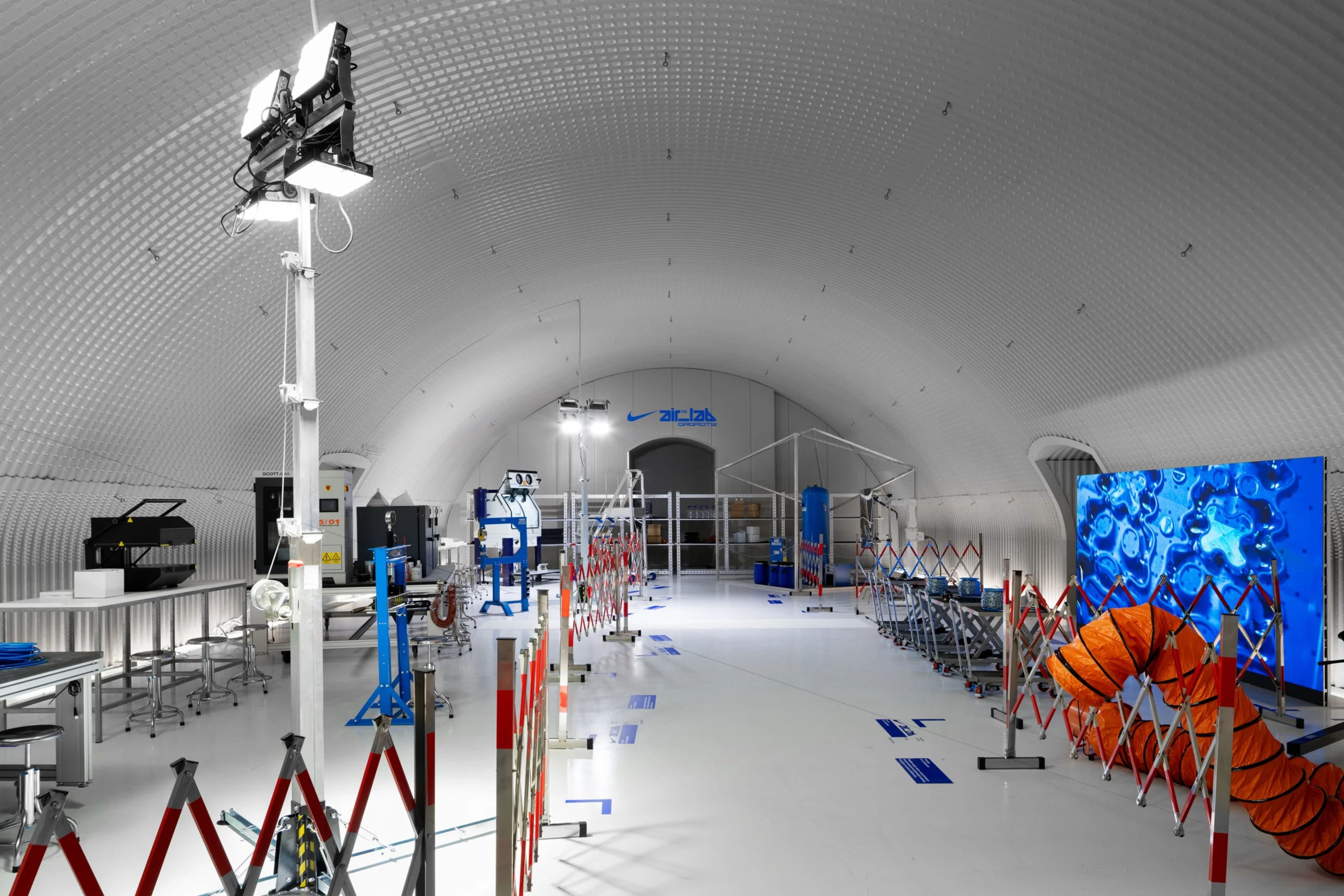
In April 2026, within the industrial edges of Milan—a city that has long mastered the language of form, material, and cultural authorship—Nike chose not to present a product, but to stage a condition. At Milan Design Week, where the world’s most refined design narratives converge annually, the brand introduced NikeAir_Lab, a spatial and conceptual installation developed in collection with Dropcity. The gesture was not framed as a launch. It was positioned as an inquiry.
What unfolded at Via Sammartini 72 was less exhibition than proposition: that air—intangible, invisible, historically relegated to the interior—could be treated not only as cushioning or performance infrastructure, but as a primary design medium. This reframing carries weight. For decades, Nike Air has existed as both technology and mythology, its view oscillating between hidden engineering and iconic transparency. Yet here, in this carefully orchestrated environment, air was neither concealed nor aestheticized in isolation. It was deconstructed, stretched across disciplines, and reintroduced as a system of thinking.
The result was a laboratory—literal and philosophical—where the boundaries between product, architecture, and experience began to dissolve.
stir
NikeAir_Lab operates within a lineage of experimental spaces that resist traditional retail or exhibition formats. It aligns more closely with the atelier, the workshop, the research institute—sites where process is not obscured but foregrounded. This is significant. In an era defined by rapid product cycles and digital abstraction, the insistence on physical experimentation reads as both nostalgic and radical.
Visitors entering the lab encountered a sequence of tunnels—five in total—each functioning as both narrative device and sensory threshold. Movement through these spaces mirrored a conceptual progression: from origin to application, from archive to speculation. It is within this choreography that the installation reveals its deeper intent. The journey is not linear; it is accumulative. Each tunnel refracts the idea of air through a different lens, constructing a fragmented yet cohesive know.
The first tunnel introduces air as evidence. Here, air is viewed—captured through instrumentation, rendered view through pressure mapping, light, and motion. It is an attempt to make the unseen legible. The gesture is scientific, yet undeniably an observance of phenomena. Air becomes trace, residue, a record of interaction between body and surface.
Subsequent tunnels expand this vocabulary. Air as shape. Air as transformation. Air as force. Each articulation is anchored by a corresponding tool station—eight in total—equipped with machinery that ranges from robotic arms to thermoforming systems. These are not symbolic props. They are functional instruments, activated through workshops and guided experimentation.
This emphasis on participation marks a critical departure from passive consumption. The visitor is not merely observing innovation; they imply in its making. The lab becomes a site of co-authorship, where design is experienced as process rather than outcome.
idea
Introduced in the late 1970s through the work of aerospace engineer Frank Rudy, Air technology has always occupied a dual identity: functional innovation and cultural signifier. Its evolution—from encapsulated units to visible Air bubbles—transformed footwear into a site of both performance and spectacle.
Yet the introduction of Air Liquid Max signals a shift. No longer confined to discrete units embedded within a sole, air is conceptualized as fluid—continuous, adaptive, responsive. The term “liquid” is not literal but metaphorical, suggesting a system that behaves with the dynamism of a liquid while retaining the structural properties of air.
Within the lab, this concept is explored through samples, swatches, and prototypes—nearly 100 in total, many of which are presented publicly for the first time. These artifacts trace the iterative journey from early experimentation to contemporary application. They reveal a design process that is neither linear nor singular, but layered, recursive, and deeply profound.
Materials such as FlyWeb and Radical AirFlow extend this exploration further. They challenge traditional notions of textile and structure, introducing new relationships between flexibility, breathability, and form. Therma-FIT Air Milano, meanwhile, situates air within the context of thermal regulation, expanding its functional domain.
Collectively, these innovations suggest a broader redefinition of materiality. Air is no longer treated as absence—a void to be filled—but as substance, capable of being shaped, manipulated, and engineered with precision.
precursor
Central to the ethos of NikeAir_Lab is the act of prototyping. As articulated by Nike’s design leadership, prototyping is not merely a step within the design process; it is a mindset—an ongoing dialogue between idea and execution.
This know manifests in the lab’s emphasis on iteration. Objects are not presented as finished products but as evolving entities, each bearing the marks of experimentation. Surfaces are imperfect. Edges are provisional. There is an honesty in this presentation that resists the polished finality often associated with brand exhibitions.
The inclusion of archival materials reinforces this narrative. Early experiments by Frank Rudy are displayed alongside contemporary prototypes, creating a temporal continuum that underscores the persistence of inquiry. The presence of artifacts related to projects such as the Alphafly NEXT% and Faith Kipyegon’s Breaking4 speed suit further situates Air within a broader ecosystem of performance innovation.
What emerges is a portrait of design as ongoing negotiation—a process defined not by resolution but by refinement. In this context, failure is not concealed but embraced as a necessary condition for discovery.
share
The connection between Nike and Dropcity is not incidental. It reflects a strategic alignment between corporate innovation and civic infrastructure. Dropcity, with its ambition to function as a public-facing design center, provides a framework that extends beyond the temporal boundaries of Milan Design Week.
The lab, while initially conceived as a one-week preview, is designed to persist as a permanent fixture within Dropcity’s ecosystem. This continuity is crucial. It transforms the installation from event to institution, embedding it within the daily practices of designers, architects, and students.
Through a long-term agreement with the municipality of Milan, Dropcity positions itself as a hub for accessible, high-quality workspaces. Its facilities—spanning robotics, 3D printing, textiles, ceramics, and more—create an environment where interdisciplinary connection is not only encouraged but structurally supported.
Nike’s involvement in this context suggests a reimagining of brand presence. Rather than operating as an external sponsor or temporary exhibitor, the company becomes an integrated participant within a larger design community. This shift carries an imply or how corporate entities engage with cultural ecosystems.
The lab thus functions as both a site of innovation and a model of partnership—one that prioritizes shared resources, knowledge exchange, and long-term impression.
extent
Beyond its conceptual framework, NikeAir_Lab distinguishes itself through its sensory orchestration. The integration of light, sound, and tactile elements transforms the lab into an immersive environment, where perception is actively shaped.
Light is used not merely for illumination but as a medium of articulation. It traces the contours of air, rendering pressure and movement view. Sound, meanwhile, operates as both ambient texture and informational cue, guiding the visitor through the spatial narrative.
Touch is perhaps the most critical dimension. Through hands-on workshops and interactive stations, visitors engage directly with materials and processes. This tactile engagement reinforces the central thesis of the lab: that design is not abstract but embodied.
The cumulative effect is one of heightened awareness. The visitor becomes attuned to the nuances of air—its resistance, its elasticity, its responsiveness. What was once imperceptible becomes tangible.
reason
NikeAir_Lab arrives at a moment when the boundaries between disciplines are increasingly porous. Fashion intersects with architecture. Technology converges with craft. Within this context, the lab’s emphasis on air as a unifying medium feels particularly resonant.
Air, by its nature, resists containment. It moves across spaces, adapts to conditions, connects disparate elements. As a design material, it offers a framework for thinking beyond fixed categories. It invites fluidity, adaptability, and responsiveness.
For Nike, this represents both continuity and evolution. The brand’s historical investment in Air technology provides a foundation, yet the lab signals a willingness to expand its scope—beyond footwear, beyond performance, into the realm of cultural production.
For Milan, the lab reinforces the city’s position as a global nexus for design innovation. It contributes to an ongoing dialogue about the role of design in shaping contemporary life—how materials, processes, and spaces can be reimagined to address emerging challenges.
For the broader design community, NikeAir_Lab offers a model of engagement that prioritizes openness, experimentation, and connect. It suggests that the future of design lies not in isolated genius but in collective exploration.
fin
In the end, NikeAir_Lab is not defined by any single object or innovation. Its significance lies in its ability to reframe a familiar element—air—within a new conceptual and cultural context.
By treating air as both medium and message, the lab challenges conventional hierarchies of materiality. It elevates the invisible, foregrounds the process, and invites participation. It transforms design from a static outcome into a dynamic, ongoing conversation.
As the installation transitions from temporary preview to permanent fixture within Dropcity, its impression will continue to unfold. It will serve as a site of learning, experimentation, and exchange—a space where ideas are not only generated but tested, refined, and shared.
In this sense, NikeAir_Lab is less a destination than a beginning. A point of departure for new ways of thinking about design, material, and the spaces we inhabit.
Air, once taken for granted, becomes something else entirely: a medium of possibility, a carrier of memory, and a foundation for what comes next.
Read Drift’s related feature, review: How Nike Engineered the Air Liquid Max Into Its Smoothest Air Max Yet.
n
From the DRIFT archive: Inside the World’s Most Iconic Ski Experiences · Nike Opens Soup Shop in China, Serving Up Comfort for Sports Recovery
Related Articles

Master Chief Reports to Call of Duty Now: Inside Xbox’s Second Reset Wave
Twenty-five years after Halo launched the original Xbox, the next mainline game belongs to Activision. […]