DRIFT AUDIO
Listen to this story
Choose a voice, then press play.
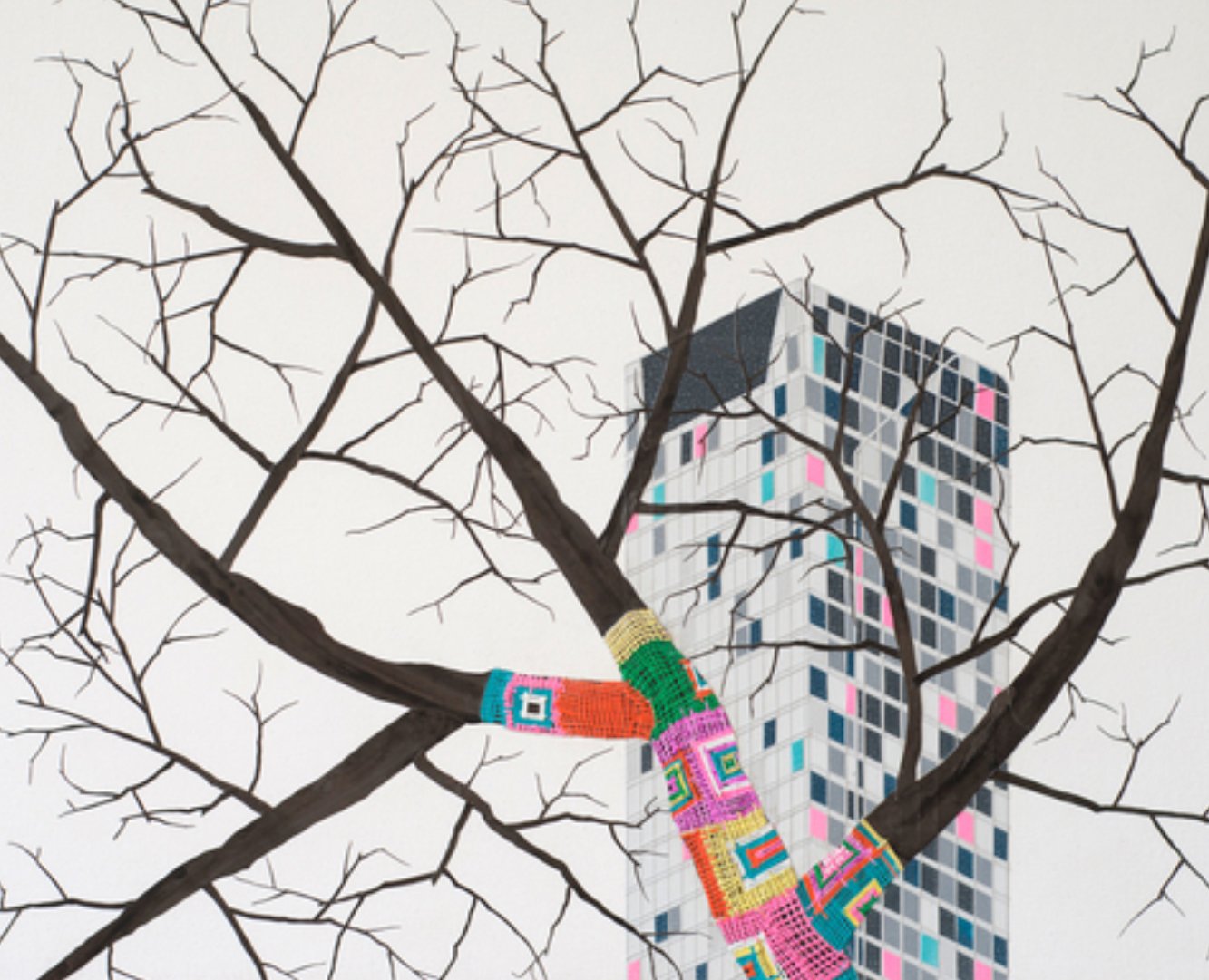
Erik Benson’s 2015 artwork, “no title (Knit Bomb),” presents a compelling intersection of traditional craft and urban art. This piece portrays a leafless tree adorned with a vibrant knitted covering, set against the backdrop of a building speckled with pink, blue, and gray windows under a white-gray sky. Through this imagery, Benson explores themes of public space, creativity, and the nuanced line between art and vandalism.
The term “knit bombing” refers to the practice of enveloping public objects—such as trees, fire hydrants, and stop signs—in knitted or crocheted fabrics. This form of street art, also known as yarn bombing, infuses urban environments with warmth and color, challenging the often cold and impersonal nature of cityscapes. In “no title (Knit Bomb),” the juxtaposition of the knitted tree against the stark architectural backdrop invites viewers to reconsider their perceptions of urban spaces and the role of art within them.
Benson’s choice of knitting as a medium carries rich cultural and social connotations. Knitting is traditionally associated with domesticity, warmth, and comfort—qualities that contrast sharply with the anonymity and rigidity of urban architecture. By integrating this craft into a public, outdoor setting, the artist disrupts conventional expectations, introducing an element of softness and familiarity into the urban landscape. This contrast not only enhances the visual appeal of the piece but also prompts reflections on the intersections of private and public spheres.
The vibrant colors and intricate patterns of the knitted covering further amplify this effect. The bold geometric shapes and lines introduce a sense of order and playfulness, transforming an otherwise mundane scene into a visually engaging and welcoming environment. This transformation underscores the potential of art to redefine and humanize public spaces, making them more inclusive and reflective of the communities they serve.
Beyond its aesthetic impact, “no title (Knit Bomb)” engages with broader social and political dialogues. By appropriating a craft traditionally seen as feminine for a public art installation, Benson challenges gender norms and societal perceptions of both art and craft. This act of placing a domestic art form into the public sphere questions the hierarchies that often devalue crafts associated with women, elevating them to the status of fine art and prompting discussions about the value and recognition of different art forms.
Moreover, the piece navigates the complex territory between art and vandalism. Knit bombing, while unsanctioned, is non-destructive and temporary, distinguishing it from other forms of graffiti. This ephemeral quality invites viewers to reflect on the nature of artistic expression in public spaces and the boundaries of acceptable interventions. Benson’s work encourages a dialogue about who has the right to alter shared environments and how such alterations can foster community engagement and redefine collective spaces.
Erik Benson’s meticulous process in creating “no title (Knit Bomb)” involves a unique technique of painting with acrylics on sheets of glass, allowing the paint to dry to a specific elasticity before carefully cutting and collaging the shapes onto canvas. This method results in a textured, layered effect that mirrors the complexity of urban environments. The precision and deliberation inherent in this process reflect the artist’s commitment to capturing the nuanced interplay between human creativity and the built environment. As noted in his artist statement, Benson aims to create “a kind of totem to the Everyday,” preserving transient moments that define urban life.
“no title (Knit Bomb)” exemplifies Erik Benson’s ability to blend traditional craft techniques with contemporary urban art practices. The installation challenges viewers to reconsider their relationship with public spaces, the definitions of art and vandalism, and the societal constructs surrounding gender and craft. Through this work, Benson demonstrates the transformative power of art to reshape perceptions, foster community dialogue, and infuse everyday environments with new meaning and vitality.
Related Articles
Modigliani’s Limestone ‘Tête’
Carved from a single block of limestone in Montparnasse more than a century ago, one of Modigliani's rare stone heads goes to auction for the first time…