DRIFT AUDIO
Listen to this story
Choose a voice, then press play.
Thunderbird packs 350 cubic meters of orbital living space into a single Falcon 9 launch, about a third of what it took dozens of flights to build for the ISS.
A year ago, OMI‘s highest profile project was Hop, a propose for an autonomous multi person scooter platform design to fit several standing passenger into the footprint of a single bicycle, ease overcrowd on city cycle lane. Accord to OMI, Hop was about a third of the width of a typical four person car, carrying standing riders so it could fit twice as many people into the same footprint as a seated design. It was the kind of self initiated, near future transport brief the young London studio built its name on since launching in 2024. Now Of My Imagination, to give it its full name, has traded last mile transit for low Earth orbit entirely. Working with Max Space, a Florida aerospace startup based near the Kennedy Space Center, OMI has produced the concept design for Thunderbird Station, a commercial space station intended to eventually take over where the International Space Station leaves off.
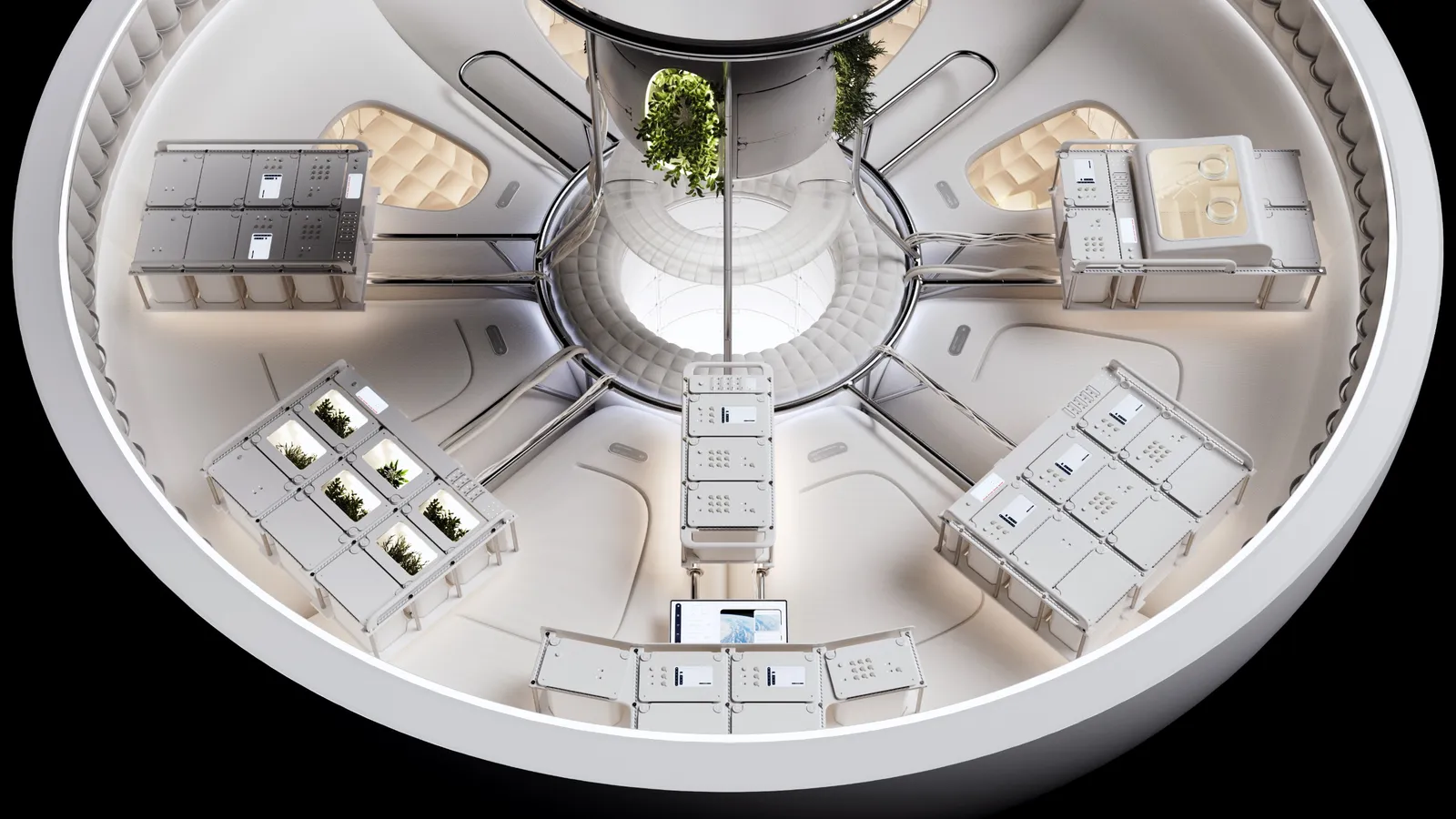
The pitch from both companies is consistent: stop treating a space station like a purely functional spacecraft and start treating it like a place people actually live. That framing shows up directly in Thunderbird’s circular interior layout, which uses the disorientation of microgravity to its advantage for navigation rather than fighting it, an approach OMI and Max Space say was shaped by working closely with veteran NASA astronauts rather than starting from a blank technical brief. Without gravity to define a floor, a circular cross section gives crew members a consistent visual reference point wherever they orient themselves relative to handholds and hatches, rather than forcing everyone to agree on which surface counts as “down.” It is also, on paper at least, a considerable leap for a studio whose public portfolio to this point has been almost entirely wheels on pavement, and one of a growing number of cases where industrial designers more used to terrestrial constraints, mass budgets, ergonomics, manufacturing tolerances, are being pulled toward orbital hardware instead.
one
What makes Thunderbird notable isn’t primarily the interior design, it’s the packaging. Traditional space stations are assembled in orbit from multiple rigid modules delivered across many separate launches. The ISS is the extreme version of that approach: NASA’s own history of the station’s construction puts the total at 37 Space Shuttle flights, plus two Russian Proton launches, two Soyuz launches and three commercial Falcon 9 missions, more than 40 assembly flights spread across more than a decade of orbital construction work.
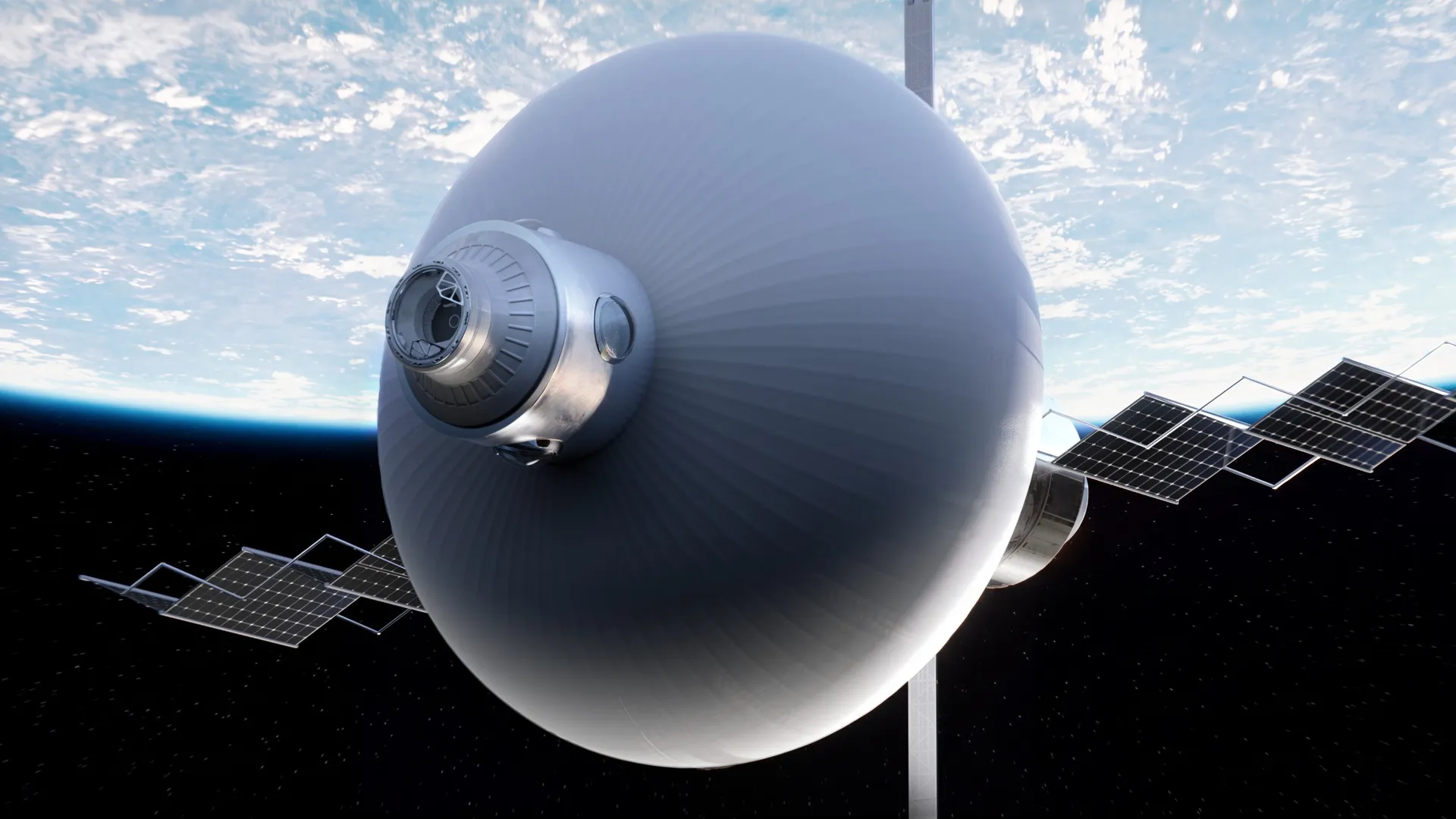
Thunderbird is designed to skip nearly all of that. The station launches compacted inside a single Falcon 9 rocket and expands roughly twentyfold once it reaches orbit, according to Max Space, removing the need for astronauts or robotic arms to piece it together in space after the fact. The underlying idea isn’t new. NASA tested an expandable module called TransHab in the late 1990s, a 342 cubic meter concept that never flew but proved the ground testing case. Bigelow Aerospace followed with Genesis I and Genesis II, two 11.5 cubic meter free flying demonstrators launched in 2006 and 2007 that are, remarkably, still in orbit nearly two decades later, and then BEAM, a 16 cubic meter module that has been attached to the ISS since 2016. Max Space’s Chief Technology Officer, Maxim de Jong, worked on all three of those earlier modules, and the company’s argument is that the technology has now matured enough to scale up from a single test article to a full station.
limin
Once deployed, Thunderbird provides 350 cubic meters of pressurized volume, Max Space says, about a third of the volume of the ISS. The station is designed to support four crew members continuously, with room for up to eight during shorter stays, and includes docking ports for visiting spacecraft. Max Space has already signed an initial launch contract with SpaceX, and the company’s own materials note that the first crewed Thunderbird flights are expected to fly astronauts up on SpaceX’s Dragon capsule rather than launching crew inside Thunderbird itself, which travels to orbit uncrewed before anyone boards it.
mat
Where the ISS relies on rigid aluminum modules, Thunderbird’s outer shell is built from multiple layers of Kevlar, the aramid fiber more commonly associated with body armor, chosen for being both lightweight and strong. Max Space says the structure is designed to a safety factor three times what NASA requires of traditional metallic spacecraft, and, as Yanko Design has reported, the module has to withstand the extreme temperature swings of orbit on top of that. In a SpaceNews interview, CEO Saleem Miyan compared the module’s micrometeoroid and orbital debris shielding to “a layer of leaves,” a system he said has performed well in ground testing but has not yet flown in space. Verifying that shielding in orbit, rather than in a lab, is the specific job of the company’s first test flight.
build
The interior itself was shaped in collaboration with veteran NASA astronaut Nicole Stott, who logged 104 days in orbit across missions to the ISS and the Space Shuttle, plus a spacewalk, before joining Max Space as its lead astronaut. Stott’s operational résumé extends underwater as well: as a NASA aquanaut, she also spent 18 days on a saturation dive mission at the Aquarius Undersea Habitat, an unusual dual background in extreme, enclosed environments that Max Space has pointed to directly when explaining why her input shaped the design. “It’s the first time I’ve seen an interior truly designed for space, not Earth,” Stott said of the design process.
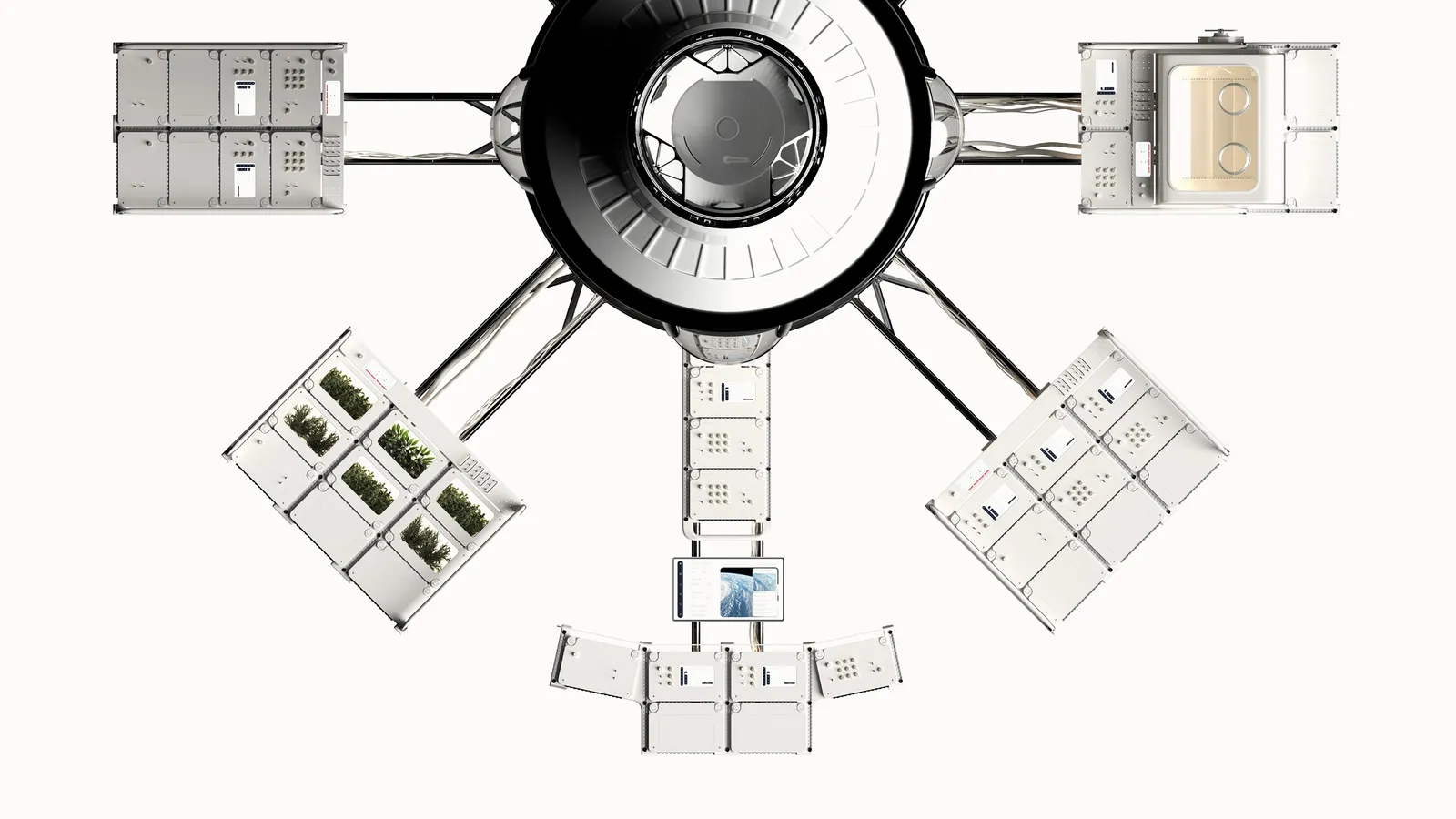
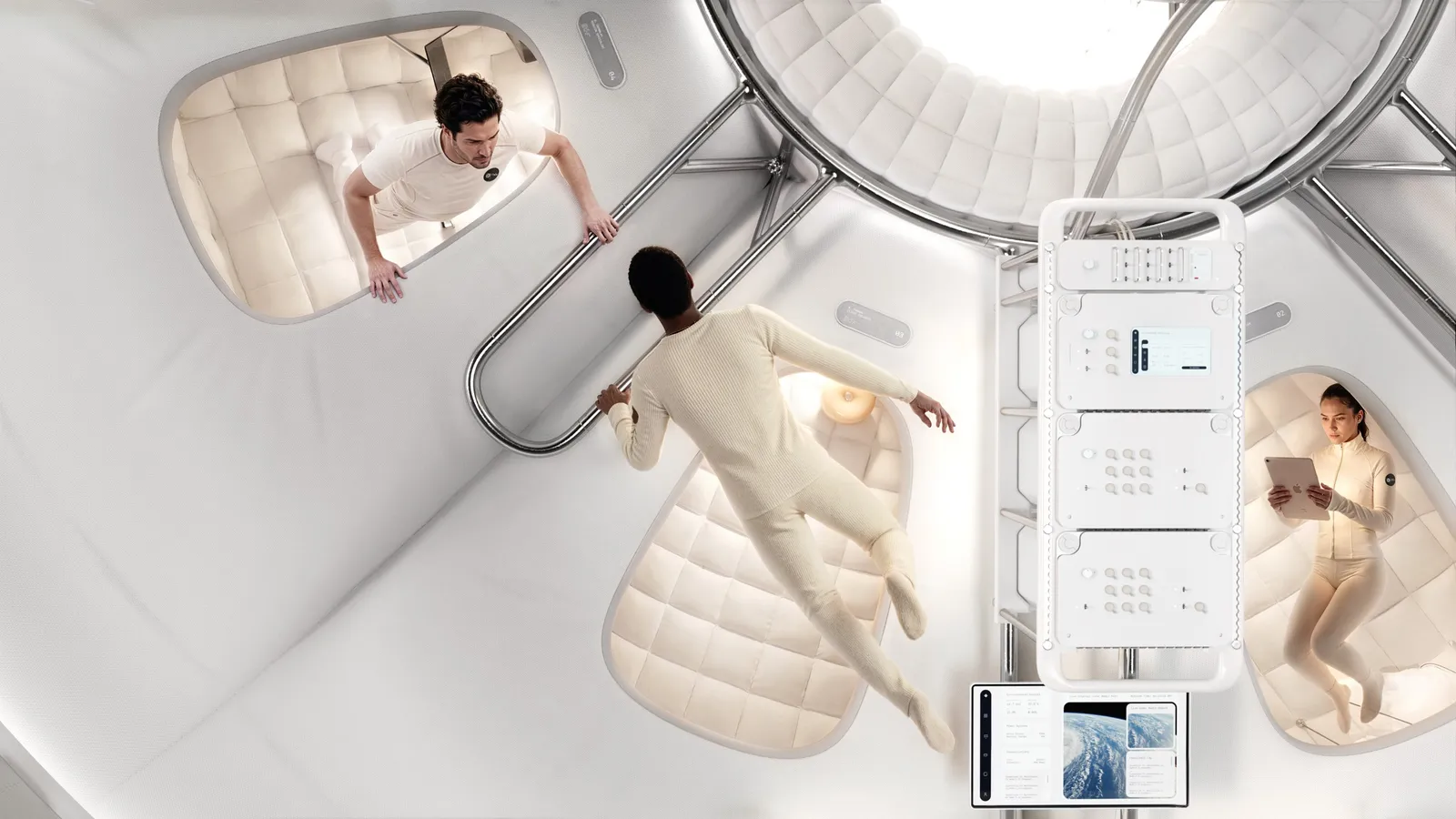
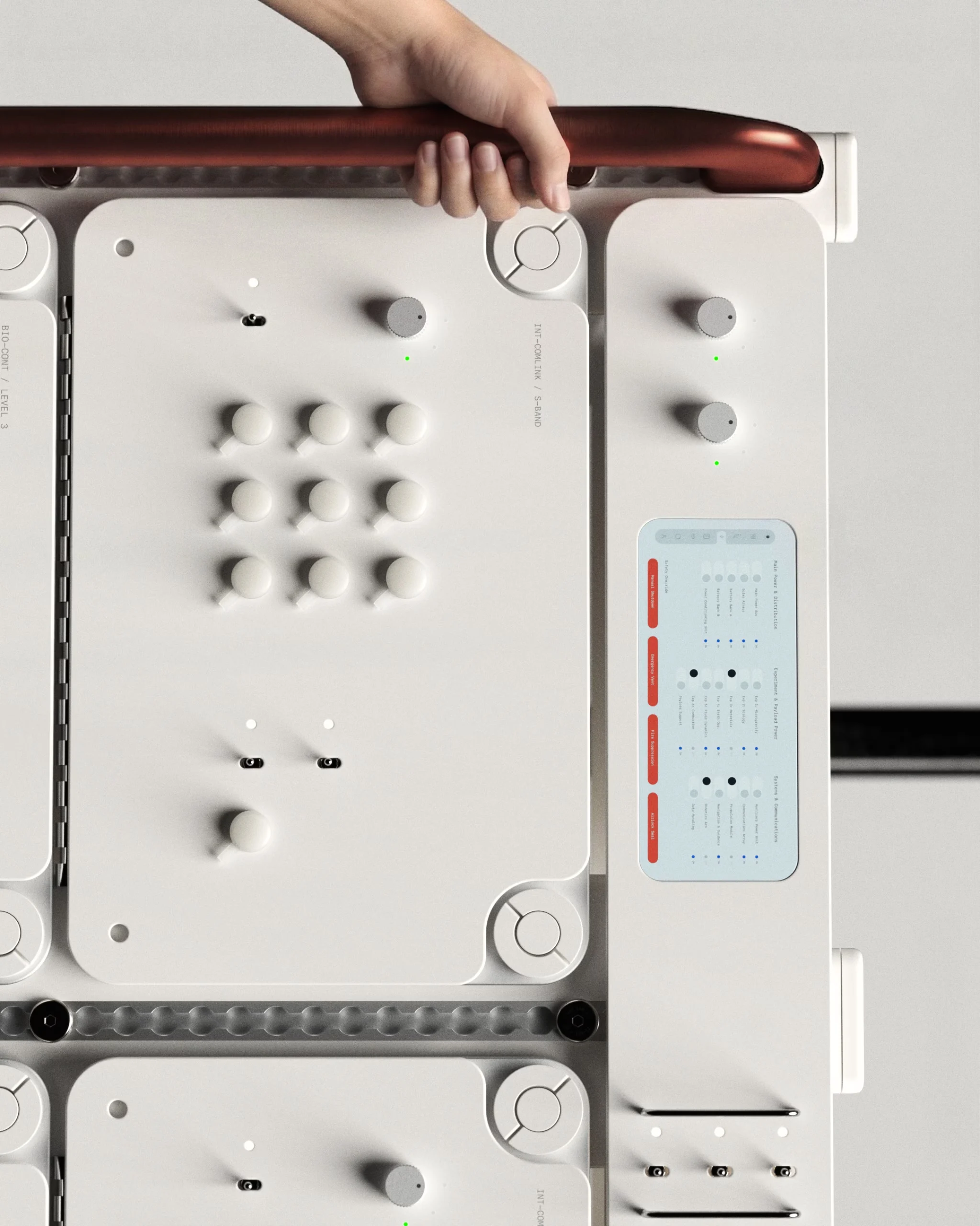
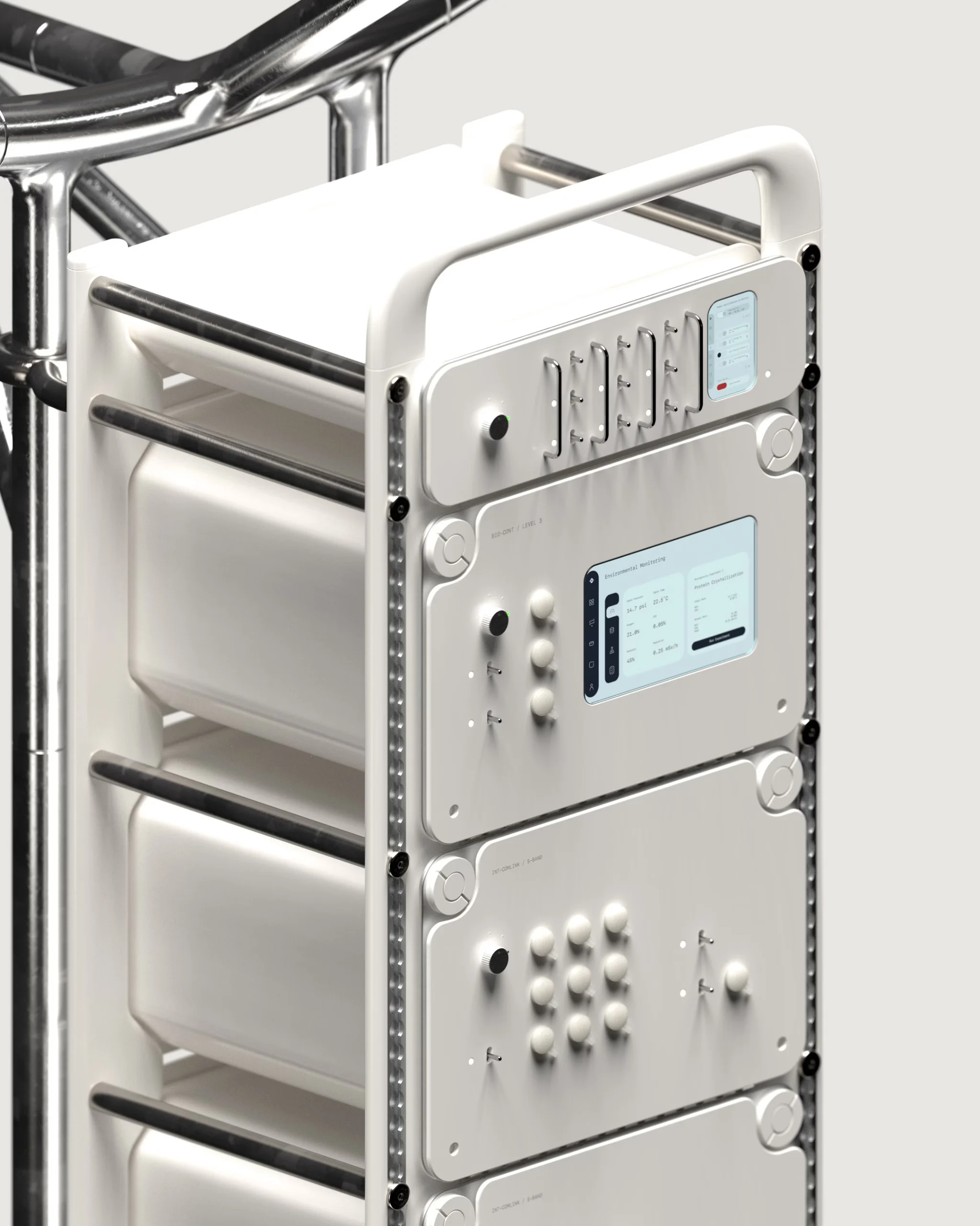
That design includes private sleeping pods for each crew member, a shared commons area with large screens for Earth and space views that double as entertainment and communications displays, an observation gallery with domed windows for private or social viewing, and more than 60 reconfigurable payload lockers for research and manufacturing work, with room for several times that in additional racks to support government and commercial missions, including industrial scale in-space manufacturing. Max Space describes the research fit out as including glovebox stations, microscopes and plant growth chambers, positioning Thunderbird as a working laboratory as much as a home. The company also says the interior’s morphic structure lets astronauts reposition working and living areas mid mission rather than committing to a fixed floor plan on the ground.
OMI’s Dan Window has said, “At Omi our best work happens when challenging what is possible in transport design.” Thunderbird pushes that instinct into an environment where up and down barely apply: fixtures, storage and workspaces had to be rethought for three dimensional use throughout the module rather than a single floor plane, the same three dimensional thinking OMI has applied to ground vehicles, now turned toward a habitat with no ground at all.
Globetrender, which reviewed the concept in detail, reports that lighting throughout the module is designed to reproduce a natural day and night cycle rather than the near constant daylight of low Earth orbit, timed to help regulate astronauts’ circadian rhythms and keep the crew aligned with the working hours of mission control teams on the ground. Hygiene areas sit behind their own bulkheads for privacy, cable runs are integrated into the structure rather than left trailing across walls the way they famously do on the ISS, and the overall look leans toward a cleaner, more considered aesthetic that invites comparison to 2001: A Space Odyssey and NASA’s own Skylab as much as to the station it’s pitched to eventually replace.
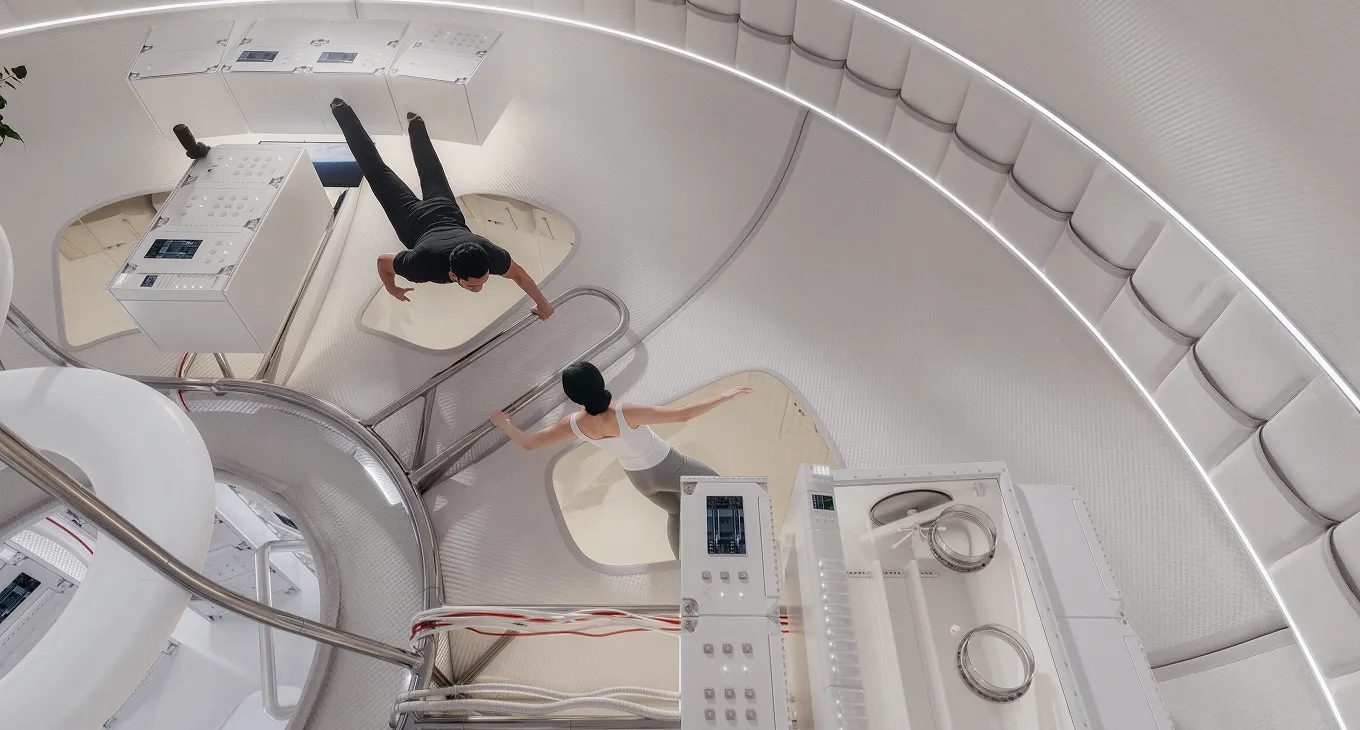
An overhead view of a futuristic, all-white curved interior with two figures: a man suspended upside down holding a metal railing, and a woman in a white tank top reaching towards him, surrounded by high-tech control panels and metallic structures.
team
Max Space was co-founded in 2023 by CEO Saleem Miyan, Chairman Aaron Kemmer and CTO Maxim de Jong. Miyan’s prior background is in scaling technology businesses, including a stint leading Philips Semiconductors’ global IoT unit and time at Checkpoint Systems and a company later acquired by Lockheed Martin’s Savi division. Kemmer previously co-founded Made In Space, generally credited as the first in-space manufacturing company, which was later acquired by Redwire. The company has also added Dr. Kartik Sheth, a former NASA Associate Chief Scientist and White House Office of Science and Technology Policy Assistant Director who oversaw missions including the James Webb Space Telescope, to its advisory bench. Max Space says it has around 50 employees, a facility in Exploration Park near Kennedy Space Center, and has raised more than 10 million dollars in a pre-seed round, funding it says covers the company through the Mission Evolution launch. OMI, for its part, describes itself as a transport focused studio that partners with industry leaders worldwide to shape original, sustainable and human centred design, work that until Thunderbird had stayed close to the ground, in electric micromobility and autonomous urban transport concepts rather than orbital hardware.
extend
Before any of that gets tested with people aboard, Max Space is flying a much smaller demonstration. Mission Evolution, an uncrewed five cubic meter prototype, is scheduled to launch on a SpaceX rideshare mission in early 2027. Its main objective is verifying that the expandable module deploys correctly in orbit and that its micrometeoroid protection layers hold up outside a lab, with a secondary goal of testing the environmental control and life support systems the full station will eventually rely on.
If that mission goes to plan, Max Space’s own roadmap lists 2029 as the launch date for the full Thunderbird Station. The company has separately secured NASA support through Space Act Agreements and a strategic investment from Voyageraimed at advancing a permanent lunar habitat, part of a broader roadmap that includes larger expandable habitats for the Moon and, eventually, Mars: successive products the company has internally named Max Moon and Max 1,000, scaling toward a theoretical 10,000 cubic meter concept it calls Max Megastructure. None of those exist in anywhere near the detail Thunderbird does today.
Max Space’s own framing for why any of this matters goes beyond a single station: the company has said Thunderbird is meant to support a continued U.S. presence in low Earth orbit while also being scalable enough to underpin future Moon and Mars habitats, positioning the technology as infrastructure for the broader space economy rather than a one-off replacement for the ISS.