DRIFT AUDIO
Listen to this story
Choose a voice, then press play.
A tote big enough to dwarf shoppers has spent New York Fashion Week parked in Rockefeller Center’s Channel Gardens, marking Gap’s first real entry into handbags.
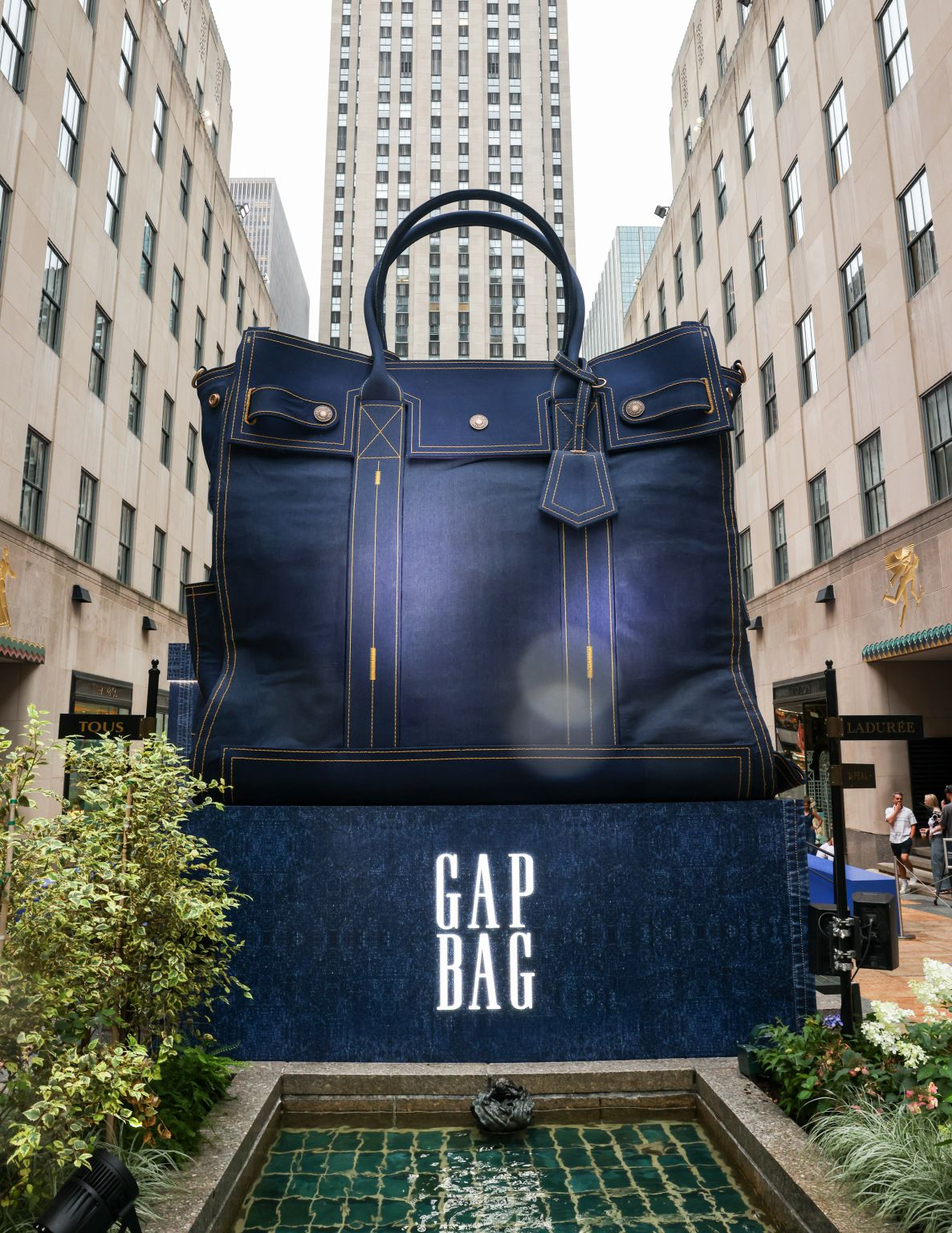
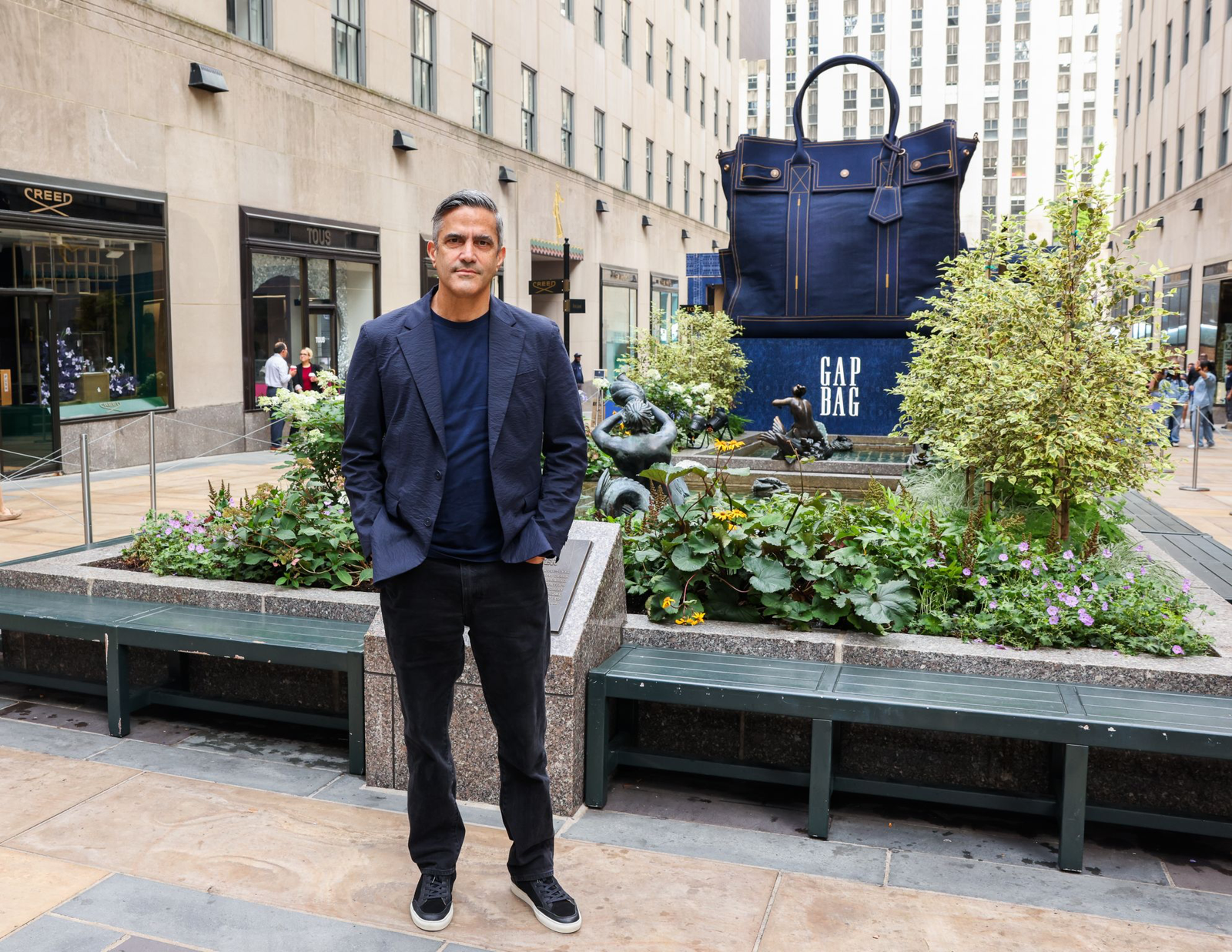
For four days this month, the sunken lawn between Fifth Avenue and the Rink at Rockefeller Center has belonged to a single handbag, rendered at a scale built for photo rather than shoulders. Gap installed an oversized version of its new Five-Pocket Tote, dark wash denim, contrast stitch, and stacked top handles all scaled up, in the Channel Gardens from September 10 through today, closing out a run timed to New York Fashion Week. WWD described the oversized tote as playing off the plaza’s Art Deco backdrop, and Krakoff told the trade paper the location “just feels really alive.” The pop-up has been open to the public daily from 10 a.m. to 6 p.m., with members of Encore, Gap Inc.’s cross-brand loyalty program, ushered in first on Thursday afternoon before doors opened to everyone else the next morning.
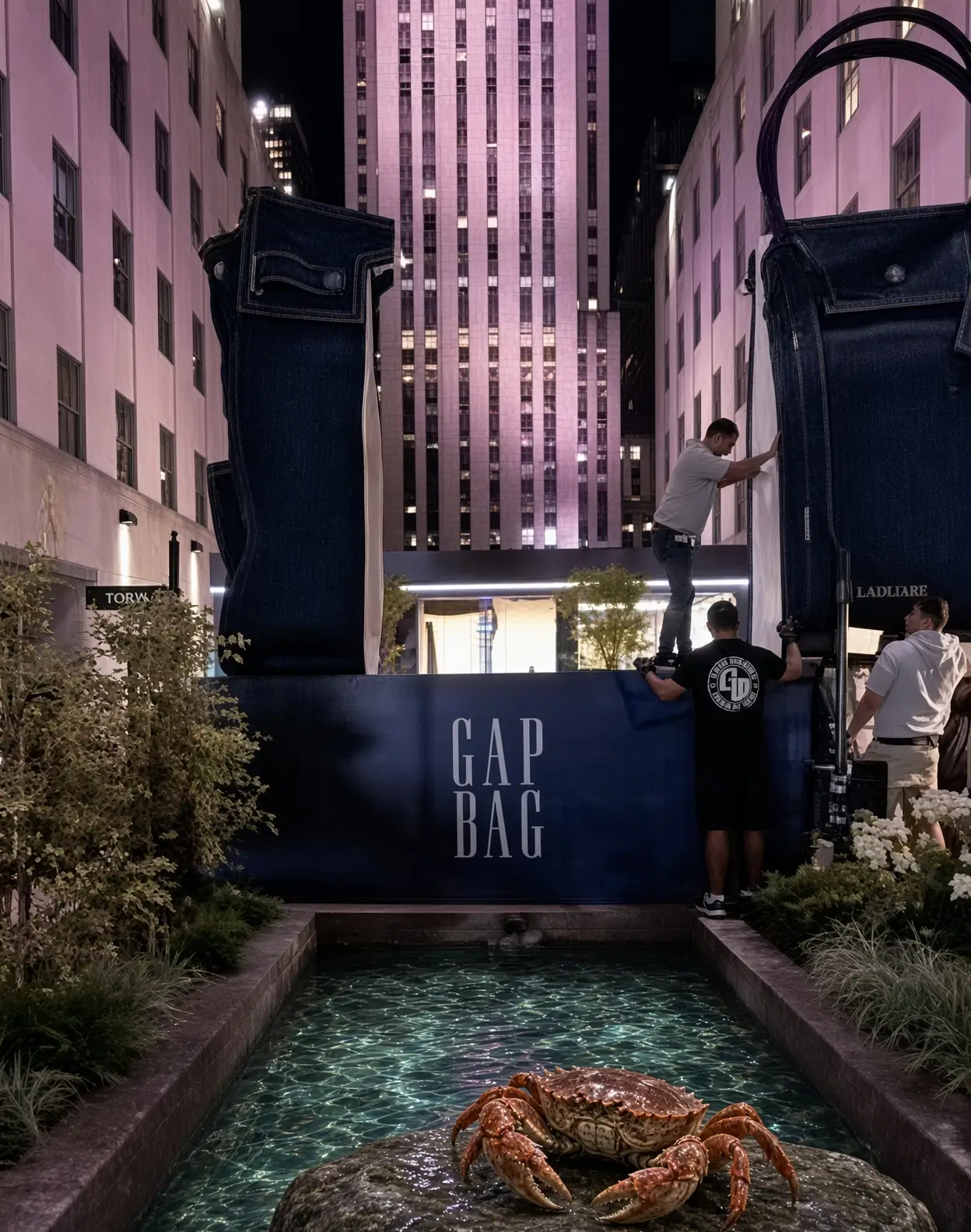
Workers installing a giant denim Gap tote bag display in a Rockefeller Center fountain at night, with a live crab perched on a rock in the foreground.
The install introduces GapBag, Gap’s first dedicate handbag collection and the brand’s most literal answer yet to years of watch competitors turn denim details into accessor business of their own. It also slots the retailer into a crowded week at the complex: the CFDA’s own United Flags of Fashion installation has occupied a different corner of Rockefeller Center since late July and runs through September 15, a full season compared to Gap’s four days. Gap’s version trades duration for intensity, one bag, one plaza, and a customization counter built to turn browsers into buyers on the spot.
The choice of venue is itself a small data point. Rockefeller Center has spent this year host a steady rotation of brand and culture takeovers, from a FIFA Museum show by Hyundai to a free concert series at the Rink, turn the plaza into a kind of stand stage for anyone willing to book it. Gap is only the latest retailer to treat Fifth Avenue’s most photographed lawn as a four day storefront rather than a scenic backdrop, and the Channel Gardens setting does double duty: it puts GapBag in front of the tourist foot traffic that passes through daily regardless of fashion week, and it borrows a level of civic gravity no ordinary Gap store windows could offer a brand new product category.
stir
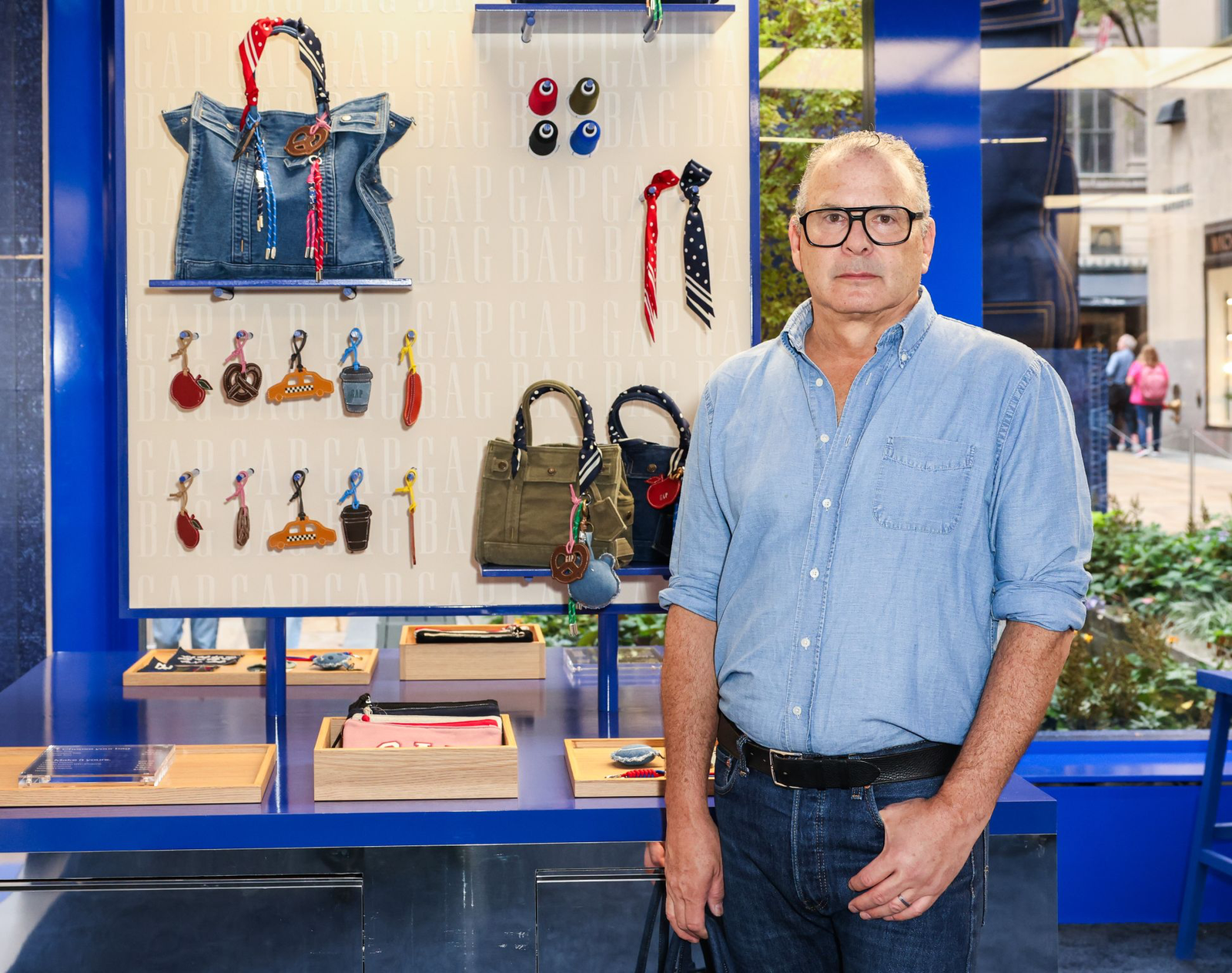
Reed Krakoff is the reason Gap has a handbag person at all. A Parsons graduate who began his career at Anne Klein, Ralph Lauren, and Tommy Hilfiger, Krakoff spent thirteen years as president and executive creative director of Coach, the run most often cited as his sig achievement: he took a sleepy leather goods label and rebuilt it into one of the 2000s’ most wanted accessories brands, at one point growing the business several times over. He launched his own eponymous label in 2010, offering ready to wear, handbags, shoes, and jewelry, before suspending the line several years later. From 2017 to 2021 he served as Tiffany & Co.’s first chief artistic officer, introducing the jeweler’s Everyday Objects and Paper Flowers collections before Tiffany’s acquisition by LVMH, and he current serve as creative chairman of the jewelry house John Hardy, where he built out the brand’s Artisan Series. A work photographer on the side, Krakoff has published several books of his own photography and exhibited his images in New York and Tokyo. He is also a three time CFDA Accessories Designer of the Year and a former CFDA vice president.
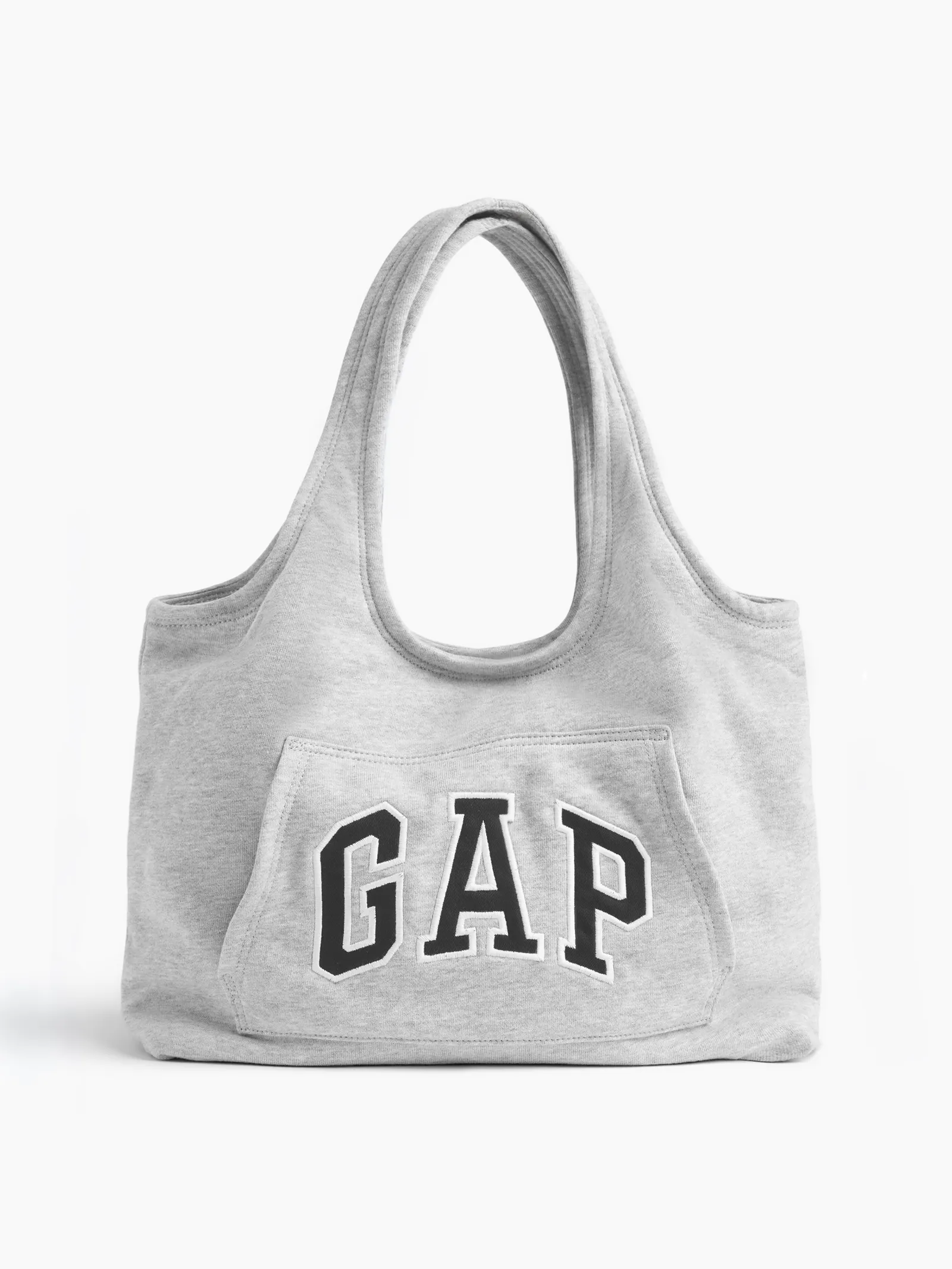
A light grey heather jersey tote bag with a large front pocket and the word “GAP” in black varsity-style lettering with white outlines.
Gap Inc. engaged Krakoff in September 2025 as executive director of accessories, an advisory post he holds alongside his John Hardy chairmanship, working alongside Michele Parsons, the company’s general manager of accessories. By Krakoff’s own account, the job came together informally, out of a conversation with Gap Inc. chief executive Richard Dickson about a real gap in the brand’s own portfolio: a company that sells millions of jeans and hoodies a year had never made a bag that felt like its own.
id
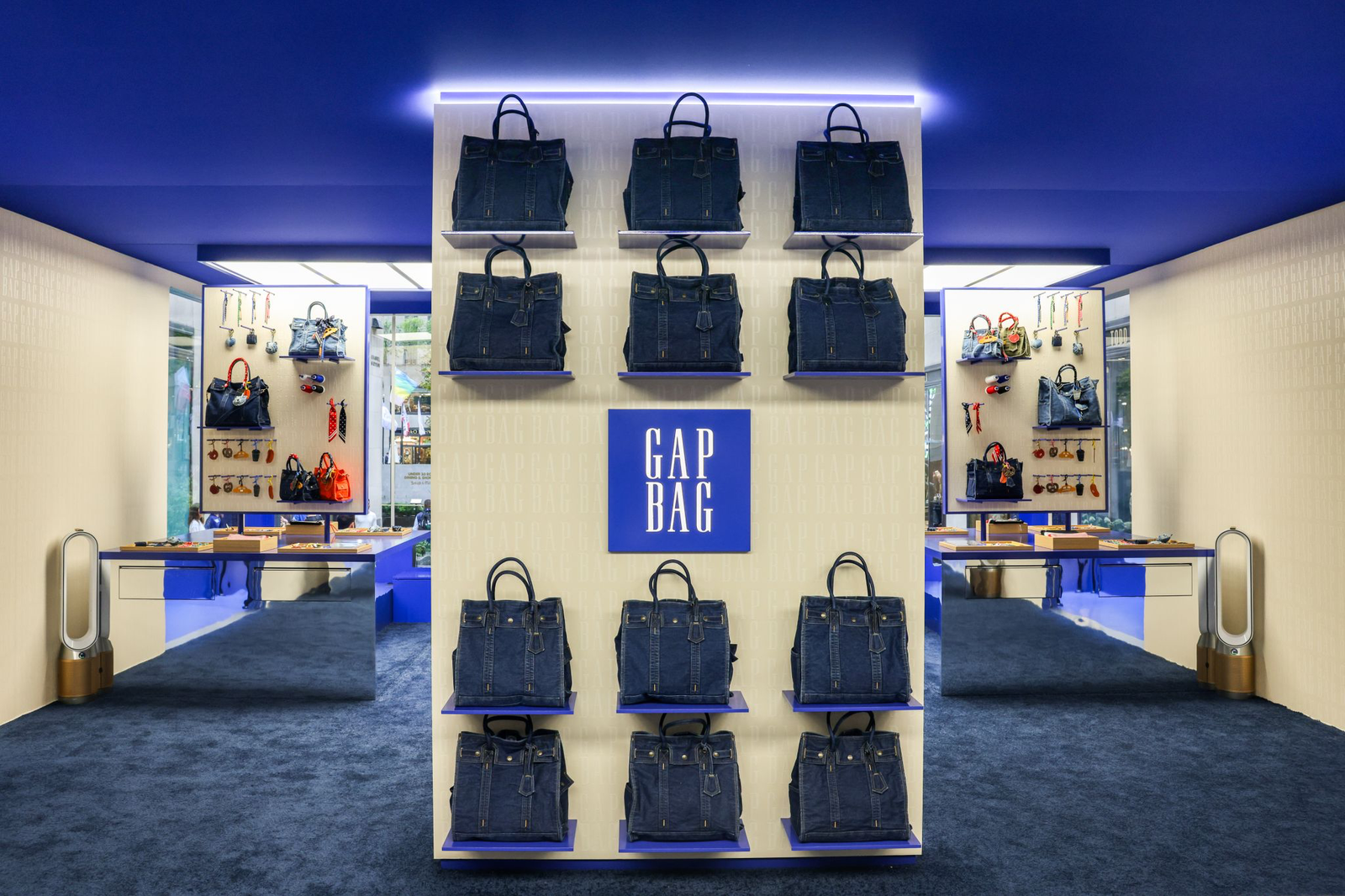
The GapBag Collection, announced September 1 and avail online since September 8, is built around five new shapes rather than one hero product. The Five-Pocket Tote is the centerpiece: belt loops, denim hardware, and five pocket stitching lifted from Gap’s own denim archive, offered in three tote sizes plus satchel and crossbody versions, across denim washes, canvas, and faux suede, priced from $79.95 to $148. A limited edition patchwork denim version runs $498. The Hoodie Tote reworks the brand’s Arch Logo hoodie into a fleece bag with drawstring closure and neoprene lining, priced from $29.95 to $99.95. The Favorite Tote comes in classic canvas colorways and prints; the Crescent Bag is a minimalist shape in denim and faux suede; the Shoulder Bag is an oversized carryall in the same two materials. All three are priced between $59.95 and $128.
Krakoff has described the Five-Pocket Tote as “made for everyone, everyay, every occasion,” lang that doubles as Gap’s pitch for the category itself: accessories priced like Gap, built with the fit and finish of a house that usually charges considerably more for a five pocket detail. The collection also adds charms, keychains, scarves, and belts, an accessories tier meant to give the new bags a reason to be restyled rather than replaced season to season. It is a deliberately different value proposition than the one Krakoff spent a career building at Coach and Tiffany, where the same denim hardware logic would have carried a luxury markup; at Gap, the argument is that the design language survives the move downmarket intact.
entire
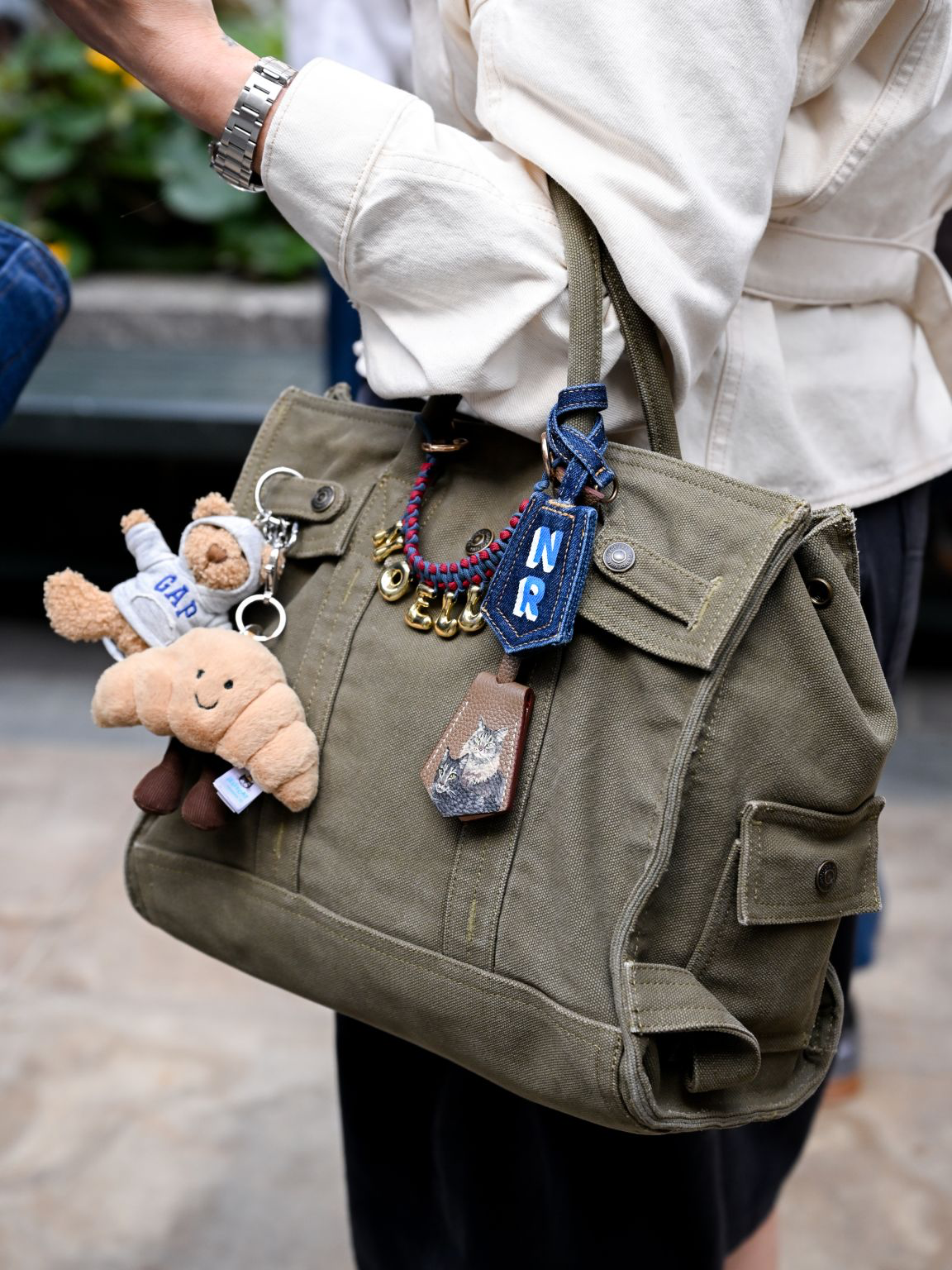
Inside the Channel Gardens tents, the actual transaction looks less like retail and more like a fit. Shoppers choose a Five-Pocket Tote size and wash, then customize it on site with chainstitch embroider, limited edition charms, and add-on accessories, the same build-it-yourself logic Gap has used on denim for years, applied here to a category the brand has never sold before. Encore members received early access on September 10, from one to six in the afternoon, and Gap cardmembers were offered priority entry throughout the run by reserving a slot through Encore Market, the loyalty program’s booking platform, along with a gift with purchase.
It borrows a small piece of theater from a much bigger playbook: give a mass priced object the mech of something scarcer, on site personalization, a countdown, a backdrop that photographs well, and let the experience do some of the work the product alone might not. That the entire build-your-own process happens under the same Rockefeller Center roof as the artist drops is deliberate. A shopper who walks in for a fifteen minute customization session is standing a few feet from totes that will never be sold again once the weekend ends, a proximity that makes the everyday bag feel, at least for the length of the visit, adjacent to the rare one.
ten
The pop-up’s most exclusive item isn’t a size or a wash. FAUST and Shantell Martin, two working New York artists, each hand customized ten Five-Pocket Totes for the activation. Martin’s editions dropped Friday, Faust’s on Saturday, and both sold as one-off pieces rather than a restockable line.
FAUST is an anonymous, New York based graffiti artist recognizable for a signature style that fuses classical calligraphy with contemporary graffiti lettering, applied to walls, storefronts, and, in a recurring winter project, snow covered cars parked around the city. Juxtapoz named him one of the top twenty graffiti artists working today, his pieces have been shown at MoMA and the Grand Palais in Paris, and his client list includes Nike, Samsung, Spotify, and Adobe. Martin, British born and based in New York since 2008, is known for large scale black and white line drawings that explore identity and play; she teaches at NYU’s Tisch School of the Arts, has been a visiting scholar at the MIT Media Lab, and has drawn live alongside Kendrick Lamar at Art Basel Miami and created large scale works for the New York City Ballet’s Lincoln Center Art Series. Her own path to drawing ran through Japan, where she moved in 2003 to teach English and instead found a following performing live illustration in Tokyo clubs, a detail that predates her New York career by half a decade.
The artist drops function as the pop-up’s scarcity mechanism, the detail that turns a four day retail event into something worth showing up for on a specific morning rather than swinging by whenever. They also do double duty as a credibility signal: two artists with real institutional resumes and brand-collaboration histories of their own, attached to a bag from a mall brand trying to convince shoppers its accessories belong in the same conversation as its jeans.
View this post on Instagram
extend
GapBag is not really a standalone launch. It’s the first view output of a push Gap Inc. set in motion a year earlier, in September 2025, when the company announced Michele Parsons as general manager of accessories and Deb Redmond as general manager of beauty, while engaging Krakoff and former Estée Lauder executive John Demsey as executive directors advising each category respectively. Chief executive Richard Dickson framed the pair of hires as what he called promising growth engines for the portfolio. Old Navy’s own beauty line launches this fall, with the Gap brand’s version following in 2026, on the same phased timeline the company is now applying to accessories.
The accessories push lands at a moment when Gap, founded in San Francisco in 1969 and still the flagship of Gap Inc.(NYSE: GAP), has been rebuilding its fashion credibility elsewhere. GapStudio, the brand’s elevated line under executive vice president and creative director Zac Posen, introduced a Fall 2026 collection built around American utility and proportion just two weeks before GapBag’s own debut, and the brand has leaned on celebrity facing campaigns, including recent work with Katseye and Troye Sivan, to reintroduce itself to a younger customer. The bet has real financial stakes behind it: one recent report pegged the global handbag market at roughly fifteen billion dollars, a category Gap Inc., a company valued at around eight billion dollars itself, is only now entering in any dedicated way. Gap is wagering that shoppers who already trust it for denim and hoodies will extend that trust to a $128 crossbody designed by someone who spent over a decade running a nine figure accessories business at Coach. Whether GapBag becomes a permanent fixture of Gap stores or a one season experiment depends less on the Rockefeller Center spectacle than on whether the Five-Pocket Tote sells through at gap.com once the tents come down and the price has to compete without the backdrop.
fin
The full GapBag Collection has been live at gap.com since September 8, alongside a rollout to Gap stores across North America. International availability extends further than a typical Gap accessories drop: the collection is landing in Japan, Vietnam, Estonia, the Middle East, Mexico, Australia, Peru, Greece, Turkey, Guatemala, El Salvador, Costa Rica, Panama, and Ecuador, plus the UK and, across the EU, through Zalando.
The Channel Gardens install itself is a four day fixture rather than a lasting one. Today marks the pop-up’s final day at Rockefeller Center, after which the oversized tote comes down and whatever GapBag becomes next plays out the way most Gap products do: on shelves, online, and in whatever a customer decides a $148 tote is actually worth once the backdrop is gone. The ten totes each customized by FAUST and Shantell Martin will not return; the Five-Pocket Tote, the Hoodie Tote, and the rest of the five sil lineup will, in stores and online, indefinitely, in whatever form the accessories category takes once Krakoff, Parsons, and the rest of Gap Inc.’s newly assembled bench decide what comes after a bag this size in a garden this famous.
Related Articles
Billionaire Boys Club Rewrites the Country Club Dress Code for Fall ’26
A cotton pique polo and a chenille golf patch anchor Billionaire Boys Club’s push into […]