DRIFT AUDIO
Listen to this story
Choose a voice, then press play.
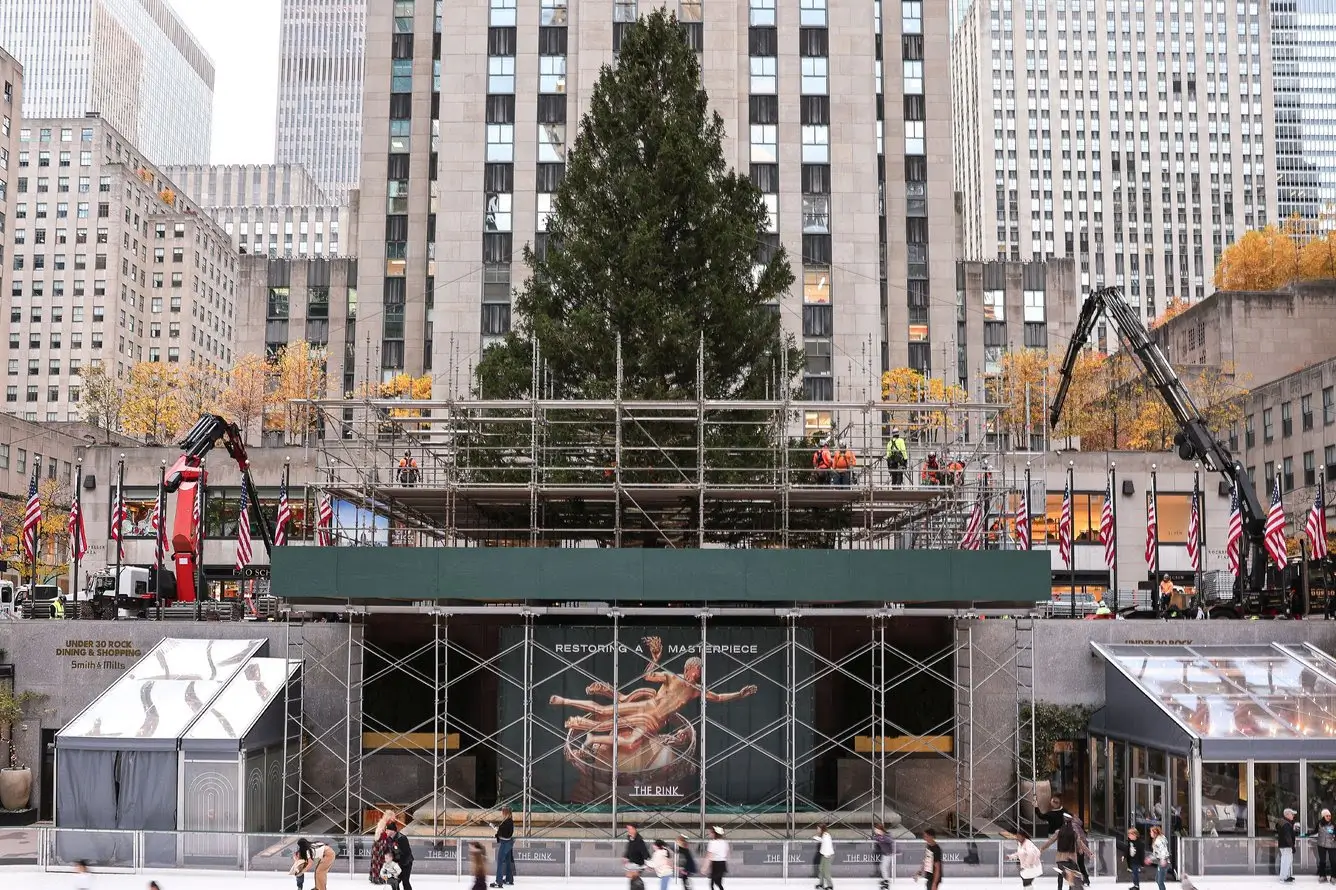
On a crisp Saturday morning, as the first hints of winter brushed across Midtown Manhattan, a giant green symbol of joy arrived at Rockefeller Center. It was November 8, 2025, and New York City welcomed its newest holiday icon: a 75-foot-tall Norway spruce from East Greenbush, New York — a suburb nestled just outside Albany. Measuring 45 feet in diameter and weighing around 11 tons, this year’s Rockefeller Center Christmas Tree is both a feat of nature and a marvel of human orchestration.
Each November, the installation of the Rockefeller Center tree is a moment of civic pride and holiday anticipation — a ritual that signals the start of the season not just for New Yorkers but for millions watching worldwide. But behind the magic lies a fascinating process: a mix of botanical precision, emotional generosity, and quiet tradition that spans nearly a century.
benevolence
Every year, the Rockefeller Center Christmas Tree is donated by a private family, never bought or sold. This detail often surprises people. In a city of staggering real-estate values, the idea that an 80-year-old tree — which could have been a backyard landmark for generations — is freely given feels profoundly generous.
The donor family does not receive monetary compensation. They don’t even get a tax deduction. The reason is purely technical yet emblematic: Rockefeller Center is owned by Tishman Speyer, a global real estate company, not a nonprofit entity. Still, for families like Judy Russ of East Greenbush, the honor carries a different kind of value — one measured in legacy, emotion, and the idea of sharing beauty with millions.
Russ donated the 2025 tree in memory of her late husband, Dan Russ, whose great-grandparents had planted the Norway spruce decades ago. What began as a family planting in the yard has become a national beacon of light. “He would’ve loved this,” Russ told the Associated Press. “It feels like a part of him will shine in New York this Christmas.”
The donation transforms private sentiment into public spectacle. For a few weeks each winter, an ordinary family’s tree becomes a symbol of unity and wonder, seen by more than half a million visitors who pass through Rockefeller Plaza daily during December.
flow
Behind the festive glamour lies a man whose job begins long before the first ornament is hung — Erik Pauze, Rockefeller Center’s head gardener and chief tree scout. For nearly three decades, Pauze has roamed the Northeast in search of the perfect tree. His work is part horticulture, part detective story, and part intuition.
Pauze looks for the rarest of natural structures: a Norway spruce that stands at least 70 feet tall, symmetrical on all sides, dense but not heavy, with a strong central trunk. Such trees are rarely found in the wild — forest-grown spruces tend to stretch toward the light, developing uneven limbs. The ideal Rockefeller tree is typically an ornamental yard tree, cultivated for decades with open exposure to the sun.
Throughout the year, Pauze fields hundreds of photos from hopeful homeowners. “People send me pictures all the time,” he has said in interviews. “They’ll say, ‘This is Grandma’s tree, it’s 80 feet tall, it’s beautiful.’ And sometimes, they’re right.” Once a candidate catches his eye, Pauze visits in person, checking the density, height, health, and, most importantly, the way it will appear under thousands of LED lights.
After a tree is chosen, he makes periodic caretaking trips, monitoring its condition through storms and seasons, even trimming its lower branches to keep its form until the big day.
journey
The logistical operation of moving a 75-foot, 11-ton Norway spruce from a quiet upstate yard to Rockefeller Plaza is nearly as extraordinary as the tree itself. The journey takes several days, requiring cranes, flatbed trucks, and highway coordination through multiple counties.
Once it arrives in Manhattan, the spectacle begins. Crowds gather along Fifth Avenue to watch the tree slowly lift off the truck, hoisted by cranes into the middle of Rockefeller Center’s famous plaza. The installation process requires hundreds of workers, from arborists and electricians to engineers, all orchestrating an operation that must balance beauty, safety, and structural integrity.
The tree is secured in a custom steel base, anchored into the plaza’s substructure, then reinforced with heavy-gauge cables to withstand the winter winds that whip between skyscrapers. Over the next weeks, crews meticulously string more than 50,000 multicolored LED lights, totaling roughly five miles of wire, before capping it with a 900-pound Swarovski crystal star designed by architect Daniel Libeskind.
civic art
To outsiders, the Rockefeller Center tree might seem like an over-the-top tourist attraction. But to New Yorkers — and indeed, to many Americans — it’s a civic artwork. Each year, the tree represents resilience, continuity, and togetherness.
The tradition dates back to 1931, when construction workers building Rockefeller Center first erected a small, decorated tree on the worksite during the Great Depression. There was no fanfare then — just a handful of laborers and a tree adorned with homemade garlands. Yet that humble gesture grew into one of the most enduring and beloved public celebrations in American culture.
Since then, the tree has stood through wars, blackouts, pandemics, and recessions, evolving into a symbol of renewal. When it lights up, it isn’t just the bulbs that glow — it’s the collective spirit of the city, a reminder that wonder still lives in concrete canyons.
style
Norway spruces (Picea abies) are not native to North America but thrive in the cold, humid climate of the Northeast. They are valued for their shape — tall, straight trunks with graceful, pendulous branches that drape evenly. Yet reaching the 75-foot scale of Rockefeller Center fame is no small feat.
Such trees are often between 60 and 90 years old, meaning they’ve survived generations of winters and pruning. They grow best in open suburban lots, where sunlight can reach every limb, which explains why many Rockefeller trees come from residential neighborhoods rather than forests.
Before transport, arborists inspect the tree’s root structure, moisture content, and needle health. The trunk is wrapped for protection, and every branch is carefully tied and padded. Once at Rockefeller Plaza, those bindings are released and the tree “rests” for several days, allowing its branches to settle naturally before decoration begins.
donation
The 2025 tree’s donor, Judy Russ, embodies what has become the emotional core of the Rockefeller Center tradition. Her husband, Dan Russ, passed away last year, but the tree he once admired outside their East Greenbush home now stands as a living tribute.
“Every year, he’d light the tree himself,” she said. “He loved how big it had gotten — said it made our whole house look small. I think he’d laugh knowing it’s in Rockefeller Center now.”
Russ’s story underscores a profound truth about the tradition: that even as the tree becomes a corporate symbol, it begins as something deeply personal. The memory of a loved one, the pride of a community, the passage of time — all find expression in those towering branches.
When millions gather for the tree lighting later this month, they will see the glow of 50,000 lights. But Judy Russ will see something else: a family legacy turned into a national moment of joy.
sustainable
In recent years, Rockefeller Center has emphasized sustainability in its tree program. After the holiday season ends in early January, the spruce is not discarded. Instead, it’s milled into lumber used by Habitat for Humanity to build homes for families in need.
This afterlife gives the tradition new meaning. A tree that once symbolized generosity becomes a literal structure of support, extending its purpose beyond celebration into service. Even the sawdust and mulch from trimming are repurposed in gardens across the region.
This commitment reflects a broader cultural shift — one that sees environmental mindfulness not as a constraint but as a continuation of the Christmas spirit.
design
Rockefeller Plaza itself is a masterpiece of Art Deco urban planning. Designed in the early 1930s, the plaza was conceived as both a commercial hub and a public space. The Christmas tree fits seamlessly within that vision — a vertical counterpoint to the surrounding skyscrapers, a natural form balancing the geometry of human ambition.
Architectural historians often note how the plaza’s proportions, sightlines, and lighting design were intended to draw the eye toward its center — where, each winter, the tree stands as a living sculpture. The skating rink beneath it mirrors its reflection, creating an image that’s become as iconic as the Empire State Building or the Statue of Liberty.
stir
The first official Rockefeller Center Tree Lighting ceremony aired on radio in 1933. Today, it’s a global event broadcast across television, YouTube, and streaming platforms. Networks compete for coverage; artists from Mariah Carey to Andrea Bocelli perform; and millions watch from living rooms worldwide.
For NBC, the broadcast is both entertainment and tradition — a reliable ratings event and a reminder of the network’s historical ties to Rockefeller Plaza itself. In the streaming era, clips circulate instantly on social media, transforming what was once a localized celebration into a shared, digital experience.
impression
The 2025 Rockefeller Center Christmas Tree stands not only as an emblem of the season but as a living narrative of remembrance and renewal. It began as a seed in a quiet yard, grew under decades of sunlight and care, and now radiates light over one of the world’s busiest plazas.
For Judy Russ, it is the story of her husband. For Erik Pauze, it’s the culmination of a year’s patient work. For New Yorkers, it’s the heartbeat of winter. And for everyone watching from afar, it’s a promise that joy — like light — can be shared endlessly, one sparkle at a time.
Related Articles
Modigliani’s Limestone ‘Tête’
Carved from a single block of limestone in Montparnasse more than a century ago, one of Modigliani's rare stone heads goes to auction for the first time…