DRIFT AUDIO
Listen to this story
Choose a voice, then press play.
Researchers in Singapore and Japan built a wearable oxygen suit that lets remote-controlled cockroaches walk underwater for three hours, a step toward disaster-response insect swarms.
In This Story
- The Breakthrough
- How the Suit Works
- Why Cockroaches, Specifically
- The Cyborg Part
- Boot Camp for Bugs
- What It’s Actually For
- The Bigger Context
Researchers at Nanyang Technological University in Singapore and Waseda University in Japan have built a wearable oxygen system that turns an ordinary cockroach into an amphibious cyborg. The device — described by the team as a diving suit — lets a cockroach breathe and move underwater for as long as three hours, a length of operation that pushes the insect well past its natural tolerance for submersion.
The work, led by NTU Singapore professor Hirotaka Sato, was published in Nature Communications under the title “Underwater Suit-Wearing Cyborg Insect Capable of Hours-Long Diving and Terra-Aqua Travel.” As the paper describes it, the wearable diving suit enables terrestrial cyborg cockroaches to maintain respiration and locomotion underwater for up to three hours, creating a biohybrid system built for sustained exploration through hazardous, confined terrain. Nature
Sato summarized the concept more plainly in comments to press: the insect diving suit works like the oxygen tank used by human divers, generating oxygen and delivering it directly to the insect’s breathing holes so the cyborg cockroach can survive and move in underwater or low-oxygen environments. ZME Science
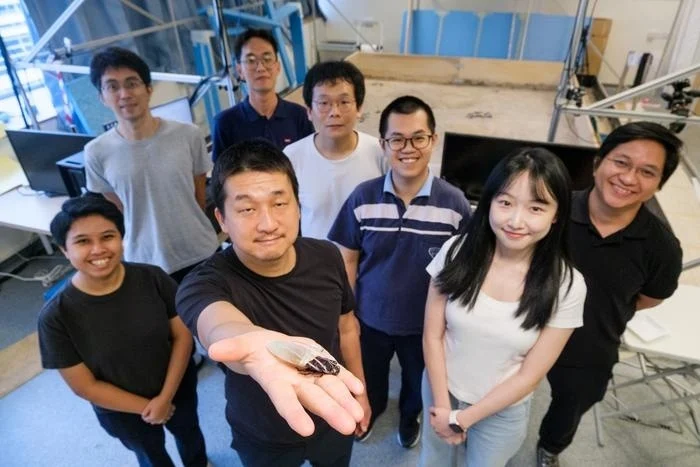
NTU Singapore researchers present their biohybrid cyborg cockroach, showcasing the lightweight diving suit developed to enable underwater exploration and environmental monitoring.
stir
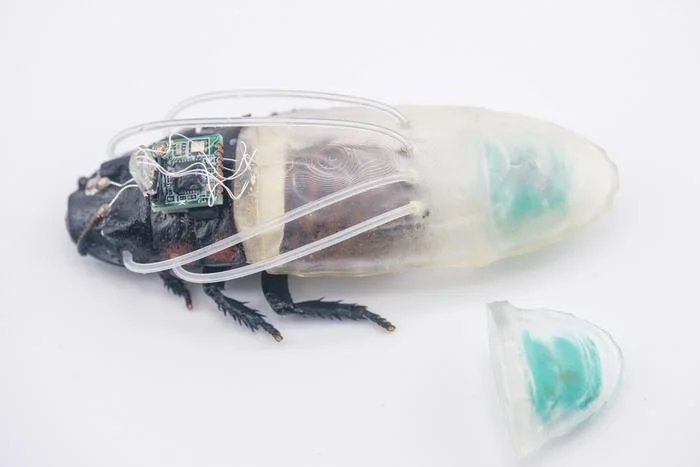
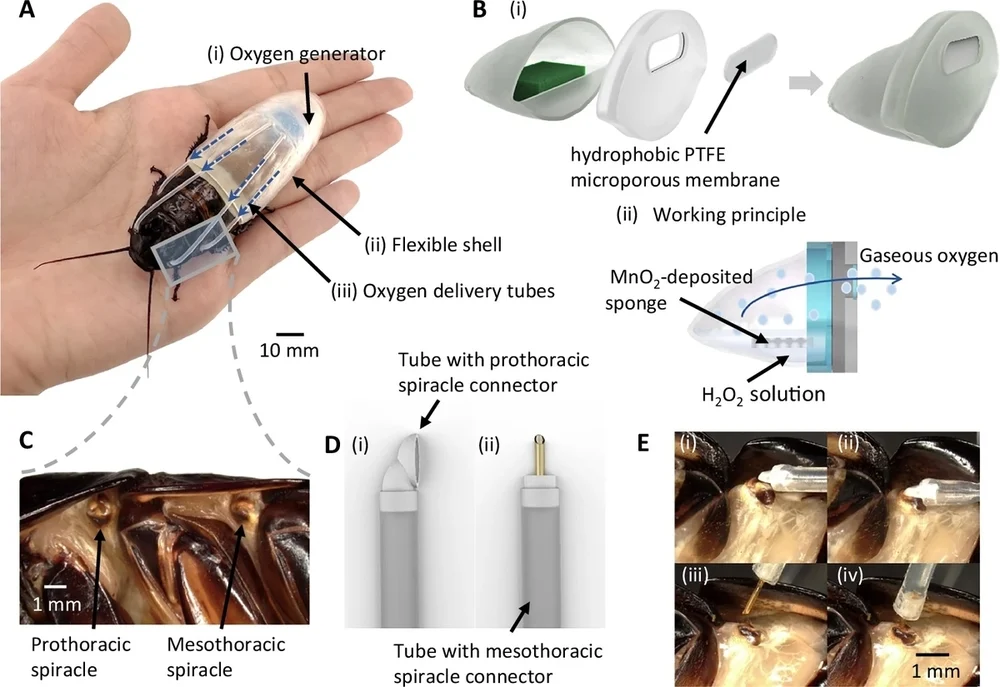
The suit itself has three main components: a flexible waterproof shell, an oxygen gen, and four soft tubes that deliver oxygen to the cockroach’s thoracic spiracles — the small breathing holes located along an insect’s body, since cockroaches don’t breathe through anything resembling lungs or a nose. ZME Science
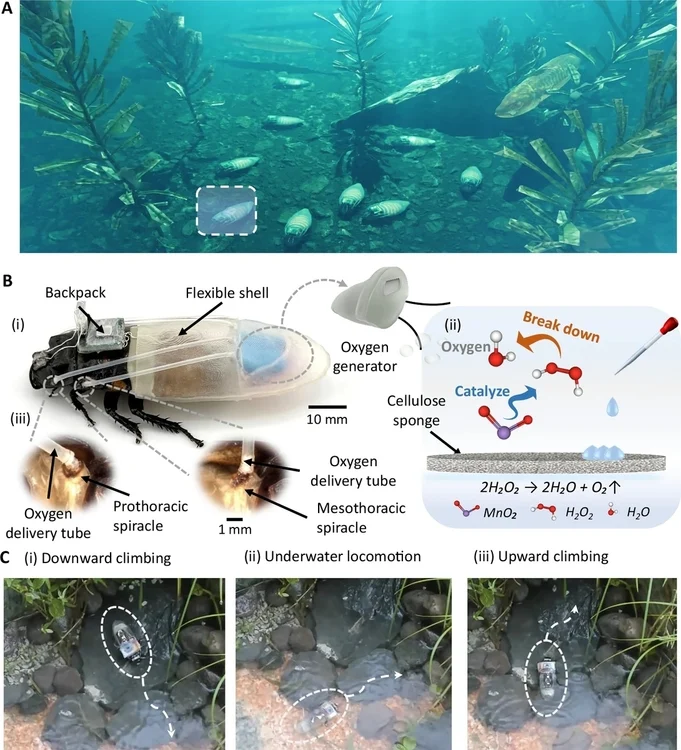
The oxygen source is where the design gets genuinely clever. Rather than strapping a miniature pressurized tank to an insect that would find the extra weight cumbersome, the team engineered a chemical reaction to generate oxygen on demand. The oxygen-generation tank was 3D-printed from a transparent, plastic-like PMMA-type resin, with a sponge inside coated in manganese dioxide, which acts as a catalyst. The researchers then injected a small amount of diluted hydrogen peroxide into the tank and sealed the opening with UV adhesive to prevent leaks. Inside, the manganese dioxide breaks the hydrogen peroxide down into water and oxygen, with a membrane that lets gas pass through while keeping liquid contained. Tech XploreZME Science
That reaction produces a steady trickle of oxygen that travels through the flexible shell and silicone tubes to the cockroach’s spiracles, allowing it to breathe underwater — functionally the same job a scuba regulator does for a human diver, just built from a sponge and two chemicals instead of a compressed air cylinder. Tech Xplore
why
The team used Madagascar hissing cockroaches, one of the largest cockroach species in the world. Researchers outfitted the insects with a diving suit that included oxygen tubes and a protective shell, with the tubes functioning similarly to a scuba diver’s regulator by attaching directly to the thoracic spiracles. Scientific American
Size and resilience both factor into the choice. Madagascar hissing cockroaches can grow to roughly 7.5 centimeters — about the length of an adult human finger — and can live up to five years. That combination of a sturdy, long-lived body and enough surface area to mount hardware makes them a practical platform in a way that smaller or shorter-lived insects wouldn’t be. The researchers themselves describe cockroaches as among the “most promising” insects for this kind of work specifically because of their robustness. Scientific AmericanScientific American
Cockroaches also come with a useful built-in trait for this application. According to reporting on the underlying research program, the insects can withstand radiation levels that would be lethal to a human, and can close their spiracles to hold their breath for up to 40 minutes on their own — before the suit’s oxygen supply even comes into play. The diving suit extends that natural breath-holding capacity from tens of minutes to multiple hours. Tom’s Hardware
flow
The diving suit is only half the system. The cockroaches used in this research are already “cyborg insects” in the specific technical sense researchers use that term — living insects fitted with electronic controllers that guide their movement. Because these systems rely on the insect’s own muscles rather than motors, they require far less power than comparably sized artificial robots, which need high-capacity onboard batteries to drive their mechanical parts. Tech Xplore
In practice, that means a small wireless backpack delivers electrical pulses to the insect, and researchers steer the cyborg cockroaches remotely using that backpack, prompting the insects to walk and change direction on command, with the long-term goal of sending these insects into spaces neither people nor larger robots can safely reach. FOX Weather
This isn’t Sato’s first cyborg-insect project. His lab has previously equipped roaches with miniature infrared cameras as part of the same broader research push, extending a research lineage that traces back roughly two decades to DARPA’s early HI-MEMS program exploring hybrid insect-machine systems. The diving suit is best understood as the latest capability layered onto an existing cyborg-insect platform, rather than a standalone invention. Tom’s Hardware
huh
Before any cyborg cockroach gets cleared for a real mission, the team puts prototypes through a battery of trials that read like search-and-rescue training for insects. The cyborg cockroaches have to pass their own version of boot camp, tackling flooded tunnels, hazardous gas exposure, underwater obstacles, and endurance tests to prove they’re mission ready. FOX Weather
That testing regimen matters because the target environments are deliberately messy. The study specifically frames its use case around search-and-rescue missions in disaster zones, where flooded rubble, standing puddles, or partially submerged spaces can block access for conventional robots. Sato has made a similar point directly: real disaster sites can be genuinely difficult to navigate after heavy rain or flooding, with rubble, drains, and narrow gaps blocking normal access routes, and expanding the cyborg insects’ operating range to include underwater travel is meant to help close that gap for search-and-rescue efforts. Tech XploreGizmodo
purpose
The practical pitch here isn’t novelty — it’s access. Small, insect-scale robots can already squeeze through rubble in ways that human rescuers and full-size machines can’t, but a purely mechanical version of that robot needs a battery large enough to power its motors, which puts a hard limit on how small it can get. A cyborg insect sidesteps that problem entirely by borrowing a living creature’s own muscles to do the moving, which is part of why researchers can build a system that “requires far less power than small artificial robots” in the first place. Tech Xplore
Adding underwater capability closes one of the last major gaps in that approach. A search-and-rescue cockroach that dies the moment it hits standing water isn’t much use in a flooded basement or a collapsed drainage tunnel — precisely the kind of terrain the researchers are targeting. With the diving suit in place, that same insect can now cross from dry rubble into submerged passages without needing a different platform entirely.
The researchers also gesture toward applications beyond earthbound disaster response. The same underlying principle — keeping an organism alive in an oxygen-deprived environment via an external chemical oxygen generator — could in theory extend to other low-oxygen settings like space, making the idea of cockroach cosmonauts less far-fetched than it initially sounds. That’s clearly speculative at this stage, but it underlines that the “diving suit” framing is really shorthand for a more general life-support problem: keeping a small organism breathing somewhere it wasn’t built to survive. Popular Science
fin
Cyborg insects sit at an odd intersection of robotics, biology, and public squeamishness, and this project leans directly into that tension rather than around it. One outlet’s coverage even name-checked the manga/anime series Terra Formars as the obvious pop-culture reference point for anyone who’s seen this kind of research before — giant, augmented cockroaches doing work humans can’t safely do themselves is exactly the kind of premise science fiction got to first. Tom’s Hardware
What makes this study notable isn’t the shock value, though — it’s the specificity of the engineering. A chemical oxygen generator sized to fit on an insect’s back, tuned to a three-hour operational window, married to an existing remote-control cyborg platform, is a fairly narrow and deliberate piece of applied engineering rather than a proof-of-concept stunt. Either it ever gets deployed on an actual disaster site is a separate question from whether the underlying system works — and for now, the published data says it does, for up to three hours at a stretch.
From the DRIFT archive: Tactical Elegance: Inside Bramford London Aqua Blue Three-Pocket Watch Roll
Related Articles

Under Rue de Castiglione, Liaigre Gives Hôtel Costes a Spa With No Hard Corners
A 20-meter lap pool, eight treatment rooms and not one sharp angle: Studio Liaigre’s spa […]