DRIFT AUDIO
Listen to this story
Choose a voice, then press play.
In This Story
- A Cockpit Modelled on a Le Mans Contender
- Podium Green, Two Liveries, 24 Cars
- What’s Inside the Monocoque
- A Steering Wheel Lifted From the Valkyrie
- Darren Turner’s Decade in Simulation
- Price, Scarcity and Who It’s Really For
- Where This Sits in Home Sim Racing
Aston Martin and Curv Racing Simulators have introduced the AMR-C01-R Hypercar Edition, a limited-run home racing simulator built to mirror the driving position of the Aston Martin Valkyrie competing in this year’s 24 Hours of Le Mans. It is the latest expansion of a partnership that began in 2020, and the most direct link yet between a piece of home gaming hardware and an active endurance racing programme.
The timing is deliberate. Aston Martin is currently in its second season back at the top of the 24 Hours of Le Mans grid, a race the marque last won outright in 1959. That campaign, run through the factory’s Valkyrie Hypercar entries, is the direct view and conceptual reference for the new simulator. Rather than a generic racing rig dressed in brand colours, the Hypercar Edition is styled explicitly after the numbered cars currently on track, down to the livery pairings and the cockpit geometry.
Curv Racing Simulators was founded by Darren Turner, a three-time Le Mans class winner who has worked with Aston Martin’s racing programme for many years. That relationship is central to how the company positions the product: not as a gaming peripheral wearing a badge, but as a simulator engineered by someone who has actually driven the cars it references.
View this post on Instagram
It also marks a shift in how automotive brands are approaching the space between the physical car and the digital one. Where a licensed steering wheel or a branded gaming chair might once have been the extent of a carmaker’s involvement in sim racing, Aston Martin has instead put its own design studio and one of its racing drivers directly into the development process. The result reads less like a licensing deal and more like a genuine engineering connection, with the same design lang, materials thinking and attention to ergonomics that would normally be reserved for a production car.
huh
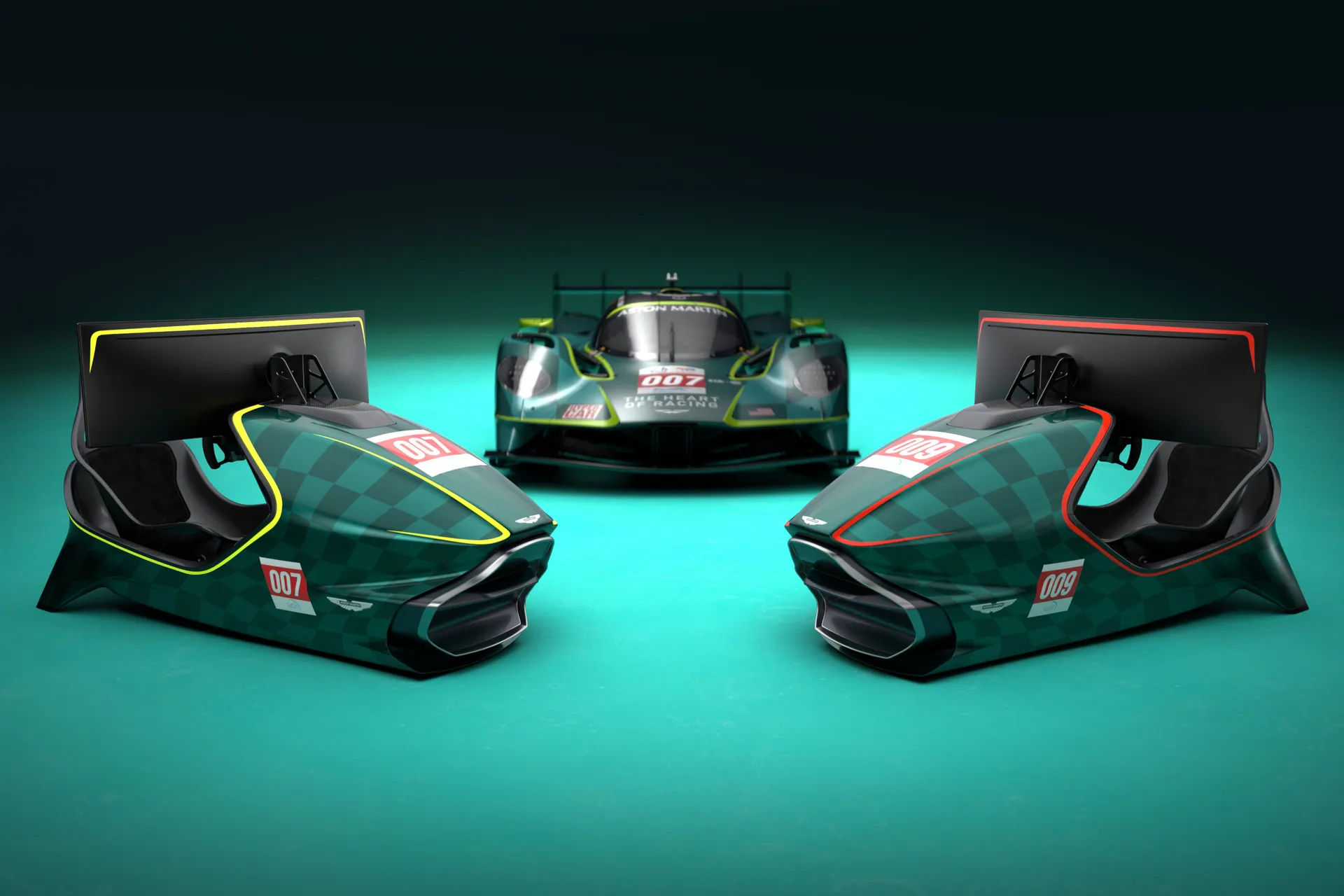
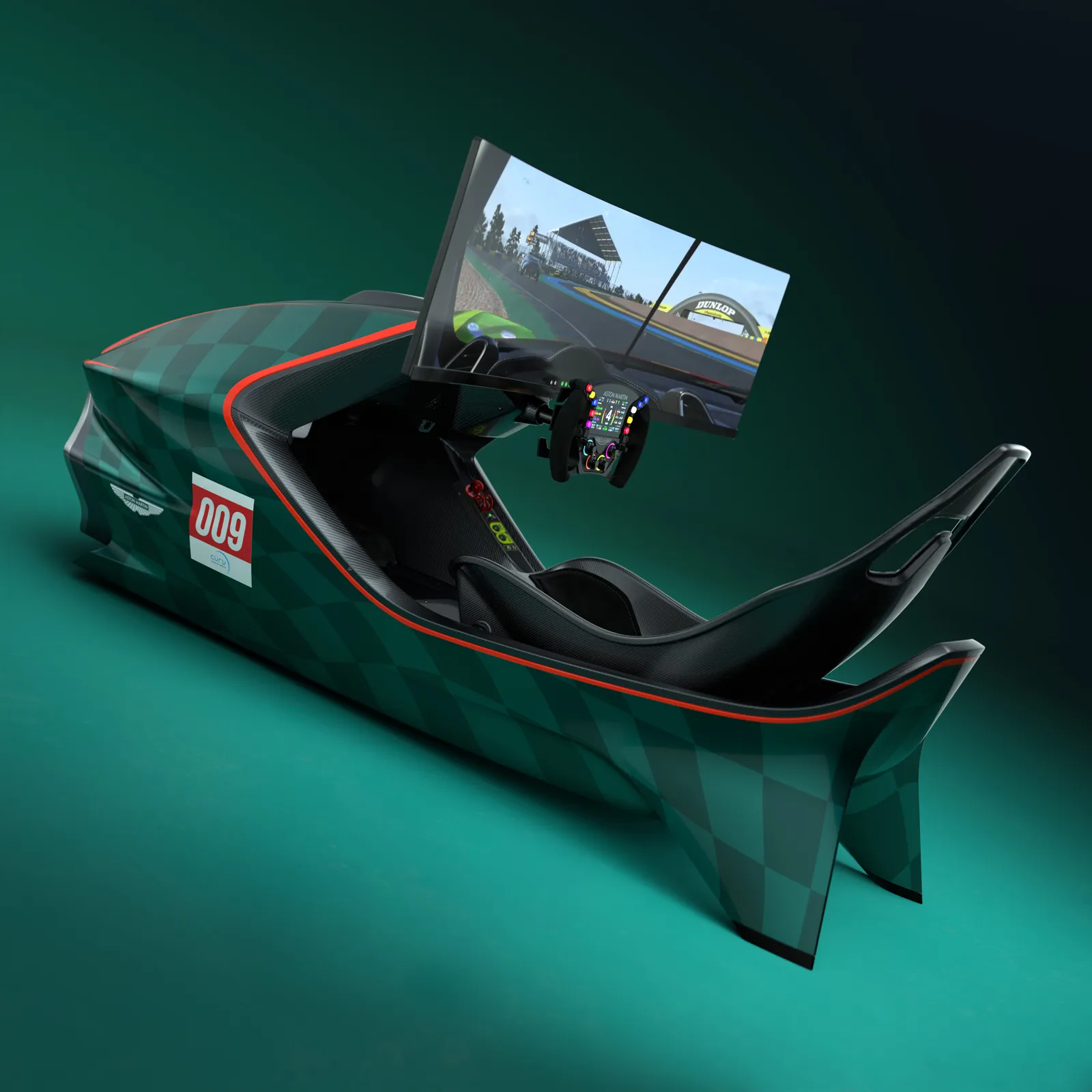
The Hypercar Edition is limited to 24 examples worldwide, split across two race-inspired liveries numbered #007 and #009. Both are finished in Aston Martin Podium Green with contrasting yellow or red accents, a direct reference to the paint schemes running on the Valkyrie entries at this year’s race. The numbering and colourways aren’t decorative flourishes; they map onto the specific cars competing on the current Le Mans grid, which is the kind of detail aimed squarely at people who already follow the team’s season rather than casual buyers.
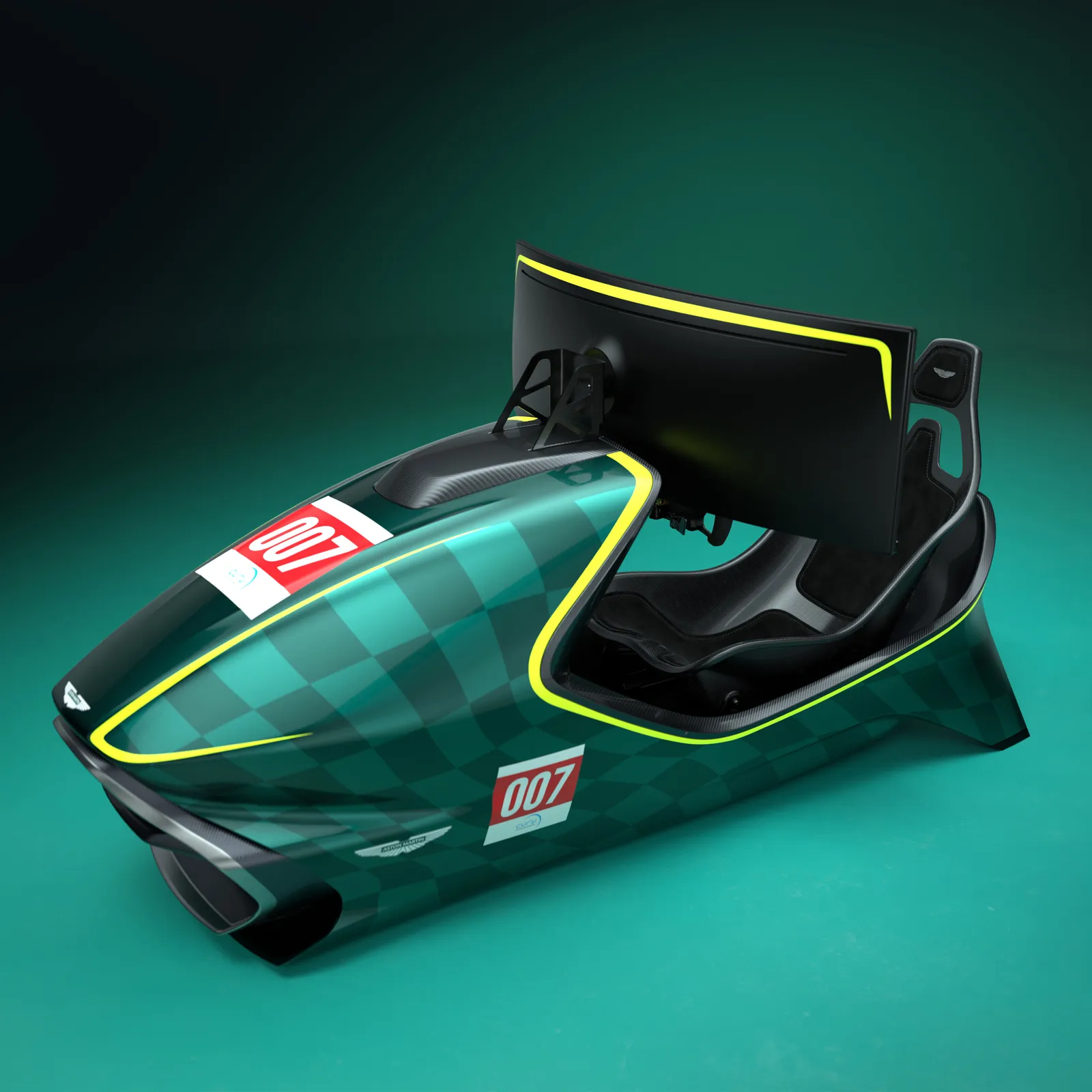
The bodywork is built around a carbon-fibre monocoque constructed using the same principle Aston Martin applies to its road and race cars, and each unit is hand-built in the United Kingdom rather than assembled on a production line. Design leadership on the project sits with Marek Reichman, Aston Martin’s Executive Vice President and Chief Creative Officer, whose studio shaped the monocoque’s silhouette. Reichman has described the Valkyrie as one of the brand’s most extreme designs, and said that character carries over directly into the simulator’s form, calling the result “pure excitement and emotion.”
Seeing out the first half of the year with our #AstonMartinLive community.#AstonMartin #INTENSITYDRIVEN pic.twitter.com/McBK0ZHTJm
— Aston Martin (@astonmartin) July 4, 2026
Aston Martin’s grille motif also carries through to the finished object: earlier versions of the AMR-C01 platform featured a signature Aston Martin racing grille worked into the front of the monocoque, and the Hypercar Edition keeps that same visual anchor rather than replacing it with something entirely new. The intent, consistent across every version of this collaboration, is that the simulator should read as a piece of sculptural furniture first and a piece of gaming hardware second — something built to sit in a games room or private collection space without looking like it wandered in from an esports arena.
That distinction matters more than it might first appear. Most home racing rigs, however capable, are built around exposed tubular frames, generic bucket seats and cable management that makes little attempt to hide itself. The AMR-C01-R Hypercar Edition inverts that approach entirely: every mechanical element sits inside the monocoque shell, and the visible surfaces are treated with the same finishing standard Aston Martin applies to a customer’s actual car. Panel gaps, paint depth and the way light moves across the carbon-fibre weave are all treated as design considerations in their own right, not afterthoughts bolted onto a functional chassis.
in
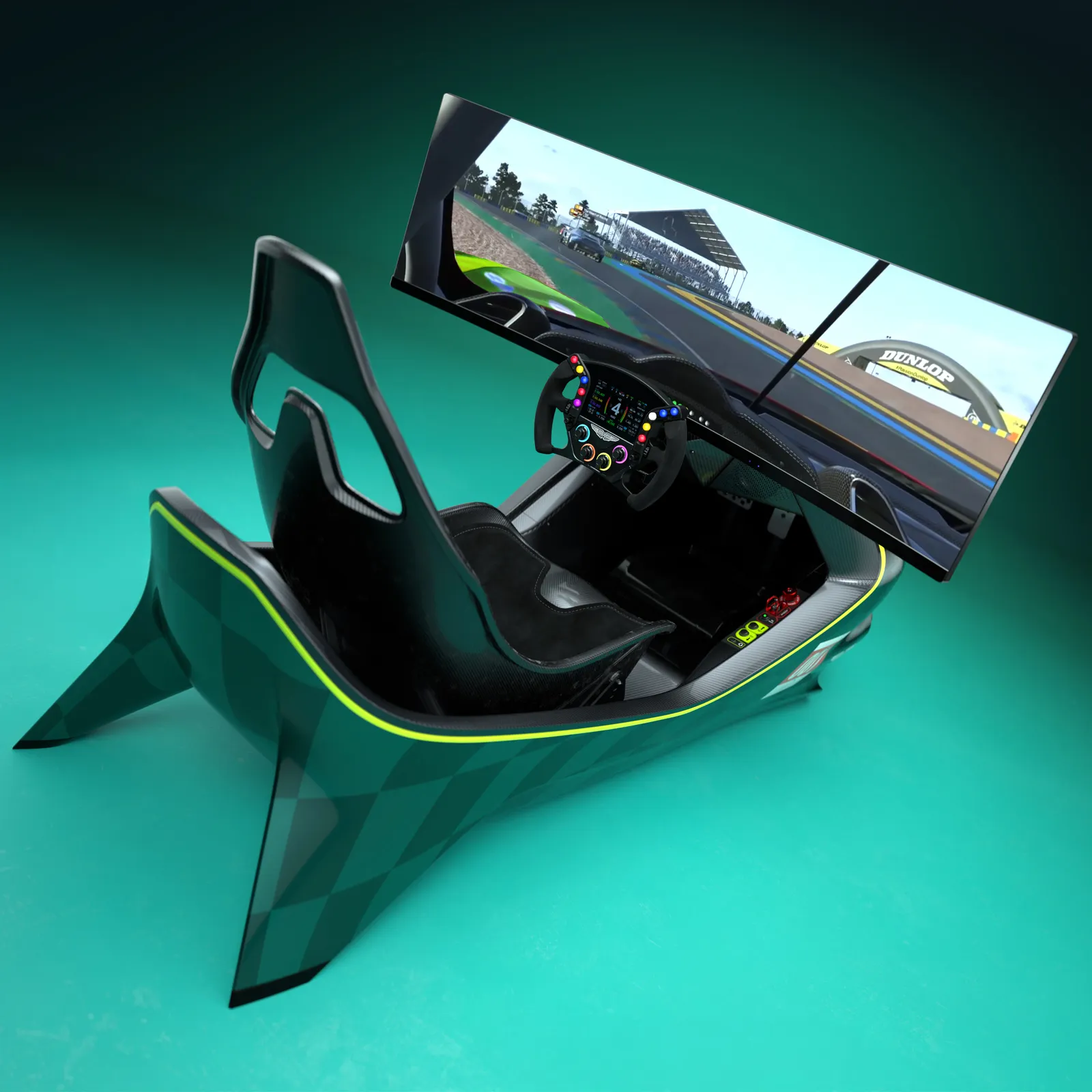
Behind the carbon-fibre shell, the AMR-C01-R Hypercar Edition runs on serious hardware. The rig pairs a curved 49-inch display with NVIDIA RTX graphics, and according to Curv’s own specification for the platform, that display is a 49-inch Samsung Odyssey G95C curved monitor delivering view at a 240Hz refresh rate. Earlier revisions of the AMR-C01-R lifted the screen’s response time to 1ms and added HDR10+ support, alongside an upgraded NVIDIA GeForce RTX 5090 graphics card, a current-generation Intel processor, 32GB of DDR5 memory and 2TB of solid-state storage — a specification built to run current sim-racing titles such as rFactor 2, Automobilista 2, Assetto Corsa and iRacing without compromise.
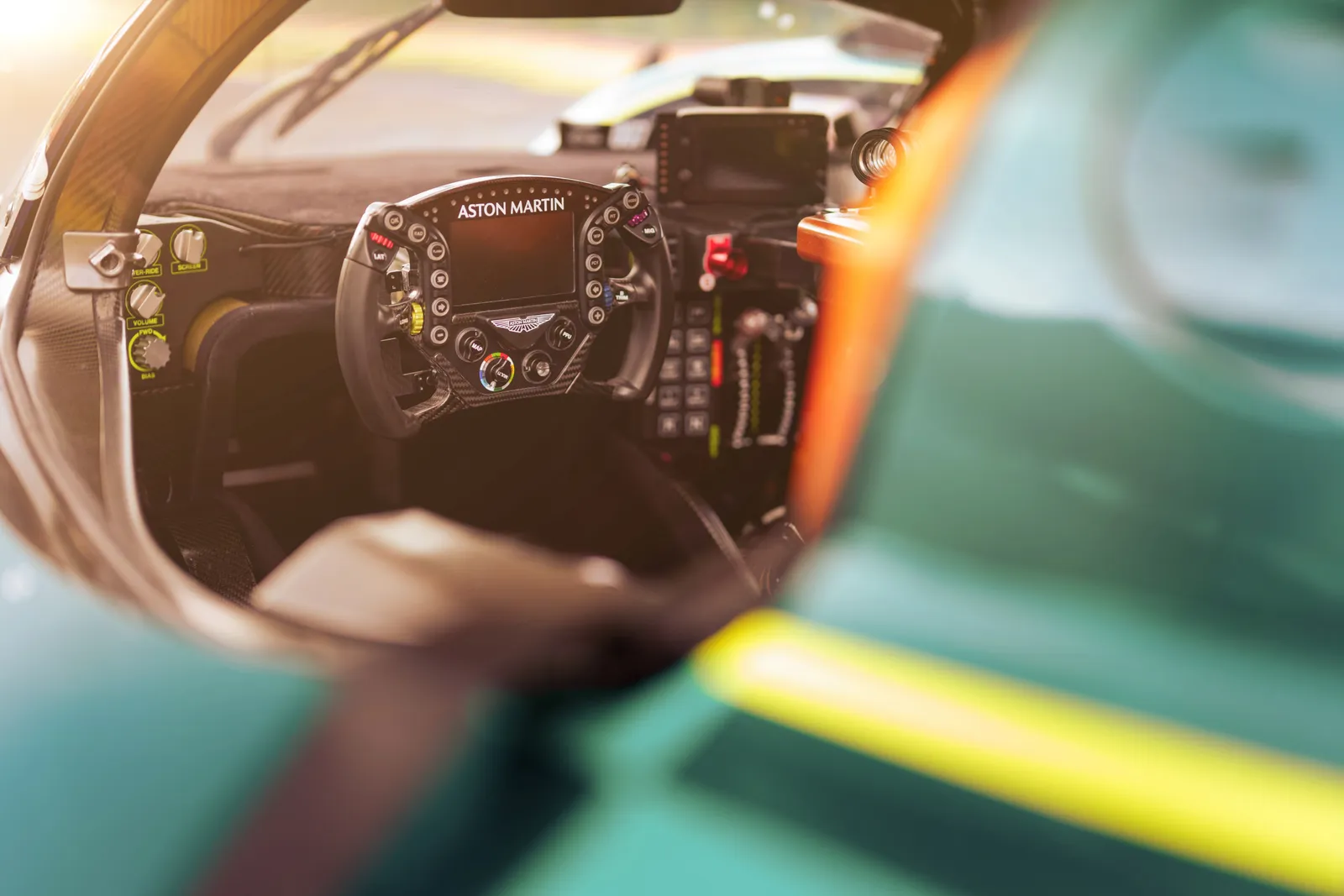
Ergonomics are where the Hypercar Edition diverges most from a conventional sim rig. The seating position is designed to mirror the Valkyrie’s cockpit exactly, and the AMR-C01 platform includes the same pedal positions as the Aston Martin Valkyrie hypercar. The pedal box itself is electronically controlled with 200mm of travel, powered by an electric actuator housed within a carbon-fibre enclosure that keeps the mechanism concealed and dust-free, adjustments made possible without exposing the working parts the way a typical rig would.
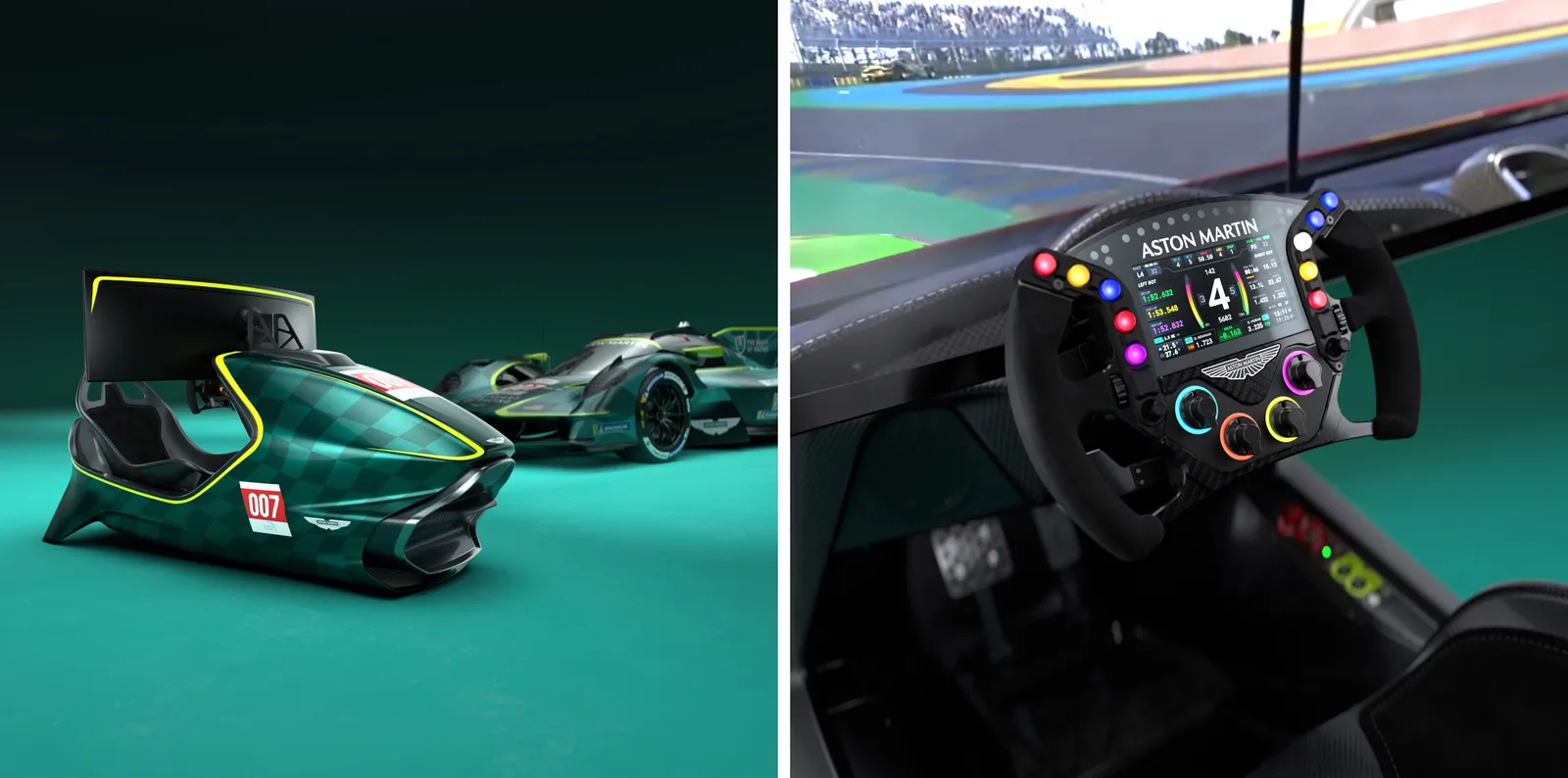
Aston Martin-inspired racing simulator pairs a sculpted motorsport cockpit with a professional-grade Formula-style steering wheel, delivering an immersive driving experience through premium materials, realistic controls, and a panoramic curved racing display.
That level of fidelity is the point the design team keeps returning to. It is not simply about resembling the Valkyrie from the outside; the goal is that the physical experience of sitting in it, reaching for the pedals and gripping the wheel should feel close to the real car, an ambition that separates the product from most simulators built primarily around a screen and a generic seat.
That distinction between a screen-first rig and a body-first one is also where the AMR-C01-R’s development history becomes relevant. The platform’s earlier revisions doubled the display’s refresh rate, cut its response time to a quarter of what it had been, and moved to a current-gen graphics card, memory and storage configuration roughly on par with a high-end gaming desktop. None of that hardware is unique to Aston Martin or Curv — the same components could, in theory, sit inside any enthusiast-built rig — but packaging it inside a single carbon-fibre monocoque, tuned to a specific driving position, is where the collaboration’s engineering effort has actually gone.
flow
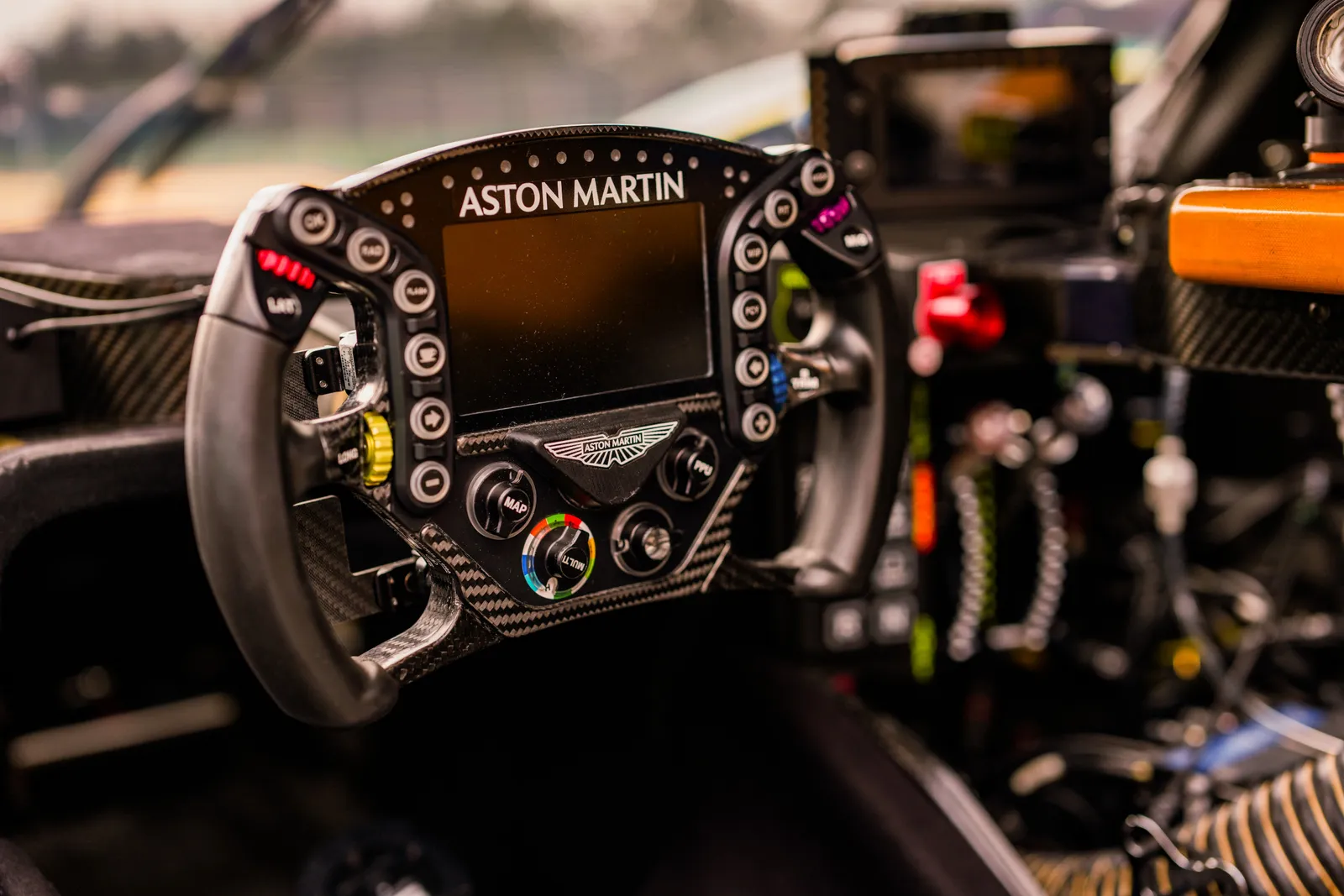
The single newest element on the Hypercar Edition is its steering wheel. New for this version is an Aston Martin Valkyrie steering wheel, and unlike the rest of the cockpit, it isn’t a fixed part shared across every unit. Each wheel is built to order and can be personalised with bespoke side and rotary colour configurations, meaning no two examples need to match, even within the same livery.
The wheel itself is a dense piece of hardware. Curv’s broader AMR-C01 specification describes a bespoke aluminium and carbon-fibre construction fitted with magnetic paddle shifters, dual-clutch controls, nine rotary dials, twelve programmable buttons and an integrated five-inch display, arranged to replicate the density of controls a driver would actually face inside a modern hypercar cockpit rather than the simplified layout typical of consumer sim wheels.
View this post on Instagram
For Turner, this was the detail that mattered most in development. “When we started developing the Hypercar Edition, the focus was on the driving position, steering feel and racing experience,” he said. “Those details are what make a simulator believable. We wanted it to feel as close as possible to sitting in the Valkyrie Hypercar.”
sim
Curv Racing Simulators’ credibile rests almost entirely on Turner’s own background. He built the company on two decades of experience with cutting-edge F1 simulators, and the AMR-C01 platform he co-developed with Aston Martin has been running since 2020, well before the Hypercar Edition arrived. The original AMR-C01-R update, revealed in 2025, was limited to 50 units and introduced the higher-refresh display, upgraded graphics card and revised Valkyrie-inspired seating position that this new edition builds directly on top of.
That iterative development is part of why the Hypercar Edition reads less like a marketing tie-in and more like a genuine hardware refresh. Each version has tightened the link between the physical simulator and the real car it’s modelled on — first through shared ergonomics, then through a shared pedal layout, and now through a livery and numbering scheme tied to an active Le Mans campaign. Reichman has framed the wider collaboration as Aston Martin extending its design language beyond the physical car altogether, treating the simulator as a piece the company designs with the same rigour it applies to a production vehicle, rather than as a licensed accessory.
straddle
The AMR-C01-R Hypercar Edition is available to order now through curvrs.com, priced at £58,750 plus taxes. That works out to roughly $74,600–$78,750 depending on the exchange rate used, and comfortably exceeds the cost of a new sports car for a machine that never leaves the house.
That price only really makes sense against what it’s being compared to. Set beside a real Valkyrie, which carries a price tag upwards of €3.6 million, the simulator represents a small fraction of the car’s value while extending the ownership experience into a games room or private collection space. For someone who already owns the road car, it’s a low-stakes companion object finished to the same standard. For everyone else, it’s positioned as the closest available substitute — hand-built, numbered, and capped at 24 units, with the scarcity functioning less like a gaming product’s limited run and more like the numbered-edition logic that governs how collector cars themselves are sold.
That framing has become a recurring pattern in how high-end automotive brands approach adjacent lifestyle products more broadly: rather than mass-producing a licensed accessory at a lower margin, the object is treated as a scarce, design-led piece aimed at the same buyer who might already own several of the marque’s cars. It’s a strategy that trades volume for exclusivity, and it only really works if the finished object can genuinely stand alongside the cars it references rather than trading purely on the badge.
fin
The AMR-C01-R Hypercar Edition sits at the intersection of two trends that have been building for a few years: automotive brands treating simulators as legitimate design objects rather than merchandise, and sim racing itself maturing into something closer to a collector hobby. Titles like rFactor 2, Automobilista 2, Assetto Corsa and iRacing already give enthusiasts the software fidelity to replicate a Le Mans entry lap for lap; what Aston Martin and Curv have built is the physical hardware to match that fidelity, finished to a standard that would look at home in a private collection alongside the cars themselves.
Either the appeal lands with committed sim racers chasing lap times or with car collectors buying a carbon-fibre companion piece to a garage they already own, the Hypercar Edition is a clear signal of where high-end automotive branding is heading — out of the garage, and into the games room, without leaving any of the craft behind.
Read Drift’s related feature, Aston Martin Valkyrie Spider: A Hypercar Redefining Open-Air Performance.
Related Articles

Under Rue de Castiglione, Liaigre Gives Hôtel Costes a Spa With No Hard Corners
A 20-meter lap pool, eight treatment rooms and not one sharp angle: Studio Liaigre’s spa […]