
DRIFT AUDIO
Listen to this story
Choose a voice, then press play.
A Tokyo bonsai collective and Seiko’s dressiest line meet on a 38mm case that ships September 5, priced differently depending on which side of the Pacific you’re standing on.
Six hundred pieces, one wood box, and a dial that a pair of watch photographers couldn’t agree on. That’s the short version of what Seiko is releasing on September 5 under its Presage Classic Series banner, in partner with a Tokyo bonsai collective most watch buyers had never heard of until this month.
stir
The watch is called the Presage Classic Series x TRADMAN’S BONSAI Limited Edition, and in its Japan domestic form it carries the reference HCC011J. It is the first project the two have done together, and on paper they make an odd pair: one is a nearly 150-year-old watchmaker with a mechanical division built around reviving old Japanese craft techniques, the other is a six-person-strong bonsai collective founded in 2015 by Kojima Teppei, a former fashion buyer who left the industry after getting pulled into the depth of bonsai cultivation. TRADMAN’S BONSAI doesn’t just grow and sell trees. It stages bonsai inside barbershops, streetwear stores and gallery spaces, treating the practice less as a preserved relic and more as something that can sit comfortably next to contemporary fashion and art without either side losing credibility.
That’s roughly the pitch Seiko is making with the watch itself. Presage has spent close to a decade since its 2016 international relaunch turning Japanese material traditions, enamel, urushi lacquer, porcelain, into wearable objects, and the Classic Series is the vintage-leaning wing of that effort. Pairing it with a bonsai specialist rather than, say, a ceramicist or a lacquer artisan is a slightly different move for the collection, closer in spirit to a fashion collaboration than a craft showcase, even though the watch itself reads as thoroughly traditional on the wrist.
Seiko’s modern catalog splits into a handful of broad families: King Seiko for premium mechanical pieces, Astron for its GPS solar line, 5 Sports for accessible everyday watches, Prospex for tool and dive watches, and Presage as the dedicated dress line. Presage is also where most of the brand’s genuinely showstopping design work tends to land, the Cocktail Time series being the clearest earlier example, and the HCC011J slots into that lineage as one of the more ambitious dial treatments the line has attempted. TRADMAN’S BONSAI, for its part, has spent the past several years building a track record of exactly this kind of crossover, staging bonsai installations inside barbershops and streetwear stores and working with fashion and culture brands to argue that a centuries-old horticultural discipline can sit inside a contemporary retail space without either side feeling like a novelty act.
exhibit
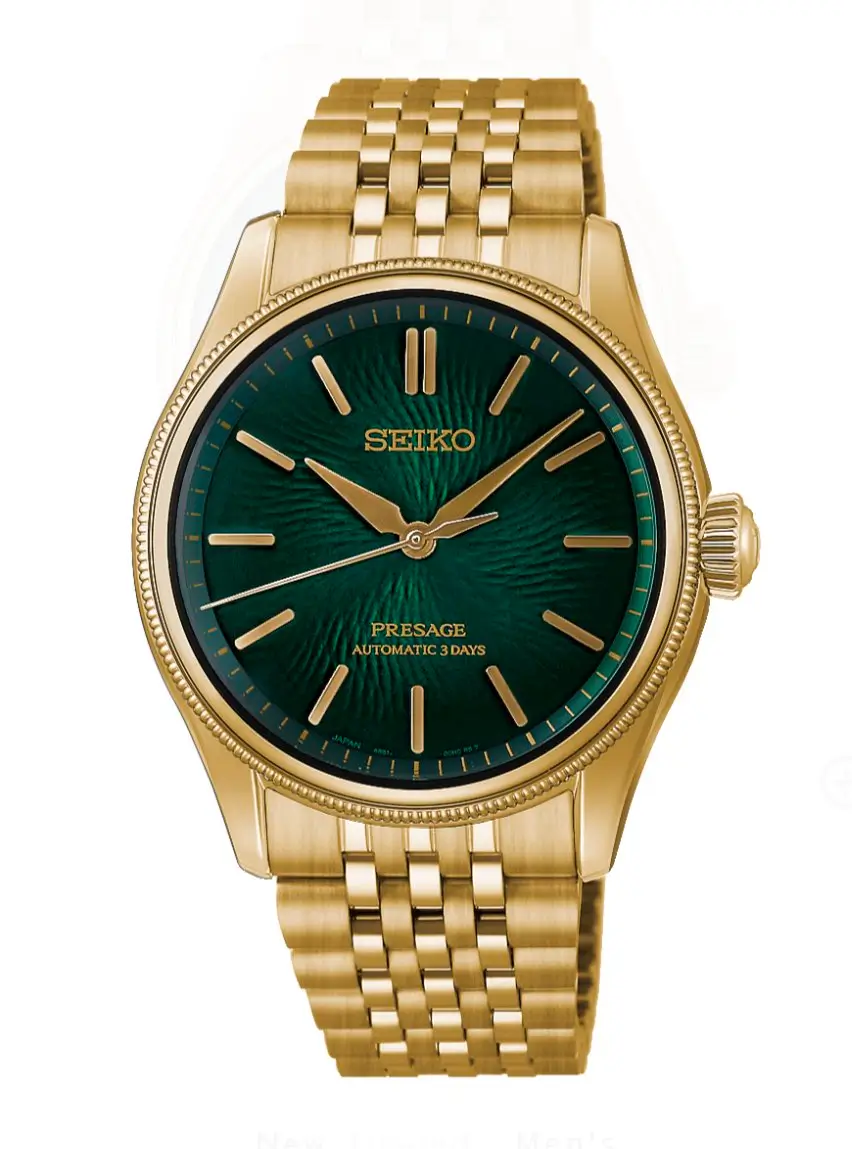
Every Presage Classic collide tends to start from a single image, and this one is unusually specific: a Japanese black pine bonsai caught in cold moonlight, its trunk and branches thrown into silhouette against the dark. Seiko and TRADMAN’S BONSAI describe the reference directly as “Black Pine Illuminated by Moonlight,” and the watch’s entire design vocabulary works backward from that scene.
The dial color is 松葉色, matsubaiiro, or pine needle green, one of Japan’s traditional named colors and one that’s carried associations with longevity and good fortune since roughly the Heian period. Rather than rendering it as a flat wash, Seiko built a gradient that’s meant to run from deep shadow at the dial’s edge toward a lighter, moonlit tone nearer the center, an attempt to compress an entire nighttime garden scene onto a 38mm surface. Gold-toned hands and indices, standing in for moonlight on water, sit on top of it. There’s no date window. On a watch designed around a single uncluttered image, Seiko clearly decided a date wheel would have broken the illusion.
The texture is where the two convincer craft actually meet. Rather than print or photograph bark onto the dial, Seiko developed a new three-dimensional embossed pattern specifically for this watch, tracing the curve of a bent pine trunk from the center outward, with a cracked, high-relief surface meant to read as old bark rather than decoration. It’s a level of tooling effort that goes beyond what Presage Classic pieces typically get, and it’s the detail every early hands-on writeup has singled out.
show
Seiko’s own studio photography shows a settled, dark green dial, evenly lit and easy to describe. Early hands-on coverage from Fratello tells a messier story. Under studio lighting on a slate background, the dial reads as nearly black, with green surviving mostly near the center. Move it outdoors into daylight and the same watch shifts to a vivid, near-total emerald. Hodinkee Japan’s daylight shots land somewhere close to that emerald tone too, while one of their angled studio frames leans teal instead. Four photographs, two photographers, one watch, and no two of them agree on what color it actually is.
The likely explanation sits in the stamping itself. Macro photography shows the embossed striations aren’t machine-regular: they’re dense and tangled near the dial’s center and stretch into longer, slightly wavering strokes toward the rim. That irregularity scatters light unevenly across the surface rather than sweeping it the way a conventional sunray-finished dial would, which is probably why the color refuses to settle into one reading depending on the angle and light source. It’s an unusual thing to build into a mass-produced dial on purpose, and on a watch this deliberately referential, it also tracks: moonlight on pine needles was never going to look the same twice either.
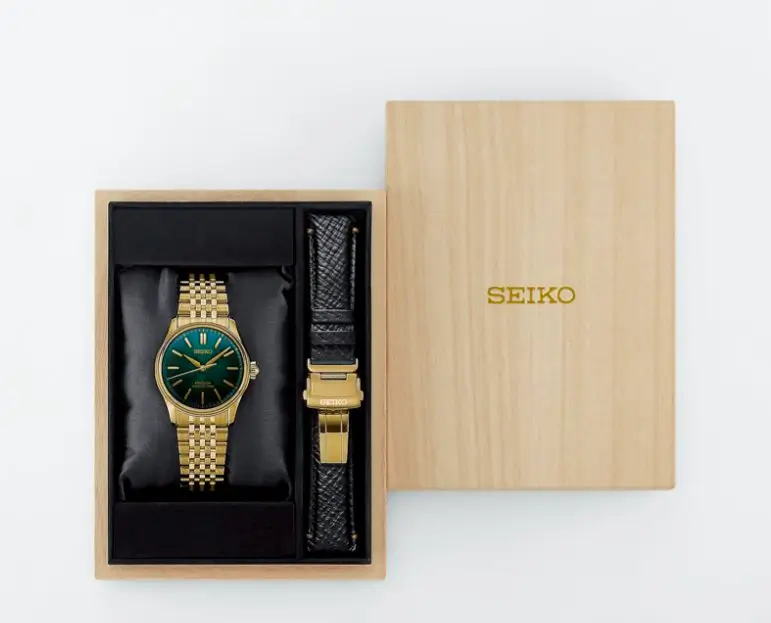
Seiko Gold Watch With Green Dial And Interchangeable Black Strap In Wooden Presentation Box
extend
Strip away the dial story and the HCC011J is a fairly conventional dress watch by Presage Classic standards, which is arguably the point. The case measures 38.0mm across, excluding the crown, and 12.9mm thick, though the polished mid-case band itself is shallow: most of that height sits in the domed sapphire crystal and the caseback rather than the case body, so it should sit lower on the wrist than the raw thickness number implies. Water resistance is rated to 100 meters, generous for a watch this dressy, and the bezel carries fine, dense coin-edge-style milling rather than the fluted look that gold-toned cases with green dials and metal bracelets inevitably invite comparisons to.
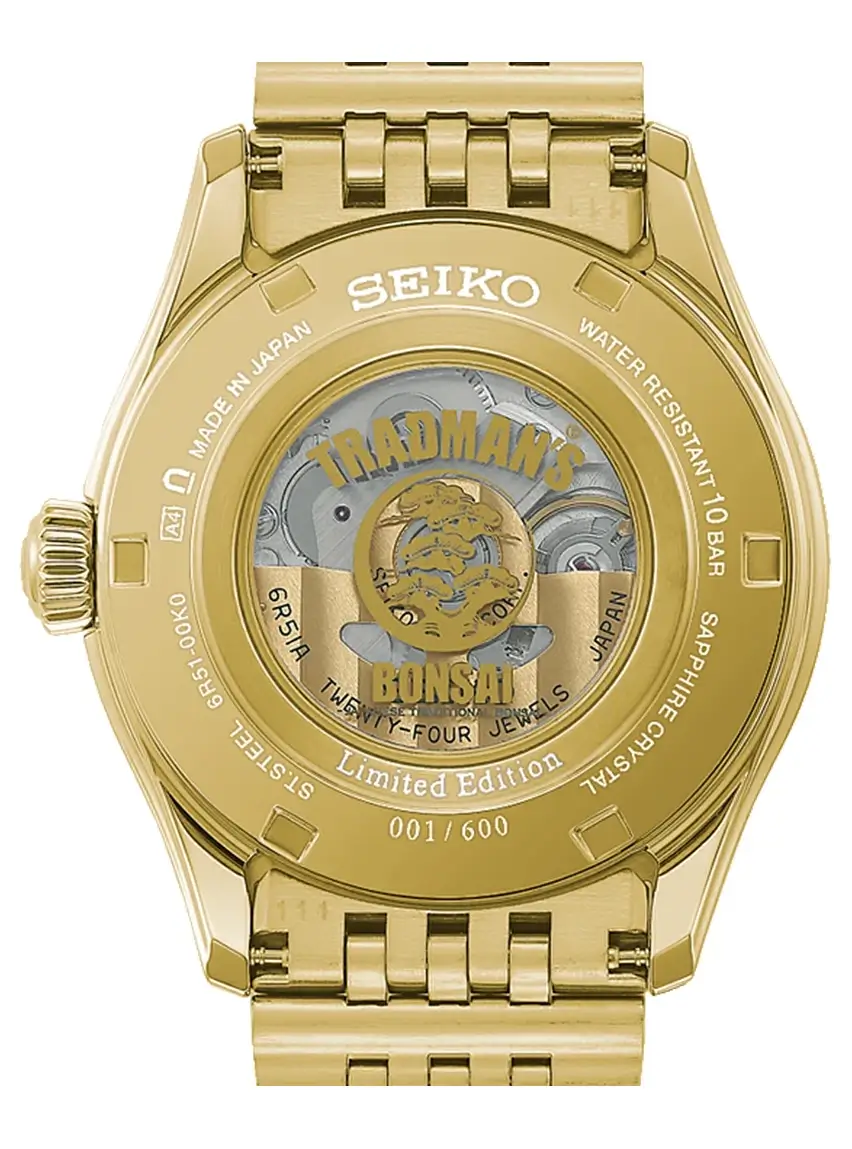
Inside is Seiko’s Caliber 6R51, a 24-jewel automatic movement with hand-winding capability, hacking seconds, and a 72-hour power reserve when fully wound, roughly three days of autonomy from a single winding. It beats at 21,600 vph, runs Seiko’s Magic Lever winding system, and is visible through an exhibition caseback, positioned so the movement itself functions as a second focal point once you flip the watch over. Accuracy is rated at +25/-15 seconds per day, in line with Seiko’s standard 6R-series specification rather than anything more exotic.
A replacement cowhide leather strap ships alongside the metal bracelet on both versions, carrying an embossed pattern that echoes the dial’s bark texture. On its reverse, the strap bears a pressed engraving of 三鈷の松, sankou no matsu, the three-needled pine, a variety said to have been brought back from China by the monk Kūkai in the ninth century and regarded since as a symbol of good fortune. It’s a small detail on the underside of a strap most owners will rarely flip over, but it’s consistent with how thoroughly the rest of the watch commits to its source material.
View this post on Instagram
The 6R51 itself sits in the upper tier of Seiko’s in-house mechanical range, one step up from the entry-level 4R-serie movement that populate most of the brand’s lower-priced automatics. The 72-hour reserve is the headline figure, roughly double what older Seiko calibers offered, and it means the watch can sit unworn over a weekend and still be running and reasonably accurate when it comes back off the shelf. The Magic Lever winding system, a Seiko-patented mechanism dating back to 1959, uses a pair of claws driven by the rotor to wind the mainspring in both directions rather than just one, which is part of how Seiko keeps the 6R-series efficient without resorting to a more expensive architecture. None of this is exotic by modern watchmaking standards, but it’s dependable in a way that suits a watch built around a slow, patient subject like bonsai cultivation rather than one built for speed or complication.
fin
The HCC011J arrives in a 桐箱, kiribako, a paulownia wood box of the kind used across Japan for centuries to store and protect valuable objects, from kimono to tea ceremony implements, alongside a TRADMAN’S BONSAI watch cloth and a bonsai-illustrated message card. Each individual watch is serial numbered, both on the caseback and the outer ring, and the domestic run is capped at 600 pieces against the global edition’s 2,000.
Pricing lands meaningfully apart depending on the market: ¥269,700 for the Japan domestic HCC011J, working out to roughly $1,830 at current exchange rates, against $1,350 for the international HCC009J1. Some of that gap reflects the smaller production run and the added caseback branding and packaging detail on the Japanese reference, though Seiko hasn’t published an official explanation for the spread. The global HCC009J1 becomes available through Seiko’s usual international retail network from September 2026. The HCC011J rel domestic in Japan on September 5, with pre-orders already open through Japanese retailers ahead of that date.
Watch outlets have generally treated the release as one of the more interesting things to come out of the Presage line in some time, less for any single spec than for how much the watch commits to a single narrow idea, a bonsai tree at night, and carries it through the dial texture, the tincture, the strap engraving and the box it ships in without any single element feeling like an afterthought. Whether that reads as a genuinely new direction for Presage connection or a one-off experiment likely depends on how the next Classic Series rel, whenever it lands, chooses to follow it. For now, the more immediate question is simpler: which of the 600 domestic pieces end up on wrists in Japan come September 5, and whether the international HCC009J1’s 2,000-piece run holds up any better once it reaches retail a few weeks later.
From the DRIFT archive: Dyson x PORTER: Engineering Meets Urban Craft in the OnTrac Limited Edition · Cornell Team Develops Ultrablack: The “Darkest Fabric Ever” That Reflects Close to No Light
Related Articles
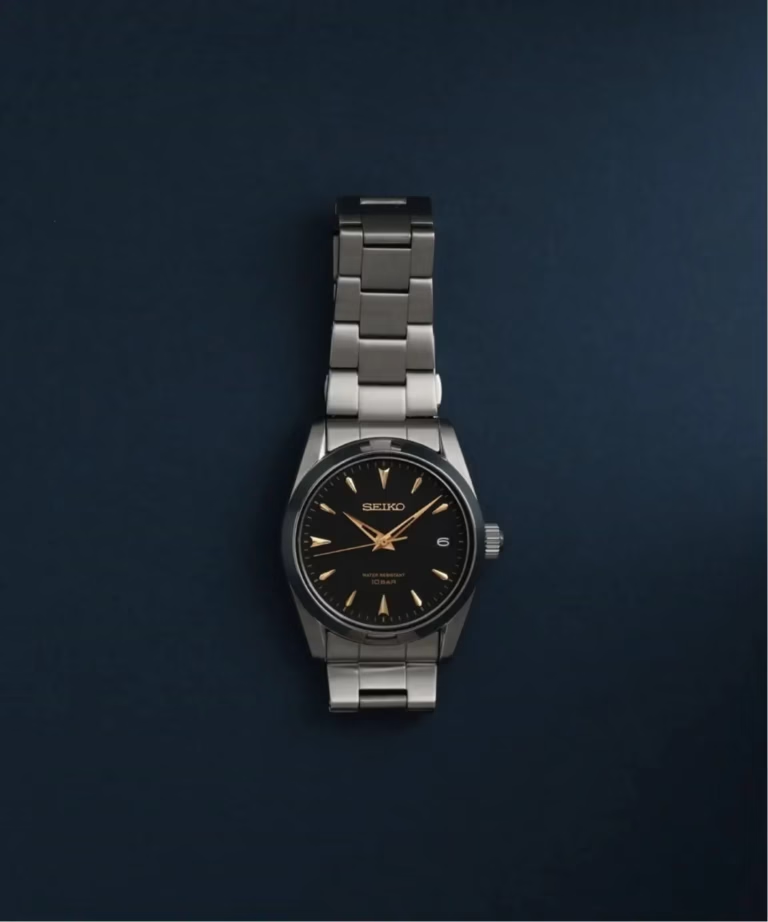
Seiko, IENA And HIROB Put The Black Bracelet Back On The Calendar
SEIKO Exclusive IENA x HIROB, Black. Mid-October 2026. Charcoal dial. 35 mm. Hairline silver, gold […]