DRIFT AUDIO
Listen to this story
Choose a voice, then press play.
Twelve drivers and seven vintage Porsches left a Łódź workshop this summer for a 4,000-kilometer drive across four countries, built to become art.
This summer, twelve drivers span several gen gathered at a workshop in Łódź, Poland, for a pre-trip briefing before setting out in seven classic Porsches built between 1955 and 1992. Ahead of each car lay roughly 4,000 kilometers, on a route through Poland, Slovakia, Hungary, and Romania. The trip had the ordinary complications of any long convoy drive: one car developed a problem with its suspension spar, diagnosed and fixed on the spot by a few skilled hands from the group, and a stretch of Romanian mountain road turned into an unplanned rest stop among vineyards.
None of it happened for its own sake. The drive is the source material for Contact Layer of Shinjuku, the newest chapter in a multidisciplinary project led by Polish designer and artist Paweł Kalinowski. Moving images, sound, light, and the physical artefacts collected along the route are being reconstructed into an exhibition environment, and that recorded experience is then becoming material for a second work, with individual elements rearranged through spatial, view, and sonic means.
It is, in effect, a project that treats a road trip the way a documentary crew treats raw footage: not the finished piece, but the material for one. That distinction matters more here than it would for an ordinary car meet, because everything about Contact Layer of Shinjuku traces back to a race that never actually happened.
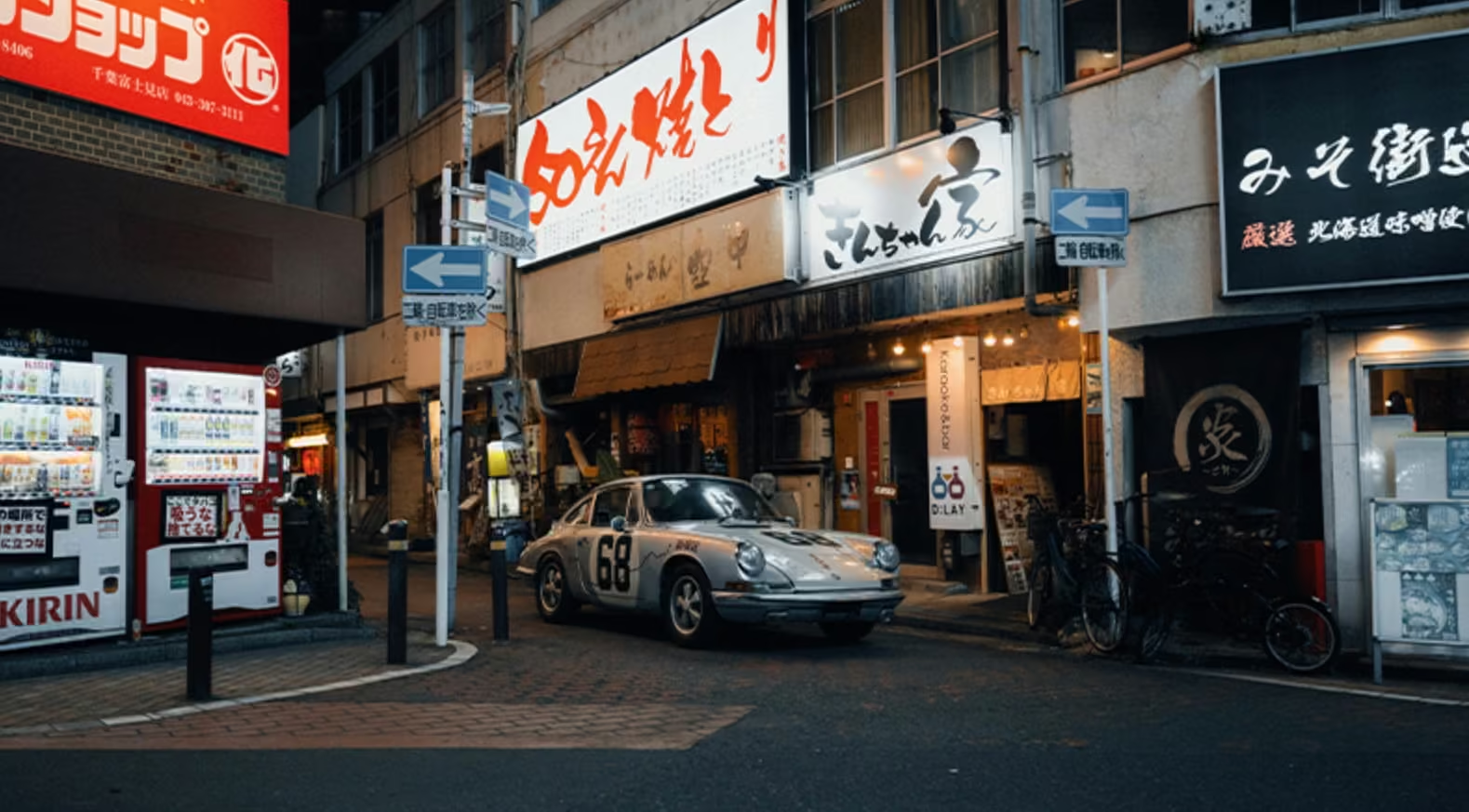
A vintage Porsche 911 rally car turning a corner on a moody, neon-lit street in Japan at night.
stir
Contact Layer of Shinjuku is the latest stage in Kalinowski’s ongoing explore of cars, memory, fiction, and lived experience, and it did not start with a real trip at all. It started with Shinjuku, a fictional universe built around an imagined night race from Tokyo’s Shinjuku district to Fuji Speedway, inspired by the mythology of 1980s Tokyo car culture.
Earlier in 2026, Kalinowski returned a 1968 Porsche 911 to Japan, developing the car around invented memories of that never-run race and hand-painting it in Tokyo using a mix of techniques. The finish car became one of the hero cars at Luft Tokyo, the first Japanese edition of Luftgekühlt, the air-cooled Porsche gather stag that year on the city’s decommission KK Line Expressway, where roughly 220 cars drew close to 11,600 visitors for the brand’s debut event in Asia. The KK Line itself had spent 66 years as a key link between Tokyo’s Kyobashi and Shimbashi neighborhoods before its 2025 decommissioning ahead of a planned public green space, and Porsche Japan used the same event to show its own cars, include a 356 and a 1973 911 Carrera RS, under a Classic to Modern theme, alongside an exclusive Luftgekühlt x Porsche Lifestyle merchandise range. Kalinowski has described his own piece to Polish press as an artistic interpretation of a 911 built entirely around a fictional overnight race between two real places, Shinjuku and the Fuji Speedway circuit.
The Tokyo unveiling closed the first chapter, but it also left Kalinowski with an unresolved question, one that would define the entire second chapter of the project.
show
After returning to Poland from Tokyo, Kalinowski found himself asking what remains once an adventure is over. That question produced Ghost Layer of Shinjuku, an install built around the decayshell of a Porsche 356, treated not as a car to be restored but as an archaeological object. He has said the piece was never about saving another vehicle; it was about the moment after, the traces left behind once the story has run its course. The 356 shell carries traces, artefacts, and memories tied to a life it never actually lived, in effect locking away the memory of a rally through 1960s Japan that only exists inside the installation.
Ghost Layer premiered at Hel Riders, an annual gathering on Poland’s Hel Peninsula that draws much of Central Europe’s Porsche community, where it was unveiled at an amusement park directly across from a haunted house. Type 7, Porsche’s own official lifestyle magazine, covered the piece shortly after, describing Kalinowski, owner of CarBone in Łódź, as one of the region’s most prominent faces in Porsche culture, and frame Ghost Layer as less concerned with what a journey entails than with what remains once it ends. The install then stood on a campsite at Chałupy 6 on the peninsula for roughly three months.
Interest followed quickly. Kalinowski has said Petrolicious approached him about making a film on the project, and that his own ambition was to eventual place the install inside a museum of modern art, naming Warsaw, Łódź, Berlin, and Tokyo as possibilities and specifically hoping to show it during Tokyo’s Art Week that November. Ghost Layer examined how a physical object can give form to the perception of a fictional past. Contact Layer of Shinjuku takes the opposite approach.
meth
Where the original Shinjuku project constructed invented memories around a race that never took place, and Ghost Layer gave those invented memories physical form inside a single car, Contact Layer of Shinjuku uses an actual, lived, and documented journey as the source material for the work. Each chapter of the project has introduced a new medium while shifting its relationship to the one before it: automotive design and hand-painted cars gave way to an archaeological installation, and now a real convoy is being fed through the same process in reverse.
The plan is to reconstruct fragments of the four-country drive inside an exhibition environment using moving images, sound, light, and the physical artefacts the twelve participants collected along the way. That reconstructed experience then becomes the raw material for a second work, in which the same elements get rearranged through spatial, view, and sonic means rather than simply display as a record of the trip. The result is not one exhibition but two connected pieces built from a single drive: one that reassembles what happened, and a second that treats that reassembly as its own new material.
The artefacts at the center of that reconstruction are not abstract props. They are the ordinary residue of the trip itself, the kind of thing a mechanic reaches for when a suspension spar needs fixing on the roadside, or the small mementos that accumulate during an unplanned stop among Romanian vineyards. Ghost Layer of Shinjuku had to invent that category of object, filling a car with traces of a past it never had. Contact Layer of Shinjuku does not have to invent anything. Its raw material already happened, to twelve real people, on a real road.
straddle
The first public show of Contact Layer of Shinjuku is planned for Luftgekühlt’s Atlanta edition in October 2026. The complete work is then set to premiere at Reszel Castle in Poland, a Gothic fortress built by the Teutonic Order between 1350 and 1401 in the Warmian-Masurian region known locally as the Land of Lakes. The castle today combines a hotel and restaurant with a gallery of modern art run as a branch of the Museum of Warmia and Mazury, making it an unusual but fitting venue for a project this deliberate layer.
Luftgekühlt itself began in 2014 as a low-key Los Angeles gathering organized by two-time Le Mans class winner Patrick Long and creative director Howie Idelson, and has since grown from a casual cars-and-coffee into a global curated celebration of air-cooled Porsche culture, with events across the United States, the UK, Germany, and now Japan. Luft 12, the edition set to host Contact Layer of Shinjuku’s debut, runs October 10, 2026, at Town at Trilith in Fayetteville, Georgia, not far from Porsche Cars North America’s own headquarters, and is built around 75 years of Porsche in motorsports with a curated mix of historic sig race cars, air-cooled road cars, and preservation vehicles, plus an opening night party the evening before.
A future presentation in Tokyo is also planned, though not yet scheduled. Returning the project to Tokyo would close a loop that began with an entirely invented race through the city, continued through a real drive across four European countries, and would ultimately arrive back in the place that supplied its original fiction in the first place.
fin
Kalinowski, born in 1981 in Łódź, studied at the Academy of Fine Arts in Łódź under professor Sławomir Iwański before starting out as a graphic designer in 2006, working for firms including AMG.net and Darkstone & Cardinal, where he illustrated the video game adaptation of the novel Tunnels. His design language since has leaned on retrofuturism layered with constructivist and unist influences, and it runs through a body of earlier work that includes the Polskie Ściganie poster exhibition, a poster series made for Petrolicious, the Tejas Treffpunkt project, and Tardza, a customized Porsche that appeared in a music video for the Polish touring festival Męskie Granie.
He founded CarBone in 2014, and by his own account the idea reaches back to childhood: at six years old, his older brother told him the Porsche 911 was the best car in the world, and he says he never stopped believing it. That belief ran in the family. Kalinowski has described growing up immersed in 1980s and 90s motorsport in a household of three car-obsessed men, himself, his father, and his brother, that his mother only half-jokingly diagnosed with a kind of automotive sickness. Recognition arrived unevenly: one Polish profile of his career noted that Kalinowski remains relatively unknown at home while enthusiasts from abroad line up for his work.
Around 2015, the company’s international break came at the Porsche Rennsport Reunion in California, one of the largest Porsche gatherings anywhere. The budget stretched only to a flight into Chicago, with the team driving the remaining roughly 3,600 kilometers themselves to make it to the show. CarBone now operates out of an unassuming workshop in an industrial pocket of Łódź, producing several hundred artistic parts and interior components each month for classic and modern Porsches, shipped out to collectors around the world; Polish motoring press has called it the country’s enclave for classic Porsche work, built to a world-class standard, with historic 911s regularly arriving at the Łódź workshop for restoration from owners the company has never met in person. Kalinowski has described the company’s own work as fusing technology with art and design. His personal Instagram bio, followed by roughly 34,000 people, lists him as CarBone’s creative director and founder, doing automotive design and cultural storytelling across international projects and collaborations. Contact Layer of Shinjuku is, so far, the only chapter in the Shinjuku universe built entirely from something that actually happened.
Related Articles
From Slip-Ons to the G-Class: Mattias Gollin and BRABUS Preview in Paris
Mattias Gollin built a following by hand-setting pearls on Vans. Deep into Paris Fashion Week, the Italian designer's touch surfaced on a BRABUS G-Class.