DRIFT AUDIO
Listen to this story
Choose a voice, then press play.
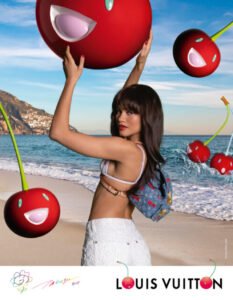
There are certain unions in the world of luxury fashion that transcend trend, commerce, and time. Louis Vuitton and Takashi Murakami is one of them. Their collaboration, first launched in 2003 under then-artistic director Marc Jacobs, didn’t just blend the visual language of Japanese contemporary art with Parisian heritage luxury—it rewrote the rulebook. Two decades later, the final chapter of this pioneering creative marriage has arrived: a jubilant, 70-piece collection that centers on Murakami’s beloved “Cherry” motif.
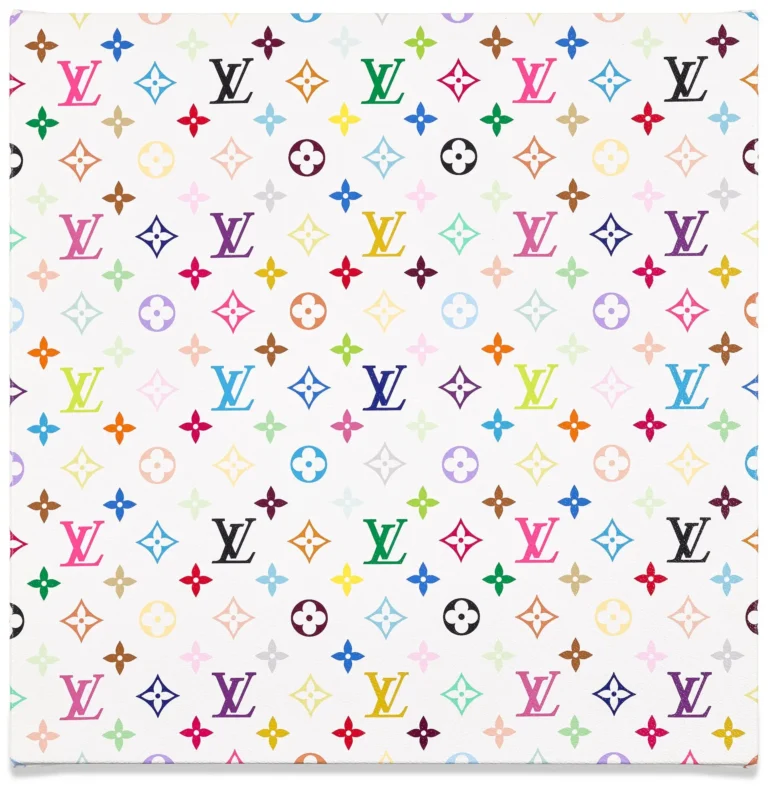
Where the first collaboration gave us the riotous Multicolore Monogram and kawaii-infused camo, and the second briefly revisited iconic elements for select capsule drops, this third and concluding act leans fully into joy. Playfulness isn’t incidental here—it’s the point. The smiling cherries, each animated with their own personality, spill across a newly minted white Monogram canvas, adding a sense of optimism and innocence that feels disarmingly fresh in an era of grayscale minimalism and quiet luxury.
At the heart of this release is an embrace of Murakami’s world—a cultural universe built on candy colors, manga surrealism, and a philosophical blend of cuteness and critique. Yet, Louis Vuitton’s unparalleled craftsmanship ensures that this never becomes costume. The Cherry motif appears with glossy, tactile depth through 3D printing techniques, rendering Murakami’s figures as if plucked straight from his studio. These cherries are not simply patterns—they’re characters, conversation pieces, wearable companions.
Items range from petite pochettes and bucket bags to reworked archival silhouettes, giving new life to classics like the Papillon and the Speedy. A denim segment gives the motif a more casual edge, while accessories such as scarves and luggage tags add modular playfulness. Footwear, too, gets in on the act: kitten heels and mules feature subtle cherry prints, balancing whimsy with wearability. The pièce de résistance? A limited-run white trunk, lacquered with cherries inside and out—part sculpture, part heirloom, entirely Murakami.
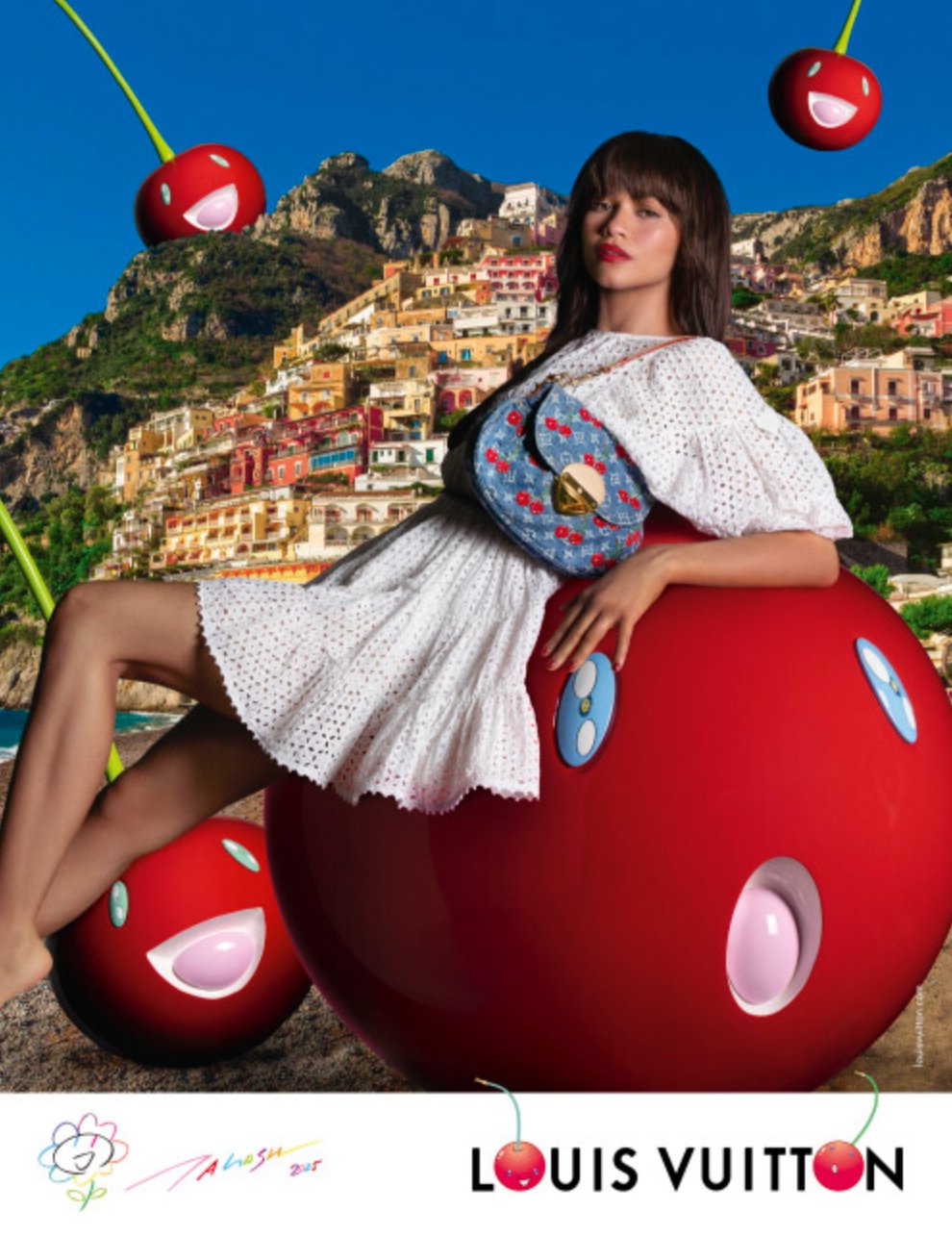
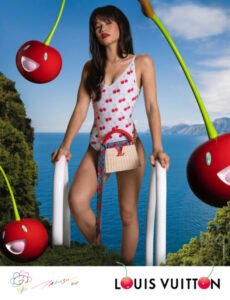
Zendaya returns as the campaign’s muse, a full-circle moment that not only marks her evolution as a style icon but also underscores how generational this collaboration has become. Shot by Inez and Vinoodh, the visuals are exuberant yet polished. Zendaya—surrounded by larger-than-life Cherry characters—embodies a kind of future nostalgia. The images recall the irreverence of early 2000s fashion while planting the collaboration firmly in 2025, a modern-day reflection of a legacy built on cheerful rebellion.
The campaign doesn’t just sell product—it tells a story of legacy and reinvention. Zendaya’s presence speaks to the intergenerational pull of both Louis Vuitton and Murakami’s respective brands. She’s Gen Z’s answer to the early-aughts It-Girls who first carried Multicolore pieces on red carpets and in paparazzi shots. Yet she doesn’t imitate them—she owns the aesthetic anew, standing at the intersection of pop culture, art, and design.
What makes this final chapter feel so timely is its unrepentant embrace of joy. In an industry increasingly dominated by cynical irony or algorithm-driven silhouettes, Murakami’s vision—and Louis Vuitton’s willingness to amplify it—feels like a refusal to conform. The smiling Cherry characters are unabashedly cute, yes, but they’re also emotionally resonant. They offer a kind of antidote to the cool detachment that’s permeated both fashion and art.
There’s also something deeply meta about this final collection. Murakami, who’s long explored themes of repetition, branding, and the commercialization of culture, here turns his own commercial hit into a kind of closing gesture. If the original Multicolore line was his entry into the luxury mainstream, the Cherry collection is his bittersweet farewell. It’s sugary, yes—but there’s sincerity beneath the surface.
For Louis Vuitton, this collaboration functions not only as a retail event but as a reaffirmation of its cultural relevance. In Murakami, the maison found a partner who challenged its visual codes, making them feel younger, stranger, more irreverent. And in turn, Louis Vuitton gave Murakami’s pop-saturated vision the gravitas and permanence of haute tradition. It was a perfect partnership—not because they agreed, but because they disrupted each other in the right ways.
The commercial success of the Cherry collection is a foregone conclusion. But its real achievement lies in how it redefines what a legacy collaboration can be. Rather than retreading old ground or merely cashing in on nostalgia, Louis Vuitton and Murakami offer a collection that honors the past while gleefully thumbing its nose at seriousness. In doing so, they provide a blueprint for future partnerships: one where artistic identity isn’t diluted, but exalted.
This isn’t just the end of a product cycle—it’s the conclusion of an era. And yet, as with all things Murakami, endings are never really final. His work—like his smiling cherries—circulates endlessly through culture, ripe for rediscovery by every new generation.
So, if this really is the last time Murakami’s vision wraps itself around Louis Vuitton’s Monogram canvas, it’s a send-off worthy of applause. Not somber. Not nostalgic. But bright, smiling, and mischievously hopeful.
Cherry on top, indeed.
Related Articles
Ten Bags Sitting In The Same Week As The Shows
Pearl egg. Fringe mini. Kelly Doll. Holdall. Pigeon. Speedy. Alex tote. Aluminum case. Cassandre pouch. […]