DRIFT AUDIO
Listen to this story
Choose a voice, then press play.
Twenty three years after Takashi Murakami first painted 33 colors onto Louis Vuitton’s Monogram, the White colorway keeps finding reasons to come back.
Marc Jacobs did not need Takashi Murakami. That is worth saying plainly before anything else, because it is the detail that gets lost every time this collection resurfaces. In 2002, Louis Vuitton was already the most commercial dominant house in the LVMH portfolio, and its brown and tan Monogram canvas, patented in 1896, was doing exactly what it had always done. Jacobs brought in a Japanese contempo artist known for flatten the distinction between fine art and commercial product, handed him the house’s most sacred asset, and let him repaint it in 33 candy hue across a stark white ground. The result, unveiled for spring 2003, is now treated as inevitable. It was not. It was a genuine risk on a two hundred year old maison’s most protected symbol, and it is the reason Louis Vuitton keeps returning to Takashi Murakami instead of treating the original run as a closed chapter.
View this post on Instagram
That return happened again this January, and the White Monogram Multicolore ground, the version collectors and resale buyers gravitate toward most, sits at the center of it.
stir
Louis Vuitton has announced the end of the Murakami era more than once. The house closed out the original run around 2015, then spent a decade treating Multicolore as archive material, the kind of thing that shows up in a Sotheby’s writeup about early 2000s fashion rather than on a current price list. Then came the 20th anniversary. Sotheby’s own retrospective on the partnership notes that the 2025 capsule reintroduced the Multicolore motif and Murakami’s cast of characters in updated silhouettes, an early signal that the house saw more commercial life left in the print than its own farewell framing had suggested. A Cherry Blossom and Cerises wave followed. An Artycapucines chapter, styled at the time as the actual conclusion, came after that.
None of it stuck as an ending. On January 2, 2026, Louis Vuitton launched a new set of Murakami sil timed to land alongside the Monogram’s 130th anniversary celebrations, a rel built specific around pieces from the original Y2K lineup that had not resurfaced in the first anniversary wave. The pattern by now is unmistakable: every time the house tries to close this collide out, the market’s appetite drags it back open. It also helps that the original run never really left pop culture’s peripheral view. Paris Hilton and Nicole Richie both carried Multicolore pieces heavily enough in the early 2000s that the bags became shorthand for a specific strain of celebrity, one built on paparazzi photos and reality television rather than runway campaigns, and that association has aged into exactly the kind of nostalgia that current opul marketing knows how to monetize. Handbag resale platform FASHIONPHILE has been tracking that appetite directly, and reported that searches for Louis Vuitton x Murakami pieces on its own site climbed roughly 1,100 percent by the end of 2025, a number that reads less like nostalgia and more like an active, ongoing demand curve.
huh
Multicolore always shipped in two grounds, black and white, and the choice was never cosmetic. The black ground pieces, worn hard by the early 2000s It girl circuit, read as nightlife pieces, built for a Paris Hilton flashbulb moment. White read differently. Against a white canvas, Murakami’s 33 silkscreened colors sit brighter and the Monogram flowers and LV initials read almost like confetti rather than camouflage, which is part of why the white ground became the version most associated with daytime carrying and with the collaboration’s Y2K, candy shop identity. It is also, practically speaking, the harder version to keep clean, and that fragility became part of its mythology on the resale market: a pristine white Multicolore piece from the original run signals a level of care that a black ground bag simply does not have to prove.
The construction itself has not changed much across two decades. Coated canvas carries the print, Vachetta leather trims the edges and ages into a deepening honey tone with wear, and gold tone brass hardware finishes it off. What has changed is the range of things Louis Vuitton is willing to put that combination on.
in
The new wave leans harder into travel and structure than the softer, bag focused 2025 rollout did. A Travel Alma makes its debut here, a silhouette that was conspicuously absent from the first Multicolore wave despite being one of the house’s most recognizable shapes. Built in White Monogram Multicolore canvas with Vachetta trim, it carries the collection’s studded hardware and a bow shaped clochette, plus an adjustable shoulder strap with a 19.7 inch maximum drop and a front pocket closed with an S lock for a passport or phone. At 17.7 by 13.8 by 8.7 inches, it is sized for a genuine weekend away while staying inside most airline cabin limits, and it is priced at $5,750.
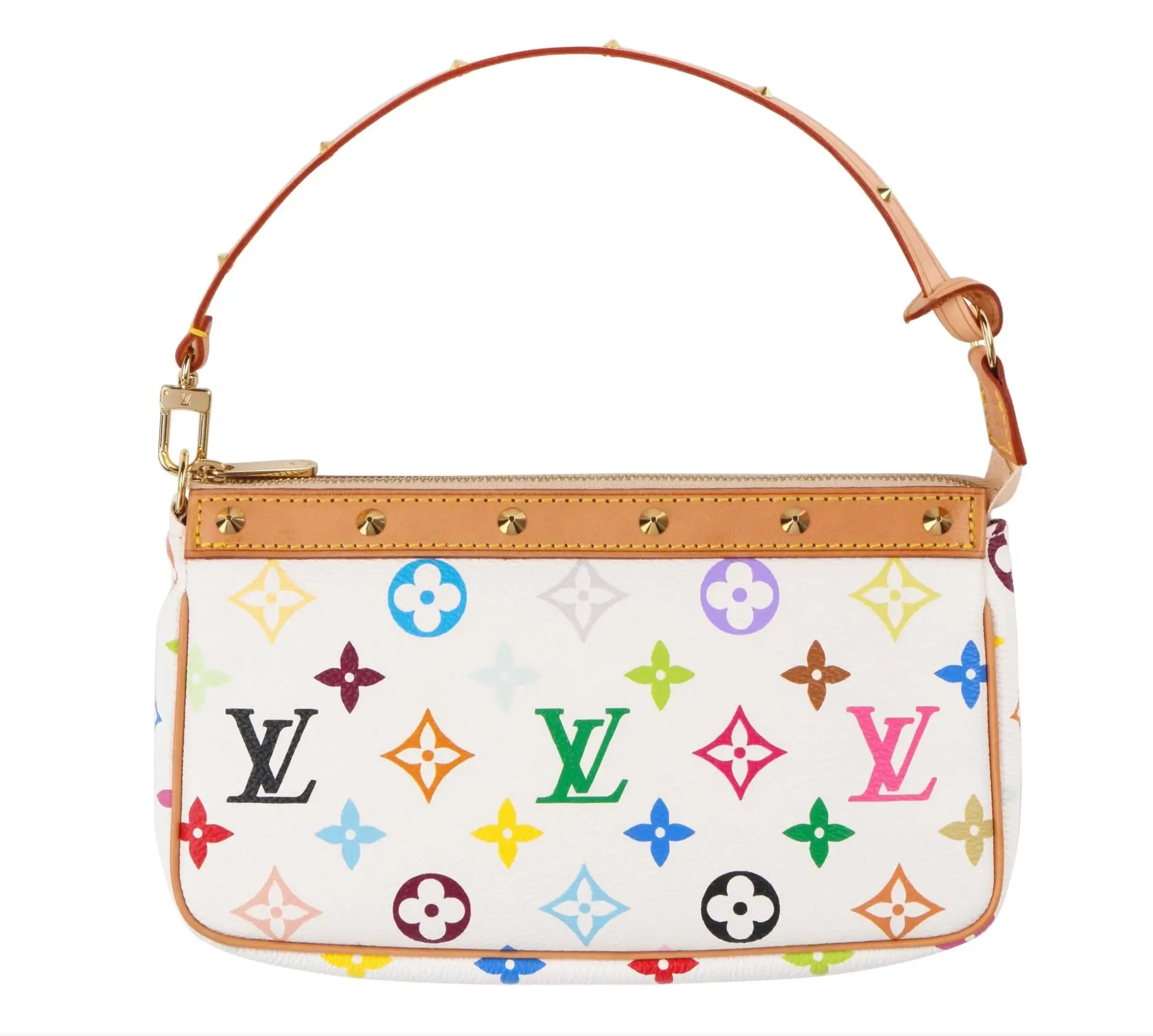
White Louis Vuitton shoulder bag with multicolored Monogram print, tan leather trim, gold-tone hardware, and a slim shoulder strap.
Alongside it sits a Neverfull MM in the same White Multicolore canvas, a more travel practical companion piece measuring 12.2 by 11 by 5.5 inches, finished with the same bow adorned luggage tag and gold tone studding, plus a matching removable pouch that works as either a clutch or an extra interior pocket. It retails for $3,250, positioning it as one of the more accessible entry points into the current wave.
The Speedy line, which has carried more Multicolore history than any other Louis Vuitton shape, gets its own update in the form of a Speedy 30 Soft, built from a noticeably softer canvas construction than the structured originals. At 11.8 by 8.3 by 6.7 inches, Louis Vuitton says it comfortably holds a 9 inch tablet alongside a wallet and phone, with reinforced metal corners and a studded bow clochette with padlock nodding back to the house’s trunk making heritage. It is priced at $4,400. A more architectural Speedy Trunk 20 joins it at $13,600, built with reinforced corners, a hinge style opening, an S lock closure, and embossed Vachetta trim, essentially compressing the house’s trunk language into a wearable 8.3 by 5.9 by 5.1 inch shape.
Not everything in the wave stays on white. A Capucines Mini arrives in smooth black leather instead, its Monogram reinterpreted through colorful enamel studding rather than printed canvas, priced at $8,250, while a softer Capucines BB comes in a powdery baby blue Taurillon leather with a white enamel LV logo and a detachable strap that flashes multicolore only on one side, priced at $7,600. Smaller pieces round the collection out, including a Horizon shaped bag charm designed to clip onto a Speedy or Neverfull, or to pair with the full size Horizon 55 for a matched travel set. Small leather goods and stationery pieces fill out the rest of the range, including a Jane notebook in the White Monogram Multicolore fabric cover, its baby blue interior pages and silken placeholder ribbon carrying the same playful register as the bags, and priced as an accessible entry point for anyone who wants the print without committing to a full size handbag.
compare
What separates this wave from a simple reissue is how deliberately it is filling in gaps from the original 2003 to 2015 run rather than just repeating its greatest hits. The Travel Alma and Speedy Trunk 20 in particular did not exist in white Multicolore the first time around, at least not in any form collectors can point to, which means Louis Vuitton is using the anniversary frame to actually expand the archive rather than just reprint it. That is a meaningfully different proposition for the segment of buyers who already own a 2003 or 2005 Speedy 25 and are deciding whether a new piece is worth adding.
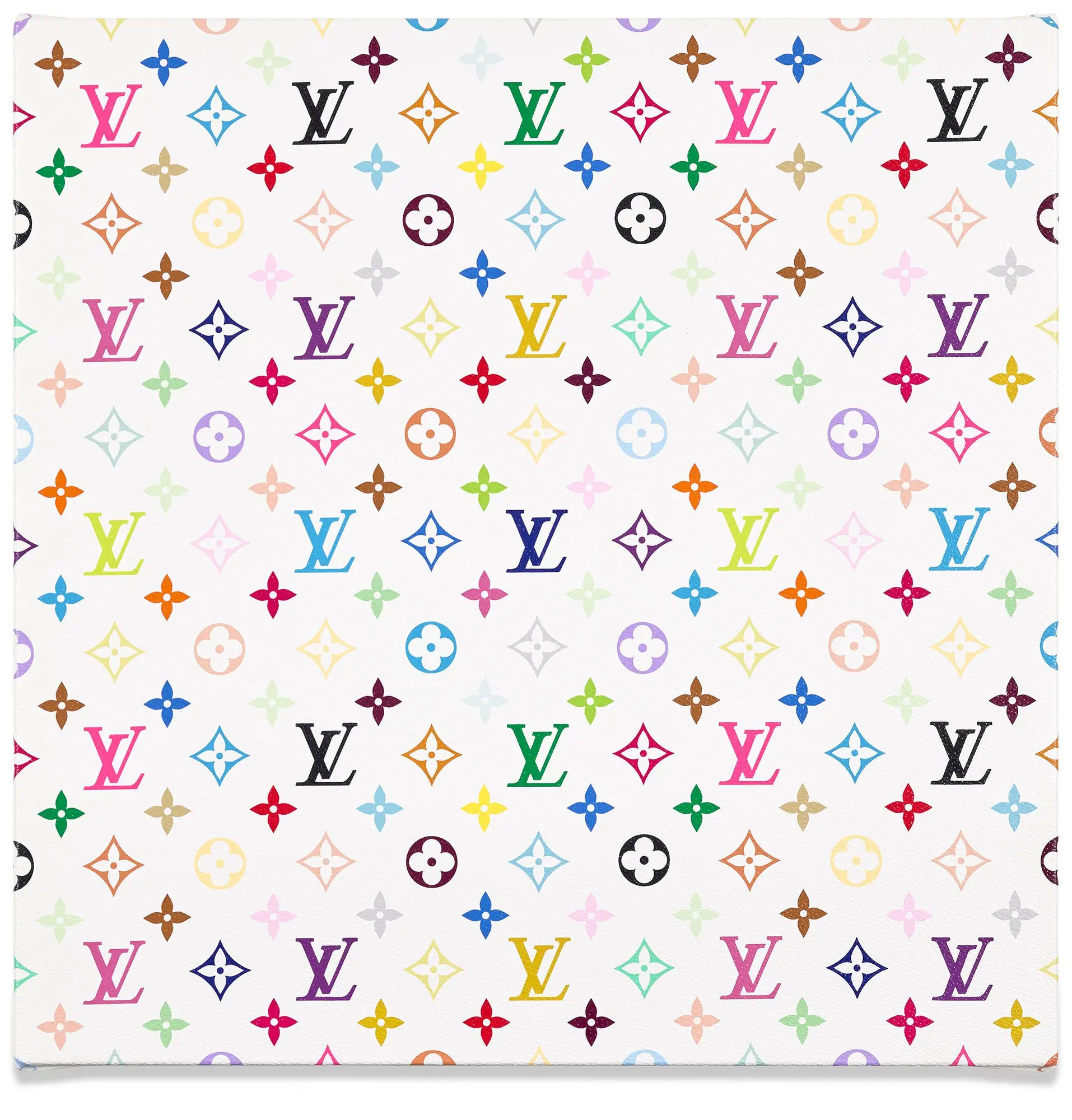
Original 2003 Louis Vuitton x Takashi Murakami Monogram Multicolore campaign piece
It also explains why resale specialists like What Goes Around Comes Around are still moving genuinely vintage White Multicolore pieces, from Sac Retro bags to Judy and Annie silhouettes, at prices that hold firm rather than collapse under the weight of a fresh retail wave. A new Speedy 30 Soft does not compete with a 2003 Eye Love Monogram Sac Retro so much as it validates the older piece’s continued relevance, reminding a buyer why the print mattered in the first place.
idea
The Multicolore motif is easy to describe as max and harder to describe accurately as technical. Murakami’s studio, Kaikai Kiki, builds the print from 33 individually silkscreened colors layered onto the canvas, a process descended directly from his Superflat philosophy, the argument that traditional Japanese art, anime, and commercial pop culture occupy the same view plane rather than separate high and low tiers. That is the same think that produced his Superflat Panda motif and his long running Eye Love Monogram lash work for the house, both of which have cycled through their own Louis Vuitton revivals alongside Multicolore. The white ground specific forces every one of those 33 colors to read at full saturation, with nothing for the eye to rest on between them, which is part of why it photo so aggressively and part of why it ages so unforgivingly if it is not cared for.
fin
There is a version of this nar where a house brings back a beloved archive print once, sells through the anniversary hype, and moves on. Louis Vuitton and Murakami have now done this three times inside two years, spanning Multicolore, Cherry Blossom and Cerises, and Artycapucines, and the January 2026 wave suggests a fourth is not out of the question either. Part of that is genuine design logic: a 130th Monogram anniversary is exactly the kind of institution milestone that justifies pulling the house’s single most commercially proven convincer back into rotation. Part of it is simply that the resale data keeps giving Louis Vuitton permission to keep going. A triple digit percentage jump in search interest for a print that last shipped new pieces a decade ago is not a subtle signal, and it lands at a moment when the haute sector broadly has been leaning on proven collaborations rather than untested new ones.
What the White ground specific offers, across both the 2003 originals still moving through vintage channels and the January 2026 additions, is a kind of continuity the black ground pieces don’t quite carry. It has never fully left circulation, has never been discontinued long enough to feel like a true relic, and keeps getting handed new profile to prove it still has room to grow. Twenty three years in, that is a rare thing for any fashion connection to hold onto, regardless of how many times the house itself has called it finished.
What comes next is genuinely open. Louis Vuitton has not signaled either the January wave is a standalone anniversary moment or the opening chapter of another extended run, and Murakami himself continues to split his time between gallery work and commercial linger without slowing either side down. What is clear from the pattern of the last two years is that the White Monogram Multicolore ground specifically keeps earning new form rather than simply being reprinted, and that alone separates this revive from a straightforward nostalgia play.