DRIFT AUDIO
Listen to this story
Choose a voice, then press play.
A 2000 installation of upside-down fly-agaric giants, built for one Milan show, has been rotating somewhere ever since.
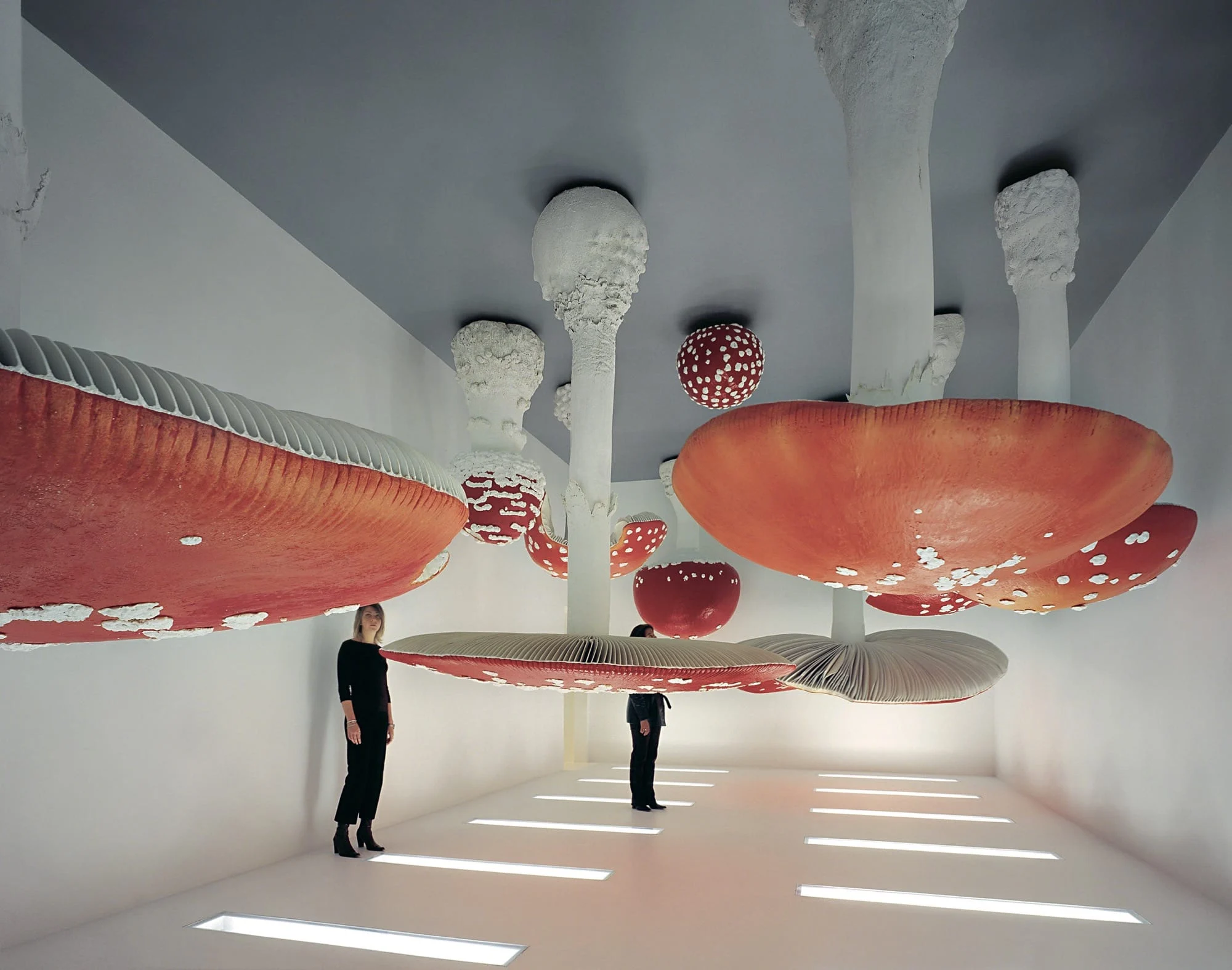
Walk into Carsten Höller’s Upside Down Mushroom Room and the ceiling is the first thing to register. Dozens of oversized fly-agaric mushrooms, the red-capped, white-flecked kind found on forest floors and in fairy tale illustrations, hang stem-up from overhead, caps pointed down. Some brush against a visitor’s head. All of them turn, slowly and almost imperceptibly, on a motor hidden inside each stem.
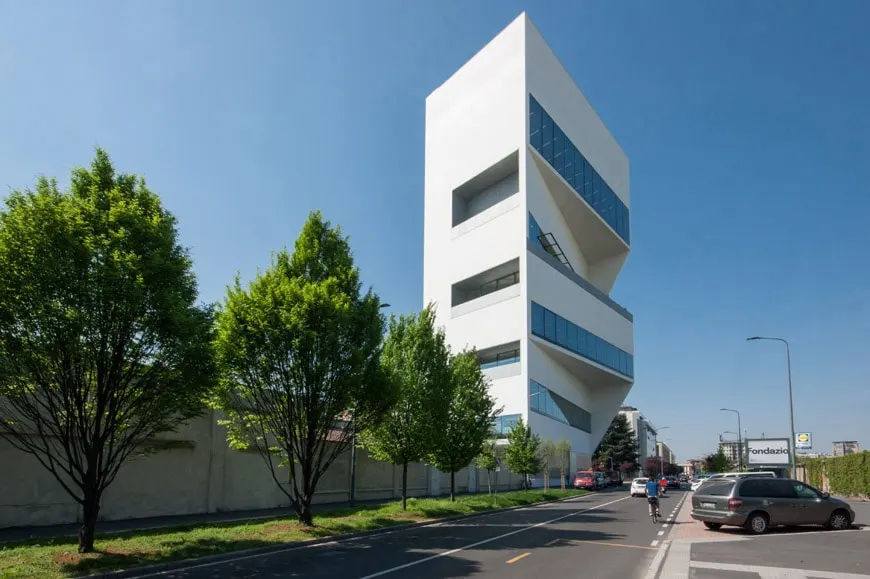
A striking white modern “Torre” tower of the Fondazione Prada Milan by Rem Koolhaas / OMAwith a geometric, stacked facade and large blue glass windows, viewed from a street lined with green trees on a clear sunny day.
The work is built as a single corridor rather than an open room. Light enters from both ends and thins toward the middle, so a visitor’s eyes adjust gradually: bright mushrooms near the entrance, a stretch of near total dark at the center, then the shapes resolving again on the far side. Carsten Höller has described the piece, in interviews, as almost embarrassingly plain. “It’s just an upside-down mushroom room,” he told a magazine in 2006. What that description leaves out is the specific disorientation of watching something recognizable from childhood forest walks flipped over and set spinning at head height, in the dark, close enough to touch.
stir
Each mushroom is built up in resin and fiberglass over an internal armature, hand finished in the fly agaric’s scarlet and white, and engineered so the rotation reads less as obvious motion than as a slow drift a visitor only notices after standing still for a minute. Höller has never treated the mechanism as the point. The consistent point, across three decades of his work, is what happens to a person’s sense of up and down, safe and strange, once the machinery starts running.
The effect has been described, more than once, in the language of children’s stories: a Lewis Carroll world set loose inside a contempo art foundation, delightful and faintly menacing at the same time. That duality is deliberate. Höller has spent his career designing experiences that read as playground rides right up until the moment they start working on a visitor’s body or sense of orientation, and the mushroom room sits early in that lineage, built the same year he began the corkscrewing tubular slides that would later carry museum visitors down through several floors at once.
Catalog writers describing comparable mushroom-corridor works have leaned on a specific phrase for the effect: the sense that ceiling and floor have shh swapped places somewhere in the middle of the walk. Höller’s own account of building the piece is almost domestic by comparison. In the same 2006 conversation, he explained that some of the mushrooms drop low enough to brush a visitor’s shoulder or head as they pass, close enough that the slow turning becomes tactile rather than only visual. That detail, more than any single fact about scale or engineering, is what separates the mushroom room from a straightforward sculpture installation: it was built to be walked through and occasion touch, not simply viewed from a doorway.
do
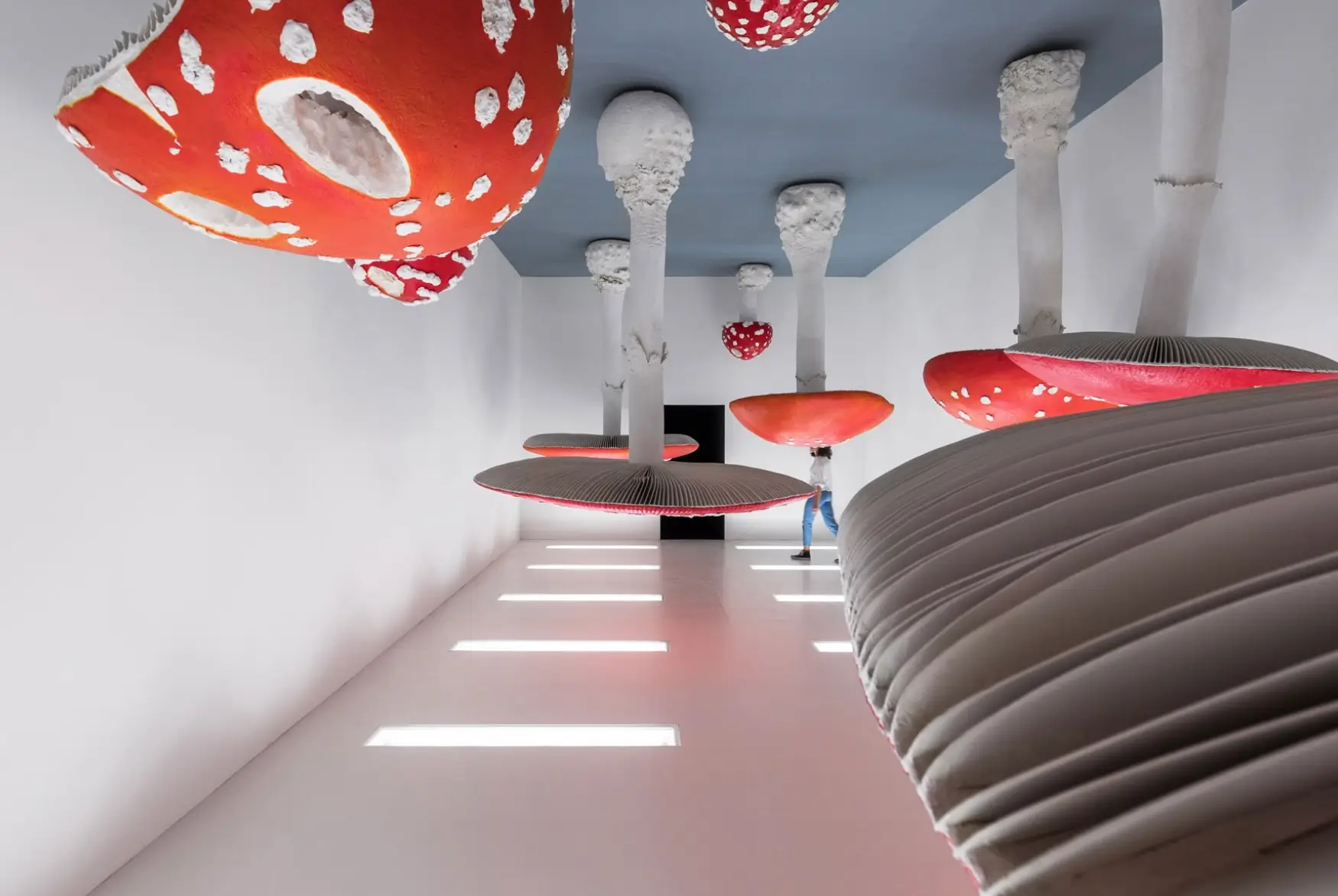
The “Upside Down Mushroom Room” by Carsten Höller, featuring giant, oversized red and white fly agaric mushrooms suspended upside-down from the ceiling in a white gallery space.
to
Höller was born in Brussels in 1961 to German parents posted to the city for work with the European Economic Community, and he did not start out an artist. He holds a doctorate in agricultural science from the University of Kiel, earned for research into the parasitoids of cereal aphids, and he worked as a research entomologist through the early 1990s before turning the same investigative habits toward exhibitions instead of insects. He came up alongside Maurizio Cattelan, Pierre Huyghe, Philippe Parreno, and Rirkrit Tiravanija in the 1990s, a loose cohort that treated the exhibition itself, rather than any single object inside it, as the thing under test.
Mushrooms entered his practice in 1994, not long after he left research science behind, and the fly agaric specifically has stayed in circulation ever since, quite literally in this case. Amanita muscaria is the mushroom of European folklore and picture book illustration, poisonous in enough quantity and associated for centuries with hallucination and Siberian ritual use. Höller has returned to it in suitcases fitted with slow spinning replicas, glass vitrines, cross sectioned giant sculptures, and, a decade after the mushroom room, a project at Berlin’s Hamburger Bahnhof that fed fly agaric to a herd of reindeer and collected the animals’ psychoactive urine for visitors curious enough to ask for it. The mushroom room’s upside-down orientation was, in that sense, an early and comparatively gentle entry in a much longer study.
One popular, if contested, etymological reading traces the word fungus back to a root meaning bearer of death, a lineage that suits a species genuinely capable of causing serious illness in large enough doses. Höller has never shied from that reading. If anything, the poison and the wonder are meant to sit inside the same object at once.
That same decade saw Höller collaborating with Rosemarie Trockel on House for Pigs and People, shown at documenta X in Kassel in 1997, a structure with a one-way mirror that let museum visitors watch live pigs without being seen in return. The project sits at the opposite end of Höller’s practice in tone, clinical rather than fantastical, but it shares the same underlying method: build an apparatus, put a living body inside its logic, human or animal, and see what the apparatus produces. Höller has since shown at the Venice Biennale five times, at documenta, and at the Berlin, Gwangju, and Lyon biennials, an exhibition record that predates and outlasts any single work, including this one.
scope
None of it was designed to stand alone. The mushroom room was one part of Synchro System, an exhibition Höller designed himself for Fondazione Prada’s Milan spaces, on view from November 22, 2000, to January 7, 2001. Fondazione Prada’s own description calls the project a village of possible, a labyrinth of psychophysical stimuli meant to move a visitor through increasingly altered states: flickering lights, darkened passages, devices built to act directly on the body rather than simply be looked at. The title referred to a synchronization the artist wanted between viewer and artwork, treating the audience as one half of a system that only produces an effect when both halves, human and machine, are running together.
Within that sequence, the mushroom room supplied something the show’s other pieces, including a flickering Light Wall built the same year, could not: a specifically biological register of disorientation, built from a shape every visitor already recognized from childhood, rather than an abstract optical trick. It is also, of everything in Synchro System, the piece that has had by far the longest afterlife.
Fondazione Prada marked the exhibition with its own catalog, Register, edited by curator Germano Celant, cementing Synchro System as one of the foundation’s signature early collaborations with a single living artist. It was also, notably, one of the first times Höller had been handed an entire institutional footprint to design as a unified sequence rather than a single room inside a group show, a format he would return to repeatedly over the next two decades at venues from Kunsthaus Bregenz to the New Museum.
show
In 2005, the piece finally left Milan, appearing in Ecstasy: In and About Altered States at the Museum of Contemporary Art, Los Angeles, a survey curated by Paul Schimmel that placed Höller’s mushrooms alongside Fred Tomaselli’s resin suspended pill paintings and Roxy Paine’s field of thousands of hand painted psilocybin mushroom replicas. Höller described the work to a magazine that same year in almost dismissive terms: a corridor that goes dark in the middle, with mushrooms that come down to head height and turn.
Six years later, Höller returned to mushrooms for Experience, his 2011 to 2012 survey at the New Museum in New York, curated by Massimiliano Gioni. The piece on view there, however, was a related but separate work called Giant Triple Mushrooms, not the Upside Down Mushroom Room itself, a distinction worth making since the two are frequently mixed up in casual accounts of that survey.
The 2005 Los Angeles catalog described the broader curatorial premise in similarly disorienting terms: works that played on disjunctions of scale or otherwise interrupted a visitor’s normal means of spatial orientation, with Höller’s mushrooms singled out for making ceiling and floor feel as though they had traded places.
Since 2018, the original has had a more settled home. Fondazione Prada folded it into Atlas, an ongoing rehang of works from its own collection staged inside the Torre, the tower Rem Koolhaas‘s OMA designed as part of the foundation’s Milan complex. Atlas paired Höller’s mushrooms with work by Walter De Maria, Michael Heizer, Damien Hirst, and Jeff Koons, in a run that has, in practice, kept the piece on and off view at the Torre for years since its 2018 opening, including a stretch timed to Milan Design Week in 2023. When the piece resurfaced that spring, it was framed in press coverage less as a return than as a work that had simply never really left, an observation Fondazione Prada’s own long-running project page tends to confirm: last updated in the summer of 2025, it still lists the piece as part of Atlas today.
where
Today, Höller is represented by Gagosian, which shows his work across its New York, London, and Los Angeles spaces among others, alongside Massimo De Carlo in Milan and Paris, Galleria Continua, and Air de Paris. Massimo De Carlo has worked with him the longest, since the late 1990s, and its current inventory runs through the same fungal lineage that began with the mushroom room: a 2025 Giant Triple Mushroom, several Double Mushroom Vitrine pieces from the past few years, and a new work slated for the 2026 Venice Biennale. Earlier this year, Gagosian’s own channels documented another Höller installation entirely, a Pink Mirror Carousel set up at a hotel in St. Moritz, a reminder that the carousel side of his practice stays just as active as the mushroom side.
His work sits today in the permanent collections of the Centre Pompidou, Tate, the Museum of Modern Art in New York, the LUMA Foundation in Arles, and Fondazione Prada’s own collection, the last of which technically owns the version of Upside Down Mushroom Room still touring the Torre. That institutional spread, more than any single gallery relationship, is the clearest marker of how far a fly-agaric corridor built for one four-month show in 2000 has traveled since.
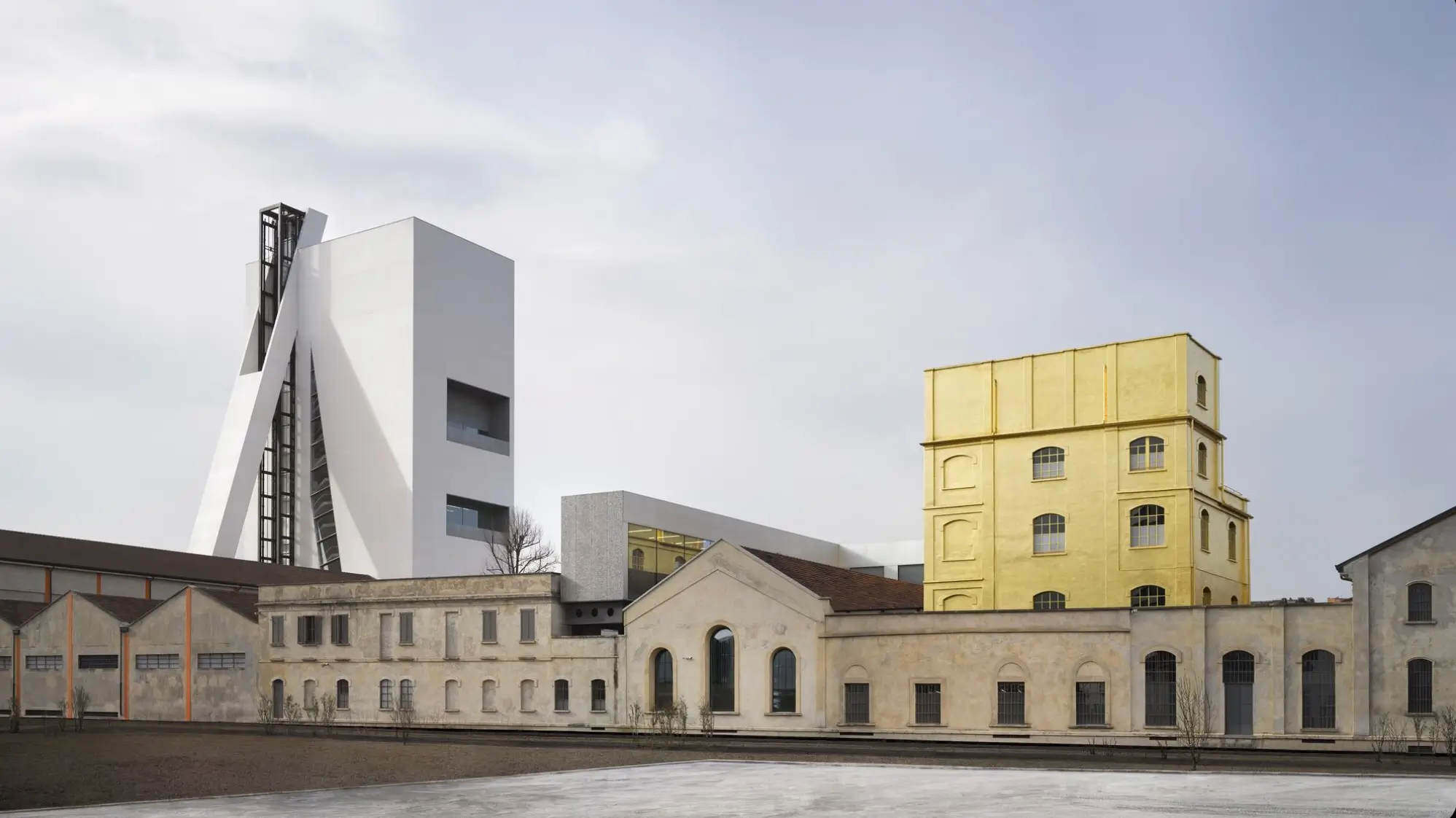
The Fondazione Prada complex in Milan, featuring the white Torre by OMA and the gold-painted Haunted House by Robert Gober, alongside the existing historic distillery buildings.
Mushrooms, upside down, right side up, or split into cross-section, remain one of the most consistent single motifs across a four-decade practice that has otherwise run through carousels, slides, sensory deprivation tanks, and a hotel room engineered to rotate on its own axis through the night. A quarter century after Synchro System closed, the installation Höller once summed up as simply a corridor and some spinning mushrooms is still doing exactly that: at height, in the dark, inside the same Milan foundation that commissioned it in the first place.
Related Articles

fnnch Revives the Honey Bear Hunt for Halloween, No Tape Required
San Francisco’s honey bear artist is turning porch season into a scavenger hunt again, five […]