DRIFT AUDIO
Listen to this story
Choose a voice, then press play.
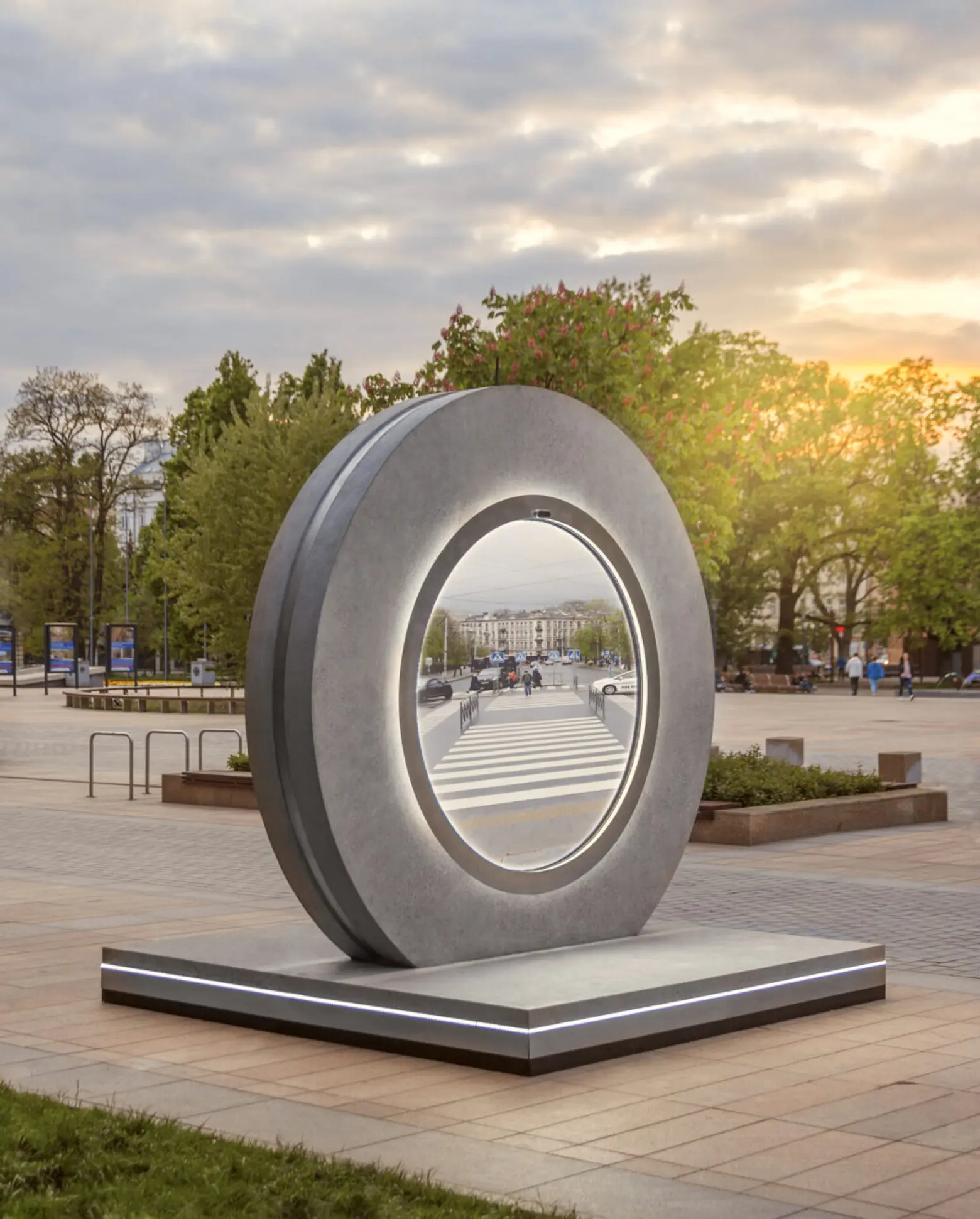
The unveiling of The Portal in Vilnius, Lithuania, and Lublin, Poland, in 2021, served as a poignant response to the global crisis brought on by the pandemic. It was more than just an art installation; it was a symbol of resilience and a call to unity in a world that had been deeply divided and isolated. By bridging two cities with a “digital window,” the project invited people to connect and communicate across borders, symbolizing the breaking down of physical and ideological barriers.
Benediktas Gylys, the visionary behind The Portal, aptly described it as a “bridge that unifies” and “an invitation to rise above prejudices and disagreements that belong to the past.” These words resonate deeply, especially in the context of a world struggling to recover from the social, political, and economic upheavals caused by the pandemic. The installation emerged as a beacon of hope, suggesting that despite our differences, humanity can find common ground and communicate openly across the divides that separate us.
The New York debut of The Portal at the Flatiron Public Plazas marks a significant expansion of this vision. Positioned at one of New York City’s most dynamic and historic intersections, the installation connects the bustling energy of Manhattan with another city across the Atlantic—fostering a real-time, visual conversation between two distinct cultures. James Mettham, president of the Flatiron NoMad Partnership, emphasized the significance of this North American debut, describing it as an opportunity to bring people together, both physically and digitally. This intersection of art and technology in such a high-traffic area not only adds to the city’s rich tapestry of public art but also challenges passersby to think about global connectivity in a new way.
The New York installation of “The Portal” is particularly meaningful in a post-pandemic world. Cities like New York have long been centers of diversity and interaction, yet the pandemic forced a reevaluation of what it means to be connected in a world where physical presence is no longer a given. The Portal symbolizes a reconnection—both to the city’s vibrancy and to the wider world. It encourages New Yorkers and visitors alike to engage with others across continents, creating a dialogue that transcends geographical boundaries.
Critically, The Portal also challenges traditional notions of public art. Where most public art installations are static, rooted in a specific place and time, The Portal is dynamic and interactive. It evolves with each person who stands in front of it, creating a constantly changing narrative that reflects the diversity of its participants. This shift from static to interactive art mirrors broader trends in the art world, where engagement and participation are becoming increasingly valued. In this way, The Portal is not just a sculpture; it is a living, breathing piece of art that depends on its audience to come alive.
Moreover, the presence of The Portal in New York’s Flatiron District until Labor Day adds a temporal element to the experience. Its limited run encourages people to seize the moment and engage with the installation while they can, knowing that such opportunities are fleeting. This temporal aspect adds urgency to the experience, making the interactions more poignant and meaningful.
In its short time in New York, The Portal has already begun to attract attention and spark conversation. As with its earlier iterations in Europe, the New York installation has become a focal point for dialogue about global unity and the role of technology in bridging divides. The juxtaposition of a high-tech installation in a historic part of the city underscores the contrast between old and new, tradition and innovation—another layer of meaning in this complex and multifaceted work.
However, while The Portal has been celebrated for its innovative approach to public art, it also raises questions about the limitations of digital connectivity. Can a screen truly replicate the experience of being in another place ? Does this kind of interaction risk reducing our understanding of other cultures to superficial encounters ? These are important considerations as we embrace new technologies that promise to bring us closer together. The Portal, in its success, also prompts us to think critically about the ways in which technology shapes our relationships and our worldviews.
The Portal is a groundbreaking project that challenges traditional boundaries—both physical and artistic. Its installation in New York’s Flatiron District not only enriches the city’s public art scene but also serves as a reminder of the importance of global connectivity, especially in a world that has been so deeply divided. As it continues to attract visitors until Labor Day, The Portal stands as a powerful symbol of hope, unity, and the potential for art to transcend borders, both real and imagined.
Related Articles
Robin Rhode, Edition of Five: Inside the 2017 C-Print Called David
A 2017 C-print by Robin Rhode, titled David, measures 185.8 x 227.8 cm in an […]