DRIFT AUDIO
Listen to this story
Choose a voice, then press play.
The ACLU’s first Ralph Ellison Award went to a musician who wrote a song about a winter of federal raids and an athlete who has spent a decade paying for one gesture.
Bruce Springsteen and Colin Kaepernick stood on the same stage at the Washington Hilton on Friday, July 24, and left with the same new prize: the ACLU Ralph Ellison Award for Defenders of Civil Rights and Civil Liberties in the Arts, Business, Science, and Sports. It is a mouthful of a title, and it is also brand new. The organization created it this year as part of its biennial Leadership Conference, an event that had previously handed out its Roger N. Baldwin Medal of Liberty and its Presidential Prize but had never had a category built specifically for people whose civil rights work happens in stadiums, on stages, and in front of cameras rather than in courtrooms.
Naming it for Ralph Ellison was not incidental. The novelist behind Invisible Man spent his career writing about the distance between how American institutions describe themselves and how they actually treat the people inside them, and the ACLU used his name to frame the new award as recognition that defending rights takes forms beyond litigation: a song, a kneeling quarterback, a camp that teaches teenagers how the law actually works. Springsteen and Kaepernick were the first two people to receive it, announced together and honored on the same night, at an event ACLU president Deborah Archer used to make the case that culture and celebrity carry their own kind of legal weight.
About 1,200 people filled the ballroom, a majority of them high school students attending through the ACLU’s National Advocacy Institute, according to reporting on the event. That detail matters more than it might first appear: the ACLU built an audience of teenagers into the middle of a ceremony honoring a 76 year old rock musician and a football player who has not taken an NFL snap since 2016, which tells you something about who the organization believes will carry this fight forward next.
stir
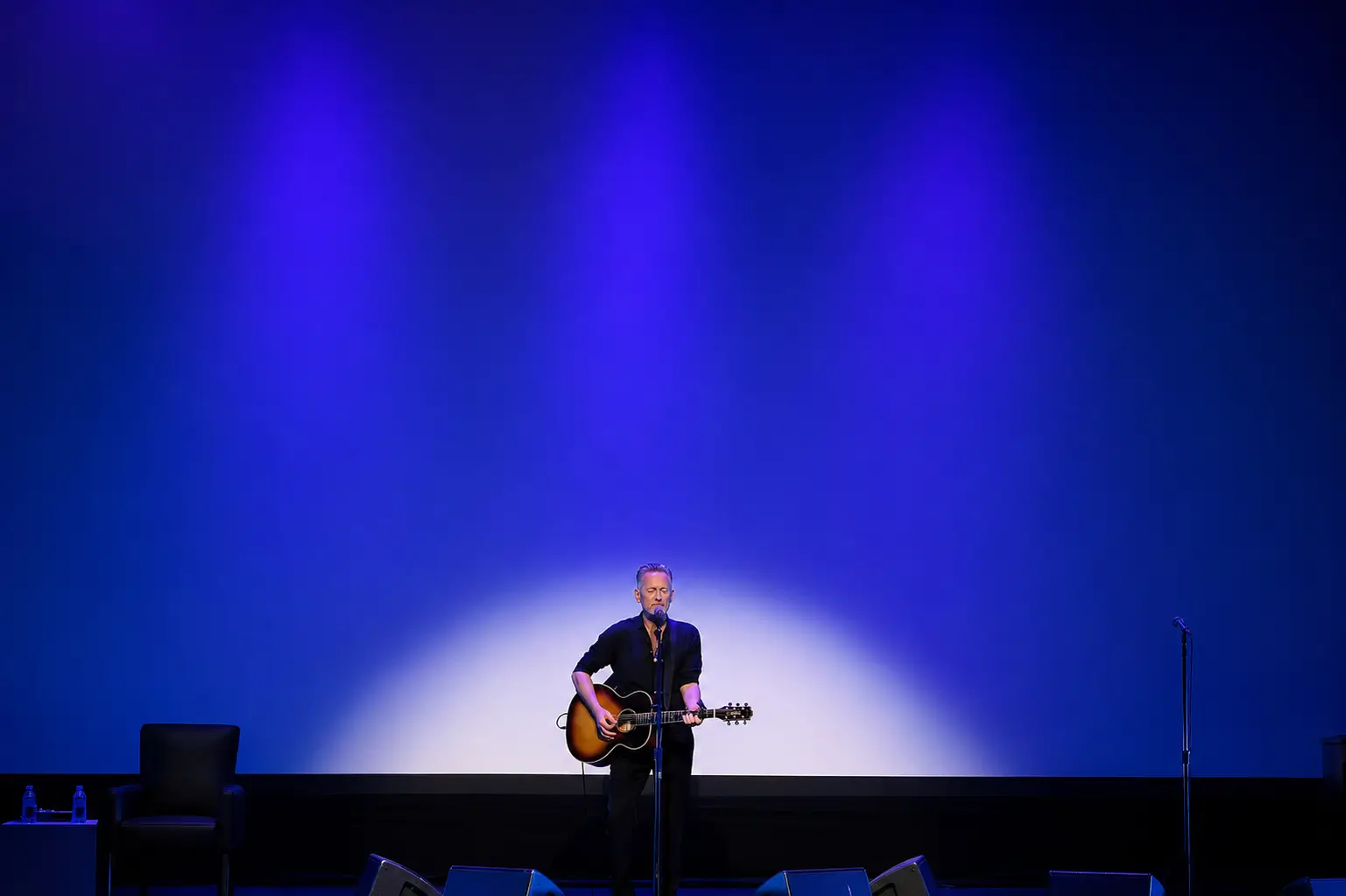
Springsteen closed the night with a solo acoustic show, guitar and harmonica rack, no band behind him. The song was Streets of Minneapolis, a track he wrote in January in direct response to the fatal shootings of two Minneapolis residents, Renee Good and Alex Pretti, by federal immigration officers. He had already performed the song once this year outside the context of an awards dinner, at a No Kings rally at the Minnesota State Capitol in St. Paul, where he told the crowd that federal troops had brought what he called death and terror to the streets of Minneapolis and that the city, in his words, picked the wrong target. At that rally he offered a version of the same idea he would bring to Washington months later: “Your strength and your commitment told us this is still America”, thanking the demonstrators for their resistance to the federal presence in their city.
At the ACLU event, Springsteen introduced the song by dedicating his award to people he did not name individually. He described accepting it on behalf of residents of cities he characterized as under siege this year, citing Minnesota, Portland, Los Angeles, and Newark by name, frame his own award as belonging more to the people who showed up in those places than to himself. It is a familiar move for Springsteen, who has spent close to fifty years writing about people who never get invited to ballrooms, and turning an acceptance speech into a hand off to them fits a pattern he has followed since long before this particular fight over immigration enforcement.
One local paper covering the ceremony noted that Springsteen, who has been openly critical of the current administration in other settings this year, took a softer approach at the podium itself, spending more of his remarks praising the organizations doing what he called the real work of defending democracy than attacking any specific policy or official by name. He also downplayed his own role in that work, describing himself in modest terms as someone who mostly just plays guitar and speaks his mind, a description that undersells a catalog that has included direct financial and creative support for the ACLU’s legal campaigns, among them the organization’s use of Born in the U.S.A. earlier this year in advertising tied to a Supreme Court case over birthright citizenship.
A speaker delivers remarks at the ACLU SoCal awards ceremony.
flow
Colin Kaepernick’s honor arrives almost exactly ten years after he first knelt during the national anthem before an NFL preseason game, a gesture aimed at police violence and racial inequality that cost him his career long before it earned him any institutional recognition of this kind. Deborah Archer, introducing his award, described the toll plainly, saying he had shown in real time “the price America too often exacts from those who challenge racial injustice”, and noting that his peaceful protest had come at the cost of the career he had spent his life building.
Kaepernick and his former teammate Eric Reid, who joined the anthem protest, both filed collusion grievances against the NFL in 2017, arguing they had been frozen out of the league for their activism; the two reached a settlement with the league in 2019 on confidential terms. In the years since, Kaepernick has built the Know Your Rights Camp, a program aimed at teaching young people legal literacy and self advocacy rather than protest tactics specifically, an approach that reframes his post-NFL work as institution building rather than continued demonstration.
At the podium, Kaepernick’s remarks leaned toward urgency rather than reflection. He told the room that civil liberties, humanity, and education were all currently under attack, and that the people trying to encroach on those rights were also trying to encroach on the country’s future. He was more direct about agency than grievance, telling the crowd at another point in his speech “We do not have to be passive”, part of a broader argument that how history remembers this period depends on what the people in the room choose to do with it rather than on the speeches being given about it.
audience
Springsteen and Kaepernick were the headline names, but the ceremony was built around five honorees total, and the other three give a sense of how broadly the ACLU is defining civil rights work this year. Vanita Gupta, a former U.S. associate attorney general who now runs The Leadership Conference on Civil and Human Rights, received the ACLU Roger N. Baldwin Medal of Liberty. Erwin Chemerinsky, dean of UC Berkeley Law, received the ACLU Presidential Prize. Elizabeth Foster, a South Carolina advocate for the freedom to read, received the ACLU’s Next Generation Leader in Civil Rights and Civil Liberties award, a category the organization introduced this year alongside the Ellison Award to make room for younger, less nationally known honorees.
Actor and advocate Laverne Cox hosted the full evening. Coverage of her remarks described her opening the ceremony by urging attendees to know their truth and know their rights, tying the entertainment portion of the night back to the same legal literacy theme that runs through Kaepernick’s Know Your Rights Camp. ACLU executive director Anthony Romero framed the two headline honorees before the ceremony by saying Springsteen and Kaepernick “epitomize talent with a purpose”, a short line the organization used across its own announcements of the award.
fin
The Ellison Award is new, but the instinct behind it is not. The ACLU has spent decades pairing its legal advocacy with culture figures willing to lend it their audience, and the Springsteen relationship in particular predates this ceremony by months: the organization’s use of Born in the U.S.A. in a campaign around the birthright citizenship case earlier this year required Springsteen’s direct authorization, something the ACLU described as a rare move for an artist who is famously protective of how his catalog gets used commercial or political. That the same organization then created an award named for one of the twentieth century’s most significant novelists of American identity, and gave it first to a rock musician and a football player, says something about how the ACLU wants its civil liberties brand to read heading into an unusually contentious stretch of immigration enforcement and campus speech fights.
Neither Springsteen’s nor Kaepernick’s win is likely to gen consensus. Both men have drawn sustained criticism for the same activism now being honored, Kaepernick from NFL owners, players, and elected officials starting in 2016, and Springsteen more recently from figures inside the current administration over his public criticism of federal immigration policy. The ACLU’s decision to build a ceremony, and a new permanent award category, around exactly the two figures who have paid the most public price for their positions is itself a statement about which side of that argument the organization is choosing to stand on, even as it frames the award in the more neutral language of civil liberties defense rather than any specific policy dispute.
What happens with the award going forward, including whether the ACLU intends to give it out again at its next biennial conference or expand it to additional recipients in the interim, has not been detailed publicly.
There is also the matter of what the award does for the ACLU itself. Civil liberties organizations do not typically compete for cultural relevance the way entertainment companies do, but an award ceremony built around Bruce Springsteen singing a protest song and Colin Kaepernick describing an ongoing fight is, either the organization frame it this way or not, a media event as much as a legal one. The high school students filling most of the room were there through a program designed to recruit the next gen of advocates, and pairing that recruitment effort with two of the most recognizable protest figures in American culture is a deliberate choice about which audience the ACLU is trying to reach and how it wants that audience to understand what civil liberties work looks like in practice.