
DRIFT AUDIO
Listen to this story
Choose a voice, then press play.
The Hugh Devlin Foundation launched this summer to give emerging creatives the free legal and financial advice its late namesake spent decades handing out himself.
Hugh Devlin spent his career as the person fashion called when a contract fell apart, a partnership needed rescuing, or a young designer had no idea what their work was actually worth. He died suddenly in 2023, and the shock of losing him rippled through an industry that had leaned on him for free advice more often than anyone kept track of. Three years later, his wife Sarah Polden has turned that loss into an actual institution. The Hugh Devlin Foundation opened this summer, offering UK based creatives in fashion, art, hair, beauty and design free access to the kind of legal and financial guidance Devlin used to give away on the phone between other calls.
The foundation was built with the backing of people Devlin represented and mentored over decades, among them Christopher Kane and Tammy Kane, Anya Hindmarch, and Charlotte Tilbury. Applications opened at the end of June, with applicants matched to volunteer lawyers and accountants depending on what they need.
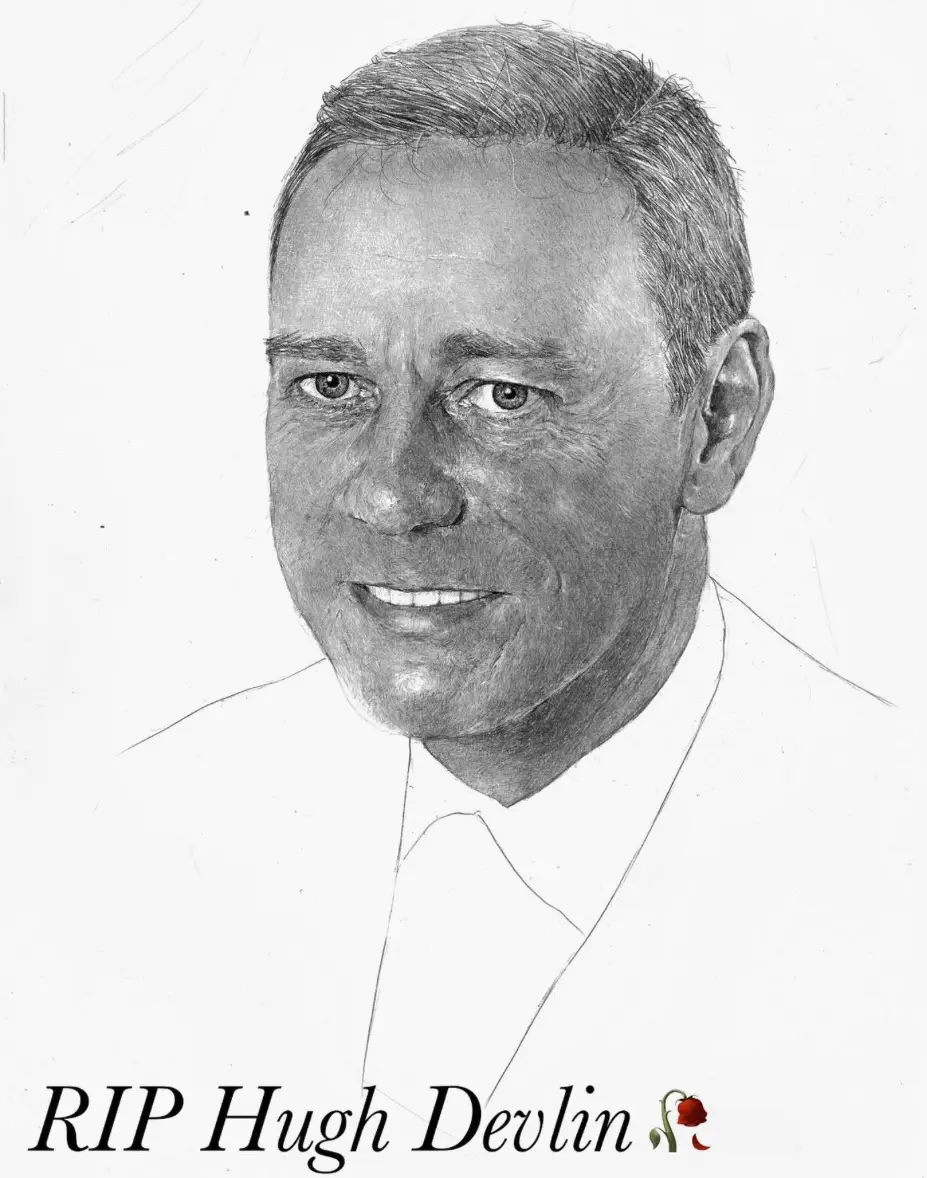
Memorial pencil portrait of Hugh Devlin with a simple tribute and single red rose.
who
Devlin’s reputation in fashion circles was less about any single deal and more about a pattern that repeated for thirty years. A designer would hit a wall, financial, contractual, sometimes existential, and Devlin would appear on the other end of the phone with a plan. Writer Tamara Cincik, who first met Devlin through Christopher and Tammy Kane, has described how he understood not just contract law but the psych of designers and the corporate machinery surrounding them internationally. That combination let him negotiate on behalf of people who, as young creatives, had no real sense of their own market value. Cincik has recounted asking for what seemed like an impossible number on a designer’s behalf, at Devlin’s instruction, and getting it.
Devlin grew up in Newarthill, a village outside Glasgow, a detail that friends have pointed to as part of what made him different from the typical City lawyer. He became a partner and later a consultant at Withers, the firm most closely associated with his name in the trade press, while building relationships across the industry that went well past billable hours. Speaking to Vogue after his death, Tammy Kane called him a polymath capable of resolving a complex legal problem on one phone call while working out a bespoke solution to something else entirely, adding that his straight talking, dry humor could turn a client’s anguish into laughter in the same conversation.
Hindmarch, who worked with Devlin for years, has said he was the person creatives could go to who would actually protect and fight for them, someone who lived to support people who were routinely undervalued and often unequipped to stand up to larger organizations when it mattered. She has also said plainly that the creative industries are less protected without him in it.
Withers, the firm where Devlin spent much of his career, published its own tribute after his death, describing him as a friend and colleague whose approach to the job never separated the legal work from the human relationships underneath it. That distinction, between Devlin the technician and Devlin the person people actually trusted, comes up again and again in how his former clients describe him. It was rarely just about what the contract said. It was about either the person reading it over the phone actually understood what a designer was building and why a particular clause mattered to that specific business, not to a template.
That kind of specify is part of what made Devlin difficult to replace with any single successor. Fashion has no shortage of commercial lawyers, but few who combine contract expertise with a working knowledge of how a small design house actually operates day to day, from cash flow timing around wholesale orders to the realities of manufacturing min. Devlin’s advice tended to account for all of it at once, which is part of why so many of the people now backing the foundation describe him less as outside counsel and more as an embedded part of their teams, even when he was never formally on staff.
muse
The foundation held its public launch at London’s Design Museum, drawing a crowd from across fashion, beauty and design who had all, in one way or another, been on the receiving end of Devlin’s advice at some point. Sarah Polden Devlin addressed the room to introduce the foundation formally, with Vogue’s Sarah Mower also speaking at the event. Photographer Richard Heald documented the evening, capturing the mix of gratitude and resolve that seems to have defined the room.
Foundation director Jade Mitchell has described the organization’s approach as deliberately practical, aimed at supporting emerging creatives at the specific moments where a wrong decision, made without proper advice, can derail an entire career. That framing lines up with how Devlin himself worked, stepping in less for routine business and more for the moments of real difficulty or crisis where professional advice was either unaffordable or simply out of reach for someone starting out.
operant
The mechanics are straightforward by design. A UK based creative working in fashion, art, hair, beauty or design applies through the foundation, and the team matches them with a volunteer professional suited to what they need, whether that is a contract review, guidance on a wholesale agreement, help structuring a partnership, or advice on setting up e-commerce operations. The advice is free at the point of use, funded by the volunteered time of the professionals involved rather than by fees passed on to applicants.
That structure directly targets a known gap in how young creative businesses actually fail. Emerging designers frequently sign contracts they do not fully understand, agree to wholesale terms that quietly disadvantage them, or launch e-commerce operations without basic legal protections in place, not because they are careless but because proper advice has historically cost more than a small studio can spend. Cincik has pointed out that in an era where anyone can run a contract through an AI tool for a surface level check, that kind of automated review still cannot replace an adviser who actually knows the field, the personalities involved, the movement of markets, and how to offer advice built for the long term rather than just the immediate question.
consider
The foundation’s ability to offer free advice at scale rests on a growing bench of professionals donating their time. On the legal side, that includes lawyers from Withers, where Devlin himself worked, alongside colleagues from Sheridans, Mishcon de Reya and Wedlake Bell. Accountants from WTBM and Hilton Consulting round out the financial advice side of the operation. Cincik’s own reporting has put the number of specialist lawyers and accountants involved at around twenty, all offering pro bono hours, with the foundation already fielding a heavy volume of requests shortly after launch.
That mix of firms matters because it spreads the load across an entire professional community rather than concentrating it in one office, which is part of what makes the model sustainable in a way that a single generous lawyer working alone, however extraordinary, could never quite be. Devlin was famously willing to give away his own time for free. The foundation is essentially an attempt to formalize that instinct across dozens of professionals at once, so that the industry does not depend on the goodwill of any one person going forward.
It also changes the incentive structure in a subtle way. Where Devlin’s own generosity depended entirely on his own bandwidth and his own relationships, a network of twenty or more professionals means the foundation can, in theory, take on more applicants without any single adviser burning out. It also gives younger lawyers and accountants at these firms a structured way to build the kind of client relationships Devlin built organically over three decades, compressed into a formal volunteering program rather than left to chance encounters at industry events.
follow
The foundation is still in its earliest weeks of operation, with the application process open and the first wave of matches between creatives and volunteer advisers already underway. Mitchell’s team has framed the work as ongoing rather than a single launch moment, with the foundation continuing to build out its roster of professional volunteers as demand grows. Coverage from Wallpaper, Cosmetics Business and Fashion Roundtable in the weeks since the Design Museum event has all pointed to the same underlying idea, that the creative industries lost something specific and hard to replace when Devlin died, and that the foundation is the closest thing to a structural answer anyone has built.
Hindmarch has said she believes the foundation’s work will end up supporting, protecting, and in some cases saving the creativity and brands of the future, calling that outcome the legacy Devlin would have wanted. Whether the foundation reaches that scale will depend on how many creatives actually apply, and how far the current network of pro bono lawyers and accountants can stretch as requests continue to come in.
There is also a broader question the foundation raises simply by existing, about how much of the creative industry’s early stage survival has always depended on informal, uncompensated advice from people like Devlin, rather than on any formal safety net built for the purpose. Contracts, wholesale terms, and partnership structures are rarely covered in design school, and the businesses that make it past their first few years are often the ones lucky enough to have found a Devlin figure somewhere along the way, whether through a personal connection, a chance introduction, or, as with Cincik, a shared hometown outside Glasgow. The foundation is, in effect, an attempt to take something that used to depend on luck and turn it into something a designer can actually apply for.
Early signs suggest the demand was already there waiting. Mitchell’s description of the foundation being inundated with requests almost immediately after launch points to a gap that pro bono legal clinics and general small business advice services had not been filling, at least not for this specific corner of the creative economy.