DRIFT AUDIO
Listen to this story
Choose a voice, then press play.
August Macke (1887–1914), a prominent member of the German Expressionist movement and the Blue Rider group (Der Blaue Reiter), was a master of color and emotion. His paintings encapsulate the vibrancy of everyday life while offering a profound exploration of human interaction within urban and natural settings. One of Macke’s compelling works, “Vordstrabstrabe”, housed in the British Collection, is a fascinating piece that exemplifies his talent for capturing suburban life through an Expressionist lens.
August Macke: A Brief Overview of His Life and Style
Born in Meschede, Germany, August Macke was deeply influenced by French Impressionists, Post-Impressionists, and Fauvist painters like Henri Matisse. His works often fused vibrant colors and bold compositions, making them distinct within the Expressionist movement. Unlike many of his contemporaries, Macke’s art was less about angst and more about harmony and the beauty of life’s fleeting moments.
Macke’s life was tragically cut short at the age of 27 during World War I. Despite his short career, his works have had a lasting impact, particularly in their ability to depict urban and suburban life as serene yet dynamic.
“Vordstrabstrabe” in Context
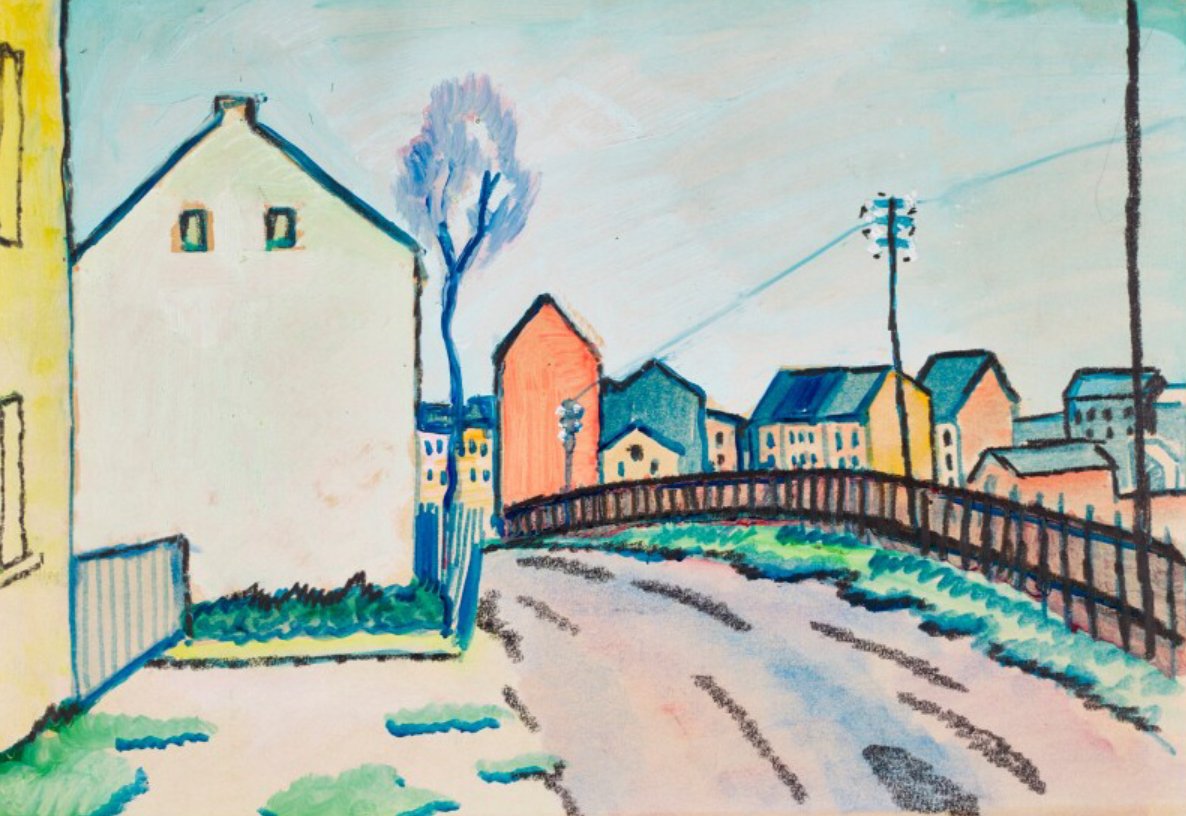
“Vordstrabstrabe” (translated as “Suburban Street”) is an excellent representation of Macke’s urban landscapes, which often depict people walking, interacting, or existing harmoniously within their environments. Completed in 1913, the painting captures a suburban street scene, likely inspired by Macke’s travels through Europe, including his stays in Bonn, Berlin, and his trips to Paris.
Setting and Composition
The painting’s title suggests a suburban street, one that is removed from the chaos of urban centers but still bustling with quiet activity. Macke’s signature use of simplified shapes and a lack of specific detailing allows viewers to focus on the interplay of light, color, and movement. Trees and buildings are stylized, blending into the overall composition, while figures on the street add a sense of life and narrative.
Focus on Everyday Life
Unlike monumental or historical subjects, “Vordstrabstrabe” celebrates the mundane beauty of suburban life. Macke often depicted women strolling, children playing, or individuals immersed in conversation. This approach reflected his interest in portraying the serenity and joy of daily routines, even as Europe edged closer to war.
Expressionist Techniques
The work is marked by vivid color blocks, fluid brushstrokes, and a slight abstraction. These techniques enhance the painting’s emotional resonance, making the viewer feel as though they are part of the scene rather than mere observers. Macke’s color palette—dominated by warm yellows, cool blues, and verdant greens—creates a sense of balance and vitality.
Cultural and Artistic Influences
Macke painted “Vordstrabstrabe” during a pivotal moment in European art history. The early 20th century was a time of rapid industrialization, urbanization, and social change. Artists like Macke sought to capture these shifts, often focusing on the tension between tradition and modernity.
Connection to the Blue Rider Movement
As a member of Der Blaue Reiter, Macke shared the group’s vision of art as a means of spiritual and emotional expression. While his contemporaries, such as Wassily Kandinsky, leaned toward abstraction and symbolism, Macke remained more grounded in the visible world. His suburban street scenes reflect the Blue Rider ethos of finding deeper meaning in everyday life.
French Influences
Macke was deeply inspired by French artists like Paul Cézanne, who emphasized structure in composition, and Henri Matisse, known for his bold use of color. This fusion of German Expressionism with French Fauvism is evident in “Vordstrabstrabe”, where the structured geometry of the street contrasts with the expressive vibrancy of the palette.
Urban and Suburban Dynamics
Macke’s choice of a suburban street as the setting is significant. The suburbs, often seen as a bridge between rural and urban life, symbolize both escape and connection. In “Vordstrabstrabe”, Macke explores this duality, portraying the suburban street as a space of calm interaction and human connection amid the broader chaos of modernity.
Key Elements of the Painting
“Vordstrabstrabe” is more than just a suburban snapshot—it is a masterclass in balancing composition, emotion, and technique.
Human Figures
The figures in Macke’s painting are not highly detailed, yet their postures and placements suggest movement and interaction. They are an essential part of the composition, giving the street life and narrative.
Perspective and Depth
The perspective draws the viewer into the painting, as if walking alongside the figures. The street recedes into the distance, flanked by rows of trees and buildings that guide the eye, creating a sense of depth and dynamism.
Light and Background
Macke’s skillful use of light creates a tranquil, almost dreamlike atmosphere. The dappled sunlight filtering through the trees adds texture and warmth, while subtle shadows ground the composition in reality.
Color Harmony
One of Macke’s defining traits was his use of harmonious, vibrant colors. In “Vordstrabstrabe”, his palette creates a balance between natural elements (trees, grass) and manmade structures (buildings, street). The result is a unified, pleasing composition.
Impression
Despite its seemingly simple subject, “Vordstrabstrabe” has left a lasting impression on both art historians and audiences. The painting represents a moment of calm before the storm—capturing the idyllic charm of suburban life before the devastation of World War I.
Preservation and Display
Today, “Vordstrabstrabe” is part of the British Collection, where it continues to captivate viewers with its timeless appeal. The painting is often studied alongside other works from Macke’s oeuvre to illustrate his unique approach to Expressionism.
Influence on Urban Landscapes in Art
Macke’s portrayal of suburban streets influenced later artists who sought to explore the relationship between people and their environments. His balance of abstraction and realism set a precedent for future generations of painters.
Relevance in Modern Contexts
In an age of urban sprawl and increasing disconnection from nature, Macke’s suburban scenes remain deeply resonant. “Vordstrabstrabe” invites viewers to pause and appreciate the beauty of their surroundings, encouraging mindfulness in an increasingly fast-paced world.
“Vordstrabstrabe” exemplifies August Macke’s ability to turn the ordinary into the extraordinary. Through vibrant colors, thoughtful composition, and an emphasis on human connection, Macke creates a work that is both timeless and deeply evocative. The painting is a snapshot of a world in transition, capturing the serenity of suburban life as Europe stood on the brink of upheaval.
By exploring “Vordstrabstrabe”, we gain insight into Macke’s unique vision and the broader cultural currents of his time. More than a depiction of a street, the painting is a celebration of life’s simple pleasures—a message that remains as relevant today as it was over a century ago.
Related Articles
Modigliani’s Limestone ‘Tête’
Carved from a single block of limestone in Montparnasse more than a century ago, one of Modigliani's rare stone heads goes to auction for the first time…