DRIFT AUDIO
Listen to this story
Choose a voice, then press play.
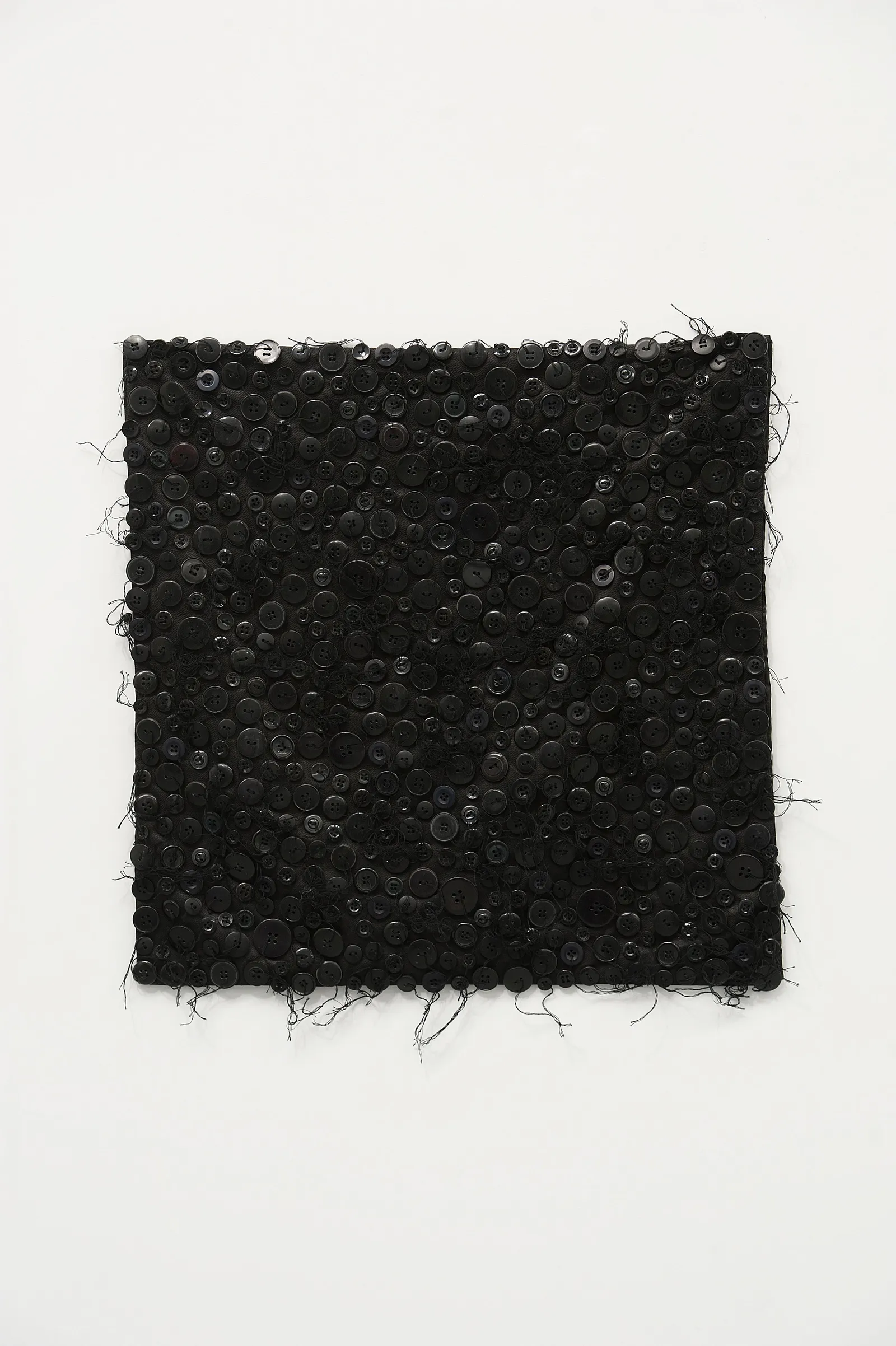
In La Guerre des Boutons I, a field of ordinary fasteners turns a modest textile square into a study of difference, density and touch.
Joël Andrianomearisoa made the work in 2009. The supplied entry records textile and mixed media, dimensions of 50 by 50 centimeters, and the notation “Ed. 2 /2.” These modest particulars establish the object before the larger language surrounding his practice enters the conversation. This is not one of his room-filling installations. Its density is concentrated within a square that can be considered at the scale of an individual encounter.
Signal. The Work: Joël Andrianomearisoa’s La Guerre des Boutons I, 2009. The Record: Textile, mixed media, 50 x 50 cm, listed by Ocula as “Ed. 2 /2.” The Context: Included in Sabrina Amrani’s Madrid exhibition running September 10 to November 7, 2026. The Focus: How ordinary fasteners produce a surface that rewards attention to material rather than color alone.
stir
Sabrina Amrani’s own record specifies textile, thread and buttons, making the broad phrase “mixed media” more concrete. Sabrina Amrani Gallery Thread is not incidental to that description. It introduces attachment as part of the work, connecting the small, comparatively firm objects to a textile support rather than presenting them as an unattached collection.
View this post on Instagram
Ordinarily, fastening joins two parts while allowing them to separate again. Here, the button’s recognizable purpose remains available to memory even as its role changes. It becomes a mark, a unit of density, a point of reflected light. That transfer from practical tool to visual component is the central material proposition, not evidence that the objects have become unrecognizable.
The work may suggest a sewing box, a repair, or clothing kept after its usefulness has ended. Those are possible associations, not documented origins. Neither the supplied entry nor the gallery record identifies the buttons as inherited, salvaged from particular garments, or collected from specific people. Reading personal memories into the surface should not turn those memories into a fictional provenance.
The distinction leaves room for an emotional encounter without assigning the artist a story he has not told. One viewer might think about mending; another might notice only arrangement and weight. The buttons can prompt either response because they remain ordinary enough to be recognized and unusual enough, in this concentration, to require another look.
flow
Translated literally, La Guerre des Boutons means The War of the Buttons. The phrase supplies conflict to a composition that offers no represented battlefield. “War” changes the tone of the encounter, while “buttons” keeps it attached to something small and familiar. The disproportion between those words is productive: a major confrontation is named through an object usually encountered without ceremony.
Nothing in the supplied catalogue text explains a specific literary or cinematic reference. It would therefore be premature to treat the work as an illustration of another narrative. The title can first be understood as something operating alongside the material. It invites a different kind of attention without providing a key that unlocks a single, final meaning.
In his essay The Space In Between, published among the gallery’s critical texts, curator Octavio Zaya considers the distance between Andrianomearisoa’s evocative titles and the abstraction of the objects themselves. Sabrina Amrani Gallery His discussion concerns the broader practice, rather than an explanation of this particular work. It offers a useful framework for allowing language and material to remain related without making them identical.
Here, the title might sharpen the sense of crowding, or make attachment seem less secure than it first appears. It might also introduce humor through exaggeration. These readings need not cancel one another. The point is not to choose the correct emotional label but to notice how a few words alter the possibilities of a surface already encountered through sight.
show
A reduced palette does not necessarily create a reduced experience. With color differences restrained, attention can shift toward spacing, texture, reflectivity and the distinction between an edge and a recess. The composition can become more demanding rather than less. Its apparent uniformity asks the viewer to recognize differences that brighter contrasts might have announced immediately.
Writing about the artist in Baroque Declination, Delfim Sardo describes works whose apparent monochrome contains multiple tones and whose structures often extend into three dimensions. Sabrina Amrani Gallery That observation offers a precise alternative to calling everything simply black. The word names a shared color range, but it does not account for all the physical distinctions that a material can produce.
The Ludwig Museum’s exhibition account similarly emphasizes textiles, specially prepared papers and the importance of tactile qualities in Andrianomearisoa’s practice. Ludwig Museum This is broader institutional context, not a technical description of the 2009 piece. It helps explain why the material itself deserves attention before black is assigned a fixed symbolism such as mourning, elegance or refusal.
Touch remains a particularly interesting absent action. Recognizing buttons supplies a memory of handling them, yet looking at an artwork does not authorize touching it. The viewer can imagine a passage across the surface without making that passage physically. Familiarity brings the body into the encounter while the object stays at a distance, allowing expectation to do some of the work.
There is no need to decide whether the surface is primarily restrained or excessive. Its palette is restrained; its accumulation is not. Holding those descriptions together produces a more useful account than choosing one. The square can feel economical at the level of color and insistent at the level of construction, with each added element increasing the amount there is to distinguish.
small
Andrianomearisoa was born in Antananarivo in 1977 and graduated in architecture from the École Spéciale d’Architecture in Paris in 2003, according to his studio biography. STUDIO JOËL ANDRIANOMEARISOA That background does not turn every square into a floor plan. It does establish that relationships among material, structure and space developed within a practice extending beyond the conventional boundaries of textile art.
In a 2022 interview with Tom Seymour, he described ideas beginning with words, then becoming drawings and sketches before entering questions of space and materials. Art Newspaper That account should not be retroactively treated as a production diary for this work. It does show that language, design and making are connected in his own explanation of his process.
Ten years after the button piece, he represented Madagascar in its first national pavilion at the Venice Biennale. I Have Forgotten the Night used black paper on a monumental scale. STUDIO JOËL ANDRIANOMEARISOA The comparison makes the smaller work newly legible without reducing it to a preliminary exercise. Accumulation can organize an environment, but it can also hold attention within the limits of a wall object.
A further comparison comes from the 2020 Biennale of Sydney, where sheer black curtains intervened among works in the Art Gallery of New South Wales collection. Biennale of Sydney There, textile affected the experience of an existing gallery. In the button piece, a familiar material changes the experience of a bounded surface. The scale differs, but both situations make looking depend on what material places between viewer and view.
These later projects are context, not a biography concealed inside the buttons. Their usefulness lies in comparison: they show how an interest can persist while the encounter changes. A viewer need not mentally enlarge the square to find it consequential. Close attention is not a lesser version of immersion; it is another relationship between an object and the person facing it.
view
The piece appears in the published selection for I Have No Regret For The Past And This Is Not The End Of The World, scheduled at Sabrina Amrani in Madrid from September 10 to November 7, 2026. Sabrina Amrani Gallery Its presence places a 2009 work within a current exhibition, rather than turning it into a newly produced object.
The gallery identifies the presentation as Andrianomearisoa’s sixth solo exhibition there, bringing together works dated from 1996 to 2026. Its statement resists the idea of a conventional retrospective, emphasizing a practice that keeps moving among media. That framing permits the older work to be approached as an active part of a conversation rather than a document of an abandoned phase.
An earlier Apollo studio interview supplies a practical counterpoint. In 2022, Andrianomearisoa described textile production and sewing in his Madagascar studio, while smaller pieces were produced in Paris. Apollo Magazine The account locates making within working spaces rather than treating it as an entirely abstract activity. It does not identify where the 2009 square was fabricated or who carried out each attachment.
In that interview, the artist also described surrounding himself with books, flowers, images and other sources of stimulation, resisting the idea that his working environment mirrored his reduced palettes. The contrast is revealing. An artwork can concentrate an experience without documenting everything that fed it. Restraint in the finished object need not imply restraint in the artist’s interests, surroundings or methods of gathering ideas. A limited visual vocabulary can emerge from a much less orderly field of attention.
fin
The Ocula artwork entry retains the supplied dimensions of 50 by 50 centimeters, also listed as 19 3/4 by 19 3/4 inches, and the edition notation “Ed. 2 /2.” A separate Artsy record calls the work unique. That discrepancy needs gallery clarification, not an editorial decision to silently replace one description with the other.
Andrianomearisoa told Trebuchet in 2022 that he does not impose an interpretation on viewers, discussing how their desires enter an encounter with his work. Trebuchet Magazine That openness is not an invitation to invent facts. It is permission to remain with the experience of an object after its materials have been named. Here, the buttons remain individually recognizable, densely crowded together on cloth, with the thread still in view at the edge.