DRIFT AUDIO
Listen to this story
Choose a voice, then press play.
Crocs turned the rivet on the side of its clog into a 6-foot mascot named Niles, bet on IP the brand already owned.
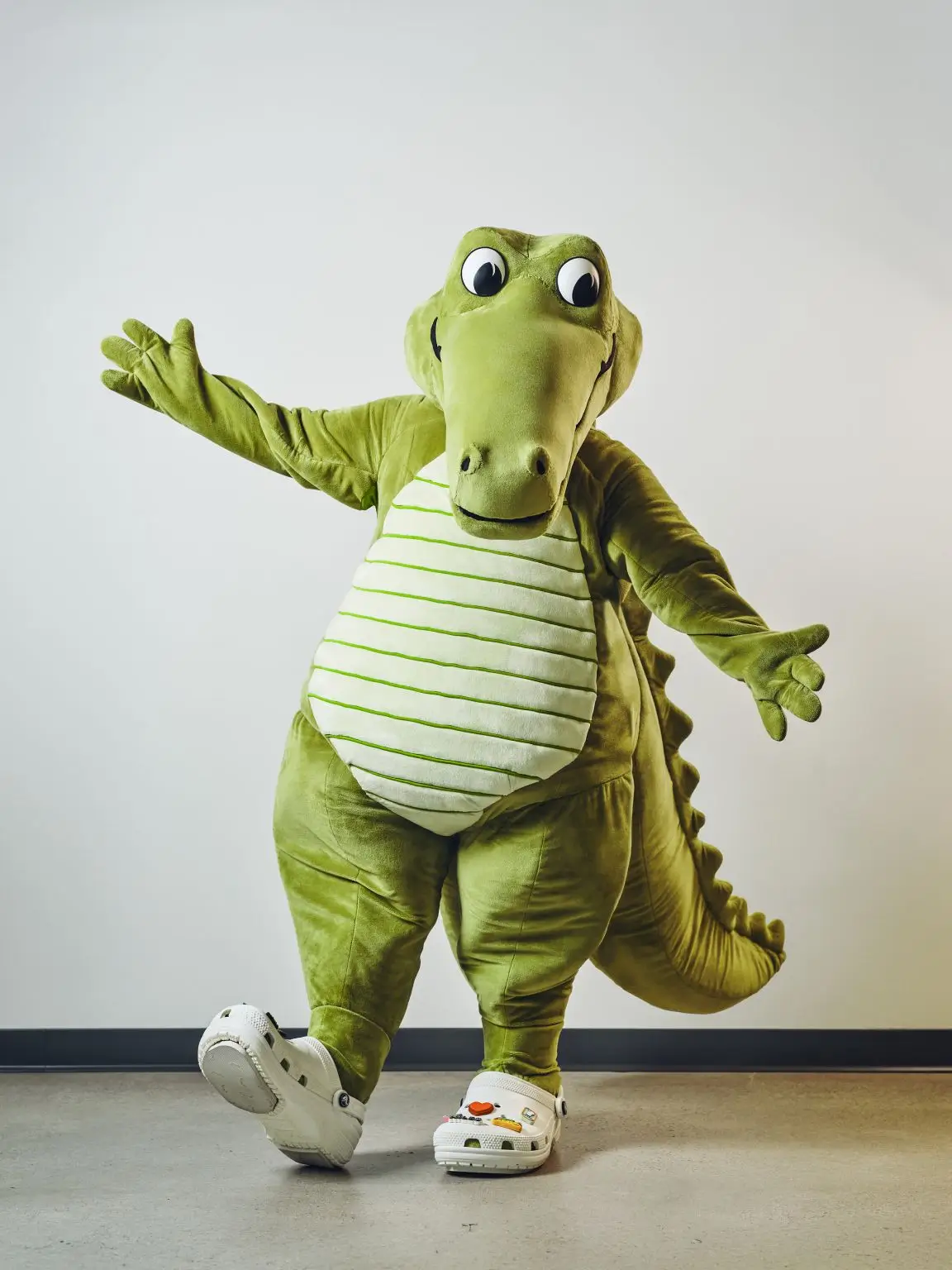
For a month, a three-foot egg kept show up where it didn’t belong. It sat in the background of Crocs TikTok Shop livestreams. It hid inside the brand’s own platform logos. Nobody explained it. Then, on August 13, 2026, a 24-hour countdown ran out on the brand’s social channels and the egg cracked open live. What climbed out was six feet tall, green, and already fam: a crocodile that Crocs says has been sitting on the side of its clogs since the company sold its first pair of shoes in 2002.
His name is Niles.
stir
Every Classic Clog carries a small reptilian rivet punched into the strap, a snout-shaped detail baked into the shoe’s outline from the very first mold. Crocs has never hidden it. It’s just never given it a name, a body, or a reason to exist outside the plastic. Niles is that detail, scaled up, given legs, and let loose in the office.
The company’s own announcement frames it plainly: the character “comes to life from the crocodile profile that has been featured on the side of the brand’s famed footwear since its first pair of shoes sold in 2002.” That’s the entire origin story. No writers’ room invent a new animal. Crocs looked at a part it had shipped on hundreds of millions of shoe and decided it deserved to stand up.
It’s a different move than the usual mascot playbook, where a brand commission a character from scratch and spends years teach people to recognize it. Niles arrives with built-in recognition. Anyone who has ever clipped a Jibbitz charm into a clog has already met the shape he’s based on, even if they never clocked it as a face.
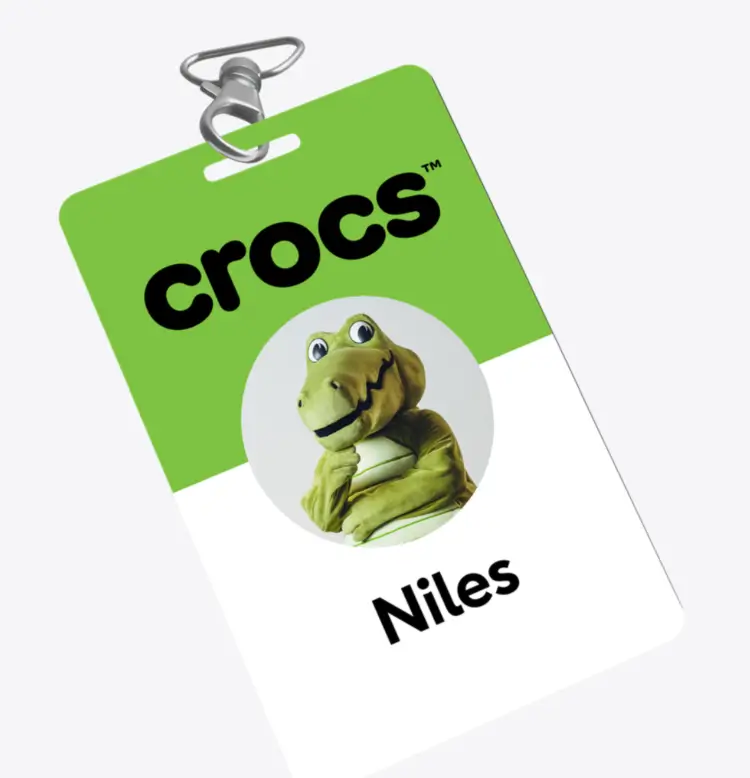
Green Crocs Employee Badge Featuring Brand Mascot Niles
transition
Chief Brand Officer Terence Reilly put the timeline in a single line: Niles has been “hiding in plain sight for nearly 25 years,” and after that long, Crocs figured “he deserved a promotion from rivet to real life.” He described the character as funny, optimistic, and always up for an adventure, and framed the whole exercise as a new way to pull people into the Crocs world that a straightforward product launch can’t manage on its own.
That’s a notable thing for a footwear brand to say out loud. Crocs has spent the last several years leaning hard into collaborations, from designer team-ups to celebrity Jibbitz drops, and each of those moves people toward a specific pair of shoes. A mascot doesn’t sell a specific pair of shoes. It sells a relationship with the brand itself, one that isn’t tied to any single drop calendar.
Reilly has a track record with exactly this kind of reframe. Before Crocs, he spent years at Stanley and Vans building brand stories around objects people already owned rather than objects they needed to be convinced to buy. Niles reads like the same instinct applied to a shoe company: don’t invent desire, excavate it from something that’s already sitting in the customer’s closet.
huh
Crocs didn’t build Niles in-house. The character was developed with CALLEN, the Austin creative studio founded by Craig Allen, a former Wieden+Kennedy creative director who led the “Smell Like A Man, Man” run for Old Spice before going independent. Allen described the assignment as building Niles into “a full-fledged character with his own quirks, dreams, and questionable choices, plus enough personality to earn his own sitcom spinoff,” which is an unusual specific ambition for a shoe mascot.
That approach shows up in the format Crocs chose for Niles’ debut: not a single hero commercial, but a micro-series shot at the company’s Broomfield, Colorado headquarters, with Niles moving through actual office life alongside real employees. One early clip has him bursting out of his egg early, celebrating, then realizing he’d jumped the gun on the official countdown and scrambling to stuff the shell back together before anyone notices. It’s a sitcom beat, not an ad beat.
Niles doesn’t speak. That’s a practical choice as much as a creative one: a silent character travels across markets, languages, and short-form platforms without a dubbing problem, leaning on physical comedy and reaction shots instead of dialogue. It also means the character can be dropped into almost any format, from a scripted office bit to a stadium appearance, without a script rewrite.
He already has a dedicated presence to fill with that content. Fans can follow him on Instagram and TikTok as @NilestheCroc, plus a LinkedIn account, a slightly absurd but deliberate touch for a character who is, after all, supposedly Crocs’ newest employee.
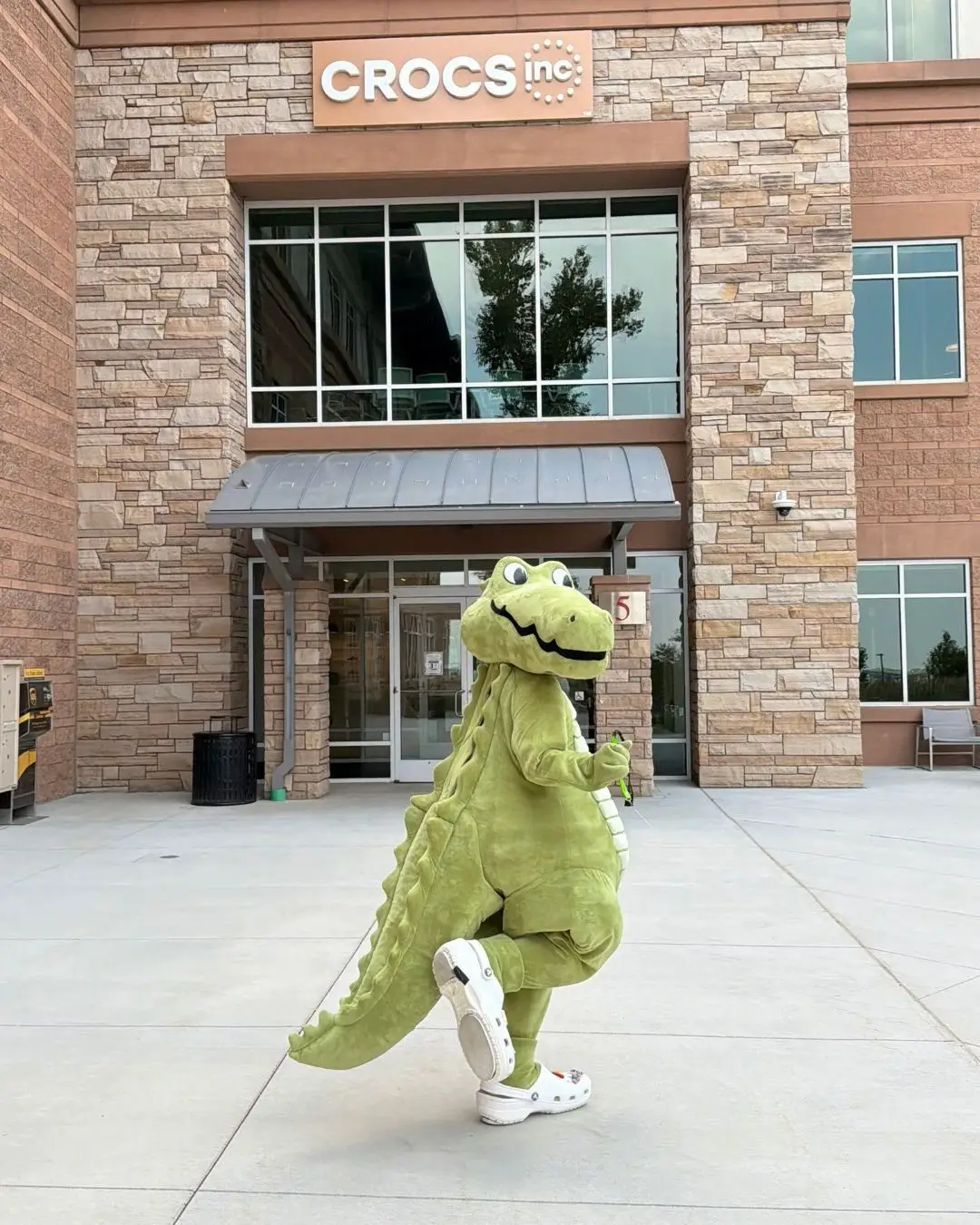
Crocs Mascot Niles Wearing White Crocs Outside The Company Headquarters
role
Chief Marketing Officer Carly Gomez described Niles less like a campaign and more like an asset on the balance sheet. “Niles represents a long-term investment in scalable intellectual property that can grow alongside our brand and community,” she said, adding that the goal is “a platform that can evolve across content, experiences, entertainment and future brand extensions for years to come.”
That word, scalable, is doing real work. A specific shoe connection has a shelf life measured in weeks. A licensed celebrity partnership expires when the contract does. A character the brand owns outright can headline a holiday special, appear at a retail opening, get his own plush toy, or eventually anchor a genuine entertainment property, all without renegotiating anything. Crocs is explicit that this isn’t conceived as a single campaign asset. It’s positioned as a permanent fixture of the brand, the kind of long-horizon bet that only makes sense if the company expects to still be leaning on it in five or ten years.
View this post on Instagram
There’s a financial backdrop to the timing, too. Crocs recently reported its first quarter with more than $1 billion in revenue, with sales climbing 4.3 percent, and the company has pointed to platforms like TikTok Shop, including a global Super Brand Day push in July, as part of that momentum. Niles’ debut leaned on that same channel for its teaser rollout, with the egg planted inside TikTok Shop livestreams weeks before the reveal. A mascot with his own accounts and his own content slate gives Crocs a recurring reason to show up in that feed that doesn’t depend on a new product existing.
fin
None of this is arriving at a random moment. Crocs turns 25 in 2027, and Niles is explicitly framed against that anniversary. The company’s own language ties the character’s arrival to a broader shift in how it wants to be seen: not simply as a maker of foam clogs, but as a brand that treats its customers as participants in an ongoing story rather than recipients of a quarterly product rel.
It’s worth sitting with what Crocs chose not to do here. It could have marked 25 years with a retro colorway, a limited rerelease of the original mold, or a nostalgia-driven campaign built around the shoe’s early-2000s reputation as a divisive, unapologetically ugly piece of footwear. Instead, it picked the one detail on the shoe that customers have looked at for two and a half decades without really seeing, and gave it a name, an office job, and a content calendar.
Whether Niles turns into the kind of durable brand character Crocs is describing, on the order of a Michelin Man or a Ronald McDonald, will depend on years of content most viewers haven’t seen yet. But the premise behind him is a clean one, and it’s stated plainly by the people who built him: the character didn’t need to be invented. He needed to be noticed.
Related Articles
Solebox Turns the Crocs Echo II Into a Loafer, and Berlin Gets a Free Haircut With It
A loafer built on a Crocs mold lands in Berlin September 12, tied to a […]