DRIFT AUDIO
Listen to this story
Choose a voice, then press play.
Esquire’s new cover profile catches the 62 year old actor mid ordinary afternoon: two dogs, a self assembled cheese board, and a house he has barely lived in.
Brad Pitt opens his own front door. That is, functionally, the news. Esquire’s September cover profile, written by Ryan D’Agostino and photographed by Chantal Anderson, spends an afternoon at the 62 year old actor’s Los Angeles home and finds a version of stardom with almost no view staff, no handlers veer the convo, and very little pretense about any of it. The piece runs as the open entry in the magazine’s annual Mavericks of Hollywood portfolio, and it is built less around a specific project than around the accumulated weight of a career that has, by any measure, reached a genuinely rare altitude.
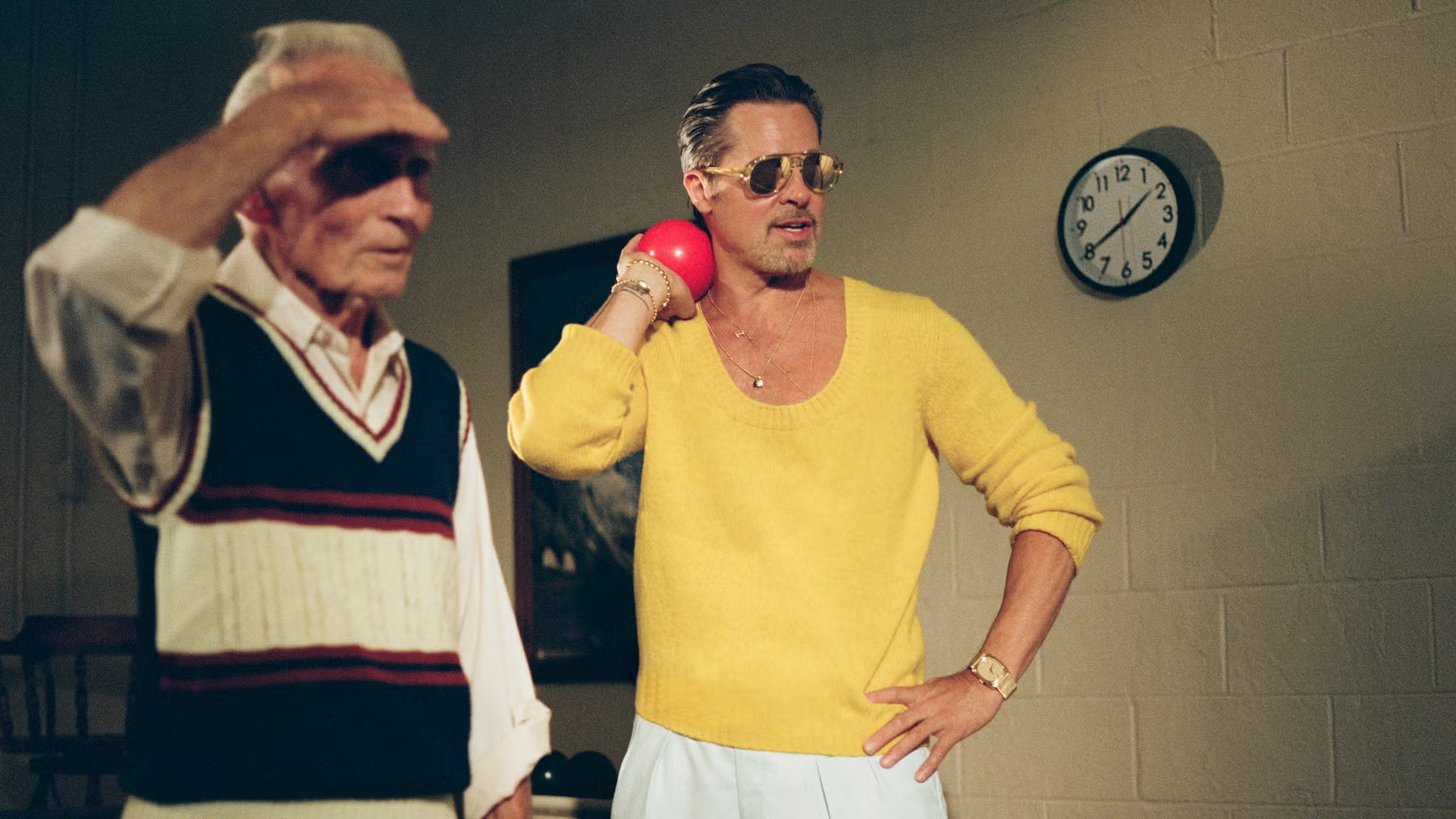
Brad Pitt in a butter yellow knit and white trousers, holding a red ball with a stringent nonchalance. The older man passes by, but the frame belongs entirely to Pitt, whose relaxed stance and gold accessories turn a bowling alley into a runway.
stir
The house itself is the profile’s sharpest detail. Pitt bought the property last fall and has, by his own account relay in the piece, spent a total of three scatter weeks there since, a specific number that turns a private habit most celebrity profiles leave vague into something concrete. The entryway is solid glass, a tall door flank by glass walls, so the whole scene of him calming his dogs is view from outside before he ever opens it. Around the pool sit a row of palm trees he had plant himself, a small indulgence he explains simply: “because I’m a tree freak.” Beyond the patio, the property looks out over the rest of the city, and the whole layout reads, in D’Agostino’s telling, as a house still being moved into rather than one that has settled around its owner.
That sense of a space still being learned rather than lived in runs through the rest of the visit. Nothing about the house feels staged for the occasion. There is a gas fireplace lit in a sitting area the profile describes as cozy despite the scale of the room around it, and a kitchen island large enough that D’Agostino compares its footprint to that of an entire small kitchen elsewhere. It is the kind of detail that could read as excess in another profile, but here it mostly underscores how much of the house remains, in a practical sense, unfamiliar territory even to the man who owns it.
There is something almost deliberately unglamorous about the way the tour unfolds, too. No room gets a formal introduction. Nothing is presented for effect. The house simply happens around the conversation, the way any house does when its owner is more interested in what he’s saying than in what he’s showing off, and by the time the visit reaches the pool and the palm trees, the property itself has receded almost entirely into the background of the piece.
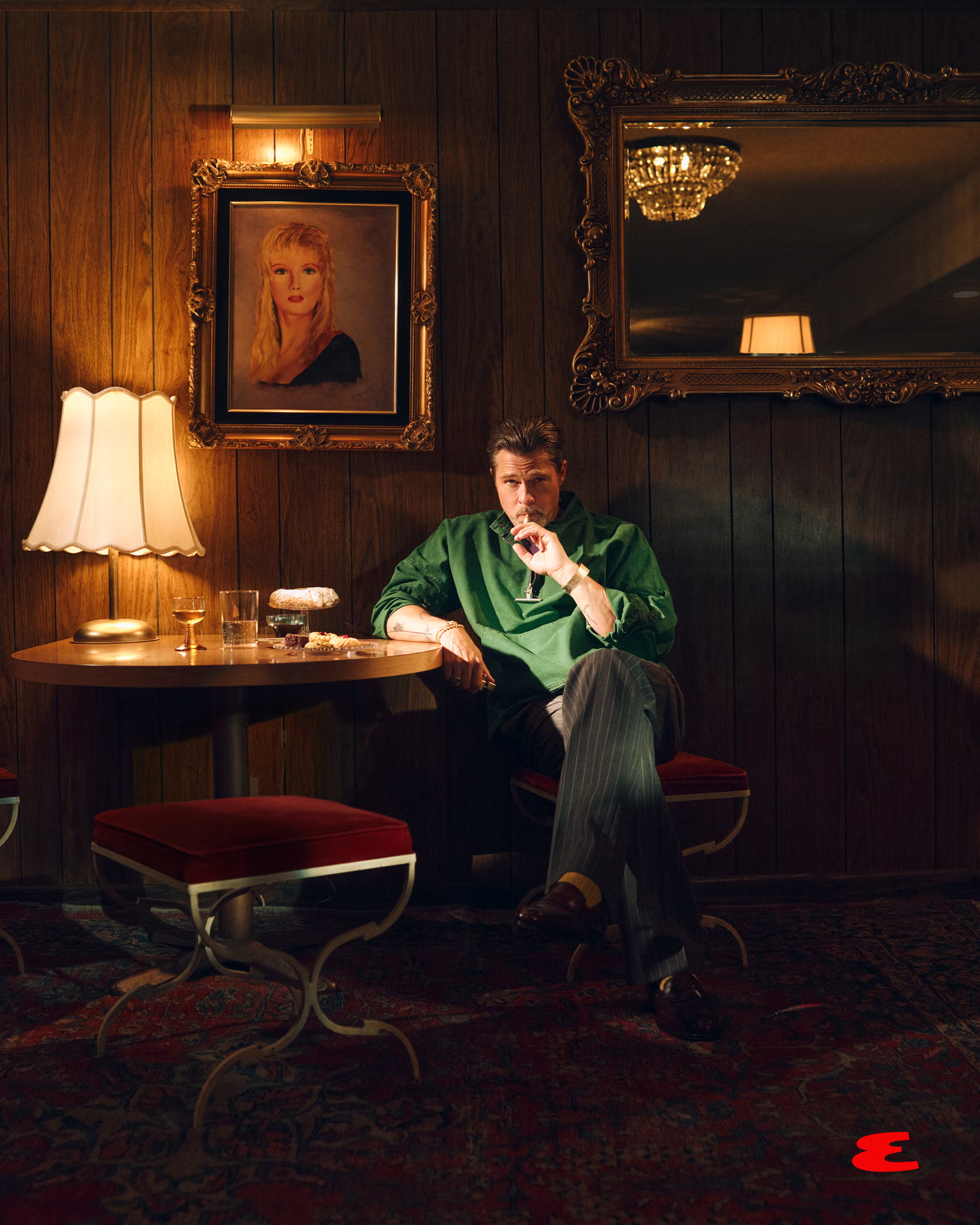
Brad Pitt Seated In A Wood-Paneled Lounge Wearing A Green Shirt And Pinstripe Trousers.
huh
At that kitchen island, Pitt does the work himself. He unwraps a wedge of Gouda straight from its supermarket shrink wrap and slices most of it, then moves on to a chunk of Parmesan the same way, arranging both neatly on a board alongside crackers and salami. There is no assistant nearby to hand him anything and no publicist managing the room, a detail the piece calls out explicitly, noting that people will likely ask afterward whether there was staff helping and confirming, plainly, that there was not. According to the profile, one of his two dogs once got into an unattended sausage with no consequence to speak of, a detail Pitt delivers with visible amusement rather than concern, the kind of throwaway domestic anecdote that a more controlled interview subject might have left out entirely.
The board making itself becomes a small piece of choreography by the time it is finished, carried past the island’s considerable length, past the lit fireplace, and out toward a table near the glass doors that open onto the pool. Nothing about the process is rushed. D’Agostino’s account lingers on it the way a person might linger on watching someone cook, less interested in the food itself than in what the unhurried pace of making it says about the man doing it. There is no sense, reading the piece, that the board was assembled with an audience in mind, that the Gouda was unwrapped a particular way because a photographer needed the shot. It reads instead like a routine, the kind of small domestic ritual a person performs the same way whether or not anyone happens to be watching.
flow
Before any of that, there are the dogs. Pitt’s two doodles, Sundae and Vandy, meet D’Agostino at the door first, nails tapping the tile as they circle and sniff. Pitt holds their collars to settle them down, and once they lose interest, he extends a hand with the plainest possible greeting, simply offering his own first name. Both dogs get a brief origin story in the piece: Sundae’s name comes from hot fudge, while Vandy’s came already attached when Pitt took her in. The profile also notes what he calls the standard warning for anyone arriving at the house, a joking heads up that guests should expect a couple of minutes of enthusiastic attention from the dogs before being left alone.
His outfit for the afternoon, per the piece, pairs an egg yolk yellow T shirt over a white one with shimmering gold parachute pants and white sneakers, an unlikely combination the profile calls surprisingly close to the coolest outfit imaginable. It is presented less as a fashion statement than as one more piece of evidence that nothing about the day has been arranged for effect, since the same casualness extends to how he greets a total stranger at his own front door. The wardrobe credits that run alongside the accompanying photography tell a slightly different story, crediting pieces from Louis Vuitton, Prada, Giorgio Armani, and a vintage archive dealer among others, a reminder that even an outfit this loose bound comes assembled by a stylist for a magazine shoot. The two things, the studied photography and the unstudied afternoon, sit slightly at odds with each other throughout the piece without ever quite resolving, which is arguably part of what makes the profile interesting to read.
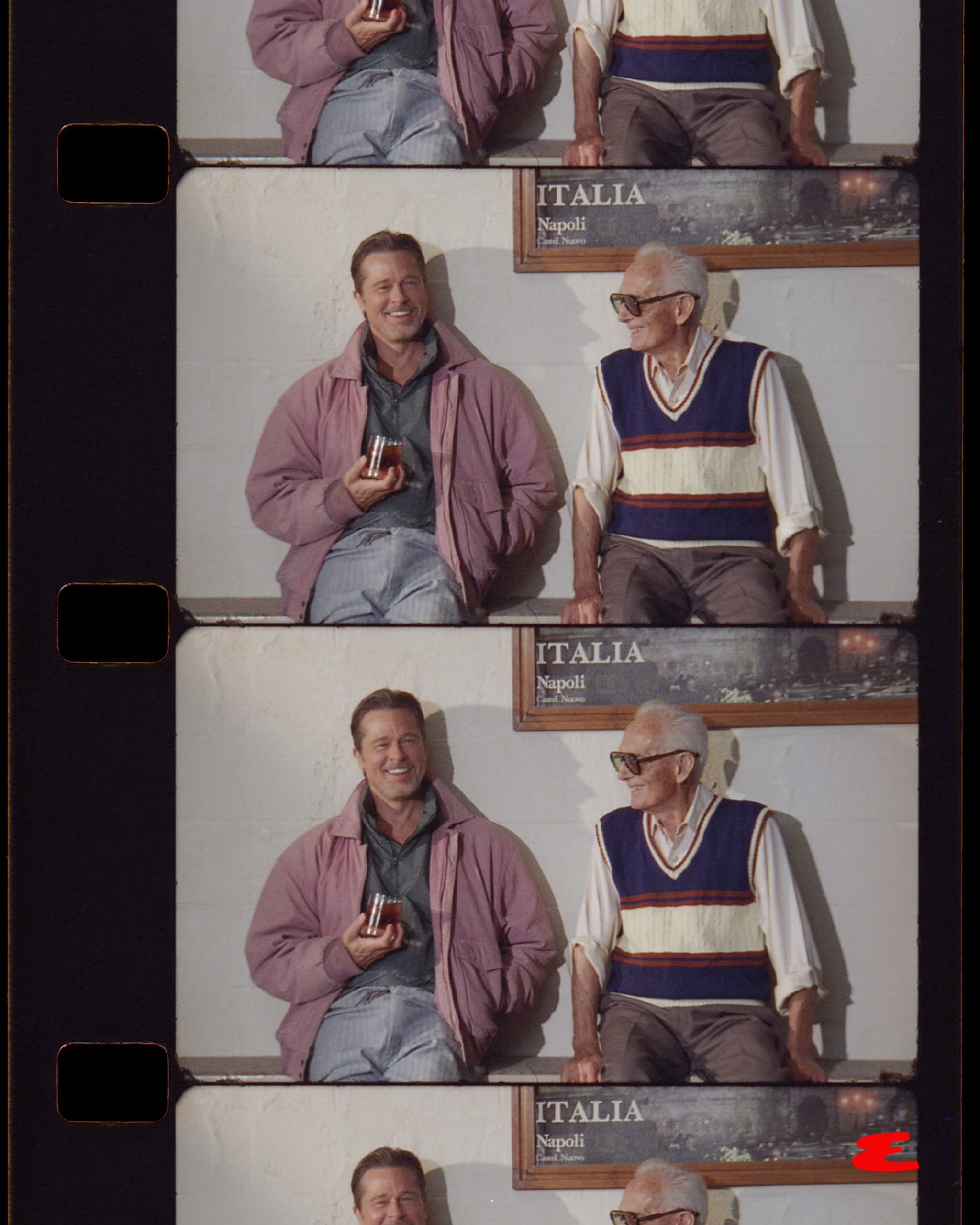
Brad Pitt Sharing A Laugh With An Older Man In A Vintage Filmstrip.
extend
Once the board is assembled, Pitt carries it past the island, past the fireplace, and out toward a table near the glass doors overlooking the pool and the city beyond. He waves his guest into a seat with a small rule of the house attached, a version of hospitality that treats the view itself as the thing being offered. He retrieves two bottles of Perrier from the refrigerator and hands over paper towels instead of napkins, since he has not yet worked out where in the new house the napkins actually are, a small, specific admission that undercuts any sense of stage management around the whole scene. It is a portrait, at this point in the profile, of a man near the top of his profession treating a first meeting with a journalist the same way he might treat any other guest, not with show, but with whatever happens to be in the refrigerator.
show
The conversation eventually turns, as these things do, to the work itself, and Pitt is unusually blunt about what he can and cannot tolerate watching on screen. Bad acting, he tells D’Agostino, drives him crazy, a pet peeve he extends into an offhand joke about why he cannot sit through a certain category of adult film. He is similarly direct, if more measured, on the subject of artificial intelligence in filmmaking, arguing that despite the pushback the technology has drawn across the industry, AI used properly as a tool could end up being exactly what keeps mid budget films, the forty to ninety million dollar range that has become increasingly hard to finance, actually getting made. It is a position that puts him at odds with a fair amount of Hollywood sentiment, delivered without much hedging.
The piece also catches him mid conversation about a current project, a film called Beast built around his character’s relationship with a German shepherd jure a dog named Odin, which he describes to D’Agostino in blunt terms as a love story. A passing mention of J. K. Simmons turns into a burst of genuine enthusiasm, Pitt calling him out by name as a great actor and singling out his Whiplash performance specifically, the kind of unprompted, specific praise that tends not to survive a normal press junket. At another point, Pitt notices a tattoo on D’Agostino’s forearm and asks about it directly, a small, unscripted moment that the piece includes less for what it reveals about Pitt’s opinions and more for what it says about his attention: he is, throughout the visit, described as a genuinely present conversational partner rather than someone running out the clock on an assigned obligation.
fin
D’Agostino frames all of it against the scale of Pitt’s career, describe him early in the piece as occupying the top one percent of the top one percent of movie stars by any metric worth measuring, intrigue included. It is a big claim, but the surrounding profile mostly earns it by declining to lean on the usual signifiers of that kind of stardom. There is no run through of box office numbers, no rehearsed list of accolades. Instead the piece builds its case for Pitt’s stature out of the accumulated small evidence of the afternoon itself: the ease with which he handles being watched, the specificity of the details he is willing to share, and the almost complete absence of anyone standing between him and the person he is talking to.
That frame matters partly because of where the piece sits in the magazine. As the opening profile in Esquire’s Mavericks of Hollywood portfolio, an annual package built around figures the magazine considers to be shaping the industry rather than simply appearing in it, Pitt’s entry sets the tone for everything that follows. The other entries in the same portfolio lean more conventionally toward career retrospective and awards season positioning; Pitt’s, by contrast, spends almost none of its length on his filmography and nearly all of it on a single ordinary afternoon, a choice that seems to argue, implicitly, that at this stage of his career the more interesting story is not what he has done but how he has chosen to live around it.
That absence is, in the end, the real subject of the profile, more than any particular film or headline detail. A man who has spent close to four decades near the absolute center of American celebrity chooses, on this particular Monday, to answer his own door, cut his own cheese, and hand a journalist a paper towel because he cannot find the napkins. None of it is dramatic. All of it is, in its own quiet way, the whole story.
Related Articles
Four-Fifths of a Giant Killer: Hedley Studios Builds an Electric Porsche 550 J
Porsche opened its archive to a workshop in Bicester. What came back is a two-seat, […]