DRIFT AUDIO
Listen to this story
Choose a voice, then press play.
A South African painter who rebuilt his practice from sobriety in 2014 returns with “Burnout” (2025), the newest entry in a decade spent painting suburbia under strain.
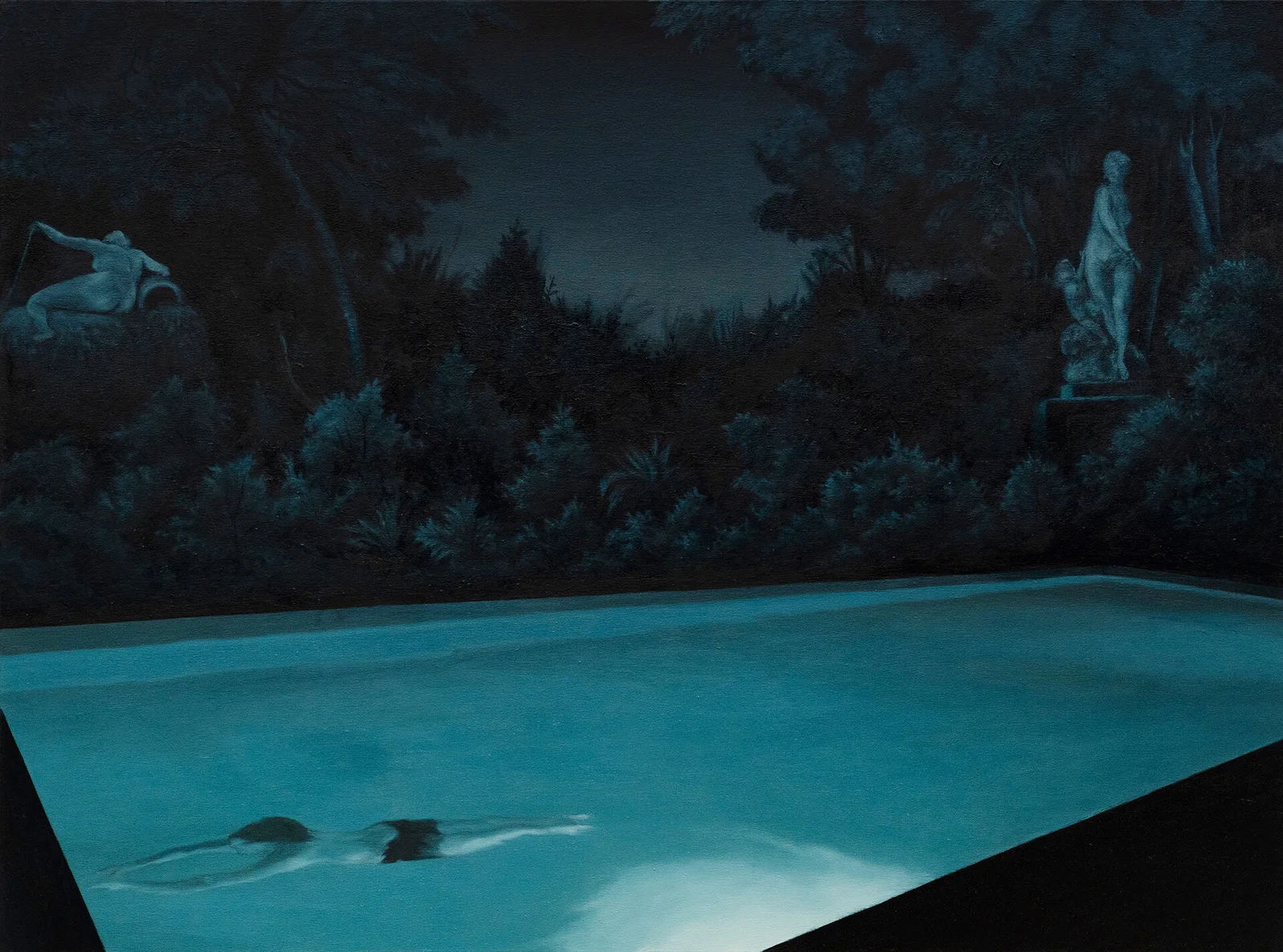
“Burnout” is a 2025 oil on canvas by Andrew Kayser, measuring 45 3/10 by 61 inches, or 115 by 155 centimeters. Those are large dimensions by Kayser’s own standards. Much of his catalog over the past few years runs closer to a meter or so on the long edge, so a canvas over five feet wide puts “Burnout” among the bigger surfaces he’s worked on recent.
Oil on canvas is also the material Kayser has spent the last several years narrowing his practice down to. Through most of the 2010s he worked across mixed media, charcoal, chalk pastel, and ink, often on paper rather than canvas. 2020 marked a deliberate shift toward oil painting as his primary vehicle, a shift his galleries describe as having “consolidated” by 2023 with a solo show built entirely around it. Kalashnikovv Gallery, which staged his first three presentations, describes that 2020 pivot as a move away from the mixed-media assemblages and works on paper that had defined his practice since his 2014 return, toward canvases built up in oil alone, and frames 2023’s “Fragments of Longer Stories” as the point that shift fully settled, a description at least one other gallery repeats almost verbatim. That kind of overlap suggests it’s the account Kayser and his galleries have agreed on for narrating his own technical development, rather than each writing it up indie. A canvas titled “Burnout,” arriving two years into that consolidation, sits squarely inside the body of work that shift produced.
What isn’t available, at least not through any listing this piece could independently locate beyond the general artist page, is a description of what the canvas actually depicts, where it currently sits (gallery inventory, private collection, or an upcoming show), or a price. The dimensions and medium supplied read exactly like an Artsy artwork listing, down to the inch-to-centimeter conversion, so the piece is almost certainly real and currently cataloged somewhere. It simply couldn’t be pinned to a specific gallery page independently. That gap is worth stating plainly rather than papering over with invented description of a canvas this piece hasn’t seen.
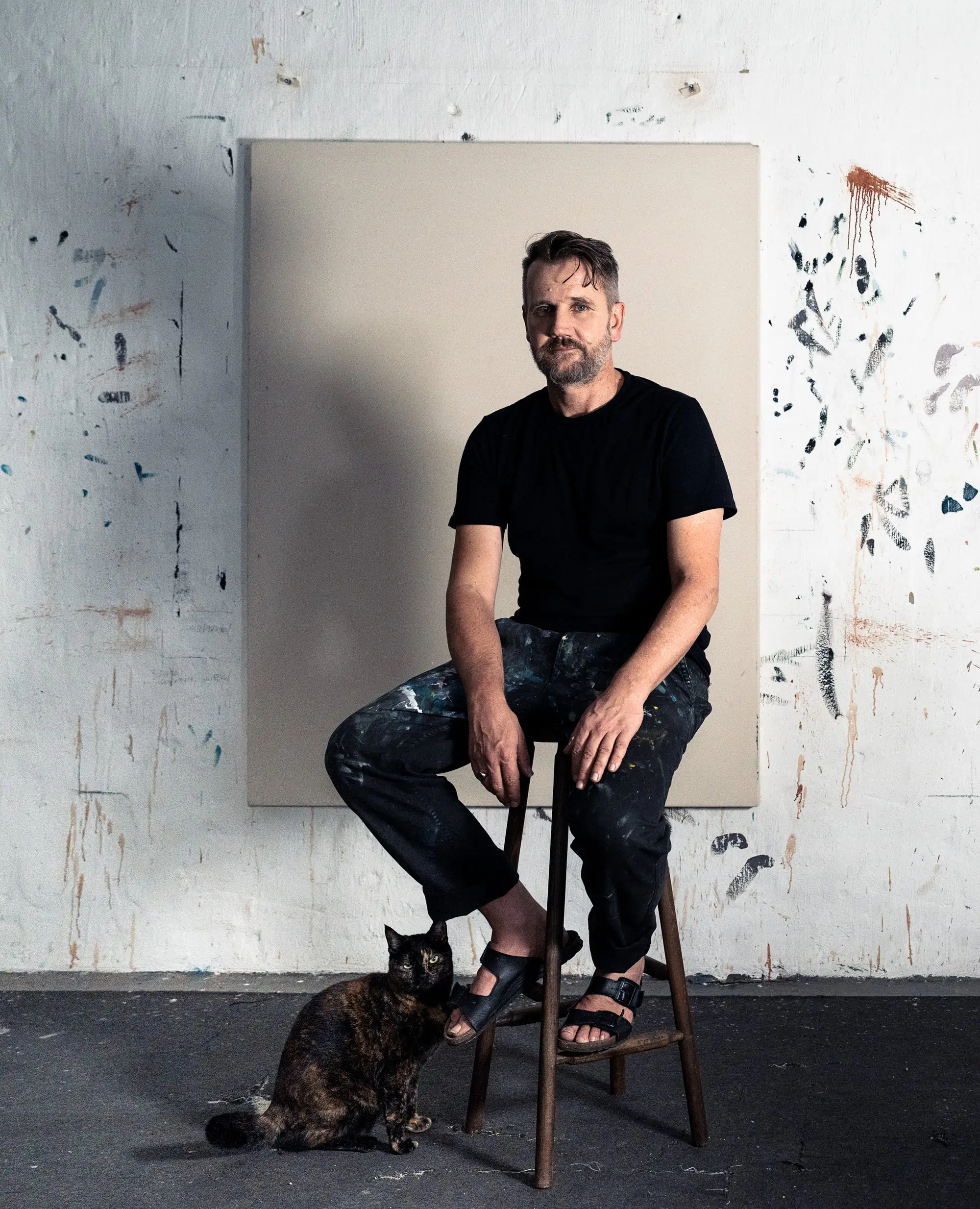
A portrait of a man with a beard sitting on a wooden stool in an artist’s studio, wearing a black t-shirt and paint-stained pants, with a tortoiseshell cat sitting on the floor beside him.
to
Kayser was born in 1975 in East London, South Africa, and trained abroad before building the practice he has now. He graduated from the Koninklijke Academie van Beeldende Kunsten, the Royal Academy of Art, in Den Haag in 2001, and spent several years exhibiting around the Netherlands before returning to South Africa in 2005. What came next is a part of his biography every one of his galleries states plainly rather than glossing over: a lengthy struggle with alcoholism that took him out of practice, followed by sobriety and a return to painting in 2014. His first solo show, “At Home After Dark,” opened three years later at Kalashnikovv Gallery in Johannesburg, in 2017. He now lives and works in inner-city Johannesburg.
That timeline matters for how his galleries frame the work itself, not just the biography. THK Gallery’s own account of Kayser’s practice describes his paintings as “both a critique and reconciliation of his coming of age,” language that sits deliberately close to the arc of the artist’s own life rather than treating the two as separate. The suburban scenes he paints read, in that framing, as a way of working back through the territory he grew up in and left, rather than as detached social commentary on a milieu he’s simply observing from outside it.
scope
Kayser’s own galleries use a specific word for what he does: psycho-geographical. His paintings take suburbia, and the particular version of middle-class comfort suburbia is built to represent, as a landscape that’s as much internal as physical. One gallery’s lang for it: his work reflects “a collision of inner and outer realities,” an impression that whatever meaning is on the canvas is fleeting and intensely personal rather than fixed. Doubt, ambiguity, and contradiction recur as his stated subjects, and multiple galleries independently use nearly identical language to describe his intent, that he refuses to resolve the ambiguity on the viewer’s behalf.
Kayser has put that approach in his own words. Describing his 2019 solo show “A Moderate Bliss” at THK Gallery, he framed his goal as building “an absurd, ambivalent, darkly humorous reality” rather than a legible or singular one, language that treats contradiction as the point rather than a flaw to smooth over. Two years later, introducing “Not Enough Time to Do Nothing,” he described the show in more provisional terms: “This is not the culmination of a journey, more of a pitstop.” Both statements point at the same instinct, that his paintings are check-ins on an unresolved process rather than finished arguments.
The saccharine surface Kayser paints, bright suburban scenes that his galleries describe as disconnected from the larger social reality around them, is where that ambiguity actually lives. The comfort in the image and the strain underneath it are meant to sit in the same frame without either canceling the other out. A title like “Burnout” fits that pattern in an obvious way, naming exhaustion directly rather than letting a viewer infer it from the scene alone, though without having seen the canvas, that’s a connection to his established themes rather than a claim about what the painting specifically shows.
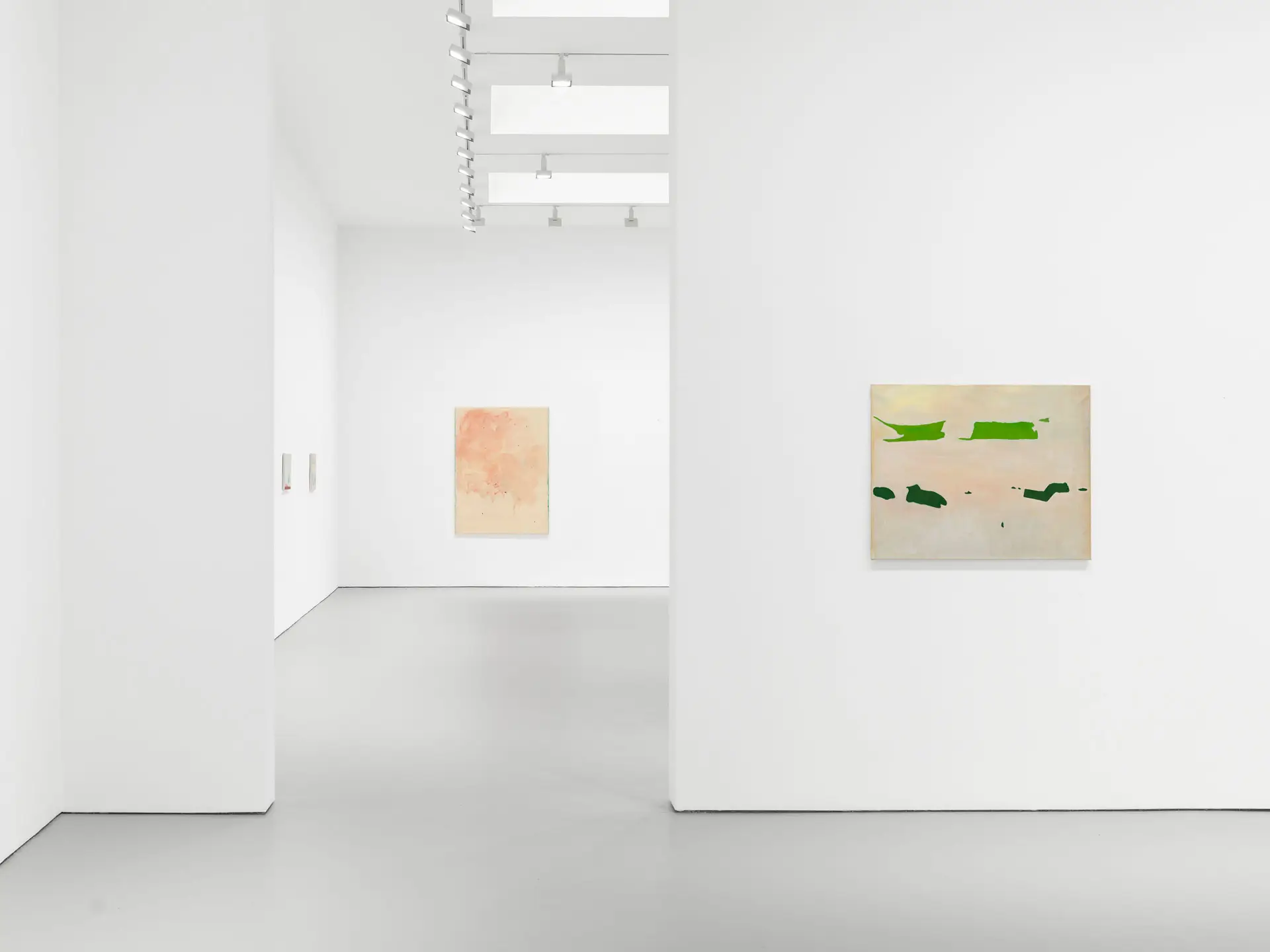
An installation view of a minimalist white gallery space featuring two abstract paintings by Jenny Brosinski, with a larger work in green and beige on the right wall and a smaller warm-toned piece on the far wall.
straddle
Kayser’s solo exhibition history runs six shows deep across two galleries and eight years. “At Home After Dark” opened at Kalashnikovv Gallery in 2017, followed by “Christ Haus!!” at the same gallery in 2019. That same year, THK Gallery in Cape Town presented “A Moderate Bliss.” THK followed with “Not Enough Time to Do Nothing” in 2021 and “Ideal Homes and Other Distractions” in 2022. Graham Contemporary in Johannesburg presented “Fragments of Longer Stories” in 2023, the show his galleries point to as the point where his shift to oil painting fully took hold.
Group exhibitions and duo shows fill in the years between and around those solo presentations: a 2018 duo show with Manuela Karin Knaut at Graham’s Fine Art Gallery, “Dark Dogs and Candy Floss”; a 2023 duo show with Rhett Martyn at Gallery2, “A Line Around Your Thoughts”; and appearances in group shows including “Africa Now: Contemporary Painters” and “TransForm” at THK Gallery, “The Un-Turning Wheel” at Kalashnikovv Gallery in connect with Latitudes Centre for the Arts in 2024, and, in 2025 alone, “Solitude” at 131A Gallery in Cape Town and “Wanderlust” at The Finch Project in London.
His work has also traveled through the international art fair circuit for most of the past decade: Cologne Fine Art and Design, the AKAA (Also Known As Africa) Art and Design Fair in Paris, the 1-54 Contemporary African Art Fair, Contemporary Istanbul, Enter Art Fair in Copenhagen, Investec Cape Town Art Fair, and, as recently as 2024 and 2025, Untitled Art Miami Beach and the London Art Fair. The galleries presenting him at those fairs have widened over time beyond THK Gallery alone, including Kalashnikovv Gallery and, most recently, Suburbia Contemporary and The Finch Project.
fin
THK Gallery, founded in Cape Town in 2018 by collector Frank Schönau and co-directed with Linda Pyke, is Kayser’s stated representing gallery and the one that submitted his official Artsy biography. The gallery operates out of Waterkant Street in Cape Town’s city center, with a satellite project space in Cologne, and has continued showing Kayser’s work at fairs including AKAA Paris as recently as 2025. THK describes its broader program as pairing established and emerging artists from Africa and the diaspora with international contemporaries, framing its work as building institutional partnerships and advancing curatorial discourse rather than running a straightforward retail operation. Kayser’s practice, rooted specifically in Johannesburg suburbia, sits inside that wider mandate as one of the gallery’s more geographically specific voices. That representation sits alongside a wider network of galleries that have exhibited or sold his work without necessarily being his primary representation, among them Graham Contemporary in Johannesburg and 131A Gallery in Cape Town. Kalashnikovv Gallery, the Johannesburg space that staged his first three presentations between 2017 and 2019 and continued showing his work as recently as 2025, closed permanently in July 2025 after twelve years in operation, part of what its founders described as a broader squeeze on gallery economics rather than anything specific to their program. That leaves THK Gallery as the clearest through line in Kayser’s current representation, with Graham Contemporary and the newer Cape Town and London venues rounding out where the work actually shows up today.
Kayser also sells directly. Andrew Kayser Editions, run from his own studio, offers limited archival pigment prints reproduced from his original oil paintings in two sizes, a smaller “Statement” (roughly A0) and a larger “Large” (roughly A1), each hand-signed, numbered, and capped at 24 prints across all available sizes combined, accompanied by a certificate of authenticity and optional framing through partner framers in Cape Town and Johannesburg. The Editions site also periodically discounts select original paintings from his private studio archive, described as a way to make room for new work while giving more collectors a chance to own an original. Titles that have circulated through retail listings of his originals in recent years include “Ophelia II,” “54 1st Street,” “Some Other Place,” “The Distance Between Us,” “Waiting,” “Daydream,” and “Morning Solitude” (2024), a spread that gives some sense of the catalog “Burnout” now joins even without a description of the newer canvas itself.
Retail listings for his originals elsewhere in the South African market have run from roughly R85,000 to upward of R205,000 (about $4,700 to $11,300 at recent exchange rates), excluding VAT, depending on the piece and its size, and his work has also passed through Strauss & Co, one of South Africa’s major auction houses. None of that pricing confirms what “Burnout” itself is asking or has sold for, only the general range his market has occupied.
Related Articles
fnnch Revives the Honey Bear Hunt for Halloween, No Tape Required
San Francisco’s honey bear artist is turning porch season into a scavenger hunt again, five […]