DRIFT AUDIO
Listen to this story
Choose a voice, then press play.
Andy Warhol rarely worked for the Beatles. In 1980 he made one exception, and that dust jacket is now back on the auction block.
Warhol’s deepest music world credit belongs to the Rolling Stones, not the Beatles. He designed the Sticky Fingers album cover in 1971 at Mick Jagger’s own request, working a real, function zipper into the jeans on the front. Curatorial notes from the National Galleries of Scotland point to a reason why: Warhol gravitated toward the Stones’ rougher image over the Beatles’ tidier one. That makes his 1980 dust jacket for a Beatles biography, titled plainly “The Beatles,” something close to a one off in his catalogue, a commission for the other band, taken on anyway.
View this post on Instagram
It wasn’t a stretch for him professionally. Warhol started his career as a commercial illustrator, drawing shoes and ads for magazines before he ever showed in a gallery, and he returned to that register periodically throughout his life for paying commissions, book jackets among them. By 1980 he was in his fifties, running the Factory as much as a production line as a studio, publishing Interview magazine, and taking on portrait work from collectors and corporations on top of his own painting. A dust jacket sat comfortably inside that mix, a smaller job than a Marilyn or a Mao, but one that put his name on a book aimed at closing out the Beatles’ first full decade since splitting.
stir
The book that resulted, published in 1980 by Times Books under its Rolling Stone Press imprint, runs 245 pages and carries more than three hundred photographs and illustrations tracing the band’s history from their 1960 formation in Liverpool through the 1970 breakup. Music journalist Geoffrey Stokes wrote the text. Stokes spent years on staff at The Village Voice, where he wrote the paper’s Press Clips column, and had already published a well regarded account of the record industry, Star-Making Machinery, four years before taking on the Beatles book. Conductor and composer Leonard Bernstein supplied the introduction, an unusual pairing of the classical music establishment with a rock biography that said something about how far the band’s cultural standing had traveled by 1980.
Art direction went to Bea Feitler, the Brazilian born designer already known for her work at Harper’s Bazaar and Ms. and, at the same time, at Rolling Stone. Feitler brought Warhol in specifically for the wraparound jacket, a narrower assignment than the interior layout, which she designed herself. She would die of cancer in 1982, two years after the book’s release, while at work on the launch issue of the relaunched Vanity Fair.
The book arrived in stores months before John Lennon was shot and killed outside his home in New York that December, a coincidence of timing that turned what had been conceived as a retrospective chronicle into something closer to an early elegy for the readers who picked it up that year.
flow
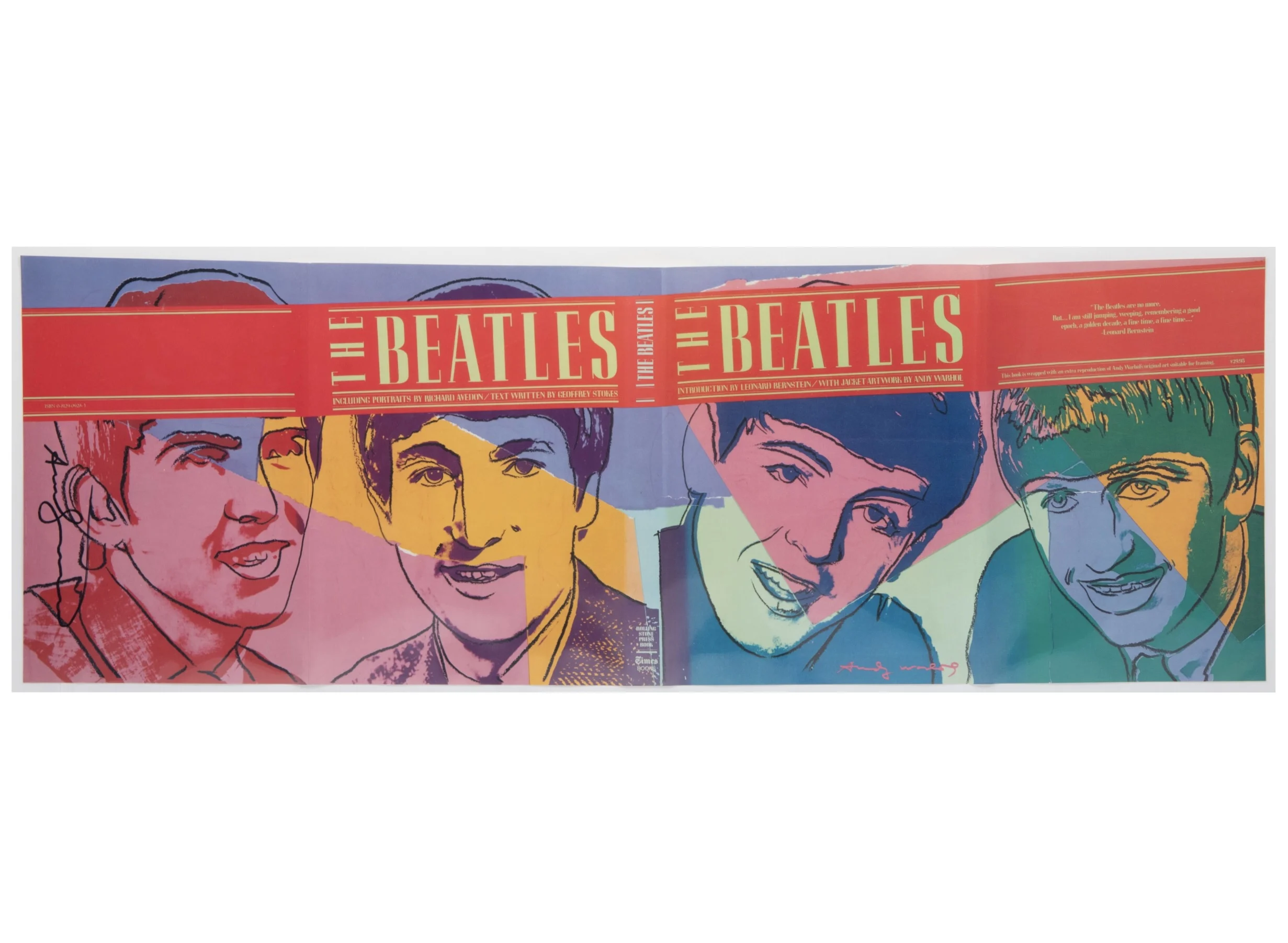
Warhol’s design is built from a photograph by Dezo Hoffmann, the photographer whose access to the Beatles during their early Merseybeat years produced some of the most reproduced images of the group. Rather than reproduce the photograph directly, Warhol broke it into blocks of irregular, screenprinted hue arranged so the panels read like sheets of collaged paper, even though the whole image was printed rather than cut and pasted by hand. Hand drawn linework was printed into the piece as well, laid over the flat tincture fields. The result leans into the same vibrant, high contrast palette that defined the Beatles’ own psychedelic album art a decade earlier, arriving well after that view lang had already passed out of fashion.
The jacket wraps the full width of the book when laid flat, front and back cover in one continuous image, which is why surviving examples of the piece run close to a meter wide while standing only about a foot tall. Individual examples of the design have circulated separately from the book itself for years, sold as signed screenprints on paper rather than as complete volumes, and versions of the image are held in institutional collections including the Tate and the National Galleries of Scotland.
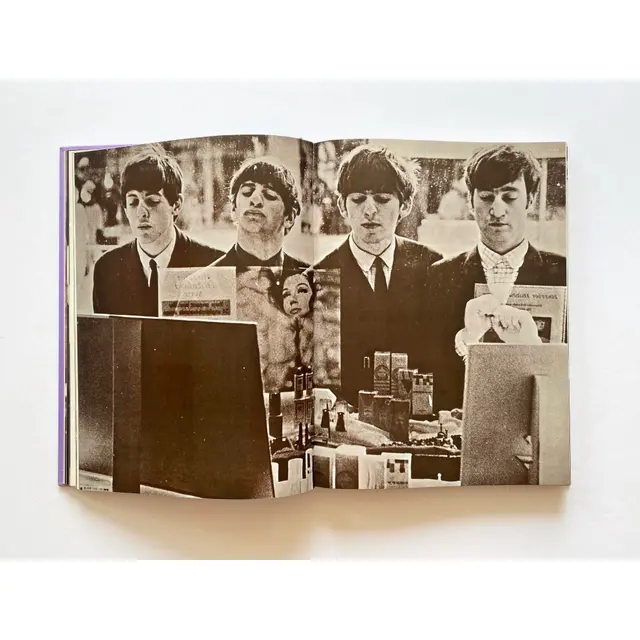
Open spread. Four suits. Table of pictures. Purple board.
scope
A signed example of the book cover design, catalogued as The Beatles (1980) and measuring 31 by 91.5 centimeters, is currently listed on MutualArt as part of a sale running from September 9 through September 12, 2026, filed under the site’s Works on Paper category. The specific auction house, lot number, and pre-sale estimate for this example sit behind MutualArt’s paid tier at the time of writing, so exact sale figures aren’t available here.
What is visible is the surrounding market. MutualArt’s aggregated data for Warhol’s works on paper shows the category’s average sold lot value roughly doubling year over year into 2025, with just under half of all lots in the category selling above their pre-sale estimate over the period tracked. Those numbers describe the category broadly rather than this specific lot, but they place the sale in a market that has, on balance, been treating Warhol’s works on paper well lately. Warhol’s prints and graphic art overall have sold for as much as $16.3 million at auction, with the category averaging in the mid five figures over the past year, a range this dust jacket sits well beneath.
The same sale includes other Warhol lots tied to film and music, among them artwork connected to the Rolling Stones’ Sticky Fingers and to Querelle, the 1982 Rainer Werner Fassbinder film Warhol also made a screenprint for, suggesting a themed grouping of the artist’s commercial and commissioned work rather than a general Warhol survey. Worth noting too: “The Beatles, 1980” isn’t a single, singular object. Other examples carrying the same title and year, in serigraph and print formats with slightly different dimensions, circulate separately at auction and through galleries. The lot currently listed is specifically the book cover dust jacket design, sold as a signed work on paper rather than one of those related editions. First edition copies of the book itself, separate from any individual dust jacket example at auction, also continue to change hands in the collectible book market.
Related Articles
fnnch Revives the Honey Bear Hunt for Halloween, No Tape Required
San Francisco’s honey bear artist is turning porch season into a scavenger hunt again, five […]