
DRIFT AUDIO
Listen to this story
Choose a voice, then press play.
At 4:49 in the morning off a Fujian fishing harbor, Cai Guo-Qiang lit a 500-meter ladder of fire into the sky, the one attempt in 21 years that actually worked.
Just before five in the morning on June 15, 2015, a white balloon lifted off the water at Huiyu Island Harbour, a fishing village on the edge of Cai Guo-Qiang‘s hometown of Quanzhou, Fujian. Trail beneath it was a ladder built from metal wire and aluminum, five hundred meters long, rigged end to end with quick burning fuses and gold fireworks. Cai has said this attempt broke from his earlier plans in one deliberate way: where the previous versions were timed for dusk, this one was set to rise at dawn, toward the morning sun rather than away from it.
Getting the ladder into position took a balloon large enough to be its own small spectacle. By one account of the launch, it carried something close to 6,200 cubic meters of helium, enough to lift roughly half a kilometer of wired ladder clean off the harbor before a single fuse was lit; that specific figure isn’t repeated across every account of the event, so it’s worth treating as a rough rather than an exact number. When the fuse caught, the structure lit in sequence, rung by rung, until a line of fire seemed to climb straight out of the harbor into the clouds above it. The whole thing burned for roughly two and a half minutes before the flame reached the top and went dark, leaving smoke drifting low over the water as the sky started to lighten. There was no audience beyond the fishermen and villagers who had helped rig it that morning. Cai Studio didn’t post footage of the event until August, almost two months later, and once it surfaced online it spread fast. Named simply Sky Ladder, the piece used gunpowder the way Cai had used it for three decades: as a drawing tool that happened, this once, to work on the scale of the sky rather than a sheet of paper or canvas.
View this post on Instagram
It was also the fourth time he had tried to build it, and the first time it went the way he’d planned.
three
The idea is older than almost anything else in Cai’s finished body of work. He has traced its origin to childhood, to watching news of the Apollo 11 landing at age eleven and wondering what an alien might make of the view looking back down at Earth. He didn’t attempt to build the ladder itself until 1994, in Bath, England, where the piece was grounded by bad weather before it ever really got off the ground. A second attempt in Shanghai in 2001 collapsed after the September 11 attacks made Chinese authorities newly unwilling to permit anything airborne over the city; Cai has recalled being told that any unauthorized flying object would be shot down without exception, regardless of what it turned out to be. A third attempt came in 2012, timed to a solo exhibition at the Museum of Contemporary Art, Los Angeles that had already been titled Sky Ladder in anticipation of it, and that one fell through when the city pulled his permit over wildfire risk during a drought year.
By 2015, the piece had been delayed or canceled across three continents over the course of 21 years. Cai has framed the pattern behind all three failures the same way: treating Sky Ladder as a public event meant working inside somebody else’s permitting process, and that process kept finding a reason to say no, whether the obstacle was rain, a security posture, or a fire code.
scope
The version that finally worked wasn’t a public event at all. Cai returned to Quanzhou on January 1, 2015, to celebrate his grandmother’s 100th birthday and found her health had declined further than he had expected. She had backed his work for decades without ever seeing any of it firsthand, since most of it had happened overseas. He decided that day to attempt Sky Ladder once more, close enough to home that she could actually be there for it.
This time there was no government application, no outside sponsor, and no announcement beforehand. Cai paid for the entire production himself and built it with help from local fishermen and residents of Huiyu Island, who assembled the ladder and got the balloon into the air before sunrise. His wife, Hong Hong, is shown worrying openly about the cost in footage from the period, comparing the whole undertaking to burning money for an audience that might amount to nobody. Working without permits also meant working without the safety infrastructure a licensed public event would normally require, a tradeoff Cai and his team accepted in exchange for not having to explain the project to anyone outside the village first. The intention was for his grandmother, his family, and the village to see it, and for everyone else to see nothing at all.
transition
Cai was born in Quanzhou in December 1957. His father worked in a bookstore and practiced calligraphy, and kept a private collection of texts that put him at risk during the Cultural Revolution; family accounts describe him burning part of that collection in the basement of their home at night rather than risk it being found. Cai has said his own turn toward gunpowder, later on, functioned partly as a release from the pressure of growing up inside that kind of scrutiny.
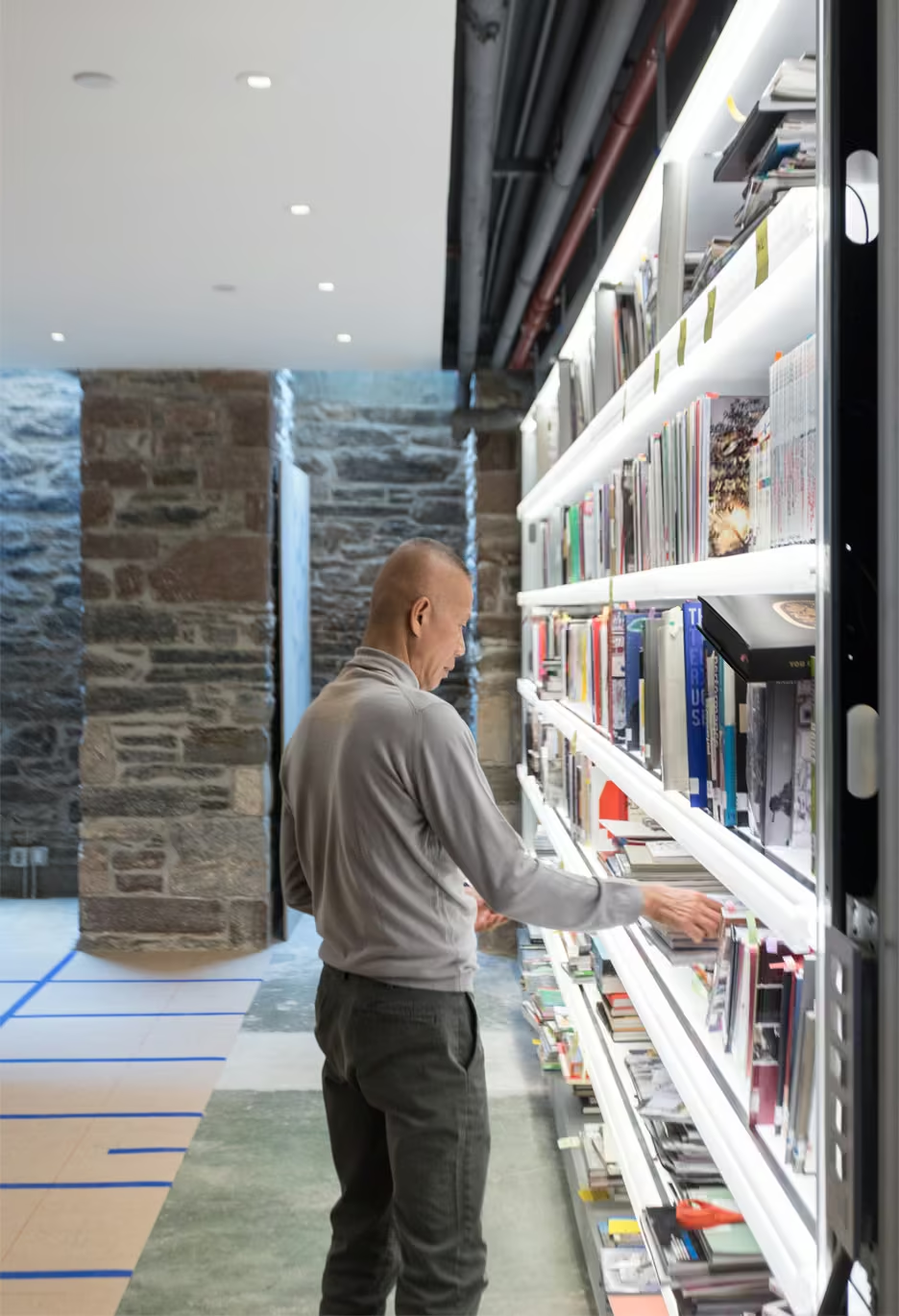
Cai browsing a brightly illuminated modern library shelf in a space featuring rustic stone walls and a contemporary design.
He trained in stage design at the Shanghai Theatre Academy in the early 1980s, then spent nearly nine years living in Japan starting in late 1986, where he kept developing the gunpowder technique he’d first picked up in China. That period left him with lasting ties to Japan that have outlasted his move to New York in 1995: in 1998 he installed Cultural Melting Bath, a public onsen-style bath permanently sited at the Naoshima Contemporary Art Museum, and for close to two decades he has kept returning to Iwaki City in Fukushima, building work there out of wrecked fishing boats left behind by the region’s disasters. He now runs his practice through Cai Studio, the organization that handles fabrication, archives, and business matters for his work out of a converted 1885 schoolhouse on the Lower East Side.
The years right after his move to New York produced some of his most direct engagement with weapons of mass destruction as subject matter. In 1993, working with fuses and gunpowder, he staged Project to Extend the Great Wall of China by 10,000 Meters, a line of fire meant to visually lengthen the wall itself. In 1994, shortly before leaving Japan, he floated a black mushroom cloud made of 114 helium balloons over a park near Hiroshima’s Atomic Bomb Dome and ignited the fuses strung between them. Two years after that, in February 1996, he became the first Chinese citizen granted access to the former Nevada Test Site, where he built a hand-held gunpowder device from firecrackers bought in a New York Chinatown and detonated it on the desert floor as part of a photographic series called The Century with Mushroom Clouds. By one telling of the story, the small blast startled the military personnel escorting him badly enough that word of it climbed all the way up their chain of command before anyone realized the “device” in question was firecracker powder and let the matter drop.
The medium that built his name also produced his most public controversy. At the 48th Venice Biennale in 1999, Cai brought sculptors from China to recreate Rent Collection Courtyard, a 1965 propaganda tableau depicting peasants suffering under a landlord, rebuilding it in unfired clay that cracked and fell apart over the run of the show. The piece won the Golden Lion, and it also drew a copyright claim from sculptors behind the 1965 original, a case that was eventually set aside given the politically sensitive ground it stood on. Cai’s fireworks reached a far larger audience in 2008, when he served as Director of Visual and Special Effects for the opening and closing ceremonies of the Beijing Summer Olympics, a role he’d repeat for Beijing’s Winter Olympics in 2022. In between, he staged Transient Rainbow, a fireworks piece commissioned by the Museum of Modern Art in 2002, and mounted I Want to Believe, a 2008 Guggenheim retrospective that broke the museum’s attendance record for a visual art exhibition before traveling on to Beijing and Bilbao. That show opened with Inopportune: Stage One, nine cars suspended through the rotunda’s void and threaded with light tubes to suggest the freeze-frame sequence of a car bomb going off, and it brought back Rent Collection Courtyard under a new name, New York’s Rent Collection Courtyard, rebuilt on site by a fresh crew of sculptors the same way the Venice version had been a decade earlier. By 2012, the year his third Sky Ladder attempt fell apart in Los Angeles, he had also been named a Praemium Imperiale laureate and had received the first Medal of Arts issued by the U.S. Department of State, recognition that sat oddly alongside a project he still couldn’t get off the ground. Cai Studio itself now runs out of a converted schoolhouse on the Lower East Side, built in 1885 and expanded by Rem Koolhaas’s firm OMA into an archive, fabrication space, and reception area for a working practice that, without a commercial gallery behind it, handles almost everything in house.
shh
Sky Ladder wasn’t built with an audience in mind beyond Huiyu Island, but once Cai Studio posted footage of it that August, it moved well past the harbor where it happened. The bigger audience arrived the following year, when Kevin Macdonald, the director of The Last King of Scotland, built a feature documentary around the piece. Sky Ladder: The Art of Cai Guo-Qiang, produced by Wendi Murdoch, follows the 21 year path from Bath to Fujian through interviews with Cai, Hong Hong, and people close to the project, and sets the ladder inside a longer account of his gunpowder practice, his family, and the Cultural Revolution he grew up under. It premiered on Netflix on October 14, 2016, running 76 minutes across English and Mandarin.
The film introduced Sky Ladder to an audience well beyond the art world, and Cai’s institutional standing kept expand in its wake. Over the following years he mounted solo exhibit inside some of Europe’s oldest museums as part of a project framed as an individual’s journey through Western art history, including the Pushkin State Museum of Fine Arts in Moscow in 2017, the Prado in Madrid across 2017 and 2018, and the Uffizi Galleries in Florence from 2018 into 2019. By 2019 he had also shown work at the National Archaeological Museum of Naples, built around the ruins of Pompeii, and at the Cleveland Museum of Art and the National Gallery of Victoria in Melbourne, a run of institution recognize that arrive only after the ladder he’d spent 21 years failing to build had finally worked without any institution involved at all.
None of it changed what actually happened at Huiyu Island Harbour that June morning. Sky Ladder was built for an audience of one grandmother, on a fisherman’s schedule, with a budget nobody outside the family was meant to see. It burned for two and a half minutes, went dark over the water, and by the time the sun was fully up, the only trace left was smoke and a video file that hadn’t yet been uploaded anywhere. What followed, the viral clip, the documentary, the museum tour, all of it happened after the fact, to a piece that had already finished being what it was built to be: a private gift, made without permits or an audience in mind, that ended up watched by millions of people who were never supposed to see it at all.
Related Articles
Modigliani’s Limestone ‘Tête’
Carved from a single block of limestone in Montparnasse more than a century ago, one of Modigliani's rare stone heads goes to auction for the first time…