DRIFT AUDIO
Listen to this story
Choose a voice, then press play.
Thom Browne trades Manhattan for the Scottish hills this fall, casting friends and locals in cable-knits, tartan and tailoring built for the cold.
A line of friends and locals moves across a hillside outside a small Scottish town, cable-knit cardigans pulled over check flannel, breath visible in the cold air. It is the kind of scene that could read as a stretch for an American label built on the boardrooms and prep schools of the East Coast. For Thom Browne, it is closer to a homecoming.
Scotland has been woven into the brand’s design vocabulary since 2006, when Browne registered a proprietary grey and navy tartan on the official Tartan Registry of Scotland, produced by Lochcarron of Scotland, the mill that has been weaving fabric in the Scottish Borders since 1947 and now operates out of Waverley Mill in Selkirk. The pattern has resurfaced across menswear and womenswear runways ever since, most prominently when Browne built an entire Fall 2022 collection around it. The country’s textile industry runs deeper still: the neighboring Borders town of Hawick has been called the cashmere capital of the world since the late 19th century, home to mills like Pringle of Scotland, founded in 1815, that turned imported cashmere and local wool into a global luxury export. Scotland’s water has long been part of that reputation, too, with the mineral content of lochs like Loch Leven historically prized for the consistency it gives to dye and finish.
That history gave Browne, an American designer through and through, a legitimate hook to shoot his Fall 2026 campaign on Scottish ground rather than simply reference the country’s cloth from a studio in New York. Browne launched his label in 2001 with a five-piece suit collection out of a by-appointment shop in Manhattan’s West Village, and has since picked up the CFDA’s Menswear Designer of the Year award three times, GQ’s Designer of the Year, and the Cooper Hewitt National Design Award, on top of becoming CFDA chairman himself in 2023, succeeding Tom Ford. The label is majority owned by the Ermenegildo Zegna Group, which acquired an 85 percent stake in 2018 at a $500 million valuation and now also owns ZEGNA and Tom Ford Fashion, with Browne remaining chief creative officer and the label’s sole other shareholder. Two decades into the business, the Scotland trip reads less like a marketing conceit than the next chapter of a relationship the brand has been building with the country’s textile tradition since its earliest tartan runs.
View this post on Instagram
stir
To shoot it, Browne turned again to Robbie Lawrence, the photographer he worked with this past spring on a limited-edition magazine shot in Japan, which paired a cast of locals with the brand’s tailoring and its Asics collaboration footwear. For the Scotland campaign, the choice carries extra weight: Lawrence is Scottish himself, born in Edinburgh and now based in London, and Scotland’s landscape and people have been the subject of his personal work for the better part of a decade.
After an English literature degree at the University of St Andrews and an early stint as a photo editor trainee at the International Herald Tribune in Paris, Lawrence built a career on long-form documentary work, photographing projects in the Congo, Sierra Leone and the Faroe Islands alongside a 2019 collaboration with the United Nations titled “Freetown.” His first monograph, “Blackwater River,” traced the Ogeechee River through coastal Georgia, was published by Stanley/Barker in 2019, landed on the cover of the British Journal of Photography and was named the New Statesman’s photo book of the year. The following year he published “A Voice Above the Linn,” which followed his visits to botanist Jim Taggart’s gardens on Scotland’s west coast, and in 2022, Stills gallery in Edinburgh gave Lawrence his first UK institutional solo show, “Northern Diary,” a survey of Scotland’s cities, rural stretches and coastal towns made in the years after Brexit.
That same instinct for finding narrative in ordinary faces and landscapes is what Browne is borrowing for this campaign: a group of friends and locals dressed in the label’s tailoring rather than professional models alone, photographed with the same painterly, observational eye Lawrence has turned on his home country for years. It is worth noting, too, that Lawrence’s own student years at St Andrews put him a short drive from the golf course where Fair Isle knitwear first entered global fashion history, a coincidence that only underlines how tightly this campaign’s setting and its knitwear are tied to the same patch of Scottish ground.
flow
Knitwear is the backbone of the collection, worked in cashmere and merino wool across a handful of techniques with real craft history behind them. Chunky cable-knits sit alongside Fair Isle patterning, the stranded colorwork technique that takes its name from Fair Isle, a tiny island in the Shetland archipelago where knitters produced the pattern by hand for generations before it broke into wider fashion. That crossover point has its own well-documented origin story: the Prince of Wales, later King Edward VIII, wore a Fair Isle sweater while golfing at St Andrews in 1921, and the resulting photographs turned a local craft into an international trend almost overnight.
Intarsia works differently. Rather than carrying a second color across the back of the fabric the way Fair Isle does, intarsia knits solid blocks of color directly into the garment, which is what allows for the sharper, more graphic images and lettering that show up in intarsia sweaters versus the smaller, repeating geometric motifs typical of Fair Isle. Browne’s Fall 2026 range leans on both techniques side by side, pairing traditional colorwork with more graphic intarsia designs across V-neck pullovers and cardigans. Patchwork knits push the idea further still, piecing together multiple stitches and panels within a single garment, and the same patchwork logic carries over into knitted outerwear as well, extending the technique beyond sweaters and into heavier, jacket-weight pieces.
It is a knitwear-forward collection in a way that suits the setting. Where Browne’s runway shows have often leaned on the discipline of his shrunken tailoring, this campaign gives the softer, handworked side of the brand more room, letting cable stitch and colorwork carry as much visual weight as a lapel or a pleat. The range spans easy layering pieces through to more sculptural patchwork constructions, giving the collection’s cold-weather offering real depth rather than a single knitwear idea repeated across different colorways.
tailor
Browne’s tailoring gets a technical update for the season, mixing lightweight down filling, more commonly seen in technical outerwear than in suiting, with the kind of fabrics that have defined his tailoring for two decades: chalk-stripe flannel, jacket-weight cashmere and windowpane tweed. The combination puts a genuinely warm, insulated layer underneath cloth that would otherwise read as pure city tailoring, a pairing that makes considerably more sense against a Scottish hillside than a Manhattan sidewalk, and a real departure from the closer-cut, unlined tailoring that first built Browne’s reputation when he launched the label in 2001.
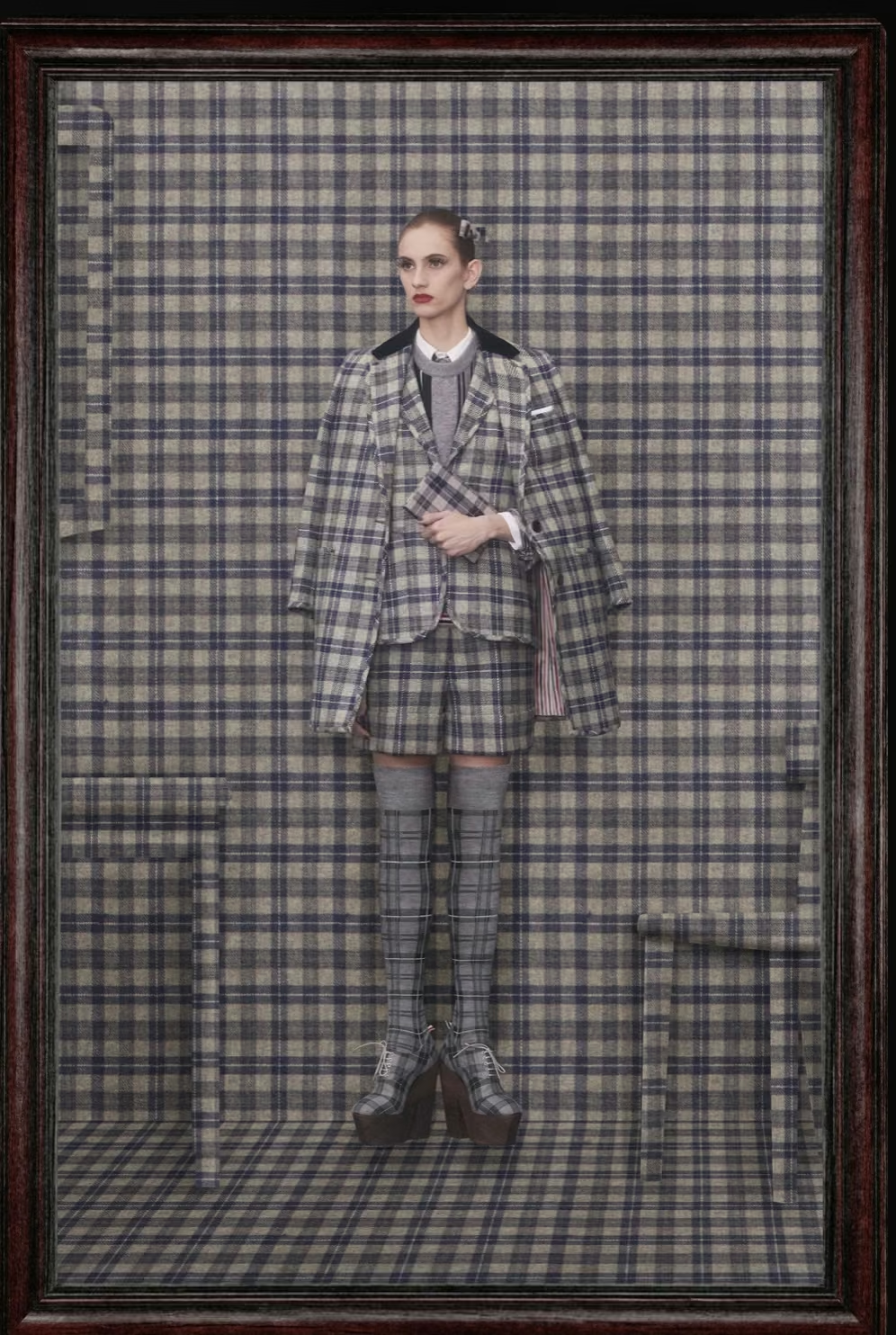
Surreal Tartan: A Thom Browne spatial illusion
Windowpane tweed carries its own piece of Borders history into the mix. Tweed cloth takes its name from the River Tweed, which runs through the same Scottish Borders region as Lochcarron’s Selkirk mill, though the connection is reportedly an accident of spelling rather than a deliberate tribute: according to the most repeated version of the story, an 1826 order for “tweel,” the Scots word for twill, was misread by a London merchant as “tweed” and the name stuck. Whether or not the anecdote is entirely accurate, tweed has stayed rooted in the Borders ever since, woven from the wool of Cheviot sheep that graze the same hills the campaign was shot in and historically finished using the region’s rivers, the same water sources that shaped the area’s cashmere and tartan trades.
Ski culture supplies the season’s other reference point. Thumbholes and rib-knit gaiters, both borrowed from alpine and ski-wear construction, show up on cropped vests, football parkas and longer, calf-length jackets, adding a functional, outdoor-ready finish to pieces that are otherwise built from tailoring cloth. The thumbholes anchor cuffs in place under gloves, and the rib-knit gaiters seal hems against wind and snow, both details borrowed wholesale from performance skiwear rather than tailoring’s own vocabulary. It is a hybrid approach, playing Browne’s East Coast prep codes against genuinely technical outerwear details, and it gives the collection’s outerwear a sportier finish than his past few seasons of tailoring-led ranges.
struct
Browne’s black tie offering is reimagined for the season with dresses, capes and sharply structured sport coats, continuing a run of formalwear experimentation that stretches back through the brand’s history. His womenswear line first drew wide public attention in January 2013, when Michelle Obama wore one of his designs to the presidential inauguration, and his eveningwear has stayed a testing ground for construction ever since. His Fall 2021 collection, built almost entirely around black-tie dressing, included a ball skirt made from more than 100 individually cut pattern pieces of layered puffer fabric, evidence of just how far Browne is willing to push a formalwear silhouette before it stops reading as formalwear at all.
This season’s updates are smaller in scale but no less technical. The formalwear leans into the same handcraft focus as the rest of the collection rather than sitting apart from it: trompe l’oeil detailing plays with the eye, open-back closures cut into otherwise buttoned-up silhouettes, and windowpane checks are rendered in pearls rather than woven or printed into cloth. It is a small, technical set of updates rather than a wholesale reinvention of Browne’s eveningwear codes, but each detail pulls formalwear a step closer to the collection’s broader idea: traditional construction, reworked with an unexpected material or technique. The pearl-rendered windowpane, in particular, echoes the tartan and check patterns running through the knitwear and tailoring elsewhere in the range, tying black tie back into the same design language rather than treating it as a separate category.
people
For the campaign itself, Browne and Lawrence gathered a group of friends and locals in a hillside Scottish town, identified by WWD as Birman, and photographed them in the season’s tailored pieces and outerwear rather than casting the shoot exclusively with professional models. Stuart Williamson styled the campaign, Eoin Mcloughlin served as director of photography, and model Arthur del Beato appears throughout the stills and an accompanying short video, which will run across the brand’s social channels alongside the still photography.
It is a casting approach Browne and Lawrence had already tested together earlier in the year, when their Japan-shot magazine paired local faces with Thom Browne tailoring and the brand’s Asics collaboration footwear rather than a conventional model booking. Casting real locals a second time, this time on Lawrence’s own home turf, fits the campaign’s broader logic: this is a collection built on a genuine, decades-long relationship with Scottish textile tradition, and shooting it with the people who actually live in that landscape, guided by a photographer from the same country, keeps the idea from reading as a costume exercise. It also gives the campaign a looser, more documentary feel than a typical studio-shot lookbook, closer in spirit to the kind of work Lawrence has been producing in Scotland for most of his career, from the Linn Gardens on the west coast to the post-Brexit portraits that made up “Northern Diary.”
The Scotland shoot also continues a pattern Browne has leaned on for years: staging campaigns as small, self-contained narratives rather than straightforward product shots, with past seasonal stories built around settings from a Manhattan office to a garden party. Framing Fall 2026 around a specific Scottish hillside and a cast of people who actually live there fits squarely into that approach, giving the collection’s tartan and cashmere references a real backdrop rather than a studio stand-in.
The Fall 2026 collection, including the knitwear, tailoring and black tie pieces from the Scottish shoot, is now available through Thom Browne’s website and its network of stores.
Related Articles
Two Flagships and a Kojima Factory: John Elliott Rolls Out Fall/Winter 26 Delivery II
The second drop of John Elliott's Fall/Winter 26 season is live online and at the Melrose Avenue and Lafayette Street flagships, following a Delivery I…