Jasper Johns: Night Driver at Guggenheim Bilbao Explores Seven Decades of Artistic Innovation

May 30, 2026
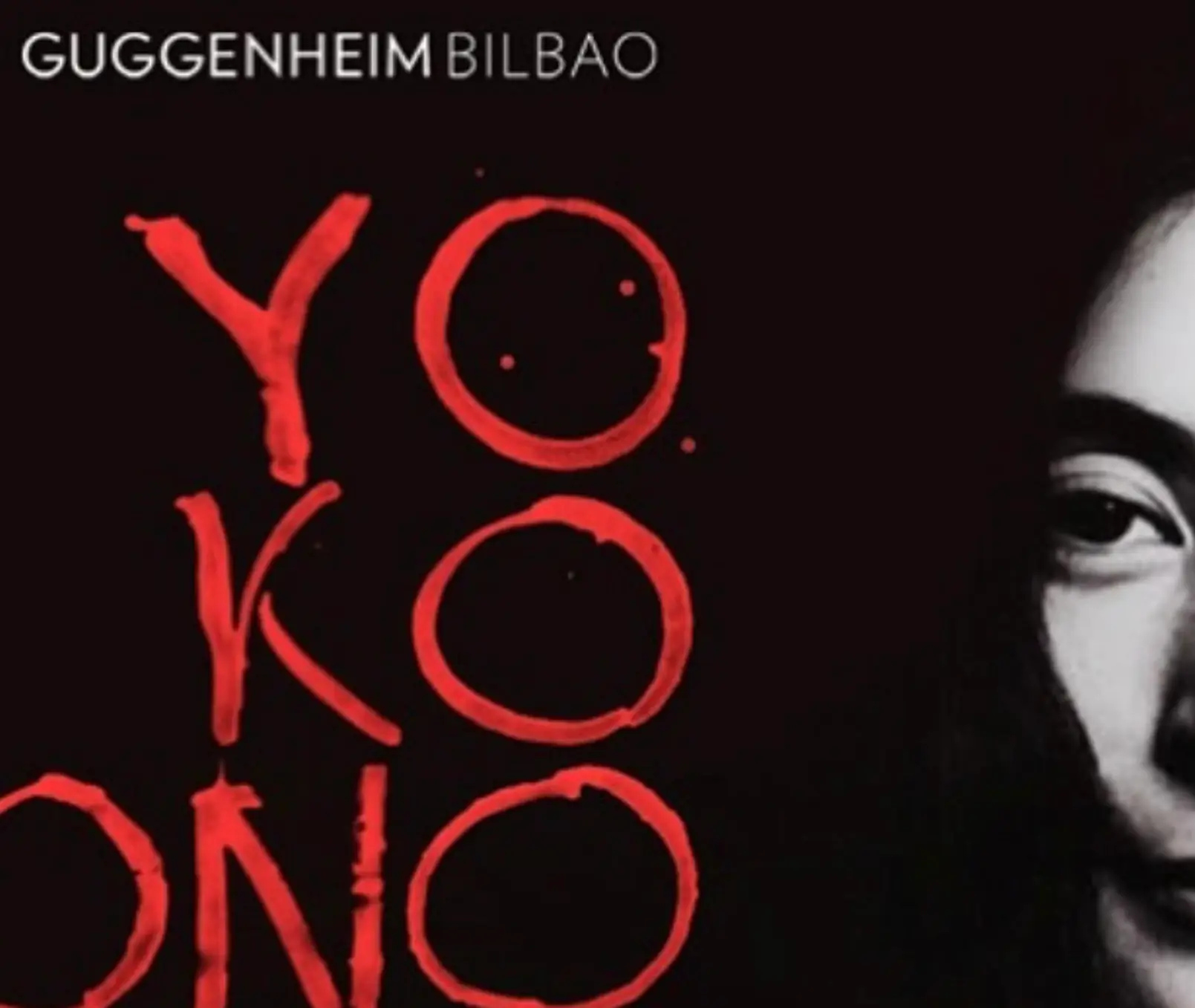
The Guggenheim Museum Bilbao has opened one of the most significant exhibitions of 2026: Jasper Johns: Night Driver. Running from May 29 to October 12, 2026, this ambitious retrospective gathers approximately 100–140 works—paintings, sculptures, drawings, prints, an artist’s book, and even stage designs—spanning seven decades of one of America’s most influential postwar artists. Curated by Enrique Juncosa, the exhibition is titled after Johns’s 1960 drawing Night Driver, evoking themes of journey, darkness, and illumination that resonate throughout his career.
Jasper Johns, born in 1930 in Augusta, Georgia, and raised in South Carolina, moved to New York in 1953. There, he formed pivotal relationships with Robert Rauschenberg, John Cage, and Merce Cunningham. In 1954–55, he famously destroyed nearly all his prior work and began creating the iconic pieces that would redefine American art: flags, targets, numbers, letters, and maps. These everyday symbols, rendered with deliberate ambiguity, marked a radical departure from Abstract Expressionism’s emotional intensity toward a cooler, more intellectual inquiry into representation, perception, and meaning.
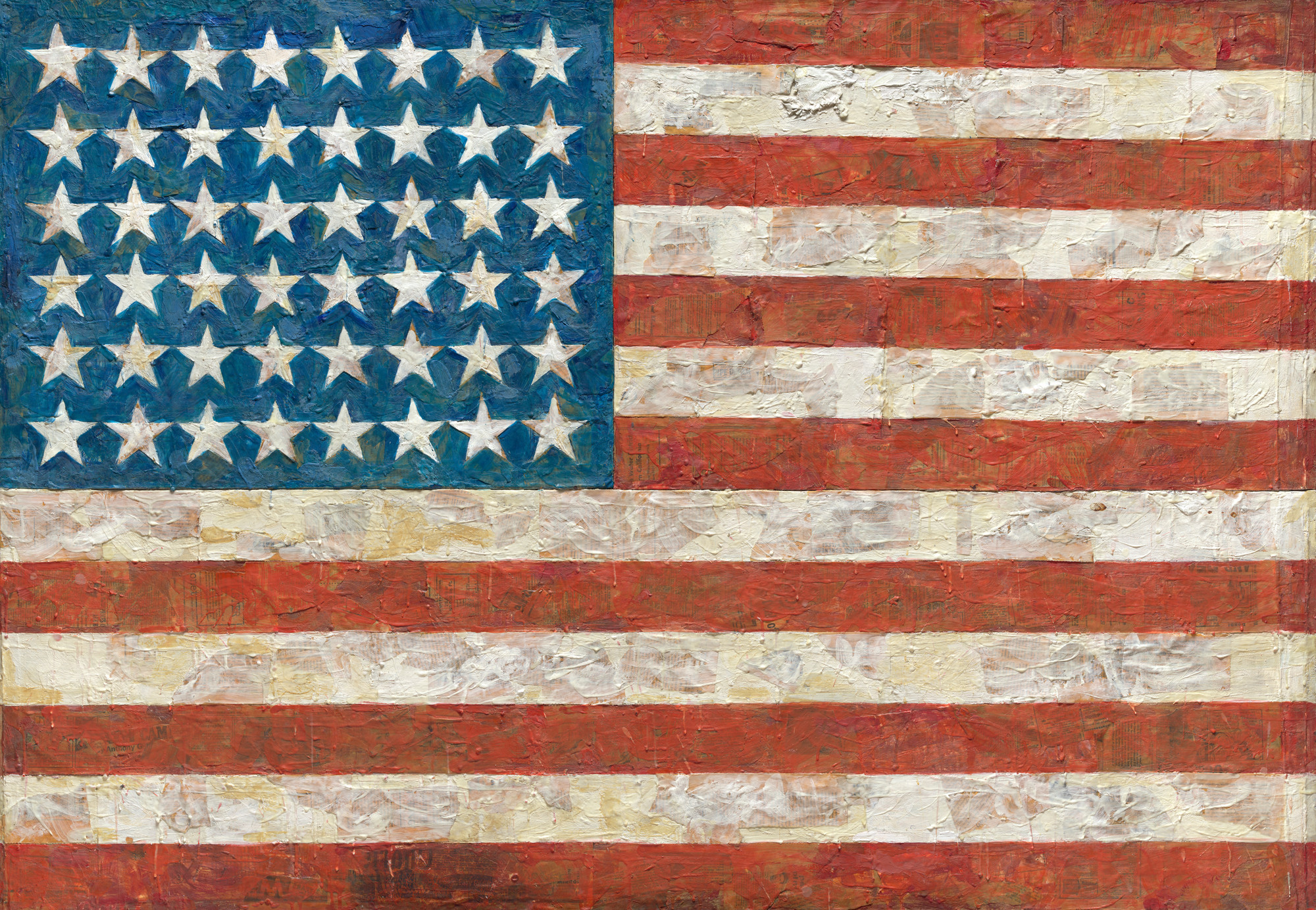
Jasper Johns, Flag, 1954–55 (MoMA collection). One of the artist’s foundational works that launched his exploration of familiar symbols.
day
The exhibition opens in Gallery 205 with Johns’s groundbreaking early works. Flag on Orange Field (1957, encaustic on canvas, Museum Ludwig, Cologne) greets visitors with its rich, textured surface. Encaustic—pigment mixed with hot wax—gives Johns’s surfaces a luminous, almost sculptural quality, embedding newspaper fragments that hint at hidden narratives beneath the familiar icon.
Nearby hangs Target (1961, encaustic and collage on canvas, The Art Institute of Chicago), its concentric circles inviting both optical engagement and philosophical questioning: What does it mean to “hit the mark” in art? Johns’s use of found objects and collage blurs the line between painting and sculpture, prefiguring Pop Art while maintaining a hermetic depth.
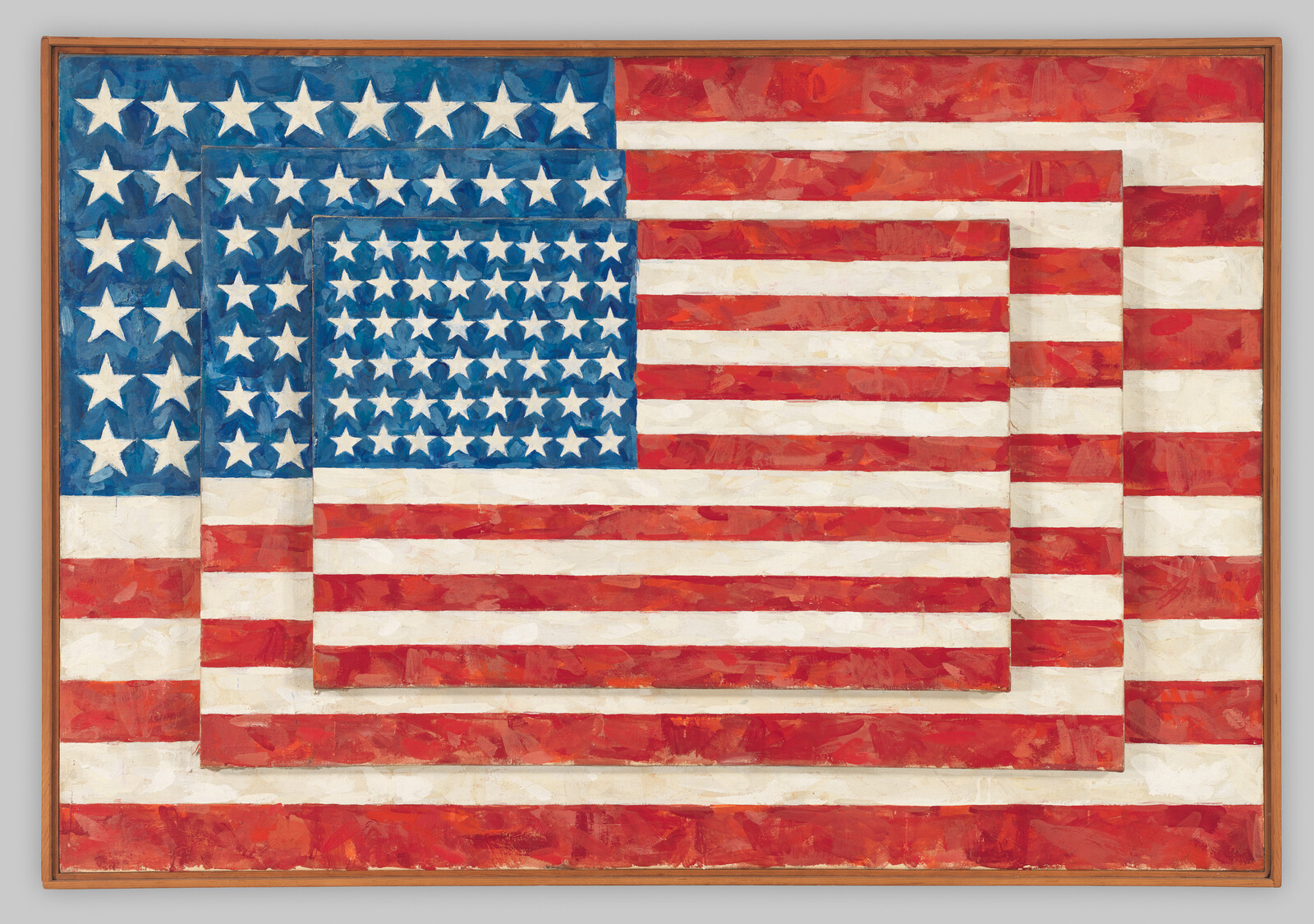
Jasper Johns, Three Flags, 1958. A quintessential example of his flag series, exploring repetition and national symbolism.
Map (1961, oil on canvas, MoMA) stretches across a large scale, with the United States rendered in Johns’s characteristic gestural yet controlled hand. These works from the late 1950s, first shown at Leo Castelli Gallery in 1958, brought Johns instant acclaim and positioned him as a bridge between Abstract Expressionism and the emerging movements of the 1960s.
Johns’s art has always resisted easy interpretation. As the curator notes, his pieces invite reflection on the nature of art itself—how symbols gain meaning, how materials convey emotion, and how viewers project their own experiences onto the canvas. This retrospective emphasizes that duality: the retinal pleasure of rich surfaces alongside intellectual rigor.
tred
Gallery 206 features works like Painting with Two Balls (1960) and Souvenir (1964), which incorporate objects and personal references. Johns’s studio-themed paintings from the mid-1960s, including Studio (1964) and Untitled (1964–65), reflect on the act of creation itself.
By the 1970s, Johns turned to abstraction with his crosshatch series—dense networks of parallel lines in vibrant colors, as seen in works like Corpse and Mirror (1974–75). These pieces echo the rhythmic structures of Cage’s music and Cunningham’s dance, with whom Johns collaborated.
The exhibition highlights the Seasons series from the mid-1980s, deeply autobiographical works featuring fragmented self-portraits, shadows, and references to art history. Summer (1985, encaustic on canvas, MoMA) and Fall (1986) layer personal memory with cultural allusions, including quotes from poets like Hart Crane and Frank O’Hara.

Installation view from Jasper Johns: Night Driver at Guggenheim Bilbao, showcasing the scale and dialogue between works.
In Gallery 207, Dancers on a Plane (1980–81, oil on canvas with painted bronze frame, Tate) pays homage to Cunningham, its title referencing a collaborative performance. These works demonstrate Johns’s ongoing dialogue with friends and influences, from Marcel Duchamp’s conceptual play to historical masters like Grünewald and Picasso.
simple
As Johns aged, his practice simplified. The late galleries feature pieces from the 1990s and 2000s, including dense, allegorical compositions from the late 1980s like Montez Singing (1989–90) and Untitled (1992–94, Eli and Edythe L. Broad Collection), which weave together skulls, body parts, and art-historical references.
The exhibition culminates with selections from the Catenary series (1997–2003), meditative abstractions featuring a hanging string or wire that creates a graceful curve across the canvas. These works explore gravity, tension, balance, and time—universal themes rendered with profound economy. Slice (2020), one of the most recent paintings included, incorporates an anatomical diagram, nodding to the artist’s awareness of the body’s fragility.
Johns’s works on paper occupy dedicated spaces (Galleries 202 and 203), underscoring that his prints and drawings are not mere studies but autonomous explorations. Pieces like Tantric Detail (1980) and Untitled (1983 monotype) reveal his mastery of lithography, etching, and other techniques.
leg
Night Driver arrives at a moment when Johns, now in his mid-90s, is widely recognized as a towering figure whose influence permeates contemporary art. His questioning of authorship, originality, and the image anticipated Conceptualism and continues to inspire younger generations. The show’s scale—drawn from global collections—makes it one of the most comprehensive European presentations of his work.
Bilbao’s Frank Gehry-designed museum provides an ideal setting. The titanium-clad galleries, with their dramatic curves and natural light, engage in a dynamic conversation with Johns’s textured surfaces and intellectual precision. Visitors move through chronological and thematic groupings that reveal recurring motifs: the body, memory, duality, and the passage of time.
Juncosa’s curation emphasizes Johns’s resourcefulness as a painter—his constant experimentation with materials (encaustic, collage, bronze casting) and his ability to extract new meanings from familiar forms. The title Night Driver suggests a solitary journey through darkness, headlights illuminating fragments of the road ahead—a fitting metaphor for an artist who has navigated art history with quiet determination.
why
In an era of digital immediacy and fleeting images, Johns’s deliberate, layered practice feels profoundly contemporary. His flags challenge nationalism and identity; his targets question aim and accuracy in a polarized world; his abstractions invite contemplation amid distraction. The retrospective not only celebrates a remarkable career but also reminds us of art’s capacity to slow us down, to make the familiar strange, and to provoke ongoing dialogue.
The Guggenheim Bilbao has positioned Jasper Johns: Night Driver as a landmark event, supported by the BBVA Foundation. Accompanying programs include opening talks, audio guides, and educational resources through the Didaktika project, making the exhibition accessible to broad audiences.
For art lovers in Europe and beyond, this is a rare opportunity to experience the full breadth of Johns’s achievement in one of the continent’s most spectacular museum spaces. As the exhibition’s press materials note, Johns’s work carries emotional weight while pioneering Minimalist and Conceptual directions—qualities that continue to resonate powerfully today.\