CBGB by Ron Crawford: A Watercolor Tribute to Punk’s Sacred

May 29, 2026
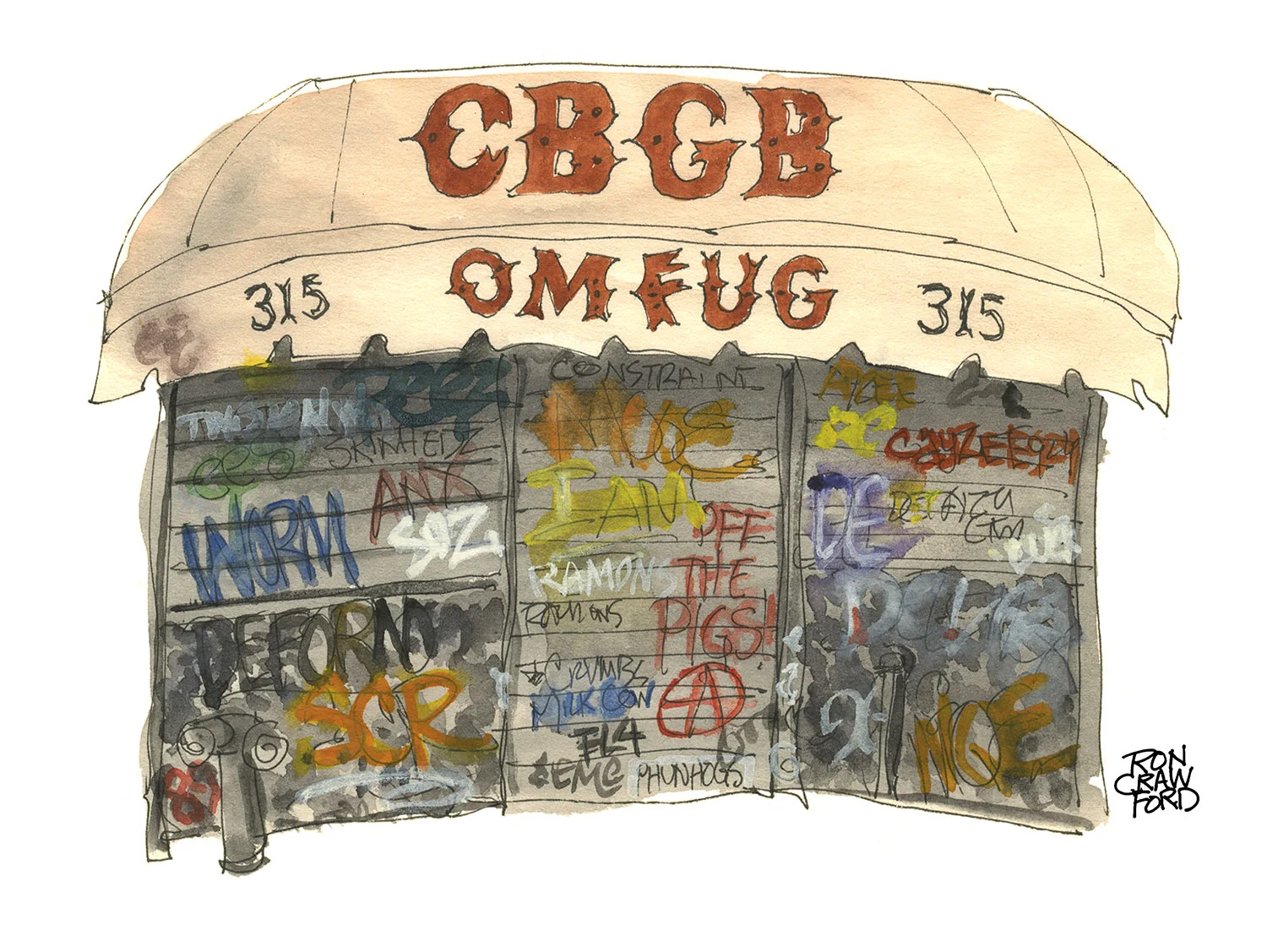
Ron Crawford’s watercolor painting of the legendary CBGB storefront captures the raw, unpolished soul of one of rock music’s most influential venues. The artwork depicts the iconic facade at 315 Bowery in Manhattan’s East Village, immortalizing the battered awning, the hand-painted signage, and the chaotic layers of graffiti that defined the club’s exterior during its heyday. This museum-quality Giclée print, produced on fine art paper with fade-free inks and hand-signed by the artist, serves as both a nostalgic artifact and a vibrant view history lesson.
View this post on Instagram
stir
Ron Crawford is a New York-based artist specializing in urban scenes, particularly iconic locations in cities like New York, San Francisco, and Chicago. His work often blends watercolor techniques with a loose, expressive style that emphasizes atmosphere, texture, and lived-in character over photorealistic precision. Crawford’s “New York City” series includes pieces like Carnegie Hall, Chinatown, and this CBGB rendering, which stands out for its energetic depiction of street-level grit.
His approach to the CBGB painting feels deeply personal. The composition centers on the club’s distinctive curved awning, rendered in soft beige and cream tones with view brushwork that suggests weathering and age. The bold red-brown lettering “CBGB” dominates the top, while “OM FUG” (part of the full acronym) appears below in the same distressed style. Flanking numbers “315” anchor the composition. Below the awning, the facade explodes with multicolored graffiti—tags, band names, and anarchic symbols in blues, yellows, oranges, reds, and blacks—mirroring the real venue’s ever-evolving, chaotic exterior. A signature in the bottom right reads “RON CRAWFORD,” and the overall piece has a spontaneous, on-location feel typical of urban sketching elevated to finished art.
flow
The painting meticulously recreates details that punk aficionados would recognize instantly:
- The Awning: The tattered, overhanging canopy with its hand-lettered signage.
- Graffiti Layers: View references include band names and punk motifs like “RAMONES,” “DEFORM,” anarchist symbols (the circled “A”), and overlapping tags. This layered chaos reflects how the walls served as a public bulletin board for the scene—constantly repainted yet always accumulating new expressions.
- The Doorway and Details: A microphone stand peeks out, hinting at the performances inside, while pipes and architectural grime ground the piece in gritty realism.
- Color Palette: Warm earth tones for the structure contrast with the vibrant, rebellious graffiti, evoking both decay and vitality.
Crawford’s watercolor medium is perfect for this subject. The translucent washes elicit underlying textures to show through, much like how the club’s walls absorbed decades of posters, spray paint, and history.
hx
CBGB opened on December 10, 1973, founded by Hilly Kristal (born Hillel Kristal), a former Marine and folk musician. The name originally stood for Country, BlueGrass, and Blues (with OMFUG meaning “Other Music For Uplifting Gormandizers”). Kristal intended it as a roots music venue, but the Bowery location—then a sketchy area filled with flophouses and vagrants—attracted a different crowd.
By 1974, it became the epicenter of the emerging New York punk and new wave scenes. The club was notoriously grimy: a long, narrow space with sticky floors, a tiny stage, and a bathroom that was legendary for its filth. The sound was loud, raw, and unpolished. No-frills PA system. No glitz. Just pure energy.
Key milestones and bands:
- The Ramones: Played their first show on August 16, 1974. Their fast, min “1-2-3-4!” style defined punk. Hits like “Blitzkrieg Bop” were born here.
- Patti Smith: Her flow, fierce performances (including with the Patti Smith Group) helped bridge punk with art rock.
- Blondie, Talking Heads, Television: These acts brought new wave sensibilities, blending punk with pop, funk, and avant-garde elements.
- Other Legends: The Dead Boys, Richard Hell and the Voidoids, Suicide, Mink DeVille, and later acts like the Misfits, Agnostic Front, and even occasional visits from bigger names.
CBGB hosted thousands of shows until its closure on October 15, 2006, after a long rent dispute with the Bowery Residents’ Committee. The final concert featured Blondie and others. The physical space is now a high-end clothing store (John Varvatos), but the spirit endures through memorabilia, the CBGB Music & Film Festival, and cultural references.
The club’s influence extended far beyond New York. It inspired the UK punk explosion (Sex Pistols, The Clash), the American hardcore scene, and alternative rock. Bands like Nirvana, Green Day, and countless others cite CBGB as a foundational myth.
why
Crawford’s work isn’t just a portrait of a building—it’s a portrait of a culture moment. In the 1970s, New York was bankrupt, dangerous, and creatively explosive. CBGB embodied that: a filthy dive where misfits, artists, and rebels created something revolutionary. The graffiti in the painting represents the DIY ethos—no corporate sponsorship, just kids with spray cans and guitars.
The Giclée printing process ensures archival quality, making these prints suitable for collectors. Each one is individually inspected and signed, adding a personal touch that echoes the club’s intimate, hand-made vibe.
leg
Today, CBGB lives on in:
- Documentaries and films (CBGB (2013) starring Alan Rickman as Hilly Kristal).
- Museums and exhibits (the Rock & Roll Hall of Fame has artifacts; the Met has related photography).
- Fashion and merchandising (the iconic awning logo appears on T-shirts worldwide).
- Music education: Punk’s emphasis on authenticity, speed, and attitude influences everything from indie rock to hip-hop production.
- Tourism: Fans still visit the Bowery to pay homage, even if the club itself is gone.
Ron Crawford’s artwork contributes to this preservation. In an era of digital everything, his hand-painted tribute reminds us of the tangible, messy reality of cultural birthplaces. It’s not sanitized or romanticized—the stains, overlaps, and imperfection are the point.
huh
Available through Crawford’s official site (roncrawfordart.com), the print comes in various sizes with pricing starting around $30 for smaller editions. Its accessibility makes it appealing for both punk historians and art lovers. The watercolor style pairs well with mid-century modern, industrial loft, or eclectic rock-themed interiors.
Framing suggestion: A simple black or distressed wood frame to echo the club’s aesthetic, perhaps with a small plaque noting the venue’s address and years of operation (1973–2006).
clue
Ron Crawford’s CBGB is more than a pretty picture of a famous building. It freezes in time the chaotic beauty of a place where the rules were rewritten. Looking at the graffiti-covered walls in the painting, one can almost hear the feedback from a Ramones amp, smell the stale beer, and feel the sticky floor underfoot.