DRIFT AUDIO
Listen to this story
Choose a voice, then press play.
Two old convincers, one room, eight episodes: JAŸ-Z sits with Rick Rubin to walk through three decades of his own catalog, song by song.
HBO Max released the full trailer for “JAŸ-Z in 8” on August 26, following an earlier teaser that arrived back in June when the project was first announced. What it shows is deliberately spare. Two men sit across from each other in an ornate, high ceilinged room, cameras trained on their conversation rather than on archival clips, performance footage, or outside interviews. JAY-Z and Rick Rubin listen to music together, then talk about what they heard.
The whole thing was shot over two days in Paris, in black and white, with Bradford Young, the Oscar nominated cinematographer behind “Arrival” and “Selma,” serving as director of photography. The trailer opens on a fragment (“But imagine…”) before Jay recites the opening bars of a song from 2003’s “The Black Album.” Rubin turns to him and asks, “You up for listening to a bit of music, sir?” Jay’s answer comes fast: he’s in.
From there the conversation drifts toward his own beginnings as a writer. He describes catching what he calls the writing bug around age nine and settling into a habit of writing daily, a routine he traces directly back to the writer he’d eventually become. He goes on to frame hip hop’s pull in terms of the underdog spirit it channels back at its own audience. Rubin, audibly struck by the scale of what came out of that instinct, calls it incredible and wonders aloud how far the music can still go.
An earlier teaser, rel back in June when HBO first announced the series, leaned even further into that same emotional register. In it, Jay talks about using his lyrics to put words to what he and the people around him were living through, and Rubin responds with a line that doubles as a thesis for the whole project: “Without the pain, you wouldn’t have done the work.” Jay’s reply, in essence, is that the pain isn’t something to seek out, just something worth using if it happens to be there.
The choice to shoot in black and white pairs with the room’s period detail to give brand new footage an almost archival look, a visual language that echoes the way Jay talks about his own catalog throughout, treating songs written decades apart as part of one continuous document. Young’s own credits beyond documentary work include “Arrival,” “Selma,” “A Most Violent Year,” and “Solo: A Star Wars Story,” along with the Netflix series “When They See Us.”
flow
The series runs eight episodes, released two at a time each Friday: September 18, September 25, October 2, and October 9. On HBO proper, the two episodes in each pair air back to back, the first at 8:00 p.m. ET/PT and the second immediately after at 8:45 p.m. Both are available to stream on HBO Max the same evening, starting at 8:00 p.m. ET.
Rather than moving in a straight chronological line through Jay’s career, each episode is built around a small cluster of songs that Rubin selected himself. The published breakdown covers six of the eight chapters so far. The premiere pairs “Meet the Parents” and “Can’t Knock the Hustle” with “Brooklyn’s Finest” and a deep cut featuring Angela Winbush. Later chapters work through “This Can’t Be Life,” “4:44,” “Where I’m From,” “Jail,” “Kill Jay-Z,” “99 Problems,” and “Dead Presidents II,” among others, while the eighth and final installment is expected to close on “The Story of O.J.,” “No Church in the Wild,” “Family Feud,” and a track titled “Legacy.” A full song list for chapter seven had not been made public as of this writing.
The mix within a given chapter is telling. Chapter six alone pairs the confrontational self examination of “Kill Jay-Z” with the swagger of “99 Problems” and “Threat,” suggesting the series isn’t grouped strictly by mood or era so much as by whatever conversation a given set of songs happens to unlock. More than two decades separate some of the tracks discussed in a single sitting, from “Politics as Usual” off “Reasonable Doubt” to 2017’s “4:44,” underlining how much ground eight episodes are being asked to cover.
The structure treats individual recordings, rather than a strict timeline of events, as the entry point into Jay’s life. Specific songs set the agenda for each conversation, with the discussion built outward from there instead of following a straightforward biographical throughline. It’s a format Rubin has used once before, and that precedent is a big part of the next chapter of this story.
scope
Rubin’s relationship with Jay’s catalog didn’t start with this series. He co-founded Def Jam Recordings in 1984 and later launched American Recordings, building a production career that runs from early hip hop pioneers like LL Cool J, the Beastie Boys, and Run-DMC through decades of work in rock, metal, country, and pop, producing for artists including Johnny Cash, Metallica, and Adele along the way. Somewhere in the middle of that run, he produced “99 Problems,” the Black Album single that’s now one of Jay’s signature records, and reportedly one of the tracks anchoring an episode of the new series.
The two have crossed paths on camera before this. Rubin appears alongside Jay in the 2004 concert film “Fade to Black,” shot during the making of “99 Problems,” and the pair later recorded a commercial series in which Jay played Rubin early tracks from 2013’s “Magna Carta… Holy Grail.” “JAŸ-Z in 8” extends that same basic dynamic, a session of shared listening and reaction, into a full eight episode format, and it marks Rubin’s first credit directing a documentary series of his own.
His closest prior credit in the space is 2021’s “McCartney 3, 2, 1” for Hulu, in which he sat across from Paul McCartney working through Beatles and Wings recordings in essentially the same conversational, song anchored style now being applied to Jay’s catalog. The new series is produced under Tetragrammaton, Rubin’s own media outlet and long running interview podcast, and presented by HBO Documentary Films.
Rubin’s own resume includes eight Grammy Awards, among them Album of the Year for The Chicks and for Adele, plus repeated recognition as the recording industry’s Producer of the Year. Those credentials put him in a small group of people Jay might plausibly sit across from for eight hours of unscripted conversation about his own work without the exchange feeling like a standard interview.
drive
The timing here isn’t incidental. 2026 marks thirty years since JAY-Z‘s debut album, “Reasonable Doubt,” and twenty five since “The Blueprint,” and the documentary lands squarely inside a year Jay has already built around both anniversaries. He played a three night residency at Yankee Stadium in July, followed by additional shows in Paris and London, part of what’s shaping up as one of the more concentrated stretches of career retrospective activity he’s put together in years. Rare remixes and pop up experiences tied to “Reasonable Doubt” have surfaced elsewhere in New York throughout the year as well.
The pairing of stadium spectacle with an intimate, unhurried sit down gives the anniversary year two very different registers: one built for an audience of tens of thousands, the other for a single conversation partner and a room full of cameras. Coming right behind those shows, “JAŸ-Z in 8” reads less like a standalone project than the next beat in a longer victory lap, one built around listening back rather than performing live.
Roc-A-Fella Records, which Jay co-founded in 1994 to release his own early albums beginning with “Reasonable Doubt,” remains the throughline connecting that original independent push to a documentary now airing on one of the country’s largest streaming platforms.
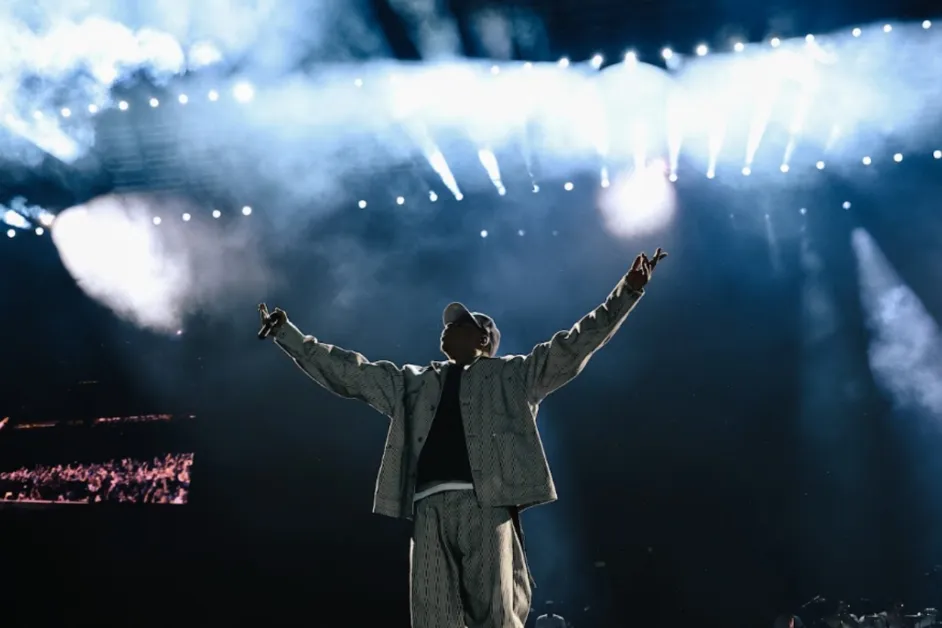
Jay-Z performing live with his arms raised in front of a dramatic backdrop of stage lights and smoke.
contour
Behind the camera, the series is executive produced by Jay himself, credited under his given name Shawn Carter, alongside Rubin and actor Daniel Kaluuya. Kaluuya’s credit traces back to an appearance on Rubin’s Tetragrammaton podcast, after which he reportedly supplied notes on early cuts of the series, an involvement said to predate this year’s announcement by more than two years.
Leila Mattimore and David Rohde serve as producers, with Harlin Lawal and Will Mavronicolas credited as co-producers. On the HBO side, Nancy Abraham, Lisa Heller, and Sara Rodriguez are listed as executive producers, with the series presented by HBO Documentary Films and produced by Tetragrammaton.
Tetragrammaton has spent the past few years building a following well outside the music industry, publishing long interviews with guests ranging from designers and scientists to fellow musicians through both its podcast and its minimalist, Squarespace built website. This documentary marks one of the platform’s first forays into long form video at series length, expanding what had mostly been an audio and web based project into television.
With Jay himself holding an executive producer credit, the series gives him a level of control over how his own catalog gets discussed that a traditional third party documentary wouldn’t offer, a dynamic that’s likely to color how critics and longtime fans read the project once it actually airs.
fin
“JAŸ-Z in 8” premieres September 18 on HBO and HBO Max, with the first two episodes airing back to back before the schedule shifts to weekly Friday pairs through the October 9 finale. Official marketing materials style the title slightly differently than the shorthand circulating in coverage, rendering the “8” as an infinity symbol: “JAŸ-Z in ∞.”
The series arrives as part of a packed September slate for HBO Max, alongside new titles including “A Killer Story” and the documentary “Siren: The Voices of Shelley Beattie.” Online reaction to the trailer so far skews toward anticipation from longtime fans revisiting a catalog many of them grew up on, alongside a smaller, more skeptical thread wondering whether eight episodes of conversation, without concerts or new music attached, can sustain that same energy over multiple weeks.
Both camps will get their answer in real time, episode by episode, rather than all at once, since HBO’s weekly rollout means the series’ full shape won’t be visible until the October 9 finale. The trailer has circulated widely since its August 26 release. The first real answer arrives September 18.
Related Articles
A$AP Rocky Answers FERG’s Album Search With an Invitation Home
After months of disagreement over FERG’s name, Rocky’s response to his album update suggests a way to work together again.