

DRIFT AUDIO
Listen to this story
Choose a voice, then press play.
Jil Sander shot its Fall/Winter 2026 campaign on a private airfield, furnishing an empty runway like a living room that wandered outside.
Jil Sander shot its Fall/Winter 2026 campaign on a private airfield, and nobody bothered to explain why a sofa was sitting on the tarmac.
A Runway Without a Show
The set is the first thing that unsettles. An otherwise empty runway, the kind built for planes rather than models, has been furnished like a living room that wander outside and got lost. A sofa wrapped in foil catch the light wrong. A dining table is sheath in latex. A gleaming black desk sits exposed to the wind, as if an office had been lift whole from its building and set down in the open air. There is no explanation offered for any of it, and none is coming. The campaign, styled around Jil Sander’s Fall/Winter 2026 collection under creative director Simone Bellotti, treats that absence of explanation as the whole point.
The mood pulls from an unlikely pair of references: Alfred Hitchcock’s controlled dread and Rainer Werner Fassbinder’s claustrophobic domestic tension, both filtered through grainy, washed out VHS texture. Planes occasionally cut through the frame uninvited, a reminder that this furniture has no business being where it is. The effect sits somewhere between a photo shoot that got interrupted and a dream that borrowed its props from home before losing track of where home was.
Bellotti has described the intent behind the setting in plain terms, saying he wanted to convey “tension and surprise with the least means possible.” Doing more with less is, in his own words, very much the house’s lang already. What he pushed toward this time, by his own account, was an eerier route into that same restraint, one built less around what’s missing from the frame than around what shouldn’t be in it at all.
View this post on Instagram
stir
Edie Campbell and Daisuke Ueda carry the story, to the extent it can be called one. Campbell, cast in something close to a Hitchcockian heroine role, moves through the incongruous furniture in states the campaign never resolves: caught between arrive and departing, at ease and unsettle in the same frame. The British model has spent close to two decades doing exactly this kind of ambiguous, character-driven campaign work. She was discover as a teenager through a Vogue feature by Mario Testino, broke through with a Burberry campaign at sixteen, and went on to become a fixture for Chanel, Dior, Hermès and Saint Laurent, earning Model of the Year at the British Fashion Awards in 2013 along the way. She studied History of Art at the Courtauld Institute, competes as a jockey, and has run her own label, Itchy Scratchy Patchy, since 2015. She has also used her platform to speak publicly against abusive practices in the modeling industry, backing model rights campaigns and writing about the issue for trade press. None of that biography explains what her character is doing on an abandoned runway, which is presumably the idea.
Daisuke Ueda carries the menswear with a similar charged ambiguity beside her. The Japanese model has built a two decade career on exactly this kind of shh command show, become the first Asian model to appear on the cover of Vogue Hommes Japan, shot by Steven Klein under Nicola Formichetti’s artistic direction. His campaign history spans Dior Homme, Giorgio Armani and Dolce & Gabbana, and he was the only Asian face among the thirty one models featured on Details’ September 2015 cover. More recently, he has walked for Fendi and appeared in Canali’s advertising, keeping a low, steady presence in menswear that suits the Jil Sander campaign’s refusal to overexplain itself. Pairing him with Campbell, two models whose careers have both leaned on quiet intensity rather than obvious charisma, is very much in keeping with a campaign that asks its cast to hold tension rather than perform a narrative.
scope
The footage itself was shot by British photographer Moni Haworth, working on a mini DV tape camera rather than anything higher resolution. That choice was deliberate: the format’s imprecise color and texture reads as more impressionistic than documentary, which suited the sense of a slightly undone, half remembered domestic scene that Bellotti was after for the collection. Campaign stills were pulled directly from the moving footage rather than shot separately, which is part of why the images carry the unstable, in-between quality that runs through the whole project.
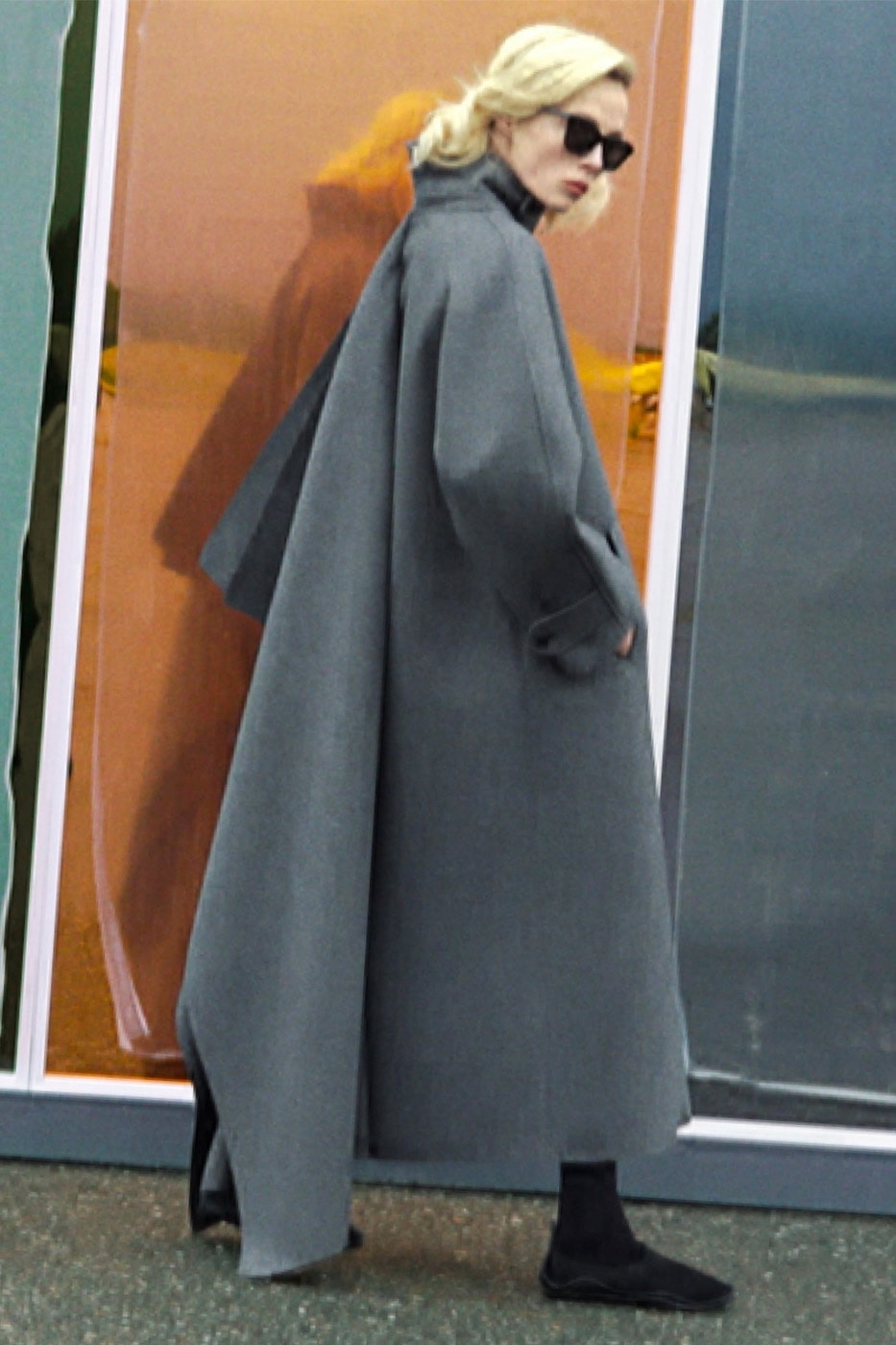
Haworth, UK born and now based in Los Angeles, has built a career on exactly this kind of grainy, nostalgic image making. She is a longtime convincer of artist and photographer Petra Collins, a partner that produced Haworth’s first book, Lunar Library, in 2021, and she has shot campaigns for Marni, Miu Miu, Hodakova, Acne Studios and, most recently, Adidas and Yohji Yamamoto’s Y-3 line, alongside editorial work for Dazed and AnOther. The Jil Sander project pushes her usual aesthetic into more overtly cinematic territory, treating the campaign less like a lookbook and more like stills from a film that was never meant to have a plot.
Asked about the format, Haworth has said she loves “an impressionist image more than a detailed high-resolution one,” and that the choice fed directly into the abstract, slightly surreal read of home and life Bellotti was chasing for the collection. She has also said the soundtrack came together only after the footage was shot, arriving with a rhythm and psychology that lined up with the material almost immediately once she and the team heard it. That sequencing, image first and score second, runs against how most fashion films are built, and it goes some way toward explaining why the finished piece feels less like a soundtrack laid over footage than two separate anxieties that happened to arrive at the same conclusion.
hum
Space Afrika supplies the soundtrack, and the choice says as much about the campaign’s mood as anything happening on screen. The Manchester and Berlin based duo of Joshua Tarelle Reid and Joshua Inyang have spent over a decade building a reputation for spacious, unsettled electronic music that draws on ambient, dub techno and trip hop, most notably on 2021’s Honest Labour, which won Resident Advisor’s Album of the Year and Bandcamp’s Best Ambient Album. Their track “If This Is Hell,” featuring New York artist Deuén, arrived as the lead single from their upcoming fourth album, Quiet Storm, due September 25 on Dais Records, a record shaped in part by a collaboration with conceptual artist Glenn Ligon, who provided both the album’s title and its cover artwork.
The track itself is built around a single take, stream of consciousness vocal from Deuén, real name Kaiuna Odogba, delivered at a pace fast enough that the lyrics resist a clean read on first listen, cutting out abruptly on the line “I wonder if that’s what heaven’s like?” Quiet Storm itself carries a wider list of contributors beyond Deuén, including Kelly Moran, Klein, Tony Njoku and RXKNephew, and takes both its title and its cover artwork, a reworking of Figure #30, from Ligon, whose work has long dealt with Black identity. None of that context is legible from the campaign alone, but it places “If This Is Hell” inside a genuinely significant release for Space Afrika rather than a one-off placement, which gives the soundtrack a weight the view lean on without ever spelling out.
Jil Sander’s creative team has said the track arrived after the shoot was already finished, and that its nervy, fragmented rhythm ended up matching the footage almost by accident. Either or not that account is taken at face value, the pairing works: a soundtrack that refuses to resolve, laid under images that refuse to explain themselves.
View this post on Instagram
second
This is Simone Bellotti’s second collection at Jil Sander, and its themes track closely with what he started building in his first. Bellotti was named creative director in March 2025, succeeding Luke and Lucie Meier after their seven year run at the house, and arrived with a resume built at Bally, where he served as creative director from 2023, and a sixteen year run at Gucci before that, alongside earlier stints at Dolce & Gabbana, Bottega Veneta, Gianfranco Ferré and A.F. Vandevorst. His Jil Sander debut, shown in Milan in September 2025 for Spring 2026, leaned on sculptural silhouettes and saturated cobalt and cerulean tones to establish his own register within the house’s minimalist frame, with longtime Sander muse Guinevere Van Seenus, a model in her late forties and a fixture of the house since the Meier era, opening the show. Casting director Ben Grimes filled out that debut with a run of other models over forty, including Malgosia Bela, Natasha Poly, Saskia de Brauw, Marina Perez, Iselin Steiro and Elise Crombez, a choice that read as a deliberate statement about who gets to embody Jil Sander’s idea of quiet authority.
For Fall/Winter 2026, shown at Jil Sander’s Milan headquarters on February 25, Bellotti built the runway collection around the idea of an “indoor wardrobe,” sending out looks in deep black, grey and midnight blue alongside a soundtrack of Kim Gordon reading a poem by Italian writer Chiara Barzini about the unease of inheriting someone else’s home. Guests received the poem in their inboxes as an audio file days before the show, framing what they’d see before they saw it. The show explored the tension between what’s superfluous and what’s essential in a garment, backward tipped collars and slit backs standing in for the idea of a house that reveals more of itself the longer you live in it. Bellotti, the son of an upholsterer, has framed the show around the idea of inheriting a house that was already fully furnished by the time he arrived, its rooms shaped by someone else’s history before he ever got to add his own.
The campaign picks that theme up and relocates it somewhere stranger. If the runway show was about inheriting a house, the campaign is about what happens when that house’s furniture ends up somewhere it was never meant to be. Clean lines and crisp shapes carry over from the collection itself, alongside structured outerwear and precise tailoring, but the unexpected textures Bellotti built into the clothes (a gloss here, a rougher weave there) find their echo in the props around them: foil, latex, distressed video static. Rather than moving away from Jil Sander’s Scandinavian minimalist roots, the campaign pushes them into a space they’ve rarely occupied, trading the brand’s usual white cube stillness for something closer to unease.
fin
None of this is a wholesale reinvention of the house, and it isn’t meant to be. Jil Sander built her namesake label in Hamburg in 1968 on the premise that restraint could be its own form of haute a know that earned her the nickname “Queen of Less” and carried the brand through a complicated ownership history: a majority stake sold to the Prada Group in 1999, a series of exits and returns by Sander herself through the 2000s, Raf Simons’ seven year tenure starting in 2005, and the Meiers’ run from 2017 before Bellotti’s arrival. The brand is now part of Renzo Rosso’s OTB Group, alongside labels including Diesel, Maison Margiela and Marni, a stable of houses that has made a habit of hiring designers willing to push a founder’s original language somewhere it hasn’t been before rather than simply maintaining it.
What Bellotti appears to be doing, two seasons in, is treating that minimal inheritance the same way his Fall/Winter collection treats a house: not as something to strip back further, but as a structure worth complicating from the inside. A campaign shot on expired feeling videotape, set to a soundtrack that refuses to sit still, staged in a location that has nothing to do with domestic life at all, is a strange way to sell tailor. It is also, on the evidence of Bellotti’s first year at Jil Sander, exactly the kind of strange the house now seems willing to make room for.