DRIFT AUDIO
Listen to this story
Choose a voice, then press play.
A two-year, $8 million deal places the NBA’s all-time leading scorer beside Joel Embiid, Tyrese Maxey and Jaylen Brown, turning Philadelphia into the league’s most closely watched late-career experiment.
The most surprising part of LeBron James choosing Philadelphia is not that he changed teams again. He has spent the second half of his career making large decisions in public, carrying the expectations of franchises, television networks and entire cities along with him. The surprise is the scale of the contract and the language around it. James announced that he is joining the 76ers on a reported two-year, $8 million agreement with a player option, then described it as his “last decision.” For a player whose choices have repeatedly reorganized the NBA, the final one arrives as both a blockbuster and a deliberate reduction.
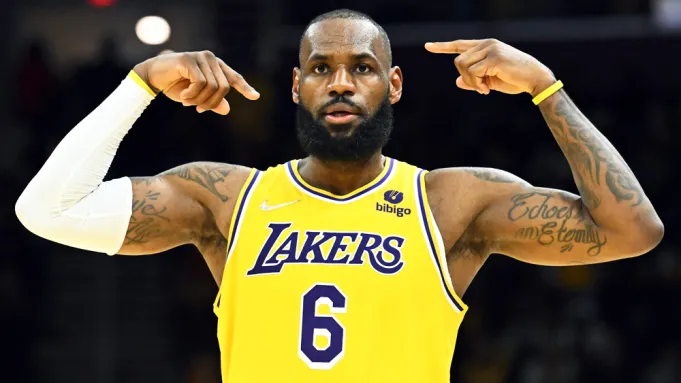
LeBron points to the mind that built a career of rings. At 41 he leaves the Lakers for Philly on an $8M deal, chasing one final title with Maxey, Brown and Embiid.
James is not arriving in Philadelphia as a ceremonial veteran. He is entering a 24th NBA season after averaging 20.9 points, 6.1 rebounds and 7.2 assists for the Lakers in 2025-26. Those numbers represented his lowest scoring average, but they would still define a highly productive season for almost anyone else. At 41, he remains capable of controlling possessions, punishing mismatches and turning a broken offensive sequence into a useful shot. The physical margin is smaller. The reading of the game is not.
His social-media statement made clear that retirement had become a real possibility. James wrote that he had been fairly sure he had played his final game before taking time to decide what remained. The answer was not a reunion in Cleveland, another year in Los Angeles or a nostalgia tour in Miami. It was Philadelphia, a franchise whose recent history has been shaped by championship ambition, physical uncertainty and the long afterlife of The Process.
why
The money gives the decision its emotional and strategic weight. James earned $52.6 million with the Lakers in 2025-26 after exercising his player option. A two-year package worth $8 million is not simply a pay cut. It is a veteran-minimum-scale agreement for one of the most commercially powerful athletes in the world, and it communicates that this final chapter is being organized around opportunity rather than salary.
That distinction matters under the NBA’s current roster rules. Philadelphia has spent aggressively to collect stars and now has to live with the restrictions that follow. James arriving at a minimal cap number gives the 76ers a player with elite decision-making without forcing the franchise to dismantle the supporting structure simply to fit him. The contract creates flexibility precisely because his reputation suggests he could have demanded almost any arrangement that the market could legally support.
It also changes the usual late-career story. Aging stars often become expensive symbols of a franchise’s past or arrive as specialists expected to survive around younger legs. James is doing something stranger. He is lowering the financial cost while increasing the cultural pressure. Philadelphia is not paying him like a savior, but everyone will judge the season as though he arrived to save it.
flow
The 76ers already had enough talent to make every disappointing season feel avoidable. Joel Embiid remains the central question. At his best, he is an MVP-level center who changes the geometry of the floor and forces opponents to build entire series around his scoring, foul pressure and defensive size. His availability, however, has repeatedly determined whether Philadelphia’s ambitions remain alive long enough to matter.
Jaylen Brown’s arrival from Boston added another proven scorer, defender and transition threat. Tyrese Maxey has grown into the kind of guard who can carry possessions without waiting for a veteran star to organize everything. VJ Edgecombe gives the roster youth, athleticism and a different timetable. On paper, James is joining a team with enough creation to reduce his nightly burden. In practice, the entire idea depends on whether those bodies are available together when the postseason compresses every weakness.
Calling the group a superteam is understandable, but the label can hide the actual engineering problem. Philadelphia does not merely need stars. It needs a workable hierarchy. Maxey requires room to attack. Brown is most dangerous when he can play through decisive actions rather than overthinking congested possessions. Embiid needs touches that establish his authority without freezing everyone else. James has spent two decades solving these questions, but even his basketball intelligence cannot manufacture continuity from an injured roster.
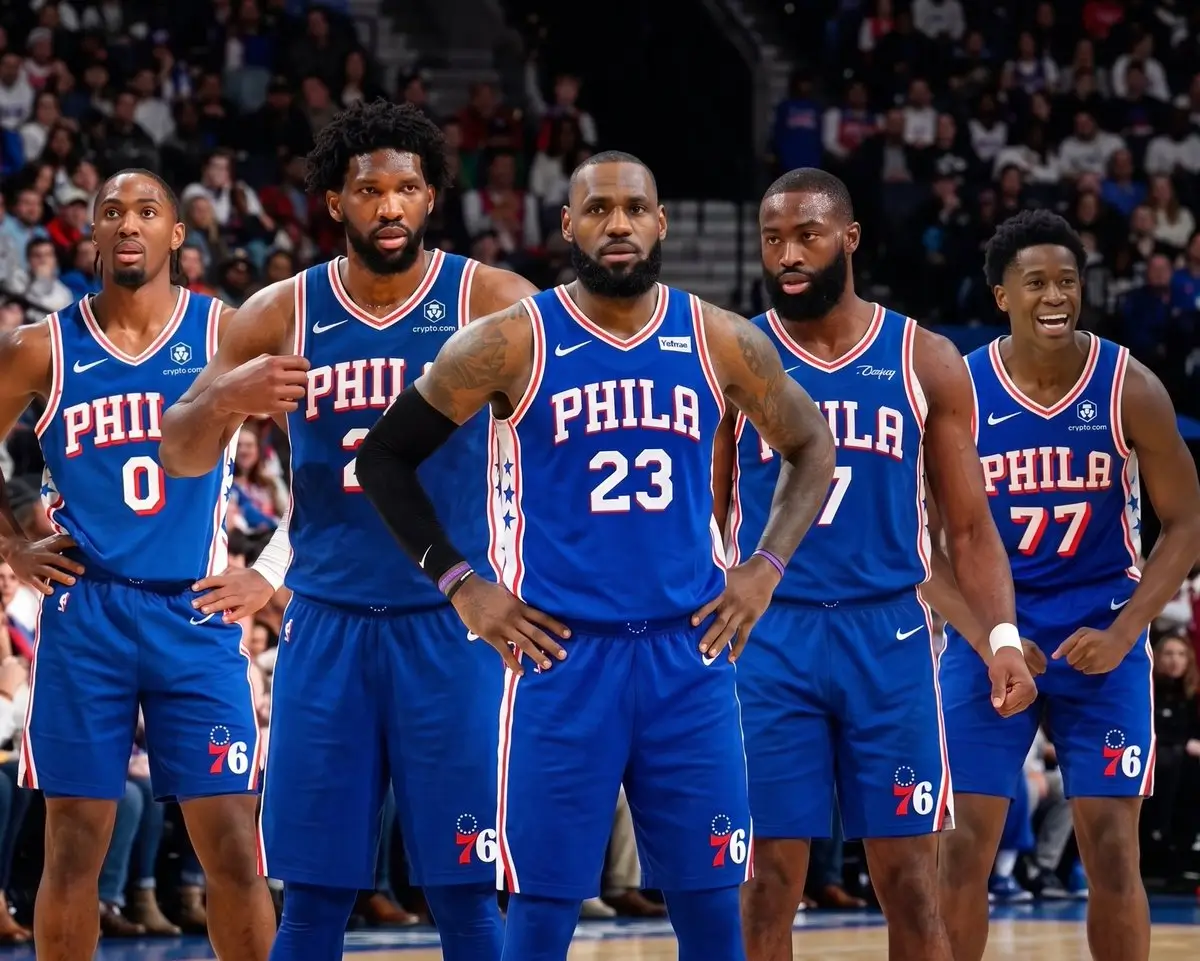
LeBron in Sixers blue, No. 23, flanked by Maxey, Embiid, Brown and Edgecombe. The $8M last decision is now reality—one final
team
The easiest version of the fit starts with James as a connector rather than a permanent engine. He can initiate offense, but he no longer has to dominate every possession. With Maxey pushing pace and Brown attacking tilted defenses, James can work from the elbow, screen for guards, identify switches and become the passer who converts one advantage into a better one. That role preserves energy while using the part of his game that has aged most gracefully.
Beside Embiid, the possibilities are unusually broad. James has always been most dangerous with a big who can create vertical or interior pressure. Embiid is not a conventional rim-running center, but his shooting and post gravity can pull defenders into impossible choices. If opponents load up on Embiid, James sees the weak side. If they switch, both can punish the mismatch. If they retreat, Maxey gains the runway that defines his best basketball.
There will also be friction. James and Embiid naturally slow possessions when they are reading the floor. Brown and Maxey often look best when decisions happen quickly. The coaching challenge is to build lineups that do not treat every star as the same kind of star. Philadelphia should not ask James to recreate the usage of his Cleveland or Miami years. It should ask him to make the group legible, especially in the final six minutes when talent can become clutter.
Defensively, the calculation is less forgiving. James can still defend with strength and anticipation, but a long season cannot be built around asking him to chase younger wings every night. Brown’s versatility and Embiid’s presence should allow the 76ers to shelter certain matchups. Edgecombe’s development may matter just as much as any veteran’s reputation. The roster becomes convincing when its younger players absorb the running and pressure that its oldest stars can no longer sustain for 82 games.
extend
Philadelphia will be James’s fourth NBA franchise after Cleveland, Miami and the Lakers. Each previous move changed the terms of his career. Miami proved that he could build and lead a modern superteam. The return to Cleveland delivered the championship that had defined his hometown relationship. Los Angeles extended his cultural reach and produced another title while connecting his career to the league’s most visible franchise.
Philadelphia offers a different kind of ending. There is no homecoming and no obvious brand expansion that he still needs. The city gives him a serious basketball problem: a talented team with enormous expectations, a franchise that has not won a championship since 1983 and a fan base that rarely confuses affection with patience. Winning there would not simply add a fifth ring. It would make James the organizing veteran behind a title for a fourth franchise, a final argument built less on statistical accumulation than on adaptable.
The choice also returns him to the Eastern Conference, where much of his career mythology was constructed. For eight consecutive seasons between 2011 and 2018, the road to the Finals ran through a team led by James. That history does not guarantee anything now. It does make the visual feel familiar: LeBron in the East, surrounded by stars, forcing every contender to recalculate what April and May might look like.
I thought I was done when the season ended. I wasn’t ready to announce it, and I knew I needed some time to really decide, but I was pretty sure I played my last game. I was honest at that last press conference when I said I needed to look at myself and deicide if I still love
— LeBron James (@KingJames) July 24, 2026
live
The most lifestyle-ready detail in the reporting is also the one that requires the clearest restraint. ESPN reporters said that the possibility of James living in New York or New Jersey and commuting to Philadelphia added to the appeal of the move. Subsequent coverage translated that possibility into a helicopter commute, helped by the relatively short distance between Manhattan and Philadelphia.
At this stage, it is a possibility, not a confirmed routine. James has not announced a permanent New York residence, and the 76ers have not described a travel arrangement. It is fair to include the detail because it says something about the unusual geography of his final decision. It should not become the article’s central fact or be written as though a daily flight schedule already exists.
The larger point is that Philadelphia allowed James to choose a basketball destination without surrendering access to another major cultural center. For a player whose career has always existed across sport, entertainment and business, that flexibility has an obvious logic. The Wawa jokes will write themselves. The actual story is that a veteran of his stature could negotiate not only a role and a contract, but the shape of the life around the season.
challenge
The signing turns the 76ers into a spectacle before it turns them into a champion. They will be one of the league’s most watched teams, and every ordinary problem will be interpreted as evidence about the experiment. A January losing streak will become a question about age. A missed Embiid game will revive the health debate. A quiet fourth quarter from James will be treated as a referendum on whether the final season has already lasted too long.
Philadelphia’s task is to resist living inside that noise. The regular season should be used to establish combinations, protect the oldest bodies and define who controls which moments. Maxey cannot be reduced to a supporting guard simply because James has arrived. Brown cannot become an expensive defensive accessory. Embiid cannot carry a workload that makes April less likely. James cannot be asked to solve every problem that existed before he signed.
The reward is obvious. Few teams can put four players of this reputation on the floor and still claim that the oldest one accepted the smallest contract. Few final chapters begin with this much possibility. James has spent his career making decisions that create a before and an after. Philadelphia now has the last one, and with it the obligation to turn a remarkable announcement into a coherent basketball team.
For the 76ers, the move is not proof that The Process finally worked, nor is it a guarantee that one more superstar will erase the franchise’s postseason disappointments. It is a narrow, expensive, fascinating chance. James has decided that he still wants to play. Philadelphia has decided that its current window is worth one more dramatic expansion. Everything after that will be measured in health, fit and the games that remain when the season stops being theoretical.