DRIFT AUDIO
Listen to this story
Choose a voice, then press play.
index
- Luc Tuymans: Master of the Muted Image
- Bob, 2022: Technical Specifications and View Description
- The Source: Bob Ross and The Joy of Painting
- Art Historical Dialogues: From Velázquez to the Digital Age
- Context Within The Barn Exhibition (2023)
- Themes of Artificiality, Empathy, and Media Spectacle
- Tuymans’ Technique: Thin Paint, Loaded Meaning
- Culture Resonance in 2026: Nostalgia, Truth, and the Painter’s Role
- Legacy and Collecting History
- Why Bob Matters Now
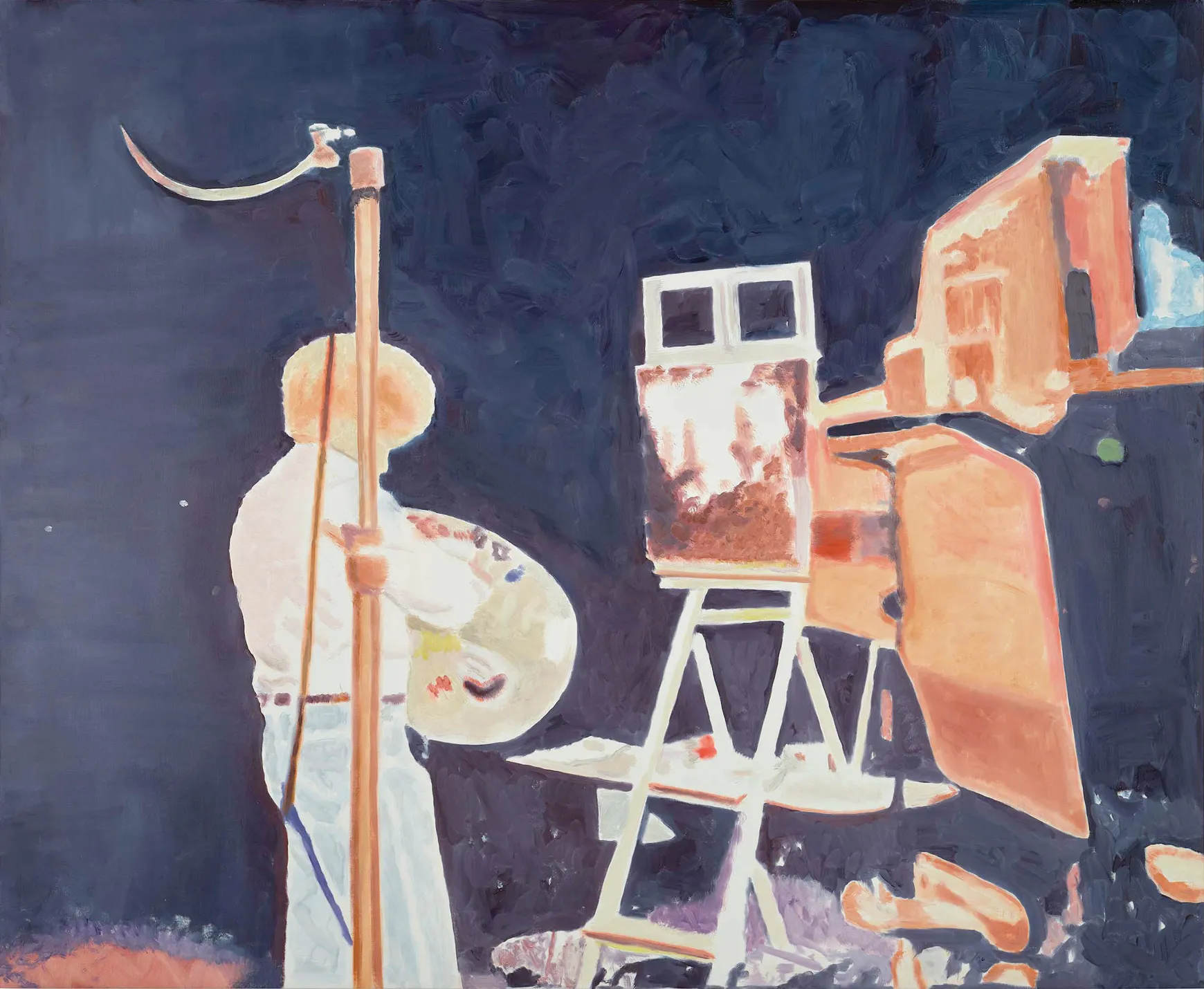
Luc Tuymans, one of the most influential painters of his gen, has long interrogated the slippery boundary between image and reality. His 2022 painting Bob, a large-scale oil on linen measuring 77 x 93 1/2 inches (195.6 x 237.5 cm), exemplifies this inquiry with characteristic subtlety and force. Created as part of a suite of works exploring digital ephemera, media icons, and constructed comfort, Bob captures television personality Bob Ross mid-episode on The Joy of Painting. Rendered in Tuymans’ signature restrained yet intensified palette for this period, the work transforms a figure of widespread culture nostalgia into a haunting meditation on authorship, shoe, and the consolations of televised creativity.
stir
Born in 1958 in Mortsel, Belgium, Tuymans trained as a filmmaker before turning decisively to painting in the late 1980s. His early exposure to cinema informs a practice that treats painting as a form of edited reality — cropping, blurring, and distilling source material (often photographs or video stills) into images that feel simultaneously familiar and estranged. Over decades, Tuymans has addressed heavy historical subjects — Belgian colonialism, the Holocaust, political power — through an aesthetic of understatement. His thin, almost translucent layers of oil paint create a ghostly effect, as if the image is perpetually on the verge of dissolving or being forgotten.
By the early 2020s, Tuymans’ work had evolved to engage more directly with the deluge of digital imagery. Works from this period often begin with cellphone photographs of screens, blending the immediacy of personal capture with the banality of online scrolling. Bob emerges from this context, part of a body of paintings that probe how mass media shapes collective memory and emotional life.
flow
Bob (oil on linen, 195.6 x 237.5 cm) is a substantial horizontal canvas that commands physical presence. The composition centers on Bob Ross in profile or three-quarter view on his television set, his iconic afro hairstyle illuminated dramatically by studio lights. The surrounding environment — the easel, canvas, and set — recedes into deep, saturated silhouette, often described as a dark blue or near-black void. Ross himself appears under harsh, artificial lighting that accentuates the constructed nature of the scene: bright highlights on hair and face contrast with the muted, almost abstracted treatment of the painting-within-the-painting he is creating.
Tuymans’ brushwork is loose yet precise — wet-on-wet passages create soft transitions, while certain edges remain sharply delineated. The tincture palette, heightened compared to his earlier muted works, uses cooler tones punctuated by the warm glow of studio illumination. This contrast heightens the artificiality: Ross, the gentle guide who taught millions “happy little trees,” becomes a spectral performer under interrogation by the painter’s gaze.
origin
Bob Ross (1942–1995) became a culture phenomenon through The Joy of Painting, which aired on PBS from 1983 to 1994. His calm demeanor, catchphrases, and “wet-on-wet” oil technique offered viewers a form of meditative escapism amid the anxieties of late-20th-century America. In the streaming era, Ross experienced a revival, with episodes viewed billions of times online. Tuymans’ choice of source material — likely a screenshot or video still — taps into this renewed nostalgia while questioning its authenticity. Ross was not merely an artist but a carefully crafted media persona, complete with permed hair and standardized format.
By painting Ross at work, Tuymans invokes the trope of the artist in the studio but subverts it. Here, the “artist” is a television product, and the act of creation is performative rather than private.
hx
The painting explicitly dialogues with Diego Velázquez’s Las Meninas (1656), a canonical work depicting the artist at work within a complex web of gazes and representations. Tuymans updates this meta-commentary for the media age: instead of royal patronage, we have public broadcasting and internet virality. Ross becomes a modern stand-in for the painter-as-celebrity, offering viewers not power but emotional solace.
This connection underscores Tuymans’ ongoing engagement with painting’s relationship to other media. Like Gerhard Richter, he uses photographic sources to explore how mechanical reproduction alters perception. Yet Tuymans’ hand remains insistently present — the painting never fully dissolves into photorealism, preserving a layer of subjective interpretation.
reflect
Bob debuted prominently in “The Barn” at David Zwirner, New York (May 11–July 21, 2023), Tuymans’ first U.S. solo since 2016 and the third in a trilogy following Good Luck and Eternity. The exhibition featured large-scale works drawn from digital sources: Smiley (hot air balloon), Abe (Disneyland animatronic Lincoln), The Barn (pastoral scene with iPhone photo roll view), and pieces addressing contemporary conflict like Bucha.
In this company, Bob functions as a counterpoint — a moment of apparent comfort amid themes of dissolution, polarization, and mediated violence. The exhibition’s title painting, The Barn, similarly blurs pastoral idyll with digital framing, reinforcing Tuymans’ interest in how technology shapes our view of reality.
straddle
Bob probes several interconnected ideas. First, the artificiality of televised intimacy: Ross’s soothing voice and steady hand contrast with the harsh studio lighting Tuymans emphasizes. Second, the role of art as emotional infrastructure — Ross provided “joy” through painting instruction; Tuymans questions whether such comfort is sustainable or illusory in a fractured world. Third, the painter’s authority: by depicting another painter (or performer of painting), Tuymans reflects on his own practice and the commodification of creativity.
The work also engages with nostalgia as a cultural force. In 2026, amid digital overload and geopolitical tension, figures like Ross represent a longing for simpler, more deliberate creation. Tuymans neither fully endorses nor dismisses this longing; he holds it at a distance, inviting viewers to examine their own attachments.
mode
Tuymans’ method is deliberate and restrained. He often works from memory after initial photographic capture, mentally rehearsing compositions before committing to canvas. Thin layers allow underlying tones to show through, creating luminosity and ambiguity. In Bob, this technique renders the television set as both tangible space and ethereal projection — much like memory itself. The large scale amplifies the effect, forcing physical engagement with an image originally consumed on small screens.
role
As of 2026, Bob feels increasingly prescient. The resurgence of analog practices, slow media, and figures promising calm amid chaos mirrors Ross’s appeal. Yet Tuymans’ painting reminds us that even comforting images are constructed. In an era of AI-generated art, deepfakes, and polarized discourse, the work asks: What does it mean to paint — or to find joy in painting — when images are so easily manipulated?
leg
Bob has entered notable collections, including Glenstone, and remains a highlight of Tuymans’ recent output. Its exhibition history ties it to major institutions and David Zwirner’s long-term representation of the artist. Auction records for Tuymans’ works demonstrate strong demand for pieces that bridge historical reflection and present urgency.
huh
In Bob, Luc Tuymans delivers a deceptively simple image freighted with complexity. It is at once a portrait, a studio scene, a media critique, and a quiet elegy for shared culture rituals. By painting the painter who taught millions to find beauty in mistakes, Tuymans affirms painting’s enduring capacity to reveal hidden truths — not through literal representation, but through deliberate mediation.
As we navigate 2026’s image-saturated landscape, Bob stands as a powerful reminder: the most resonant art does not shout. It whispers, blurs, and lingers, compelling us to look closer at the sources of our comfort and the mechanisms that shape them.
From the DRIFT archive: Invader Reimagines Pop Icons with Rubik Shot Red Marilyn (2023)