DRIFT AUDIO
Listen to this story
Choose a voice, then press play.
After two decades selling through partners, MB&F finally has a room of its own in Manhattan, and a 25 piece watch made only for that address.
Climb to the fifth floor of the Fuller Building at 595 Madison Avenue and you will not find a counter, a locked case, or a salesperson hovering near the door. That is the point. MB&F, the Geneva watchmaking lab known for turning wristwatches into three dimensional sculpture, has spent the past several weeks settling into its first permanent Manhattan address, a space the brand calls a Lounge rather than a boutique. There is a reason for the distinction, and it has less to do with real estate strategy than with how founder Maximilian Büsser has run the company since he started it.
The room sits on the corner of Madison Avenue and 57th Street, inside a building that has reticently hosted independent watchmaking for a while now, alongside neighbors like The 1916 Company and De Bethune. It operates by appointment only, Monday through Friday, which already tells you something about who it is built for. This is not a walk in retail environment designed to catch foot traffic off the sidewalk. It behaves more like the brand’s M.A.D.Gallery concept that has run in Geneva for fifteen years, a place built around slow looking rather than quick buying.
View this post on Instagram
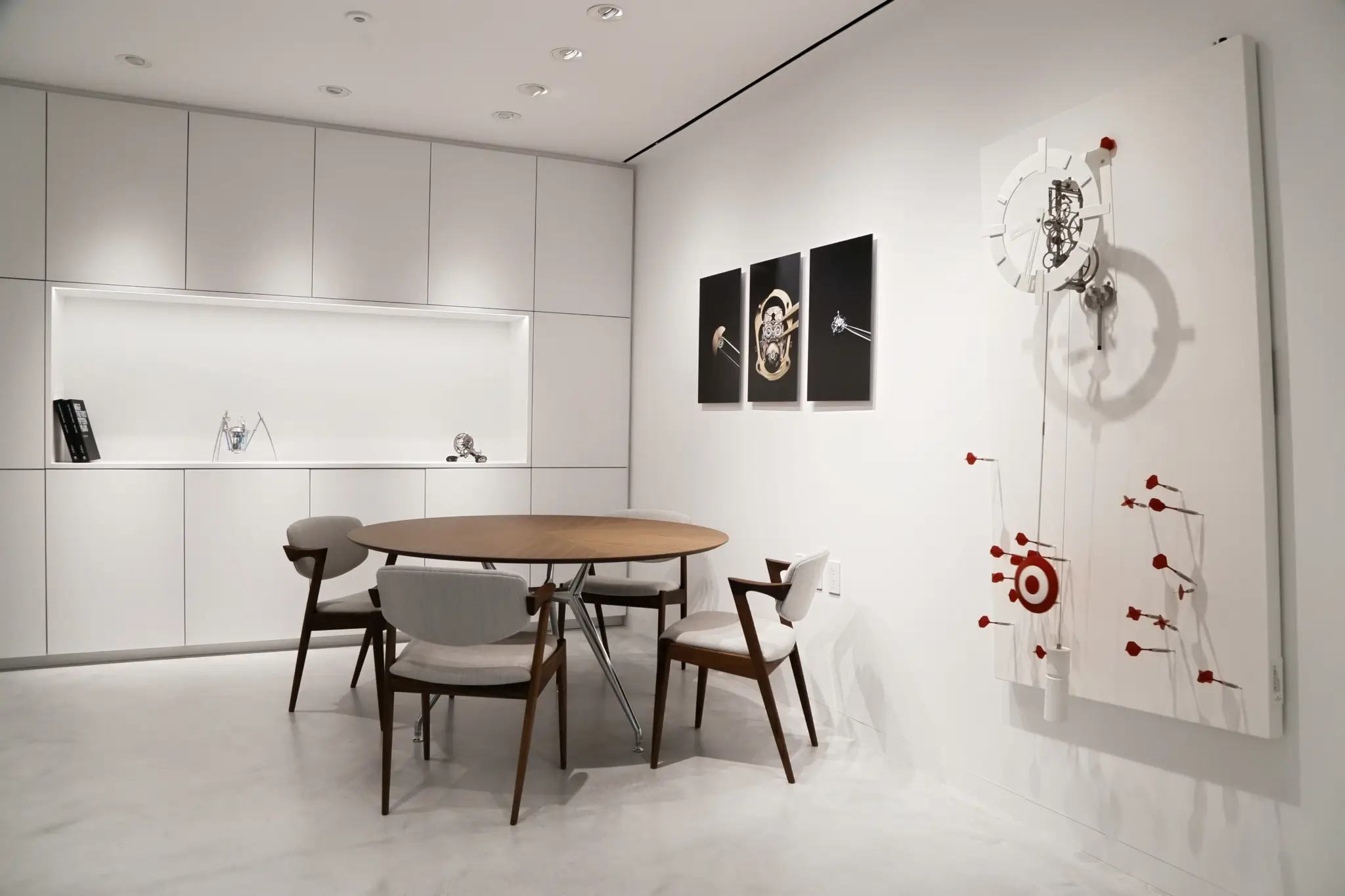
Inside, the material palette leans warm rather than cold: wood, natural light pouring in from the windows facing 57th Street, a living room style seating area, a private office, and presentation spaces arranged so that a watch can actually be examined rather than glimpsed under glass. Kinetic art and mechanical curiosity sit alongside the watches themselves, which is very much in keeping with how MB&F has always described its own work: not accessories, but small mechanical sculptures that happen to tell time.
There is also a practical dimension to a room like this that gets lost if you focus only on the atmosphere. MB&F produces somewhere between 350 and 500 watches a year across its entire catalogue, a figure small enough that a conventional multi door boutique network would never make much sense for the brand. An appointment only lounge, staffed by people who can walk a visitor through how a balance wheel actually floats above a dial, fits a company of this size in a way a glass counter never could.
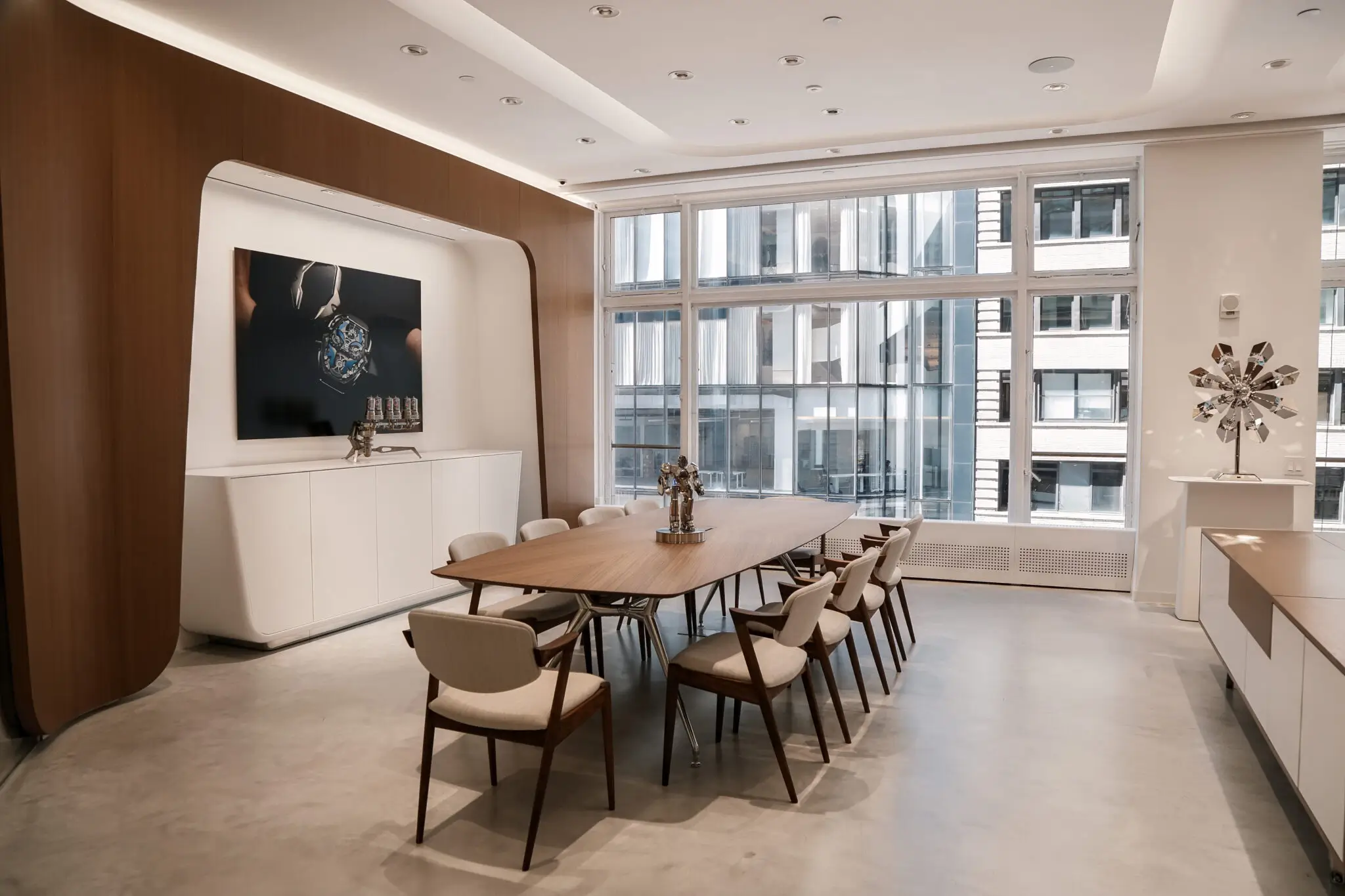
The MB&F New York lounge pairs contemporary architecture with collectible horology and kinetic art, creating a refined setting where warm walnut finishes, minimalist furnishings, and gallery-style displays reflect the independent watchmaker’s blend of craftsmanship, engineering, and design.
stir
To understand why this particular opening matters, it helps to know how unusual it is for MB&F to run its own retail space at all. Since Büsser founded the company in 2005, the brand has built its entire American presence through a small handful of trusted retail partners: Westime in Beverly Hills, Stephen Silver in Silicon Valley, Watches of Switzerland in Las Vegas, and Provident Jewelry in Jupiter, Florida. Those relationships are not being severed. MB&F has been explicit that all four continue in their roles even as the Manhattan Lounge opens. What changes is that, for the first time in more than two decades operating in the United States, the brand now also has a room that belongs entirely to itself.
That patience is worth sitting with for a moment, because Büsser is not a man who arrived in watchmaking by accident, nor one who moves quickly for its own sake. He studied micro technology engineering in Lausanne, then spent seven years inside Jaeger LeCoultre during what he has described as a genuinely romantic period for the craft, before being pulled into a much harder job: running Harry Winston’s rare timepieces division starting in 1998, at just 31 years old, during a stretch when the historic jeweller was close to bankruptcy. He is credited with multiplying that division’s revenue roughly tenfold over seven years and, along the way, with creating the Opus series, an annual collaboration with an outside independent watchmaker that gave people like François Paul Journe an early platform. By his own account, the more that job succeeded commercially, the less it satisfied the part of him that wanted to make things rather than manage a brand. He left in 2005 to start MB&F from nothing.
Twenty years and roughly four hundred to five hundred watches a year later, MB&F has become one of the reference points for independent watchmaking, a category that has grown considerably more crowded and more closely watched by larger luxury groups. In 2024, Chanel acquired a twenty five percent stake in the company, a move that let MB&F expand without handing over creative control. The Manhattan Lounge is best read as a continuation of that same instinct: grow deliberately, on the brand’s own terms, in a room designed by people the brand already trusts.
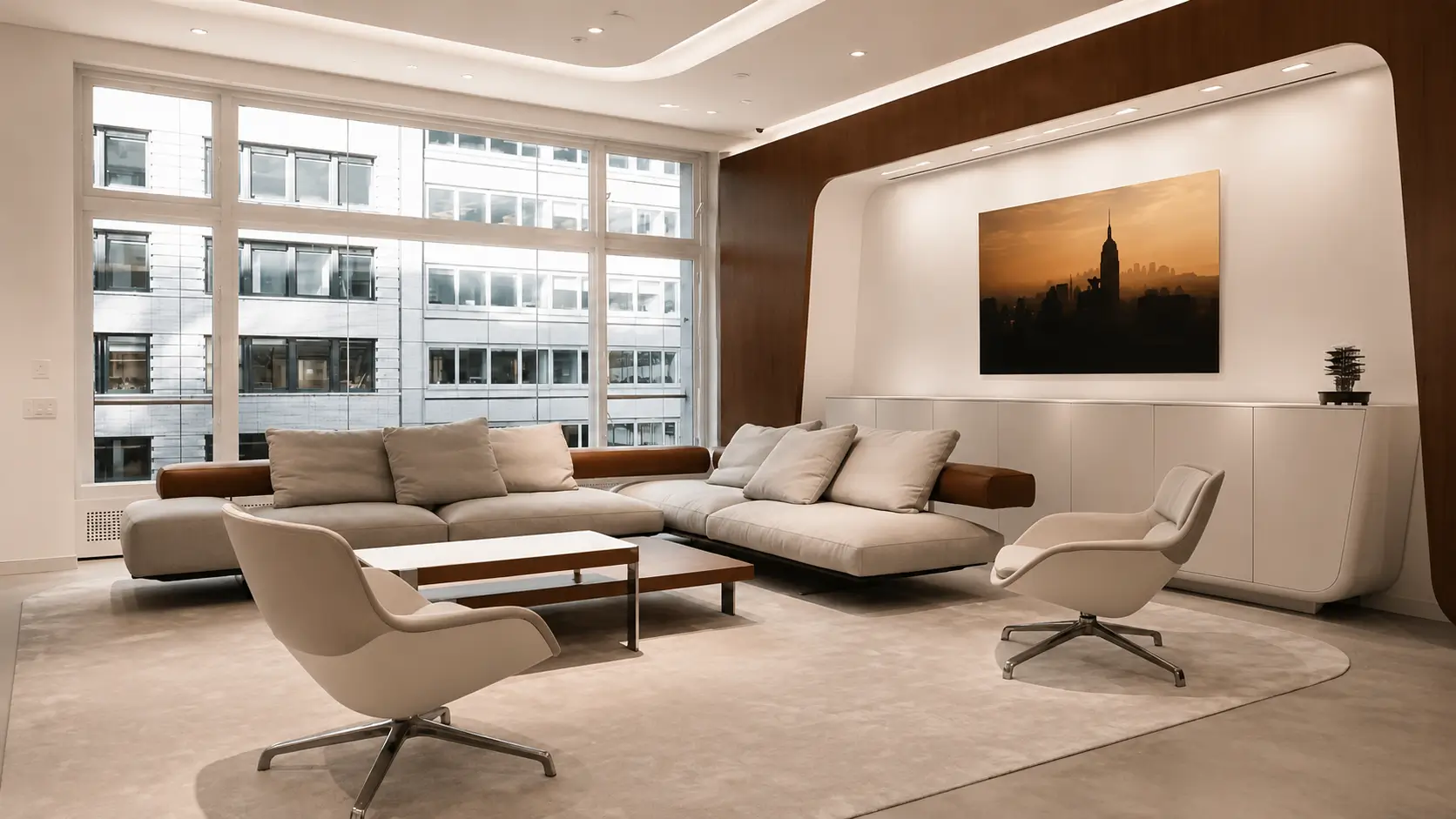
The MB&F New York lounge blends contemporary residential comfort with gallery-inspired design, combining sculptural furnishings, warm walnut accents, expansive city views, and curated artwork to create a welcoming environment that reflects the independent watchmaker’s creative philosophy.
That deliberateness stands out more now than it might have a decade ago. Independent watchmaking has stopped being a niche corner of the industry that only serious collectors tracked. Brands that once operated almost entirely through word of mouth are now being courted, and in some cases bought into, by the same luxury conglomerates that own the largest heritage houses. MB&F’s own Legacy Machine No. 1 picked up both the Best Men’s Watch prize and the Public Prize at the Grand Prix de l’Horlogerie de Genève back in 2012, a fairly early signal that the brand’s approach to watchmaking was going to be taken seriously well beyond the small community that first embraced it. Two decades on, a self funded, appointment only room on Madison Avenue reads less like caution and more like a company choosing exactly how fast it wants to grow.
That design work fell to Voltige Design & Architecture, the Lausanne based studio MB&F has worked with before, including on a broader rollout project completed in 2024. Voltige’s other clients have included Hermès and the Kempinski hotel group, and the firm’s own description of its approach, drawing matter and shaping space, tracks closely with what visitors will find on the fifth floor: a room built to be occupied slowly rather than photographed quickly.
flow
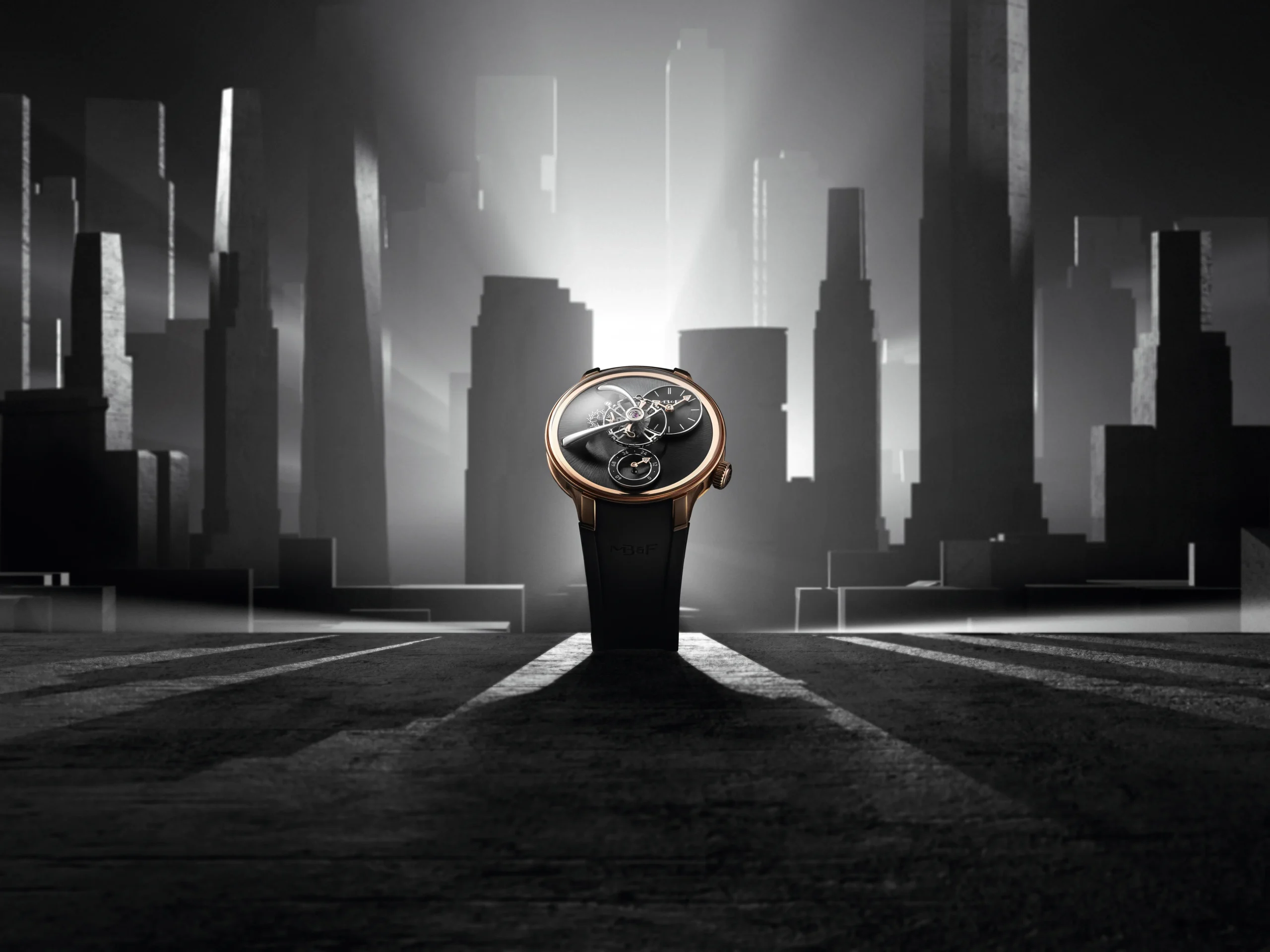
MB&F rarely lets an occasion pass without marking it in metal, and the opening of a first owned American space was never going to be an exception. To celebrate, the brand introduced the LM101 EVO NYC Edition, a run of exactly 25 pieces available only through the new Manhattan Lounge. It will not appear at Westime, Stephen Silver, Watches of Switzerland, or Provident Jewelry. It exists for one address and one address only.
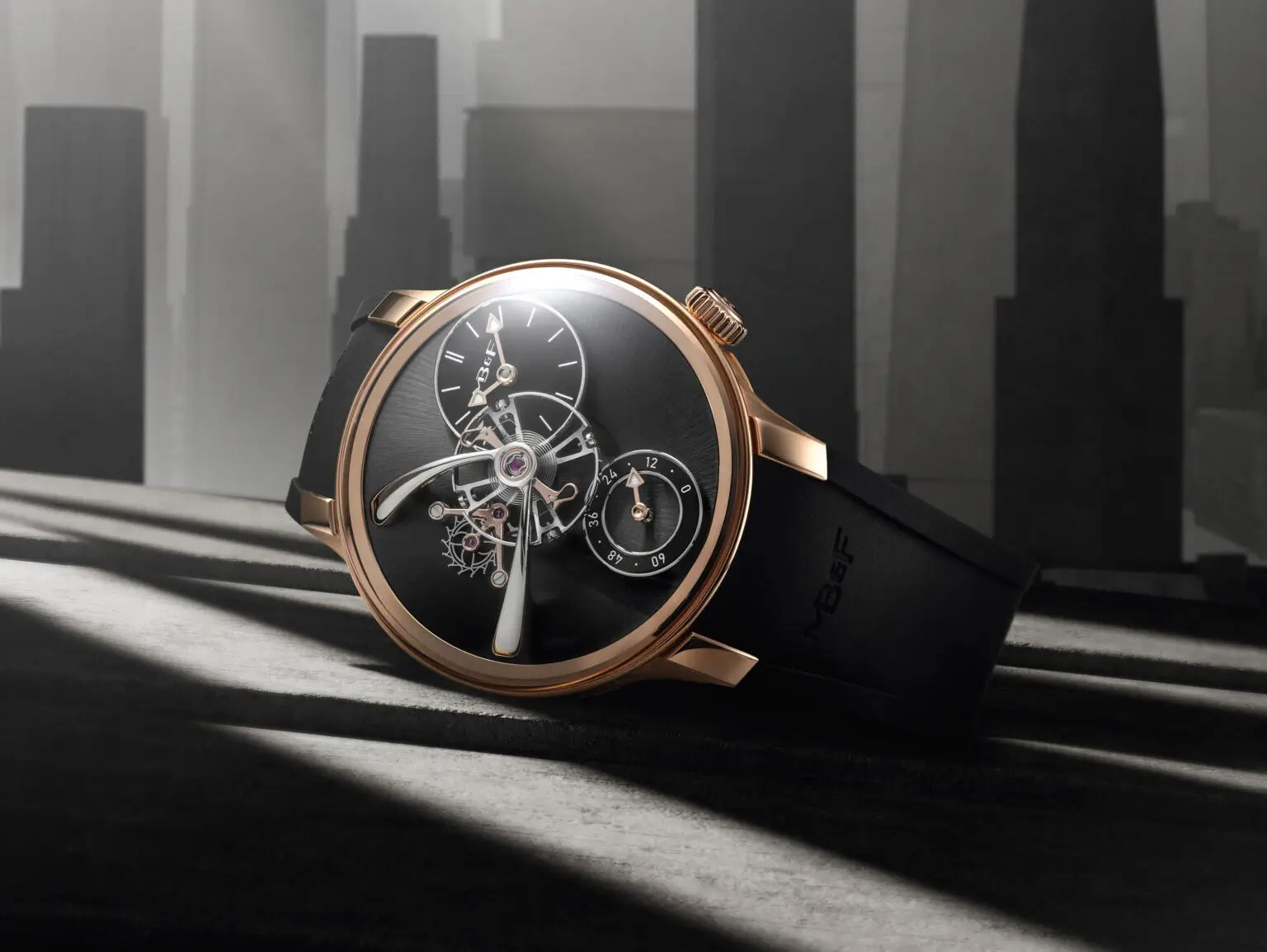
The watch is built on the LM101 EVO, itself a relatively recent addition to the Legacy Machine family that only arrived in 2025 as part of MB&F’s twentieth anniversary celebrations, initially cased in titanium. The NYC Edition takes that platform and recasts it in 18 karat rose gold paired with a black PVD treated dial plate, marking the first time the LM101 EVO has appeared in that particular combination of case metal and dial finish. At 40 millimeters, it is one of the more compact and, by MB&F’s usual standards, restrained pieces the brand makes, closer in spirit to something you would actually wear every day than to the brand’s more sculptural Horological Machines.
Flip it over and the case back carries a small, direct tribute to why the piece exists at all: an engraving reading MB&F NYC, marking the Lounge’s opening in plain terms rather than through some abstracted design motif. It is a quiet gesture, in keeping with a piece that is otherwise defined by restraint rather than spectacle.
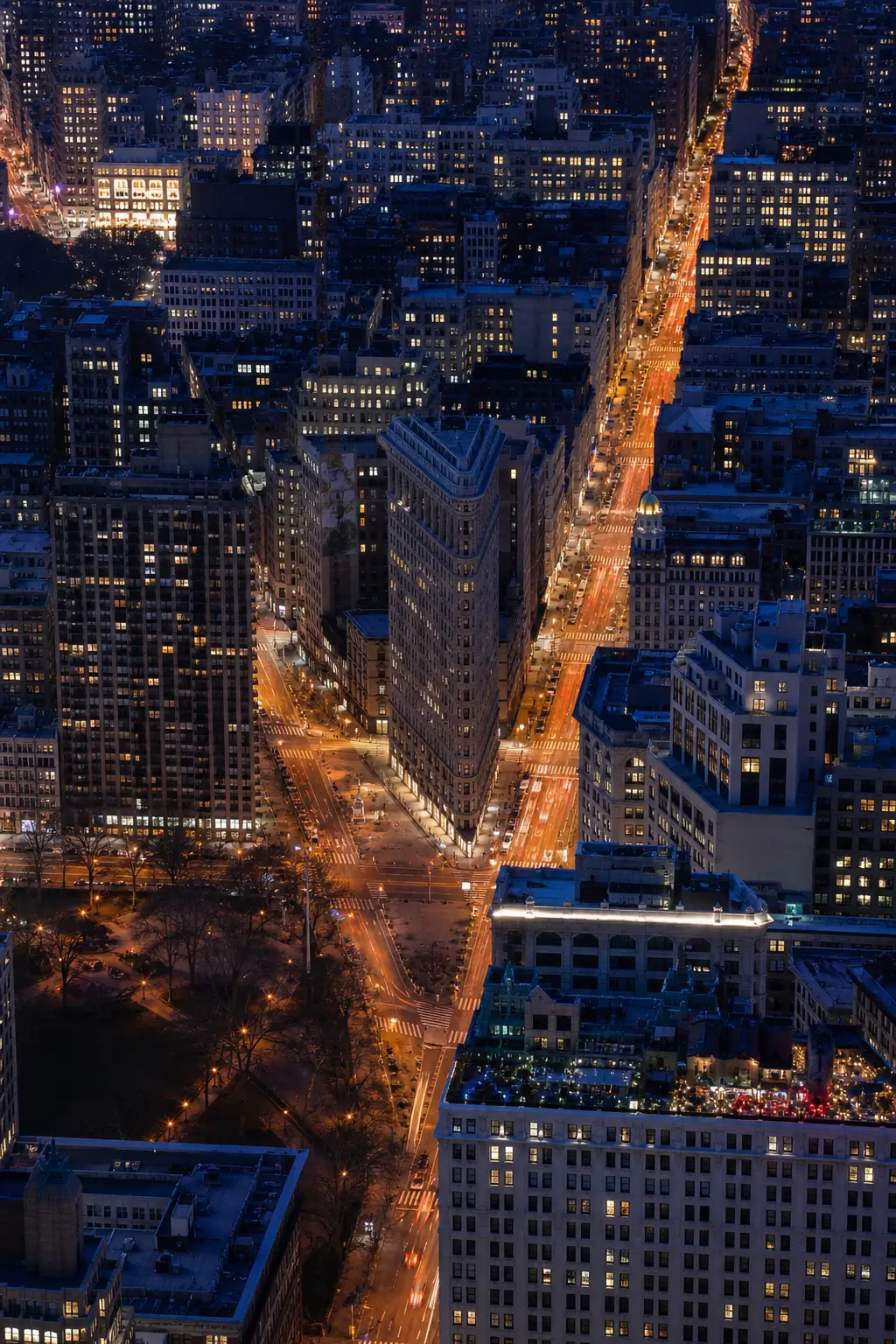
The Flatiron Building anchors this sweeping nighttime view of Manhattan, where glowing streets and illuminated towers reveal the city’s unmistakable urban grid.
Twenty five pieces is a genuinely small allocation even by MB&F’s own standards, and tying it to a single physical address rather than a broader retail rollout means the watch functions almost like a piece of memorabilia for the room itself. Anyone who wants one has to actually walk up to the fifth floor of the Fuller Building, by appointment, to do it. That is not an accident. It is consistent with a brand that has spent twenty years insisting its watches be examined in person rather than bought off a screen.
in
The Legacy Machine 101 has occupied a specific role inside MB&F’s catalogue since it first appeared in 2014: the smallest and thinnest watch in the Legacy Machine range, and the first movement conceived entirely in house by MB&F’s own engineering team, with input on architecture and finishing from the independent watchmaker Kari Voutilainen. Where MB&F’s Horological Machines tend to sprawl into sculptural, almost architectural cases, the LM101 strips the idea down to three elements arranged in a three dimensional layout: an oversized flying balance wheel, a power reserve indicator, and the time display itself.
In the NYC Edition, that architecture is unchanged from the 2025 EVO version. The black dial plate carries a sunray brushed finish, and the hour and minute display appears to float above it, detached from the rest of the dial in a way that is very much a Legacy Machine signature. A power reserve indicator sits at six o’clock, tracking a 60 hour reserve from the manually wound LM 101 caliber. The case back is open, letting the finishing on the balance bridge, developed jointly with Voutilainen, remain visible. A folding clasp secures a black rubber strap, and the watch carries 8 ATM of water resistance, practical numbers for a piece that otherwise reads as a piece of engineering theatre in miniature.
At a price of 105,000 US dollars including taxes, the LM101 EVO NYC Edition sits at the accessible end of MB&F’s range, which says something about where the brand wanted this particular piece to land: not as the loudest object in the room, but as an entry point tied to a specific place and moment, one that collectors either happened to be in New York for or specifically traveled to be part of.
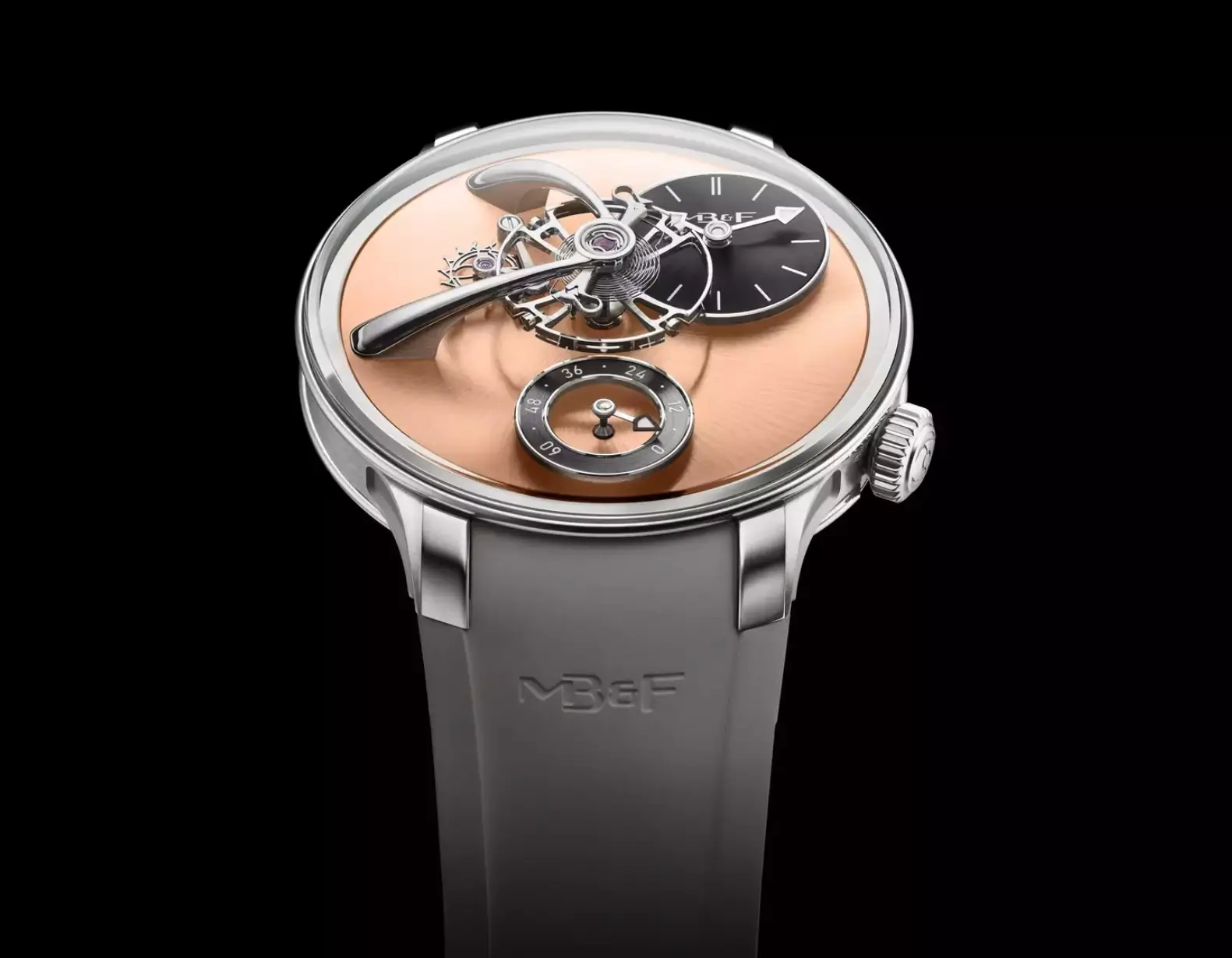
The MB&F timepiece pairs a warm salmon dial with an exposed flying balance and minimalist display, highlighting the brand’s signature approach to contemporary haute horology.
It also helps to remember what the original LM101 was reacting against when it first appeared in 2014. Where MB&F’s earlier Horological Machines had leaned hard into science fiction sil and animal forms, the LM101 was conceived as something closer to a wristwatch in the conventional sense, round, wear, and comparatively restrained, while still carrying the brand’s insistence on visible mechanical drama. Collectors had been asking for a sportier, more everyday version of that formula for years before the EVO variant finally answered that request in 2025, first in titanium. Recasting it in rose gold for New York a year later dresses that same restrained architecture in a noticeably warmer, more formal register, without touching a single element of how the movement itself works.
fin
MB&F did not pick 595 Madison Avenue at random. The Fuller Building is an Art Deco landmark completed in 1929, designed by Shreve, Lamb & Harmon, the same architecture firm that would go on to design the Empire State Building only two years later. It sits on a stretch of Midtown that has long mixed serious architecture with art galleries and a certain institutional gravity, the kind of block where a company can make an argument about permanence just by choosing where to put its name.
That argument matters more for MB&F than it might for a more conventional watch brand, because MB&F has spent twenty years building its identity around ideas rather than volume: mechanical ingenuity, unusually literal collaboration credit for the people who help build each watch, and a refusal to treat exceptional watchmaking as something to be glanced at rather than studied. The Lounge extends that same know into a physical space, and the LM101 EVO NYC Edition gives it a specific date and a specific address to point to.
The company MB&F now keeps on that block matters too. The 1916 Company and De Bethune have both established a presence in the same building, which turns a single address into something closer to a small, informal district for brands that build watches outside the traditional Swiss conglomerate structure. That kind of clustering rarely happens by coincidence in Manhattan real estate. It suggests a shared read, across several independent names, that this particular stretch of Madison Avenue is where a certain kind of collector already expects to look.
None of this changes the fundamentals of how MB&F sells watches in the United States. Its established retail partners remain exactly where they were. What the Manhattan Lounge adds is something the brand has apparently wanted for over two decades and never quite built until now: a room in New York that belongs to nobody but MB&F itself, open by appointment, built for people willing to sit down and look closely at how a watch like this is actually put together.
From the DRIFT archive: Tactical Elegance: Inside Bramford London Aqua Blue Three-Pocket Watch Roll
Related Articles

Six Days of Asphalt, One Day of Dirt: The 2026 Tacoma TRD Pro Makes Its Case
Two red shock absorbers ride on the back of the driver’s seat, and they say […]