
DRIFT AUDIO
Listen to this story
Choose a voice, then press play.
Masterworks has agreed to pay $405,000 for a 1989 Kazuo Shiraga canvas, then split ownership of it into 22,500 shares for public sale.
On May 29, 2026, Masterworks filed the 28th post-qualification amendment to its Regulation A offering circular with the U.S. Securities and Exchange Commission, adding a new line to its running list of securitized paintings: Series 532, a single 1989 oil on canvas by Kazuo Shiraga titled Shintan. The file states that Masterworks, acting as agent for the issuer, bought the 24 by 29 inch canvas from a private collector for $405,000 on April 14, 2026, in a privately negotiated transaction. The offering opened nine days later, on April 23, selling 22,500 Class A shares at $20 apiece for a total raise of $450,000. The extra $45,000 covers what the file calls an Expense Allocation, an upfront fee equal to roughly 11 percent of the purchase price, paid to Masterworks rather than deducted from proceeds later.
Nobody buying into Series 532 owns any part of the physical painting. They own Class A shares of Masterworks Vault 3, LLC, a Delaware series limited liability company that indirectly holds title to Shintan through a segregated portfolio of a Cayman Islands entity called Masterworks Cayman, SPC. The canvas itself sits in insured storage in the United States until Masterworks decides to sell it, a process the company says typically takes three to ten years, with no guarantee of a specific timeline or a profitable outcome. Buying in requires qualifying as what the filing calls a “qualified purchaser,” meaning either an SEC-defined accredited investor or someone committing no more than 10 percent of their income or net worth. Series 532 sits alongside offerings for artists ranging from Andy Warhol to Ernie Barnes on Masterworks’ current roster, part of a continuous SEC-qualified program the company has run since 2023.
stir
Shiraga was born August 12, 1924, in Amagasaki, a port city in Hyogo Prefecture, and trained in Nihonga, the tradition Japanese painting style, at what is now the Kyoto City University of Arts. He abandoned that train after encountering Jackson Pollock’s drip paintings at a Tokyo exhibition in 1951, a shift the Metropolitan Museum of Art credits with pushing him to move his canvas onto the floor and treat it as a field for action rather than a surface to compose. In 1952 he co-founded an experimental collective called Zero Society with fellow artists Akira Kanayama, Saburo Murakami and Atsuko Tanaka. Three years later the group merged into the Gutai Art Association, the postwar Japanese collective founded by Jiro Yoshihara, whose central instruction to members was to avoid imitate anyone and make only what had never existed before.
By the time Gutai absorbed his group, Shiraga had already invented the technique that would define his career. In the summer of 1954, he began applying paint to canvas with his bare feet instead of a brush, a method he arrived at gradually, first experimenting with his fingers and fingernails before stepping directly into the work. Within Gutai’s ranks, where members were pouring paint from bottles, dragging objects through mud and shooting paint from cannons, Shiraga’s foot paintings became, according to multiple retrospectives including one staged by Mnuchin Gallery in 2015, the movement’s single most enduring view sig. His approach was later cited as an influence on European gestural painters include Georges Mathieu and on Yves Klein’s own body-based experiment in the years that follow.
suspend
A rope hangs from the ceiling. Below it, a canvas lies flat on the floor, paint already poured across the surface in loose fields of red, black or blue. Gripping the rope with both hands for balance, Shiraga would swing his body over the canvas and drag his bare feet through the wet paint, slide, pivot and occasion lose his footing entirely, spreading pigment through momentum rather than technique in any conventional sense. The Met’s own description of the resulting marks points to both Pollock’s drip method and Japanese martial arts in the same breath: thick ridges of impasto built from a body moving at speed rather than a hand moving with control. Shiraga worked fast by necessity. He believed hesitation showed on the canvas, and that the only way to avoid a result he would later regret was to finish before he had time to reconsider it.
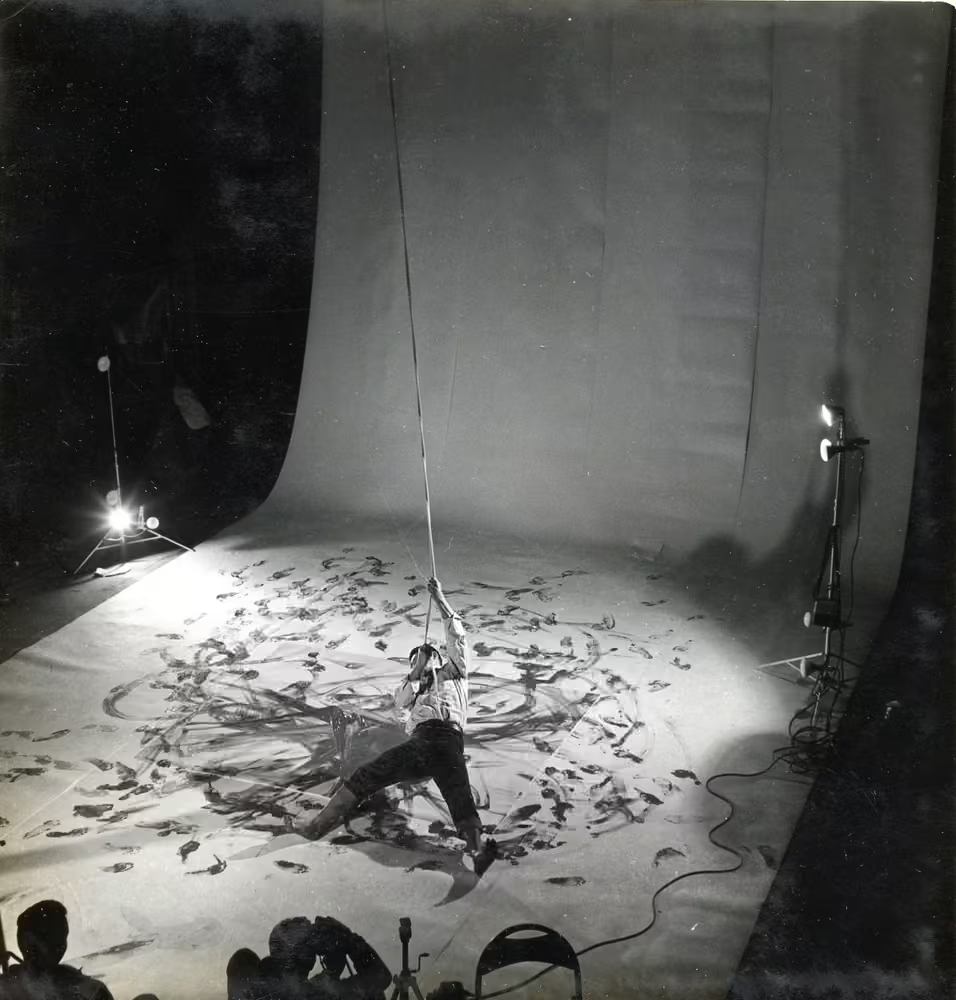
In a dramatic black-and-white studio shot, an artist suspended by a rope swings over a large canvas on the floor, leaving a chaotic trail of dark paint splatters under bright stage lights.
The foot painting technique was not his only body-based experiment. In 1955’s Challenging Mud, a related performance piece, Shiraga wrestled semi-naked through a pit of mud and cement in front of an audience, treating the material itself as an adversary rather than a medium to be shaped. Through the 1960s and into the 1970s he began reintroducing tools like boards and spatulas alongside his feet, expanding his vocabulary without abandoning the underlying premise that the body, not the hand, generates the mark. That premise held even as the paintings themselves changed dramatically over the following two decades.
name
In April 1971, Shiraga stopped painting altogether. He entered Enryaku-ji, a Tendai Buddhist monastery on Mount Hiei near Kyoto, for a month of ascetic training, and in May he was formally ordained as a monk under the tutelage of the sect’s head priest, taking the Buddhist name Sodo, meaning Simple Path. According to an essay published alongside the Dallas Museum of Art’s exhibition on the artist, his training continued until June 1974. Gutai formally dissolved in 1972, the same year Shiraga resumed painting, now working under his monk’s name and increasingly drawing his titles from Buddhist cosmology and Chinese mythology.
The stylistic shift that followed was real and lasting. MoMA’s account of the period describes an initial return to painting in a subdued, largely monochrome black-and-white palette using quick-drying alkyd paint, followed by a gradual return to oil and a fuller range of blue, white, red and black by the late 1970s and into the 1980s. That is the period Shintan comes from. The title itself, written 震旦 in the original Japanese, is a classical term drawn from Buddhist sutra translations referring to ancient China, adapted centuries earlier from the Sanskrit place name Cinasthana. Masterworks’ filing does not explain the reference, but it fits a broader pattern: other Shiraga titles from this era point directly at Buddhist deities and East Asian myth, including one work named for a wrathful guardian figure called Daiitoku Myoo and another for the water-dwelling bodhisattva Suigetsu Kannon, according to curatorial notes compiled by TheArtStory. Auction records show 1989 was a particularly active year for the artist: at least two other large oils from that same year, titled Yagenko and Konkai, have surfaced at auction in the years since. Recognition in Japan continued steadily through this period even as his American profile remained minimal; he received Hyogo Prefecture’s Cultural Prize in 1987 and represented Japan at the 1993 Venice Biennale, continuing to paint under the name Sodo until his death in 2008.
actual
For most of Shiraga’s career, his American market was close to nonexistent, and not for lack of exposure. Fergus McCaffrey’s own account of the artist notes that his work was first shown to American audiences at a Gutai exhibition at Martha Jackson Gallery in New York back in September 1958, where it was largely dismissed as derivative of Pollock rather than recognized as its own thing. That misreading held for decades. It was not until a run of museum exhibitions, including MOCA Los Angeles’ Destroy the Picture in 2012, MoMA’s Tokyo 1955-1970 the same year, and the Solomon R. Guggenheim Museum’s Gutai: Splendid Playground in 2013, that Western curators and collectors caught up in earnest, mostly after his 2008 death. The gallery Fergus McCaffrey, which represents the artist’s estate and has staged multiple exhibitions of his work across its New York and Tokyo locations since opening in 2006, has been central to that rediscovery.
The prices since then have covered an enormous range, and they are not limited to paintings. Screenprints and works on paper trade for a few thousand dollars or less; a price-tracking database maintained by LotSearch lists more than 300 Shiraga lots that have come to market, the majority of them in the United Kingdom and through Sotheby’s specifically. In 2016, a Shiraga sculpture titled Untitled (Red Fan), the first of his sculptures ever to reach auction, sold for £1,538,500 at Bonhams London, a record for any Gutai sculpture at the time. Major oils from both his prime Gutai years and his later monk period have sold for considerably more still. Hoshokai (Lop Nur), a 1988 canvas, brought $5.13 million at Christie’s New York in May 2023, according to the market data platform HENI. More recently, Yagenko, the 1989 painting mentioned above, sold for £1,636,000 (about $2.18 million) at Christie’s London on March 5, 2026, having last changed hands in 2014 for $1.39 million, an annualized return of roughly 3 percent over that twelve-year hold. A 2014 market analysis published by artnet found Shiraga’s average auction price had climbed from roughly $79,000 in 2009 to roughly $482,000 by the time of that report, tracking a broader surge of interest in Gutai as a movement. Shintan’s $405,000 purchase price sits well below any of these recent headline figures, reflecting its considerably smaller scale (Yagenko measures 76 by 102 inches against Shintan’s 24 by 29) more than any difference in period or quality.
Masterworks’ own filing adds broader market context. The company’s internal Post-War and Contemporary Art index shows the category appreciating at an estimated annualized rate of about 10.24 percent from 1995 through 2025, nearly matching the S&P 500’s 10.35 percent over the same stretch, while combined public auction revenue at Christie’s, Sotheby’s and Phillips rose roughly 15.5 percent in 2025 to $9.56 billion, recovering from a 26 percent decline the year before.
turn
Series 532 does not sell a painting. It sells shares in a company that owns one, structured the same way as every other offering Masterworks has run since Scott Lynn founded the platform in 2017. The company has said publicly that it evaluates thousands of potential acquisitions a year and buys only a small fraction of them, screening for artist markets it believes have momentum before committing to a specific canvas. Class A shareholders collectively hold 100 percent of the series’ capital accounts and an 80 percent claim on any profit from an eventual sale, after fees. Masterworks keeps the remaining 20 percent through Class B shares, plus an ongoing 1.5 percent annual management fee paid in preferred shares of the Cayman entity, a structure that gradually dilutes Class A holders’ stake over the life of the investment. There are no dividends and no fixed timeline: investors get nothing back until Shintan actually sells, and Masterworks alone decides when, or whether, that happens. The filing is explicit that the painting could ultimately be sold at a loss, and that Masterworks’ own appraisals, prepared by its own employees, may not match what an independent appraiser would conclude. If Shintan does eventually go to public auction rather than a private sale, the filing notes that standard transaction costs apply on top of that arithmetic: a seller’s commission and a buyer’s premium, both set on a graduated scale by whichever auction house handles the sale, neither of which factors into the hammer price investors might see reported in the press.
Liquidity, such as it is, runs through an alternative trading system operated by North Capital Private Securities Corp, where Masterworks says it will permit secondary trading starting three months after a series offering fully closes. Volume there is thin by the company’s own admission, and resale prices may not reflect the underlying value of the artwork. New investors face a $15,000 minimum buy-in, equal to 750 shares; anyone who has previously invested through the platform can commit as little as $500. The maximum any single investor can put into one series is $250,000. As of this writing, Series 532 remains listed as Open on Masterworks’ public offering table, one of more than a dozen active series the company has yet to close this year.
Related Articles
Twelve Albums on a Pharmacy Shelf
Damien Hirst has shelved Eminem's twelve albums beside pill packets, and one cabinet stocks every drug the rapper has named in a lyric.