DRIFT AUDIO
Listen to this story
Choose a voice, then press play.
At Gladstone Gallery, three 20 foot bolts and a wall bound cloud turned a single instant of weather into something permanent, painted so bright the bronze underneath disappears entirely.
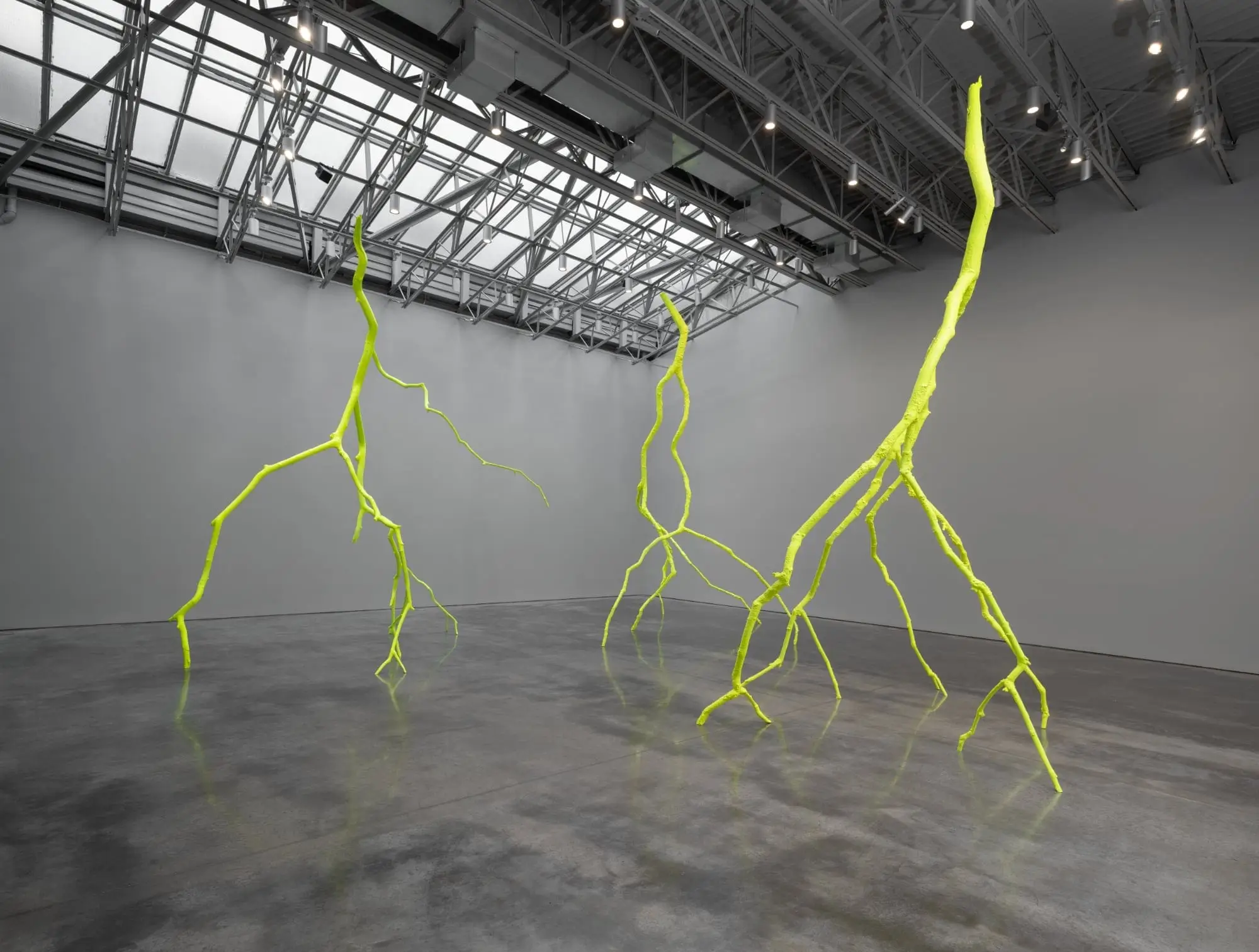
Lightning lasts, at most, a few hundred milliseconds. Ugo Rondinone spent bright shining light trying to hold onto one of those milliseconds indefinitely. The exhibition ran at Gladstone Gallery in Chelsea from October through November 9, 2023, and its centerpiece was a trio of bronze sculptures, each standing more than 20 feet tall, suspended from the gallery ceiling and driven down toward the floor like the moment a storm actually connects with the ground. Painted in a dayglo yellow closer to a highlighter than anything found in nature, the sculptures turned the otherwise gray, cavernous gallery into something closer to a held breath.
The scale alone set the show apart from a typical gallery visit. At 20 feet, the bolts extended well past the height of a single story, forcing visitors to look almost straight up to take in a full sculpture, an angle that mimics the way an actual lightning strike is usually experienced from below rather than head on. Bronze casting at that height is also a genuinely difficult technical undertaking, requiring the forms to be built in sections and assembled on site, and the finished pieces carried enough visible weight and mass that they read as something closer to architecture than to a conventional freestanding sculpture, an object a visitor moves through rather than simply around.
What made the pieces work as sculpture rather than spectacle was how much they changed depending on where a visitor stood. Lightning branches unpredictably in real weather, splitting into secondary forks that never repeat the same pattern twice, and Rondinone built that same unpredictability into the bronze. Walking around and beneath the pieces shifted their apparent shape entirely, so that a bolt that read as a single jagged strike from one angle would resolve into something closer to a splayed, almost skeletal branch from another. Visitors who spent time move through the gallery describe the effect as close to animation, as though the sculpture were still mid motion rather than fixed in cast metal, an illusion of choreography built entire from a static material.
The material itself carried its own tension, even though almost none of it is view. Bronze is heavy, permanent, and associate with monument, portrait busts, and century of art history built around commemorate things meant to last, but that tradition bronze look, the brownish green patina people usual picture, is nowhere in this show. Every inch of it is buried under the dayglo yellow, so a visitor standing in front of the piece has no view cue that it’s bronze at all rather than fiberglass, resin, or painted steel. Lightning is the opposite of everything bronze traditionally signals, gone before most people even register having seen it, and casting one in the other while completely disguising the material was the real premise of the show: giving a genuinely fleeting natural event the physical permanence of a monument, then hiding the one visual signal that would have told anyone it was a monument in the first place. There’s a kind of dry humor buried in that choice too, since a medium built to outlast its subject by centuries was being used here to memorialize something that, by definition, never lasted more than a heartbeat, all while looking nothing like itself.
View this post on Instagram
mode
Alongside the three lightning pieces, bright shining light included a smaller, wall mounted work titled alluring cloud, made from a mixture of sand, gravel, and concrete rather than the polished bronze of the main sculptures. Installed in a corner of the gallery, the piece functioned as a quieter counterpart to the towering bolts nearby, another attempt at freezing a single transient moment of weather, this time a cloud caught mid afar rather than a bolt caught mid strike. Where the bronze pieces reached upward and pierced downward through the room, allure cloud stayed low and nebulous, its rough, granular surface reading closer to sediment or eroded stone than to sky.
The material choice was doing real conceptual work. Sand, gravel, and concrete are earthbound substances, the literal ground underfoot, and using them to depict a cloud collapsed the usual distance between sky and earth into a single object. That collision between the artificial and the natural, and between the electric charge of the bolts and the inert stillness of the cloud, ran through the whole exhibition rather than sitting in any one piece alone. Gladstone’s own materials for the show described the work as an attempt to capture the excitement, fear, and sense of powerlessness that comes with watching a natural, uncontrollable event unfold, whether that event is a single lightning strike or something with far larger stakes.
Placement inside the gallery reinforced that reading. Where the three bolts commanded the open center of the room, alluring cloud sat off to one side, mounted flat against the wall rather than freestanding, closer in scale and presentation to a painting than to the towering bronze pieces nearby. That difference in scale and orientation gave the exhibition a kind of internal rhythm, moving a visitor from the overwhelming, room dominating bolts toward a smaller, more contemplative object that rewarded closer looking rather than distant awe. The rough, granular surface of the cloud piece also stood in direct contrast to the smooth, high gloss finish of the bronze bolts, a textural pairing that made the show’s central tension between electric and inert, artificial and natural, register almost as much through touch as through sight.
nomenclature
Rondinone named the three bronze bolts sublime light, glorious light, and blissful light, and the choice of lang matters more than it might first appear. None of the three titles describe lightning in purely meteorological terms. All three reach instead toward the register of religious or spiritual experience, the kind of word usually reserved for descriptions of transcendence rather than weather reports. That was very much the point. Rondinone has spent much of his career interested in the point where ordinary natural phenomena start to feel like something closer to the divine, and bright shining light leaned into that idea directly by giving each sculpture a name that asks the viewer to experience it as something closer to an encounter than an object.
The specific word choices are worth sitting with individually. Sublime, in particular, carries a long history in art criticism reaching back to eighteenth century writing on landscape and natural terror, describing the particular mix of awe and fear that comes from confronting something vast and uncontrollable, a mountain range, a storm, the ocean in bad weather. Applying that same vocabulary to an indoor bronze sculpture is a deliberate provocation, asking whether a carefully controlled, artificially lit gallery object can still summon something of that original outdoor terror. Glorious and blissful push in a gentler direction, closer to religious ecstasy than to fear, suggesting that Rondinone wanted the three pieces read as a kind of emotional sequence rather than three interchangeable variations on the same idea.
The effect compounds the strangeness of standing beneath 20 feet of yellow bronze indoors. A gallery is about as far from an actual thunderstorm as an experience can get, climate controlled, silent, artificially lit, and yet the titles pushed viewers to bring some of that outdoor awe indoors with them anyway. The dreamlike quality critics noted in coverage of the show came largely from that mismatch, monumental natural imagery staged inside a deliberately neutral, indoor container.
sculpt
Bright shining light fits squarely inside a much longer pattern in Rondinone’s work. The Swiss born, New York based artist, who studied at the University of Applied Arts in Vienna before establishing his practice in the 1990s, has spent decades returning to natural phenomena as raw material for sculpture, painting, and installation. His best known work remains Seven Magic Mountains, a set of seven neon painted boulder totems stacked between 30 and 35 feet tall in the Nevada desert outside Las Vegas, first installed in 2016 and popular enough that it was repeatedly extended well past its original planned run, drawing millions of visitors and becoming one of the most photographed pieces of public art in the country. That piece, like bright shining light, took something naturally occurring, in that case stacked stone formations, and rebuilt it at an exaggerated scale in colors that exist nowhere in nature, turning a familiar landscape feature into something closer to a hallucination.
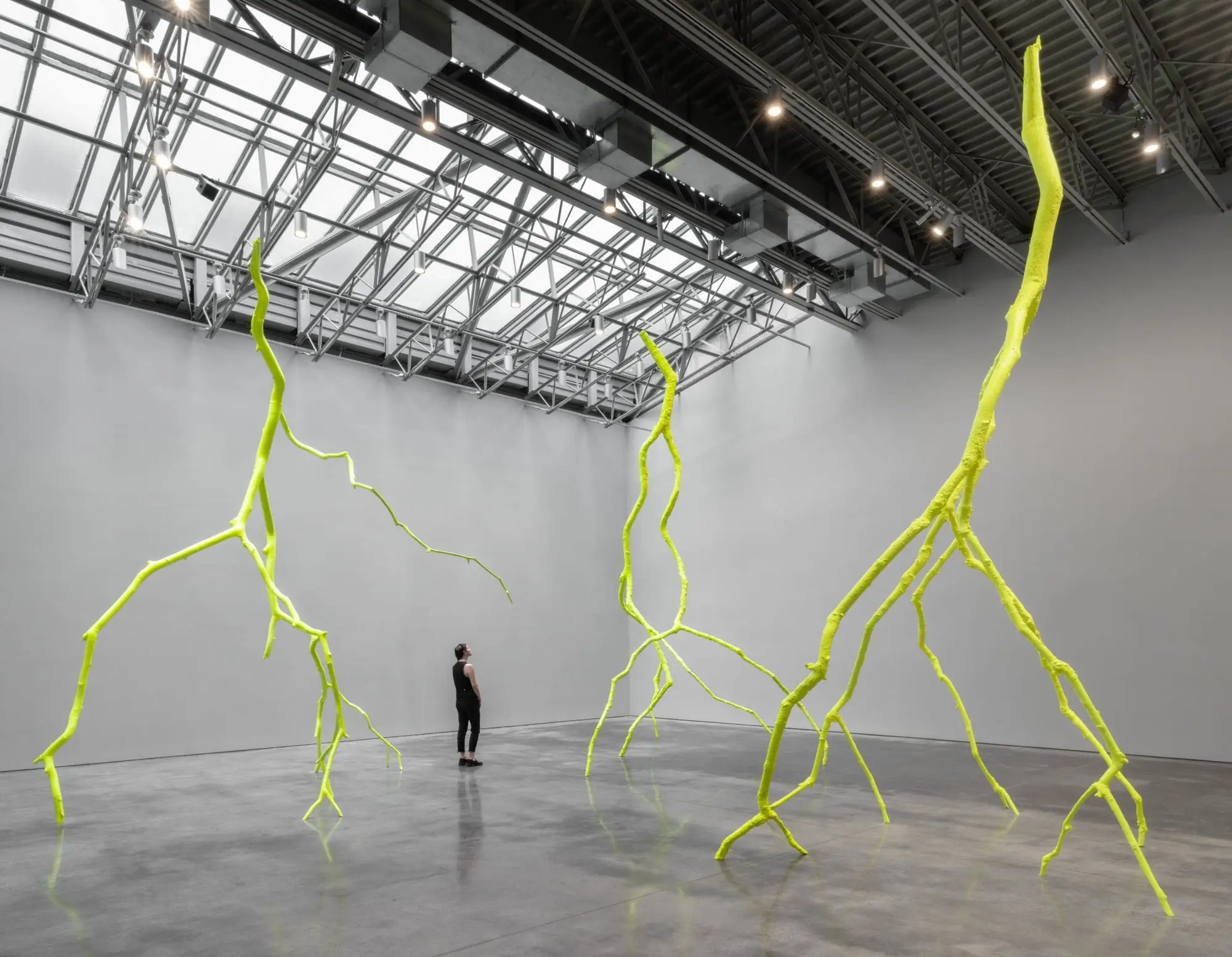
Three towering neon yellow-green, root-like branching sculptures fill a spacious contemporary gallery as a visitor stands between them beneath an industrial glass skylight.
The same instinct shows up across Rondinone’s broader catalog. Earlier bodies of work have cast clouds, suns, and mask like heads in bronze and aluminum, each one an attempt to give a temporary or intangible thing enough physical weight to outlast the moment that produced it. His Human Nature installation at Rockefeller Plaza in 2013 placed a set of towering stone figures in the middle of one of New York’s busiest public spaces, and his long running practice of building neon text sculptures out of pop lyrics and everyday phrases, ongoing since the late 1990s, works from a related premise: taking something spoken and disposable and giving it a permanent, glowing physical form. Rondinone has described his interest as sitting at the intersection of the natural world, romanticism, and existentialism, a kind of ongoing meditation on how fragile and how permanent the same object can be depending on how it’s rendered. bright shining light, with its lightning bolts built to outlive the storms that inspired them by centuries, is one of the more literal expressions of that idea in his entire body of work.
extend
The exhibition’s setting mattered almost as much as the sculptures themselves. Gladstone Gallery, founded by Barbara Gladstone in 1980, has operated out of Chelsea since 1996, when the gallery relocated from Soho and 57th Street into what eventually became a cluster of spaces on West 21st and 24th Streets. The gallery built its reputation representing artists including Matthew Barney, Anish Kapoor, and Keith Haring, and its cavernous, purposefully unadorned exhibition spaces have long been suited to large scale, immersive installation work rather than smaller wall based shows. That scale gave Rondinone’s 20 foot bolts the room they needed to actually pierce downward from ceiling to floor, an effect that would have been impossible in a more conventional, human scaled gallery.
Gladstone herself died in Paris in 2024, not long after bright shining light closed, after leading the gallery for more than four decades and expanding it into locations in Los Angeles, Brussels, and Seoul alongside its original Chelsea base. Her influence on the Chelsea gallery district specifically is hard to overstate. The 1996 warehouse acquisition on West 24th Street, split between Gladstone, Metro Pictures, and Matthew Marks Gallery, is widely credited as one of the moves that turned that stretch of Chelsea into the dense concentration of blue chip galleries it remains today, alongside neighbors like David Zwirner and Hauser and Wirth. The gallery continues to operate under her legacy now, still known for the same willingness to hand its largest rooms over to artists working at genuinely monumental scale, which made it a natural fit for a show built around 20 foot bronze lightning bolts.
leftover
A bright shining light closed in November 2023, and the sculptures themselves have since moved on from Gladstone’s Chelsea space, but the show remains a clear marker of where Rondinone’s practice was headed at that point, pushing further into monumental bronze work built around single, instantaneous natural events rather than the slower geological time scale of Seven Magic Mountains. The lightning bolts asked a genuinely strange question and answered it with total sincerity: what does it look like to keep something that only exists for an instant, and what happens to that thing once it’s forced to stick around.
From the DRIFT archive: Almost Time — Instant Ninja!