DRIFT AUDIO
Listen to this story
Choose a voice, then press play.
In 1992, a broke aristocrat spent her savings on a graduate collection nobody else wanted. That bet became one of British fashion’s defining friendships.
On 16 March 1992, the graduating class of Central Saint Martins staged its annual show at London Fashion Week, the kind of event where editors sit through dozens of student portfolios hunting for the one collection worth remembering. Near the end of the lineup came a menswear tailor turned womenswear student named Lee Alexander McQueen, presenting a collection called Jack the Ripper Stalks His Victims. It drew on the Whitechapel murders of 1888, and McQueen, whose own family history reportedly connected to the case, sewed locks of human hair into the linings as a nod to the era’s practice of women selling their hair for money. Most of the room reacted to the shock of it. One woman in the audience, unable to find a seat and reportedly sitting on the floor to watch, reacted to something else entirely.
That woman was Isabella Blow, at the time a fashion assistant working under Michael Roberts at Tatler and The Sunday Times. Blow had already built a reputation for spotting talent before anyone else did. She looked past the theatrics of Jack the Ripper and saw something more fundamental underneath it: a level of cutting and construction that had nothing to do with shock value. Detmar Blow, her husband, later recalled her coming home that night and telling him plainly that McQueen’s clothes moved like birds, and that he could cut fabric the way a sculptor works stone. She decided on the spot that she needed to own the whole thing.
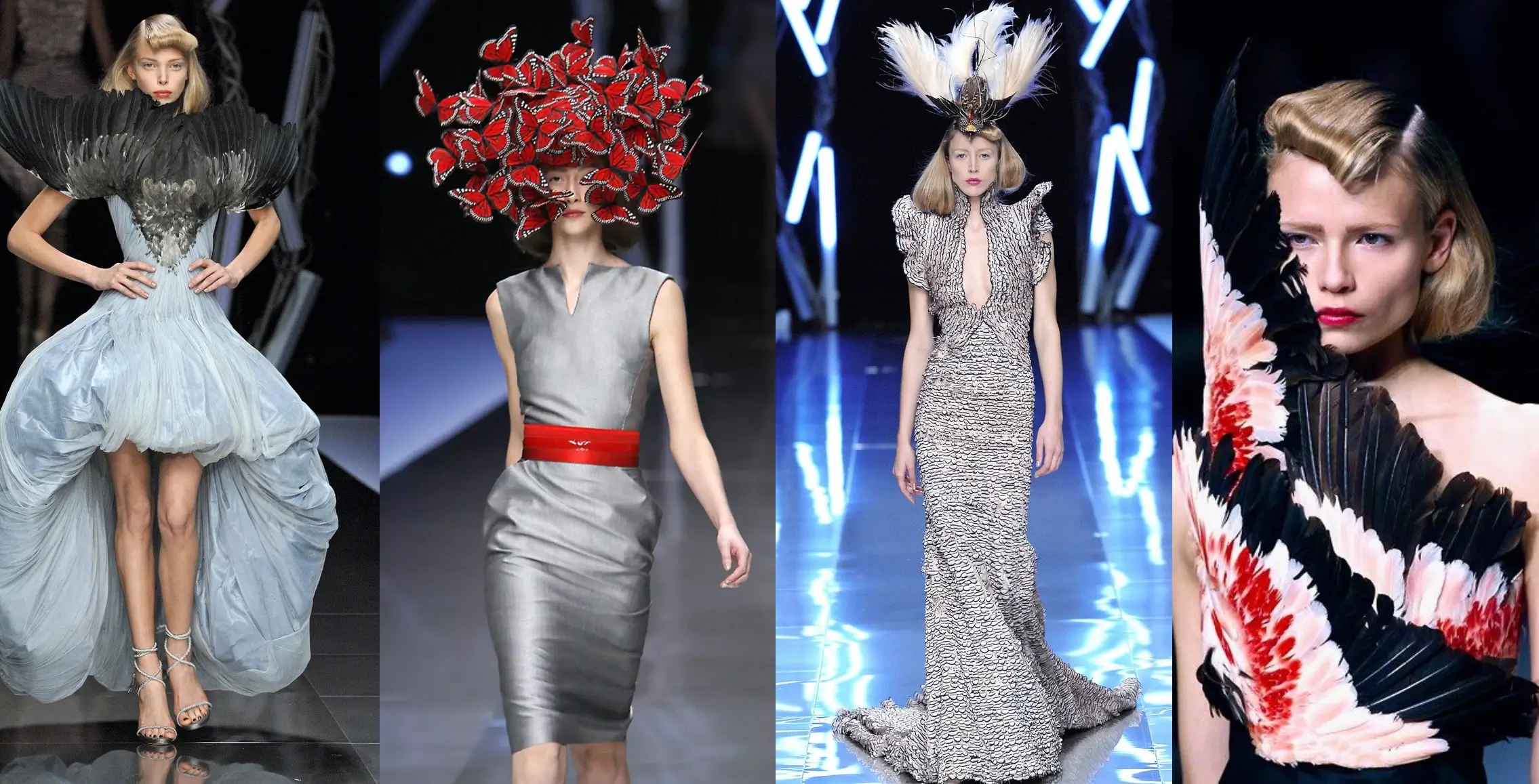
Alexander McQueen’s La Dame Bleue (Spring/Summer 2008), in memory of Isabella Blow
stir
Blow bought McQueen’s entire graduate collection for £5,000, a sum she did not actually have sitting in an account. She worked out a payment plan of £100 a week instead, and McQueen, with no studio and no formal way to package or ship clothing, delivered the pieces to her in a black bin bag. It is one of those details that sounds almost too fitting to be true: the future designer of some of fashion’s most elaborately staged runway shows handing over his first major sale like a bag of laundry.
The purchase mattered less as a transaction than as a declaration. From the following morning, Blow began working the phones, calling every editor, stylist, and buyer she had built a relationship with over years in the industry and insisting they pay attention to the young tailor from East London. McQueen had no agent and no publicist at the time. Blow filled both roles without being asked and without being paid for it. She also began wearing his clothes constantly, turning up to dinners, parties, and shows in his most confrontational pieces at a moment when much of the fashion establishment still treated his work as too provocative to take seriously. A designer’s reputation in the early nineties was built as much through who wore the clothes in public as through the shows themselves, and Blow made herself into that advertisement.
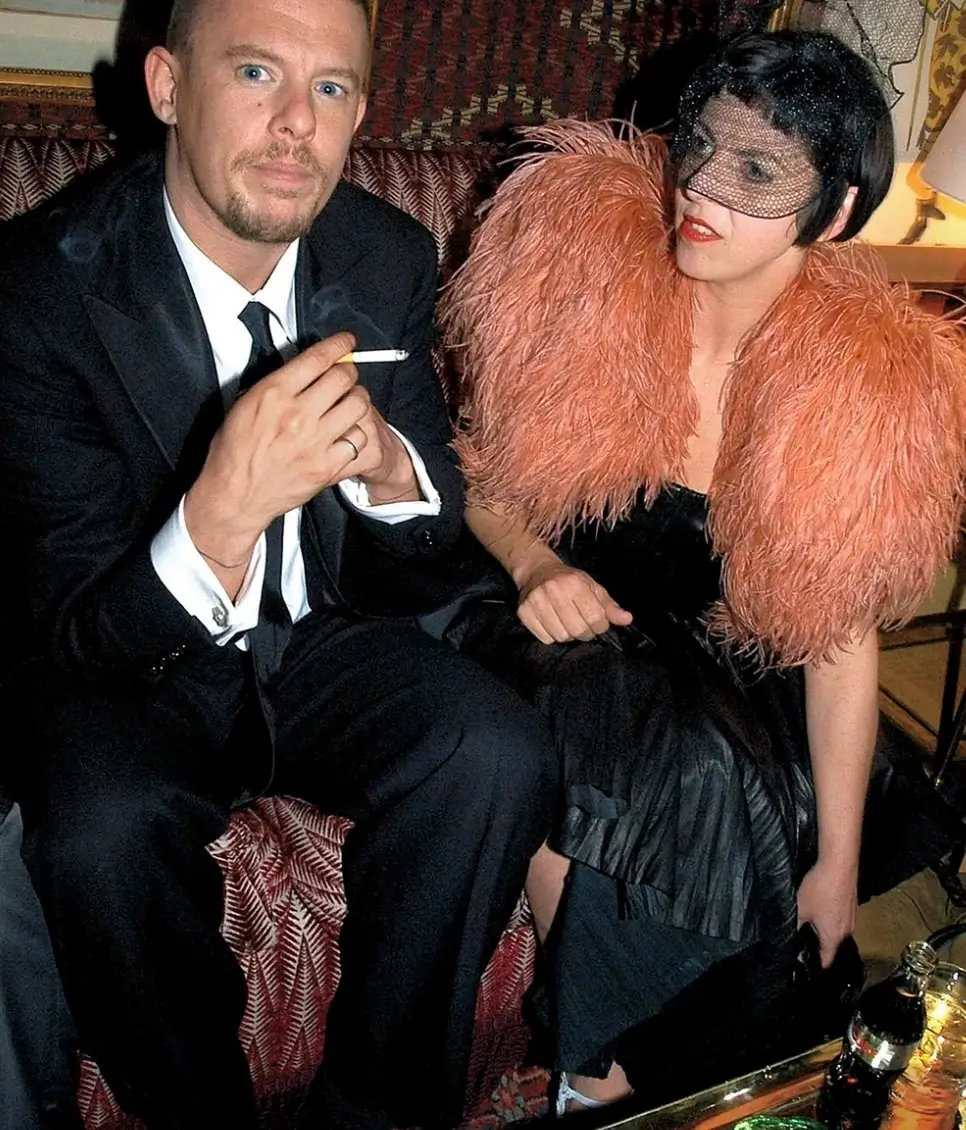
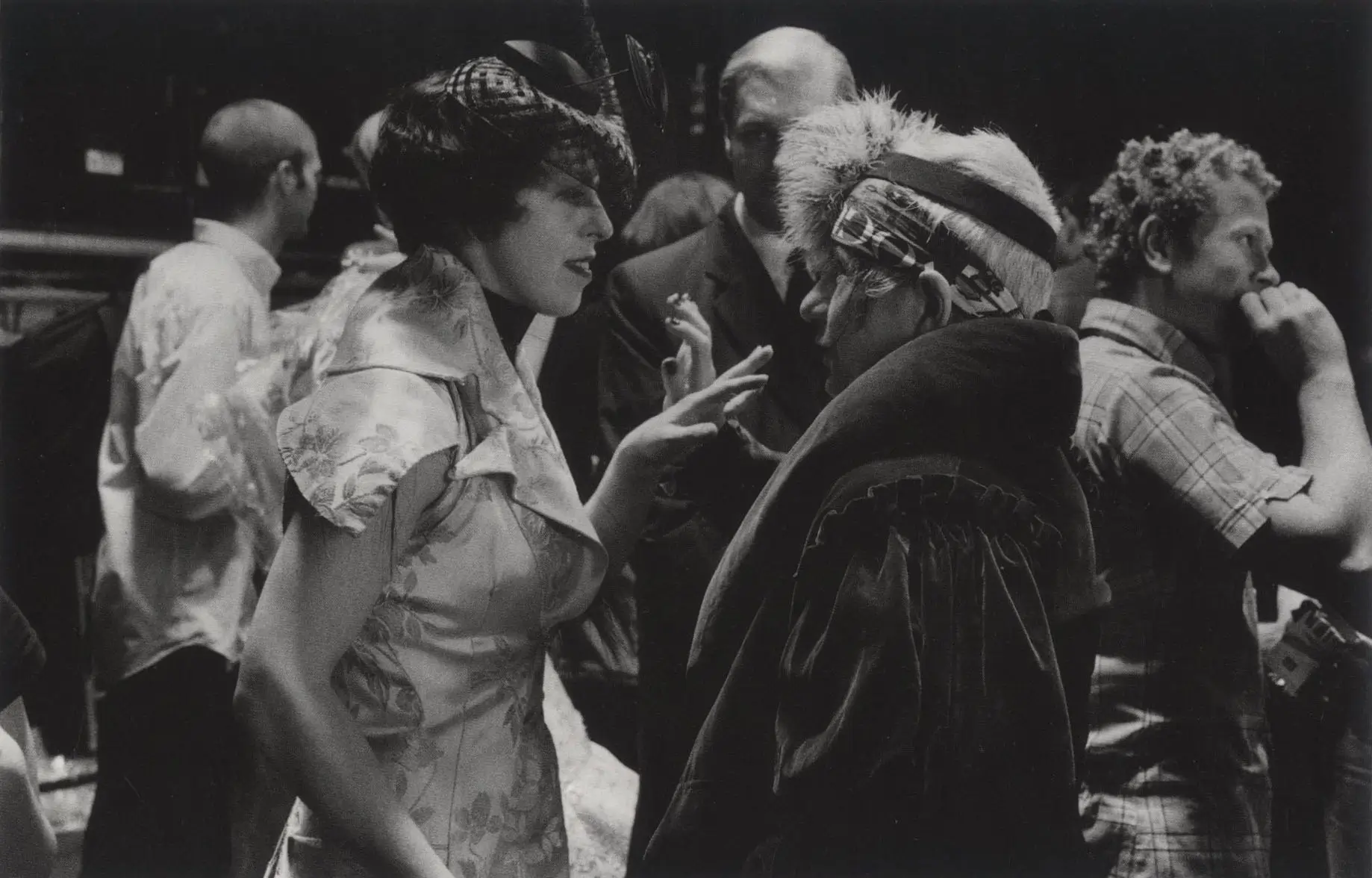
Alexander McQueen and Isabella Blow pause for a close conversation during an evening event, highlighted by an elaborate navy and crimson feathered fascinator, metallic tailoring, and candid documentary-style photography.
name
Blow’s influence went beyond networking. Everyone in McQueen’s life up to that point called him Lee. Blow decided that “Lee” did not carry the weight she thought his talent deserved, and pushed him to work under his middle name instead. People who knew them both have described her calling him “Alexander the Great,” a reference to the Macedonian king, half in jest and half completely sincere. The label that eventually became one of the most recognized names in fashion carries her fingerprint before it ever produced a single commercial collection.
She also connected him to the person who would become his most important recurring convincer. Blow had discovered the milliner Philip Treacy a few years earlier, while he was studying at the Royal College of Art, and had already begun mentoring him in much the same way she would soon mentor McQueen. Introducing the two men produced one of fashion’s more enduring creative partnerships. Treacy’s headpieces became a fixture of McQueen shows for the rest of the designer’s career, and Blow sat at the center of the relationship, often modeling both men’s work in editorial shoots and appearing in McQueen’s Autumn/Winter 1994 show, Banshee. In 1996 McQueen dedicated his Autumn/Winter collection, Dante, to her directly, a public acknowledgment of a debt he never stopped naming.
build
By the mid-nineties, McQueen’s reputation had grown enough that Givenchy appointed him creative director in 1996, a serious step up from independent London shows into the machinery of a French couture house. Blow, who had spent years building his profile without a formal role or salary, was widely expected by people around them to receive some kind of position at the house alongside him. That did not happen. When critics reacted harshly to his debut couture collection for the label, Blow again stepped in unpaid, defending him to press contacts and using her network to soften the damage at a moment when his footing at Givenchy was genuinely shaky.
A few years later she made what may be her single most consequential intervention in his career. During a lunch with Tom Ford, then heading Gucci, Blow learned that Gucci Group was actively looking for smaller fashion houses to acquire. She suggested McQueen. In 2000, Gucci Group bought a 51 percent stake in the Alexander McQueen label, a deal that eventually folded the brand into what is now Kering, one of the largest luxury conglomerates in the world. It took McQueen from independent designer to the head of a globally backed fashion house, and it traces directly back to a conversation Blow started without being asked to.
A “Isabella Blow wearing a Philip Treacy hat and Alexander McQueen design.” Caption: “Blow wore McQueen’s clothes and Treacy’s hats everywhere, effectively working as an unpaid advertisement for both men.”
challenge
The milliner Philip Treacy has been quoted saying it is easy for everyone to love McQueen now, but Blow was doing the difficult, unglamorous work of championing him for years before it was fashionable to do so. That framing captures something real, but the relationship behind it was not a simple story of a mentor cheering on her protégé from the sidelines. Biographer Andrew Wilson, author of Alexander McQueen: Blood Beneath the Skin, and Detmar Blow, who co-wrote his own account of his wife’s life titled Blow by Blow, both describe a bond that shifted considerably as McQueen’s career expanded. He built his own teams, his own business relationships, and eventually his own corporate backers, none of which required Blow’s involvement the way his early years had.
At the same time, Blow’s own circumstances were becoming harder. She struggled with money for most of her adult life despite an aristocratic background, and she experienced serious depression that worsened over the years, a fact that has been widely documented by people close to her and by her own biographers. The woman who had once single-handedly built McQueen’s early network found herself, by her forties, watching the industry she had shaped from a considerable distance.
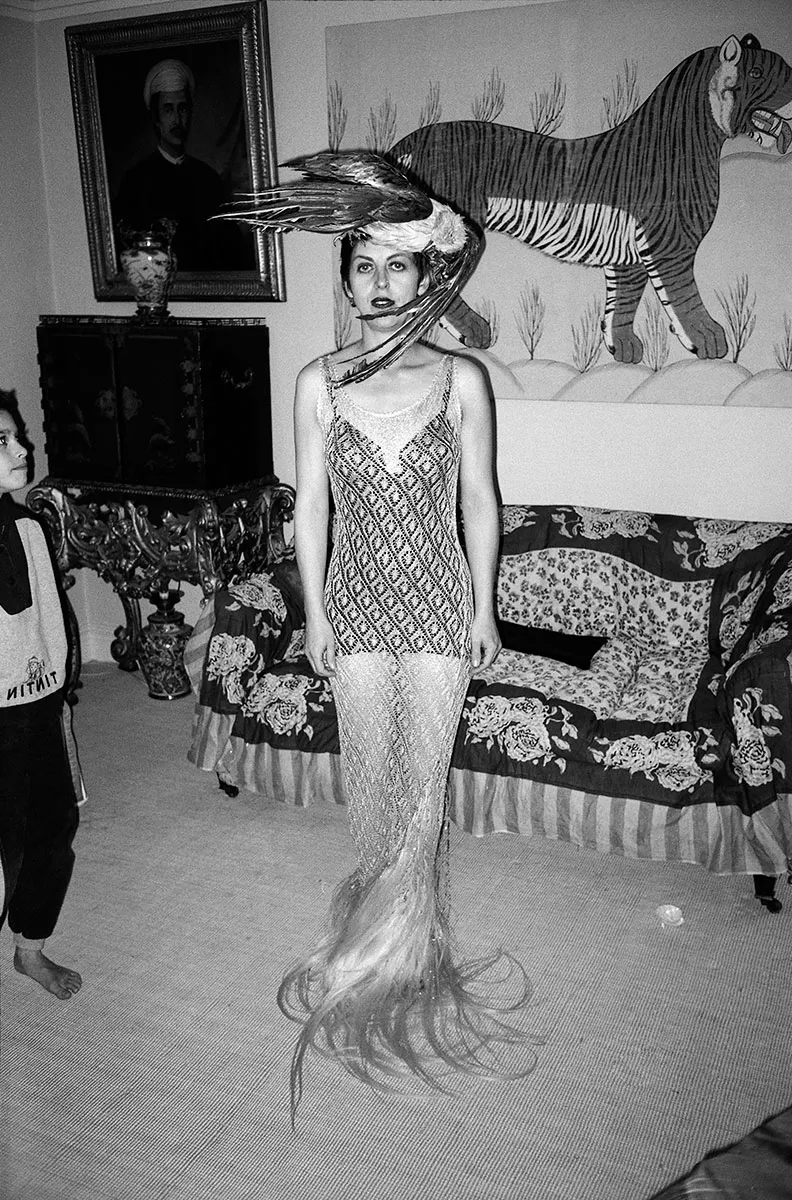
A black-and-white portrait captures a woman in a shimmering beaded gown and sculptural bird-inspired headpiece, framed by eclectic interiors filled with art, antiques, and patterned furnishings.
drive
Blow was known throughout the industry for a kind of theatrical self-presentation that matched her instinct for spotting talent in others. She once explained to journalist Tamsin Blanchard that her elaborate hats served a practical purpose beyond style: they kept people at a physical distance, giving her a built-in excuse to avoid a kiss from anyone she did not want close to her. In the same interview, she described a hat as a cheaper and less painful alternative to plastic surgery, a line delivered with the kind of dry humor that ran through most of her public persona.
She talked about the role of a muse in similarly direct terms, describing it once as something closer to a love affair than a transaction, the kind of constant inspiration that cannot simply be purchased. It is a fitting description of what she was to McQueen in the earliest years of his career, even as the practical, financial version of that relationship, the one where she introduced him to Ford and pushed Gucci Group toward the acquisition, never came with a title or a paycheck attached.
challenge
Isabella Blow died in May 2007 at the age of 48, after years of struggling with depression. McQueen responded the only way he knew how, by making a collection. His next show, La Dame Bleue, was built as a direct tribute to her, developed in connection with Treacy and filled with the corsetry, feathers, and dramatic silhouettes that echoed the way Blow had dressed throughout her life. It was staged for Spring/Summer 2008 and stands as one of the more explicitly personal collections McQueen ever produced, a farewell delivered through tailoring rather than words.
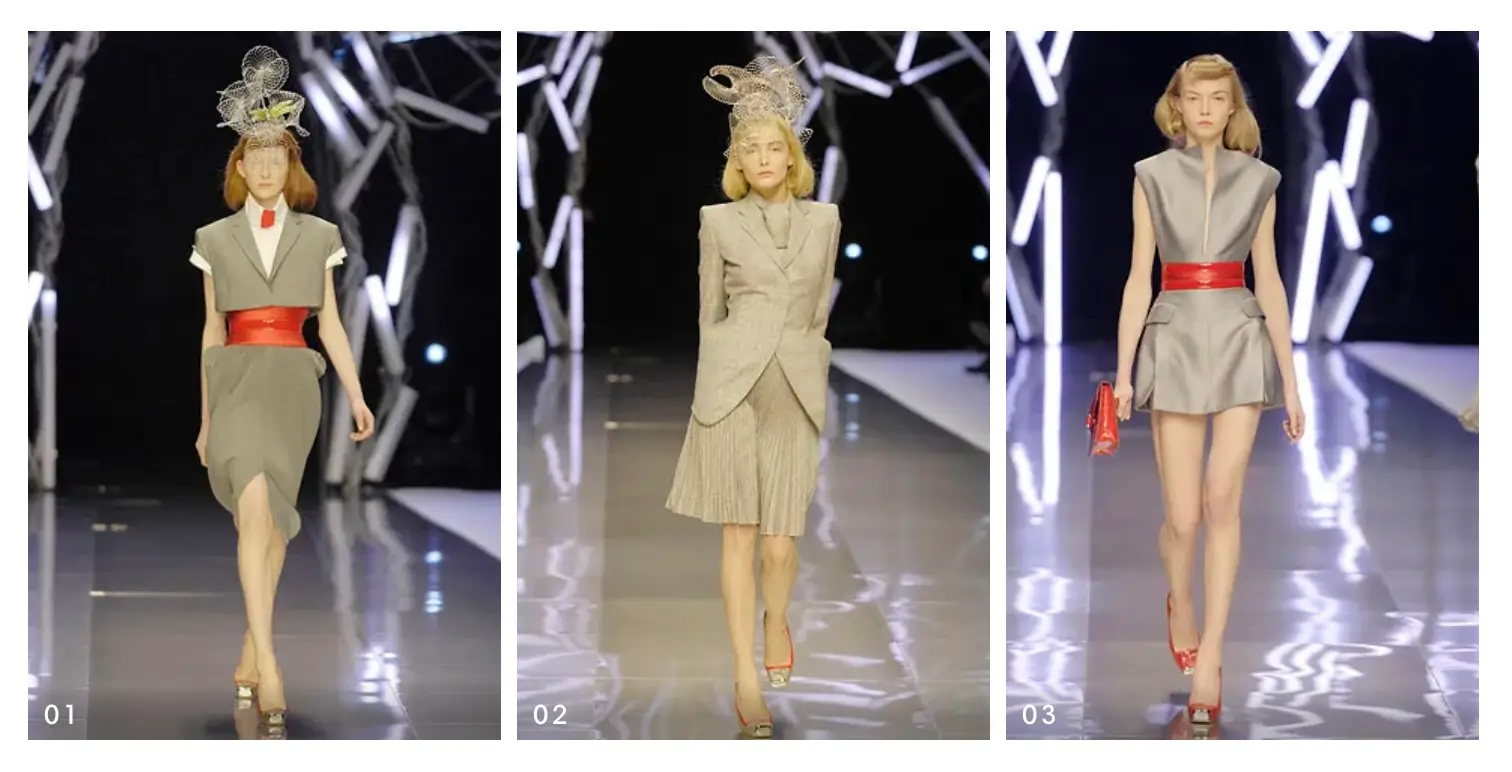
“La Dame Bleue, McQueen’s Spring/Summer 2008 collection, was built as a direct tribute to Isabella Blow following her death in 2007.”
McQueen himself died just under three years later, in February 2010. He built an entire career out of turning difficult material into something people had to look at, returning again and again to themes of loss, vulnerability, and survival, while simultaneously insisting that fashion should never be taken too seriously, that it was theater and provocation as much as craft. The two ideas sat next to each other without much apparent conflict in his work: the deepest kind of personal material, handled with a wink.
hint
What Blow and McQueen had together resists the version of the story that gets repeated most often, the one where a wealthy patron simply discovers an unknown genius and everything follows in a straight line from there. It was closer to two difficult, brilliant people who needed each other in ways that were never entirely comfortable and never entirely resolved. Blow gave McQueen the first real validation of his talent and then spent years building the infrastructure, the introductions, the view, that turned that talent into a career, all without ever asking for a formal role in return. McQueen, for his part, kept naming her in his work long after their day to day relationship had cooled, dedicating collections to her while he was alive and building an entire show around her memory once she was gone.
Their bond is remembered now as one of the defining creative partnerships of late twentieth century British fashion, not because it was simple, but because it was not. A relationship built on real mutual need rarely stays tidy, and theirs did not either. What survived, in the collections and in the record left behind by the people who knew them, is a portrait of two people who understood something similar about beauty: that the most honest version of it is usually a little unsettling, and that admitting how much something matters is its own kind of exposure.