DRIFT AUDIO
Listen to this story
Choose a voice, then press play.
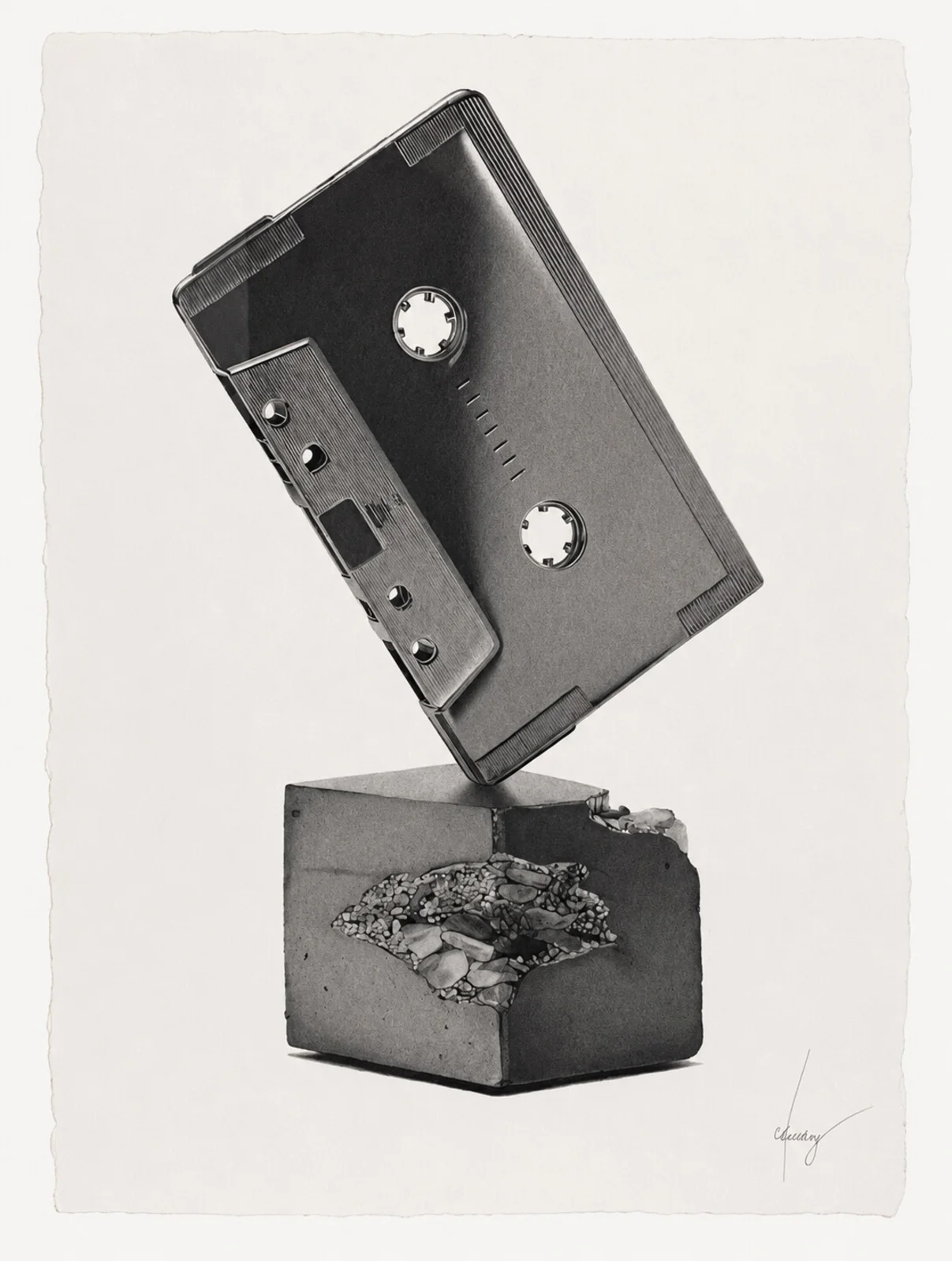
A cassette tape, drawn by hand and mounted on a trophy stand, sums up what CJ Hendry has spent a decade argue: any object can earn a plinth if you look at it long enough.
Somewhere in a private collection or a gallery back room sits a piece of paper roughly the size of a large portrait, bearing a draw of a cassette tape balanced on a trophy stand. Nothing about the object itself is rare. Cassette tapes were mass produced by the hundreds of millions and most of them ended up in landfill or a junk drawer. What makes CJ Hendry‘s 2016 piece Cassette Trophy worth $29,500 through Sydney’s Gallery OZ is not the subject. It is the hundreds of hours spent rendering that subject by hand, and the decision to place it, quite literal, on a winner’s podium.
Cassette Trophy belongs to a body of work Hendry made in 2016 that took the shape of trophies: household and luxury objects alike, each drawn in extreme detail and set atop a stand as if it had just been awarded first place. The cassette is one of the more modest entries in that group, sitting alongside items that ranged from designer handbags to a Zippo lighter. Its modesty is the point. A cassette does not announce status the way a Birkin bag does, and that mismatch between the object and the ceremony built around it is where the drawing does its work.
who
Catherine Jenna Hendry was born in South Africa in 1988 and raised in Brisbane, Australia. She studied architecture at Queensland University of Technology and later finance at the University of Queensland, spending the better part of seven years on degrees she never finished. She has said in interviews that she has no formal art training and does not consider herself especially creative, a claim that sits oddly next to a body of work built almost entirely on technical control.
Her first sale came in 2014: a drawing of a pair of R.M. Williams boots that sold for $10,000, a figure that reportedly surprised her more than anyone. Within a year she had left Australia for New York, where she has been based since 2015. The city gave her a bigger stage and, soon enough, a bigger price tag. An executive at Macquarie Bank paid $50,000 for a drawing of a crumpled Gucci shopping bag, and Kanye West bought a piece depicting a $100 bill with his own face rendered onto it. Her practice through this period stayed almost entirely in black ink on paper, before a 2017 collaboration with Christian Louboutin, staged at Art Basel Hong Kong, introduced color into her drawings for the first time.
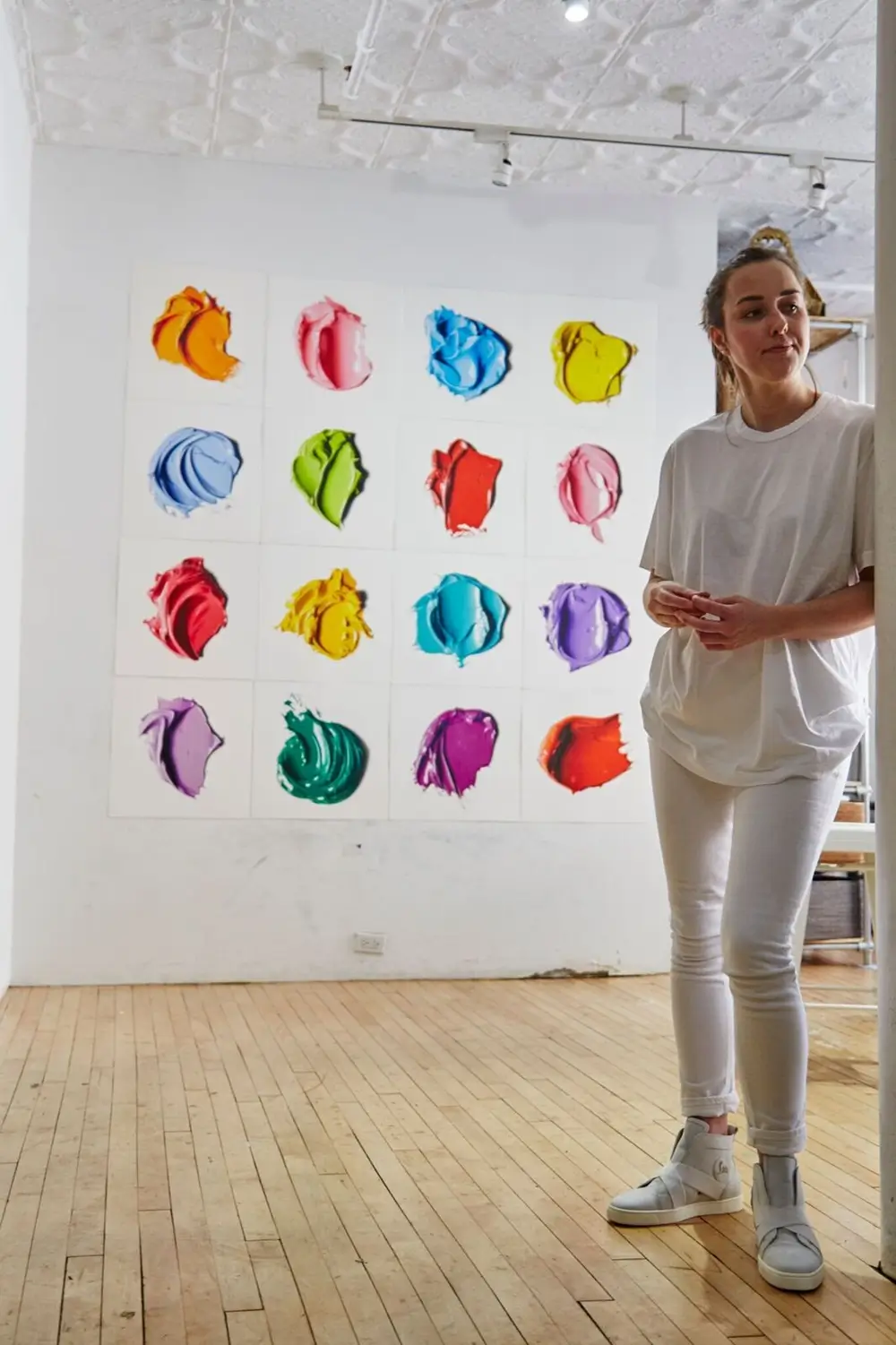
Artist Standing In A Bright White Studio Beside A Grid Of Sixteen Vivid Abstract Paintings Resembling Thick Swatches Of Colorful Paint.
in
The series that produced Cassette Trophy came together under the title The Trophy Room, which opened on November 3, 2016, at 79 Greene Street in New York’s SoHo neighborhood. It was Hendry’s first solo show in the city that had by then become her home, and it arrived less than two years after she left Australia. The premise was simple to state and harder to execute: take objects people recognize instantly, whether haute goods or ordinary household items, and draw each one resting on a trophy base, as if it had been formally honored for existing.
Some pieces in the show leaned into the language of wealth outright. Others, like the cassette, worked by contrast. A trophy implies competition and achievement, categories that make obvious sense for a Chanel bag and considerably less sense for a piece of 1980s audio hardware. That gap between the ceremony and the object is what critics writing about the show at the time flagged as its real subject: not luxury itself, but the way any object can be dressed up in the lang of haute if you frame it correctly. The Cool Hunter, the gallery platform that represented Hendry at the time, referred to related work from the same period as a “Bronzed Trophy Series,” describing pieces whose reflective, metallic surfaces let Hendry demonstrate her control over light and shadow using nothing but a pen.
The location mattered too. 79 Greene Street sits in the mid of SoHo, a neighborhood built on retail history and, more recently, on the kind of gallery real estate where a debut show can either confirm or shh deflate a young artist’s momentum. Hendry had spent barely a year in New York by the time the show opened, moving there from Brisbane after two solo exhibitions in Australia had already sold out. Staging her first American solo show a few blocks from the SoHo flagships of the very brands she was drawing was not incidental. It put the work in physical conversation with the retail logic it was commenting on, close enough to the source material that visitors could walk from a Chanel storefront to a drawing of a Chanel bag on a trophy stand in a matter of minutes.
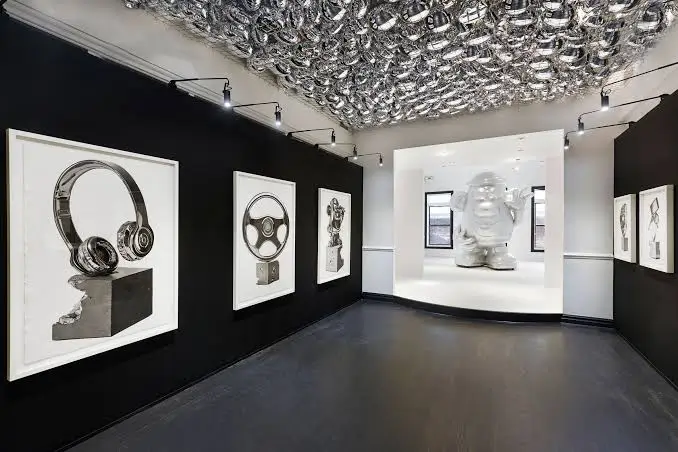
Contemporary Art Gallery With Black Walls, Framed Monochrome Drawings, A Reflective Sculptural Ceiling, And A Large White Character Sculpture.
discip
Hendry has described her process in several interviews over the years, and it stays remarkably consistent regardless of subject. She starts from a photograph, often adjusted for saturation and contrast, then uses a ruler and pencil marks as a guide to scale the image up onto a large sheet of paper, typically cotton stock chosen for its texture and archival quality. From there the work becomes additive: layer after layer of what she calls scribbles, building tone and depth rather than relying on clean outlines. She has said the process is less about line than about the relationship between light and dark, and that she generally works darker than most people expect, a habit she traces back to learning shading through colored pencil before she settled into ink and graphite as her primary tools.
A single large-scale piece can take up to 200 hours, and Hendry has spoken about being particular to the point of self-diagnosed obsessiveness about precision, a trait she says drew her to pen work specifically because a pen mark cannot be erased once it lands. For pencil pieces like Cassette Trophy, the same discipline applies even though the medium allows more room for correction. The goal in either case is a surface so exact that from a distance the drawing reads as a photograph, and only up close does the hand behind it become visible.
day
Talking about the Trophy Room series after it closed, Hendry described the underlying idea plainly: she had taken the concept of the pedestal to an extreme, putting objects on trophy stands regardless of whether they were expensive or ordinary. Some of her favorites from the series, by her own account, were not the luxury items at all. She has singled out a Mr. Potato Head piece as a personal favorite alongside items like a cheese grater and a car’s steering wheel, objects that carry no inherent status but that meant something to specific people for specific reasons.
A cassette fits neatly into that second category. It is a format most people under thirty have never actually used, and one that older audiences associate with mixtapes, car stereos, and a particular kind of analog intimacy that stream never replicate. Drawing it at trophy scale does two things at once. It treats a nearly obsolete piece of technology with the same view seriousness Hendry gives to a designer handbag, flattening the hierarchy between luxury and nostalgia. And it asks a question her whole practice keeps circling back to: what actually makes an object worth 200 hours of anyone’s attention. Her answer, across the series, seems to be that the attention itself is what confers the value, not the object’s price tag going in.
View this post on Instagram
There is also a gen split baked into the cassette as a subject that most of the other Trophy Room objects do not carry. A watch, a bag, or a car part can be aspirational to almost anyone regardless of age, since the desire attached to them is renewed constantly by advertise and resale market. A cassette’s mean depends almost entirely on when you were born. For someone who grew up record songs off the radio, the object triggers a very specific kind of memory. For someone who has only ever stream music, it functions closer to an artifact from a museum case, recognizable in shape but foreign in use. Hendry’s decision to render it with the same obsessive fidelity she brings to a Birkin bag treats both audiences equally, refusing to signal which reading is the correct one.
sit
Nearly a decade after The Trophy Room closed, Cassette Trophy is listed for sale through Artsy via Gallery OZ, an Australian dealer, at an asking price of $29,500. That figure sits within the range Hendry’s works on paper have reached at auction more broadly. According to market data compiled by MutualArt, her auction record since 2020 stands at $64,052, set by Prada IT Bag 2014 when it sold at Menzies Art Brands in Sydney in 2024, while prints and graphic works from her practice have realized up to $10,700 at auction. Over the past year her pieces have averaged just over $11,000 at sale.
Hendry’s output and market presence have both expanded well past the ink-only drawings that built her reputation. Her studio now produces work across bronze sculpture, lenticular prints, and archival giclée editions, and her show calendar has kept pace with the growth: MutualArt lists an exhibition at Salon 94 on New York’s East 89th Street in August 2026, alongside a run of appear tied to Hong Kong Art Month earlier in the year. Cassette Trophy predates all of that expansion by close to a decade, which is part of what makes it a useful marker. It comes from the period when the entire practice still ran through a single pencil or pen, no bronze, no lenticular effects, just paper and hundreds of hours of controlled mark-making.
fin
The Trophy Room did not exist in isolation from the rest of Hendry’s practice, which has always mixed pure technical display with the occasional pointed statement. The same year she was drawing trophy objects, she was also known for dipping a pair of Nike Air Mags in black paint and drawing the wrecked result for a project tied to charitable fundraising, and for an earlier piece responding to the Orlando nightclub shooting that depicted a gun-shaped shirt dripping blood, flown over several American cities under the banner #ENDGUNVIOLENCE. Read against that context, the Trophy Room reads less like pure luxury fetishism and more like an extended thought experiment about which objects a culture chooses to honor and why.
A cassette tape, drawn in graphite and set on a stand built for champions, does not resolve that question so much as sit inside it. It is a small, shh entry in a series that spent most of its energy on louder objects, which may be exactly why it has aged well. Formats become obsolete. The instinct to put something on a pedestal, apparently, does not.
What has changed since 2016 is how literal Hendry now takes the trophy premise. Her more recent limited-edition work has moved from paper into actual bronze, a material that turns the earlier drawings’ metaphorical pedestal into a physical one. A piece like Crown Volume 1, cast in bronze and sold as a hand-signed limited edition, effectively finishes the sentence that the 2016 drawings started: an object rendered so precisely it could pass for the real thing, now given the real thing’s material and permanence. Set against that trajectory, Cassette Trophyreads as an early, unresolved version of an idea Hendry would spend the better part of a decade working through in increasingly literal form.
From the DRIFT archive: The Rise of a Masterwork: Klimt’s Portrait and Its Historic $236.4M Sale · Chris RWK’s “Simple Math” Pillow Brings Street Art Deco
Related Articles

Where the Face Should Be, Rafael Silveira Paints Open Sky
A pink shirt, shoulder-length hair, then no face at all: in “Surprise,” Rafael Silveira lets flowers and a clear blue sky stand in for the person.