DRIFT AUDIO
Listen to this story
Choose a voice, then press play.
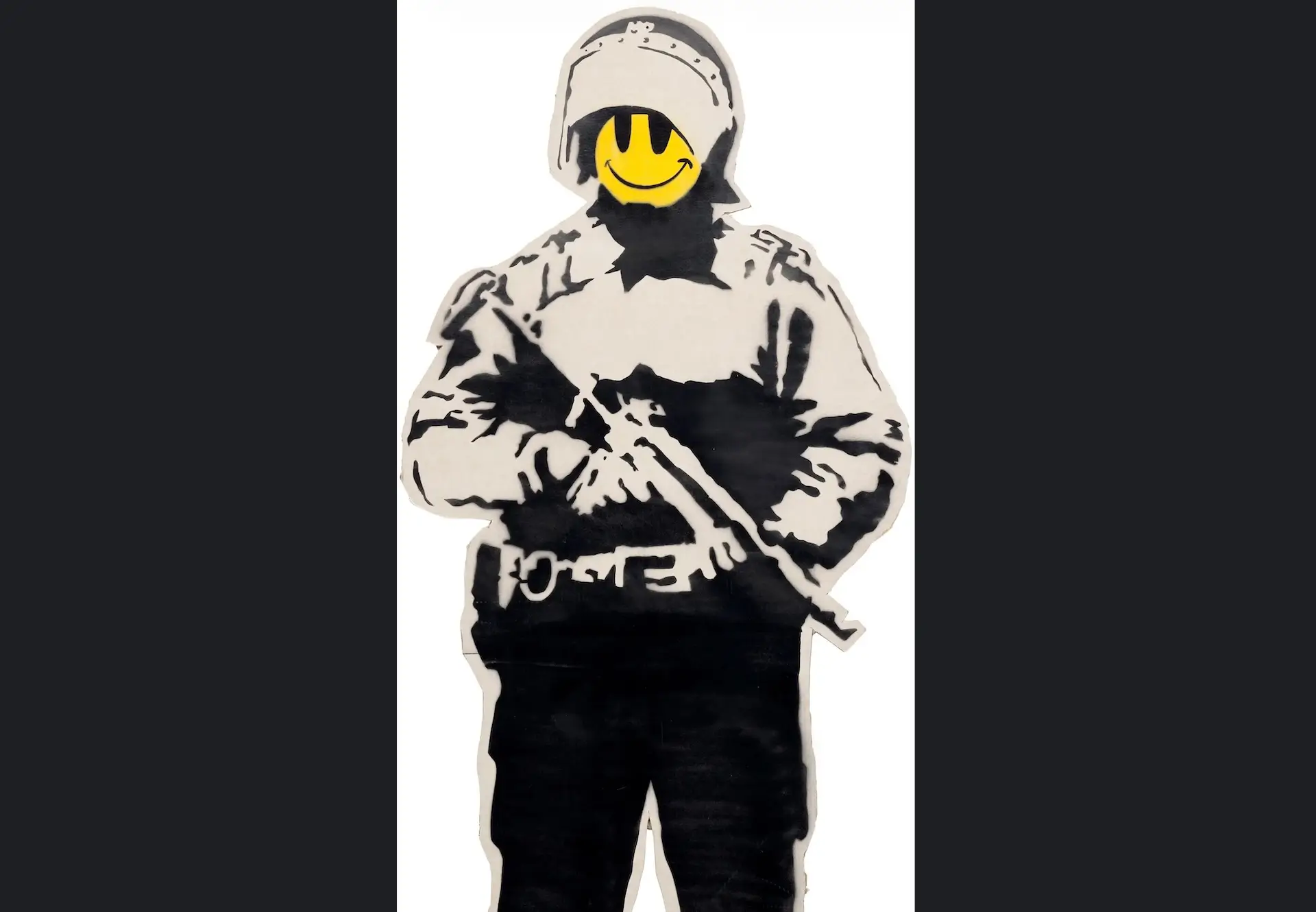
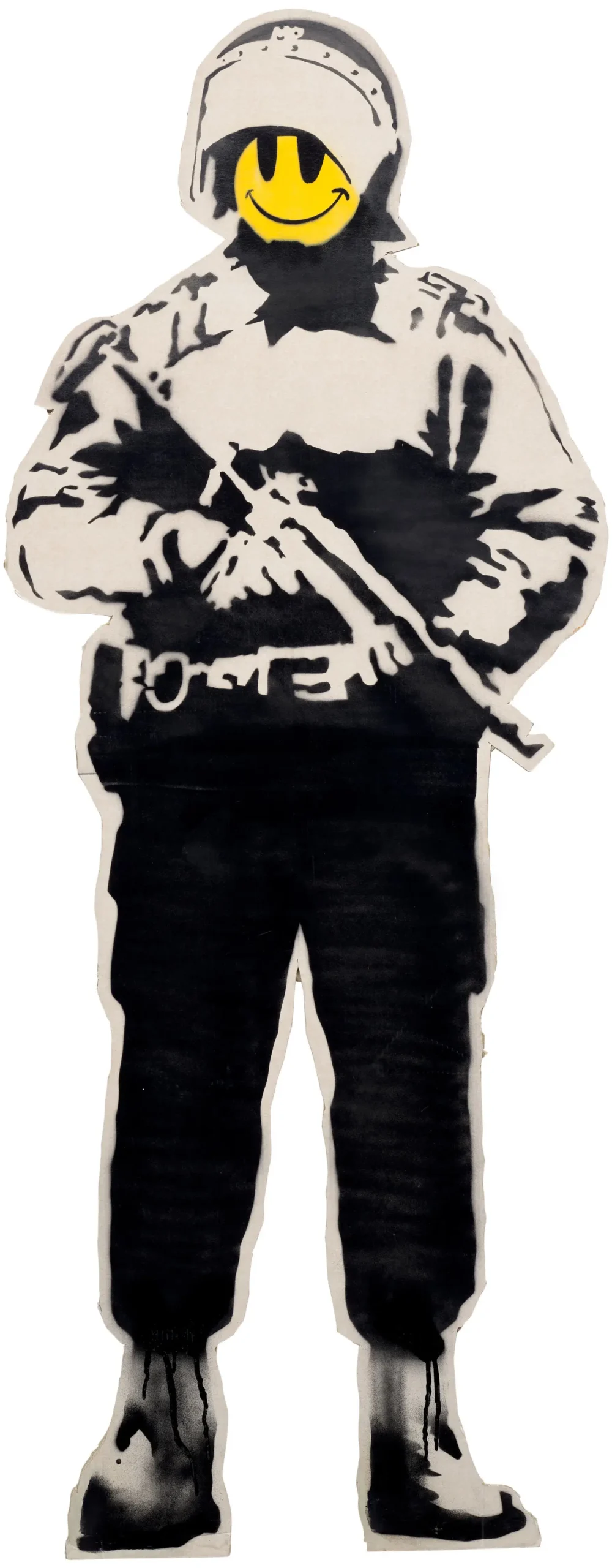
In the sleek preview rooms of Phillips London this June 2026, amid the hush of serious collectors and the soft glow of climate-controlled vitrines, stands one of Banksy’s most disarmingly potent early works: Smiling Copper. Executed in spray paint and acrylic on shaped cardboard, measuring approximately 200 x 79 cm, this life-sized cut-out figure commands attention not through bombast, but through its quiet, unsettling contradiction. A riot-geared police officer, helmeted and heavily armed, peers out from behind a radiant yellow smiley face. The provenance reads like a whispered credential in the art world
This piece is more than a Banksy—it is a culture artifact that captures the artist’s genius for distilling complex socio-political tensions into instantly legible, shareable view flow. As we approach the auction, it feels timely to unpack why Smiling Copper endures as both a market darling and a mirror to our times.
stir
At first dekko, the work is skittish. The smiley face—icon of 1990s rave culture, acid house, and carefree youth—sits incongruously atop the armored torso of authority. The officer’s gear is rendered with Banksy’s trademark stencil precision: batons, vests, the bulk of state power. Yet the face transforms threat into something almost absurdly cheerful. It is humorous, yes, but the humor carries a sting. This is not a friendly bobby; it is a critique of policing, surveillance, and the performative nature of power.
Banksy created Smiling Copper in 2003 as part of an unnumbered edition of about ten unique works, originally shown at WUK Kunsthalle Exnergasse in Vienna during the Bad Press exhibition. Many were acquired directly from that show, giving pieces like this one pristine early provenance. The shaped cardboard format—life-sized, freestanding or wall-mounted—echoes the artist’s street practice, where images were often deployed as interventions in public space rather than traditional canvases.
This motif belongs to a family of “Copper” works that defined Banksy’s early breakthrough. Compare it to Flying Copper (also 2003), which added cherubic wings to the same armed figure, or Kissing Coppers (2004), his tender yet subversive take on same-sex affection between officers. Smiling Copper strips away the whimsy of flight or romance, leaving the raw juxtaposition of joy and force. The smiley face, lifted from rave culture and earlier appropriated by artists like Keith Haring or even the anonymous Acid House smileys, becomes a mask. It hides identity while amplifying the absurdity.
rev
Born around 1974 (identity still fiercely guarded), the artist emerged from a vibrant UK graffiti scene influenced by New York hip-hop imports and local punk energy. A legendary anecdote—hiding under a truck while evading police and studying its stenciled lettering—sparked his signature technique. Stencils allowed speed, precision, and repeatability in hostile environments.
By the early 2000s, Banksy had moved beyond tagging to sophisticated conceptual interventions. Works like Smiling Copper were not random vandalism but calculated disruptions. They questioned the role of the “copper” (British slang for police) in a post-9/11 world of heightened security, stop-and-search powers, and anti-globalization protests. The yellow smiley, evoking childhood innocence and nightclub euphoria, clashes with riot gear to expose the disconnect between public image and lived reality of authority.
This period coincided with Banksy’s first major exhibition, Turf War (2003) in East London, where giant cut-outs including flying police figures dangled from ceilings. Smiling Copper shares that DNA—bold, graphic, designed to stop viewers in their tracks whether on a gallery wall or a derelict street. Its cardboard substrate reinforces ephemerality; unlike oil on canvas, it feels disposable, democratic, closer to the street than the salon.
flow
Banksy’s genius lies in accessibility without dilution. Smiling Copper requires no art history degree to “get,” yet rewards deeper reading. The smiley face recalls the happy-face badges of the 1970s, co-opted by counterculture, or the anonymous Guy Fawkes masks later popularized by Anonymous and Occupy movements. It is a view Trojan horse: disarming, meme-able, but loaded with critique of police militarization, institutional hypocrisy, and the commodification of rebellion itself.
In fashion and design terms, the work prefigures today’s streetwear obsessions with irony and logo subversion. Brands like Supreme, Off-White, and even haute houses have borrowed Banksy’s playbook—bold graphics, limited drops, cultural commentary. The officer’s uniform, with its tactical details, mirrors the utilitarian aesthetic that dominates contemporary menswear: cargo pants, vests, militaristic silhouettes recontextualized for civilian life. Banksy flips this: the uniform is the costume of power, the smile its PR campaign.
Culturally, the piece resonates across decades. Post-2008 financial crisis, during Black Lives Matter protests, amid debates over facial recognition and AI surveillance—Smiling Copper feels prophetic. The masked face anticipates our era of digital anonymity, deepfakes, and filtered realities. Who is smiling? The state? The citizen? The artist himself, hidden behind layers of persona?
transition
Auction history underscores Smiling Copper’s enduring appeal. Examples have consistently performed strongly. One sold at Sotheby’s London in 2018 for £262,000 (hammer), far exceeding estimates. Another achieved £137,500 in the same year. Recent comparables for related works show steady appreciation, reflecting broader Banksy market resilience even as the artist continues to provoke.
For Phillips’ June 26 sale, the estimate sits at £60,000–80,000, with the lot carrying the prestigious “Property from an Important European Collection” tag—a phrase that signals serious, often private museum-level provenance and excites institutional bidders. This specific work’s journey from the 2003 Vienna exhibition through private hands adds narrative weight. In a market where provenance and story drive premiums, Smiling Copper offers both authenticity and intrigue.
Collectors drawn to Banksy often span demographics: hedge funders seeking cultural capital, tech entrepreneurs valuing disruption, fashion insiders recognizing the crossover into wearable art and NFT-adjacent virality. Pest Control, Banksy’s authentication body, further legitimizes these works, bridging the outlaw street origins with blue-chip status.
scope
As of mid-2026, Banksy remains as elusive and prolific as ever. Recent interventions—whether animal-themed murals, climate statements, or wry political jabs—continue to dominate headlines and social feeds. Smiling Copper represents the foundational layer: the raw stencil work that built the empire. It predates the record-shattering Girl with Balloon shredding at Sotheby’s, the Dismaland pop-up, and the Walled Off Hotel in Bethlehem. Yet it contains the DNA of all that followed: wit as weapon, accessibility as activism.
In the fashion world, Banksy’s influence is palpable. Collaborations (official or appropriated) with brands have proliferated. Streetwear drops echo his limited-edition ethos. High fashion runways reference his graphic boldness—think Balenciaga’s oversized silhouettes or Virgil Abloh’s culture sampling. Even luxury watchmakers and sneaker designers nod to the tension between high and low that Banksy masters. A Smiling Copper in a collection signals not just wealth, but culture fluency.
why
In an age of algorithmic feeds and polarized discourse, Smiling Copper cuts through. Its simplicity is deceptive. The work invites laughter, then reflection. It humanizes critique without preachiness. For younger collectors shaped by social media, it feels like an original meme—crafted before the internet made everyone a stencil artist.
The cardboard medium itself speaks to sustainability and impermanence themes increasingly relevant in design and fashion. Unlike bronze monuments, it can be moved, stored, recontextualized—much like street art itself. Yet its survival and ascent to auction status highlight how ephemeral gestures become eternal when they resonate.
consider
Prospective buyers should note the work’s condition sensitivities—cardboard and spray paint demand careful handling. Authentication via Pest Control is standard for post-2000 works. Its size makes it statement furniture as much as wall art: commanding in a minimalist loft, provocative in a traditional setting. Pair it with other early Banksys, or contrast it with contemporary figurative painters for dynamic dialogue.
Market-wise, Banksy originals remain a bellwether for street art’s institutional acceptance. With estimates reflecting tempered optimism rather than frenzy, June 26 offers a compelling entry or addition for serious collectors. The “Important European Collection” tag adds cachet, often correlating with higher hammer prices due to implied discernment.
fin
Smiling Copper is not merely an artwork; it is a culture checkpoint. It marks Banksy’s transition from local graffiti hero to global phenomenon while retaining the edge that first defined him. In 2003, it mocked authority with a grin. In 2026, it reminds us that power’s smile is often the most disquieting thing of all.
Whether it fetches within, above, or beyond estimate, its value transcends pounds sterling. It embodies the Invent ethos: design that challenges, culture that evolves, creativity that refuses to stay in its lane. For the collector who acquires it, the piece offers daily provocation and delight—a copper who smiles back, eternally questioning the world around us.
As the gavel falls on June 26, one thing is certain: this smiling figure, born on the streets and shaped by stencils, continues to patrol the blurred boundary between art, activism, and commerce with characteristic irreverence. In the end, perhaps that’s the ultimate Banksy joke—getting us all to smile at the absurdity while wondering who’s really in control.
From the DRIFT archive: The Art of the Can: Chaz Bojórquez’s Hand-Signed MTN Spray Paint Edition · Banksy’s Pulp Fiction (2004): Inside the Satire Behind an Iconic Screenprint