DRIFT AUDIO
Listen to this story
Choose a voice, then press play.
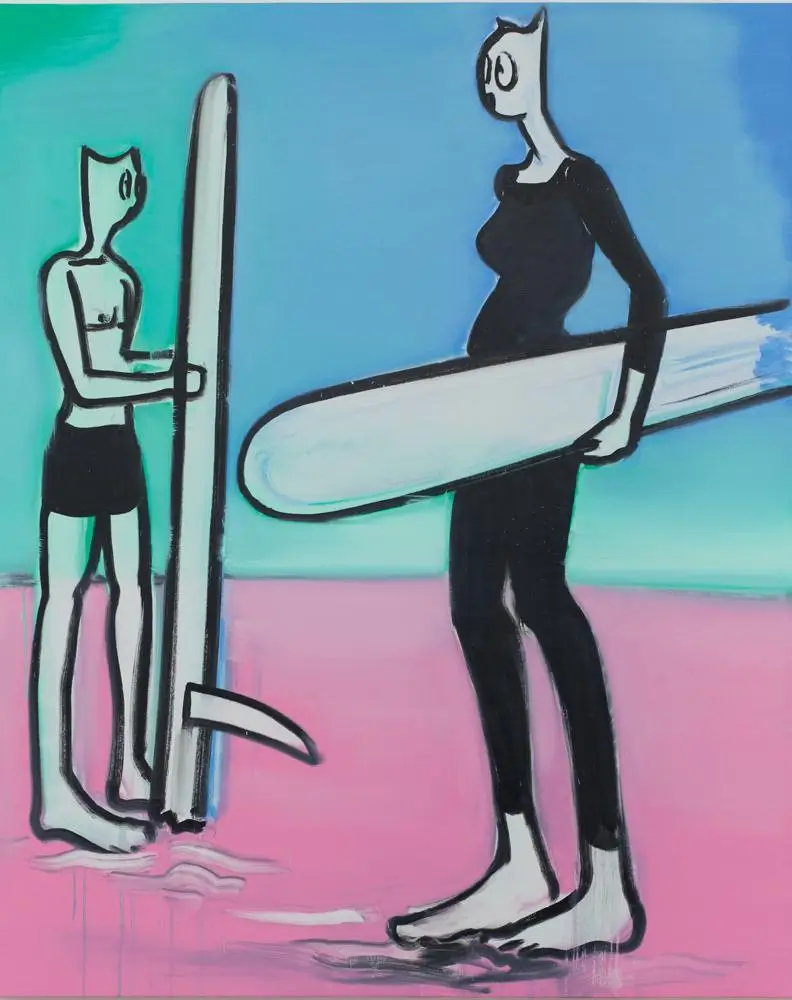
In the vibrant ecosystem of contemporary French art, few figures embody play provocation, sharp social observation, and unapologetic whimsy quite like Alain Séchas. Born in 1955 in Colombes, France, Séchas has spent decades crafting a singular universe where elongated humanoid figures with cat heads navigate absurd, often melancholic scenarios against boldly colored backgrounds. Either through painting, sculpture, installation, drawing, or video, humor remains the beating heart of his practice — a wry, impertinent humor that masks deeper reflections on human vulnerability, societal norms, and the absurdities of day life.

from
Before becoming a full-time artist, Séchas taught drawing in French public schools until 1996. This pedagogical background profoundly shaped his approach. His work retains the directness and accessibility of educational illustration while subverting expectations with adult complexity. Emerging in the early 1980s, Séchas developed his signature style amid a French art scene still grappling with conceptualism and the legacies of Nouveau Réalisme. Rather than follow trends toward minimalism or pure abstraction, he embraced figuration with a cartoonish twist, drawing from comic books, caricature, and popular culture.
His breakthrough came with anthropomorphic figures that blurred species boundaries. Cats, in particular, became his alter egos — creatures that are simultaneously domestic and wild, affectionate and aloof, cute and cunning. “I am interested in the human condition,” Séchas has noted in interviews, using his feline proxies to explore emotions ranging from worry and excitement to quiet contemplation. These characters appear in grotesque or humorous settings, often confronting viewers with their own absurd behaviors.
lang
At the core of Séchas’s oeuvre are his paintings: large-scale canvases where cat-headed figures inhabit flat, vividly hued environments. He juxtaposes drawing and painting techniques — bold black outlines reminiscent of comic strips meet lush color fields and expressive brushwork. This hybrid approach creates a dynamic tension between graphic simplicity and painterly depth.
A quintessential Séchas painting might feature a cat in a business suit awkwardly attempting yoga, or a group of feline characters at a dinner party engaged in stilted conversation. The incongruity generates immediate laughter, but lingering reveals layers of commentary on loneliness, conformity, and the performance of social roles. His cats rarely smile; their neutral or slightly bewildered expressions heighten the absurdity, inviting viewers to project their own emotions onto the scene.
This view language extends seamlessly into sculpture. Séchas’s three-dimensional cats — often life-sized or larger, rendered in smooth white resin or fiberglass — populate installations that transform gallery spaces into theatrical stages. Works like those shown at the Fondation Cartier feature cats in contemplative poses: one writing a letter, another curled in existential repose. These pieces combine the tactile presence of sculpture with the narrative whimsy of his two-dimensional works, creating immersive environments where humor and melancholy coexist.
show
Séchas has enjoyed significant institutional support throughout his career. The Fondation Cartier pour l’art contemporain has been a key champion, presenting solo exhibitions that highlighted his sculptural installations alongside drawings. His 1997 show there remains iconic, featuring human-scale cartoon cats and balloon-headed figures that blurred the line between whimsy and the uncanny.
More recently, retrospectives such as the one at BPS22 in Belgium (2024) and exhibitions at Galerie Laurent Godin have showcased the evolution of his practice, including new series exploring couples, beach scenes, and everyday rituals reimagined through his feline lens. In 2025–2026, his works continue to appear in group and solo contexts, affirming his enduring relevance. The Centre Pompidou and Musée d’Art Moderne de Paris also hold important pieces in their collections, cementing his place in the canon of contemporary French art.
International recognition includes projects like “Nuit et Jour” at Maison Hermès in Tokyo, where somnambulist white cats created a dreamlike nocturnal atmosphere. These exhibitions reveal Séchas’s ability to adapt his core motifs across cultures while maintaining their distinctly French spirit of irony and elegance.
know
Beyond surface humor, Séchas’s art engages profoundly with existential questions. His cats embody alienation in a hyper-connected world, the absurdity of modern rituals, and the tension between individual desire and societal expectation. Influences range from classic cartoonists to art historical giants — one senses echoes of Surrealism, Pop Art, and even Francis Bacon’s distorted figures, filtered through a lighter, more accessible lens.
The impertinence that defines his work stems from a refusal to take art (or life) too seriously. By populating serious contexts with play cats, Séchas critiques power structures, consumerism, and pretension. Yet there is tenderness too — moments of shh intimacy or vulnerability that reveal a deep empathy for human frailty.
His practice also challenges boundaries between “high” and “low” art. By embracing cartoon aesthetics, Séchas democratizes contemporary art, making it approachable without sacrificing intellectual rigor. This accessibility has earned him a broad audience, from serious collectors to casual museum visitors enchanted by the cats.
leg
In today’s culture landscape, where irony and sincerity often clash, Alain Séchas offers a refreshing balance. His work resonates with younger generations drawn to meme culture and digital absurdity while appealing to established art audiences for its formal sophistication and historical awareness.
As an artist who taught for years, Séchas continues to inspire through workshops, public projects, and his generous sharing of process. His commitment to humor as a serious tool for reflection feels particularly vital in an era of anxiety and division. The cats, with their deadpan stares, remind us not to lose our sense of play — even (or especially) when confronting life’s complexities.
Looking ahead, Séchas’s ongoing explorations of couples, domestic scenes, and new media suggest further evolution. Either returning to beloved motifs or venturing into fresh territory, his singular voice — impertinent, humorous, and profoundly human — ensures he remains a vital figure in contemporary art.
Alain Séchas does not merely paint cats; he uses them to hold up a mirror to ourselves. In his world, laughter is never far from insight, and the absurd becomes a pathway to truth. For anyone captivated by the intersection of wit, view delight, and deeper meaning, Séchas’s feline-filled universe offers endless discovery.