DRIFT AUDIO
Listen to this story
Choose a voice, then press play.
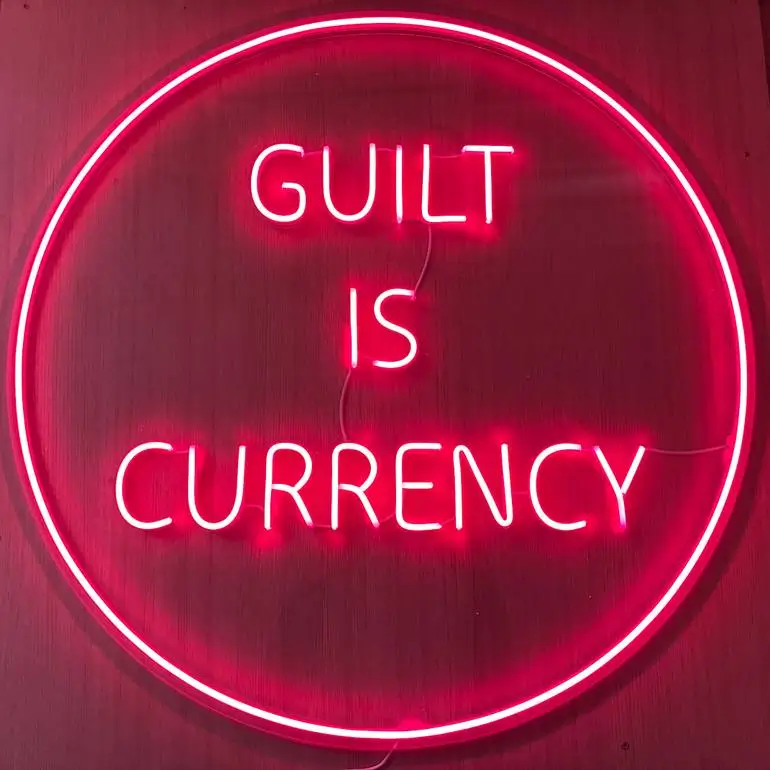
In the flickering glow of contemporary existence, where attention is traded like cryptocurrency and shame circulates as freely as likes, Spanish artist Enrique Baeza illuminates a stark truth: guilt has become our most liquid asset. His latest installation, “Guilt Is Currency (La culpa es una moneda de cambio.)”, a limited edition of just 10 neon-and-LED works, arrives as both provocation and mirror. Crafted in Barcelona, these luminous sculptures transform language into light, forcing viewers to confront the transactional nature of modern remorse in a world engineered for perpetual emotional exchange.
Baeza, a Barcelona-based artist whose practice orbits the motto Reality is Spam, has long weaponized text to pierce the veil of manipulated communication. Through neon signs, public interventions, word portraits, and performative listening sessions, he excavates the hidden scripts governing human interaction. This new series distills his inquiry into a singular, potent declaration—one that feels urgently timed for our age of algorithmic confession, cancel culture economies, and wellness industries built on self-flagellation. Each piece in the edition of 10 glows with custom LED-neon tubing, the bilingual phrase pulsing in calculated rhythms that evoke both advertising billboards and confessional booths.
flow
To grasp the depth of “Guilt Is Currency”, one must trace Baeza’s trajectory. Trained in the linguistic and performative traditions of conceptual art, Baeza rejects passive spectatorship. His process often begins with intimate dialogues—Word Portraits—where conversations with subjects yield symbolic sentences that capture their essence at a given moment. These fragments aggregate into broader tapestries of collective psyche. Projects have spanned continents, appearing at Art Basel Miami, the Venice Biennale, MACBA in Barcelona, and Burning Man, always interrogating how language suffocates authentic exchange in a spam-saturated reality.
Collides with collectives like MITO.tv and Divinas Palabras further underscore his commitment to counter-narratives. MITO activates the unconscious through myth-making interventions; Divinas Palabras borrows advertising tactics to reposition individuals as media themselves. In this lineage, “Guilt Is Currency” operates as both sculpture and slogan—a portable, glowing artifact designed for gallery walls, private collections, or unexpected public placements. The limited edition underscores rarity in an era of infinite digital reproduction, each piece hand-crafted with variations in hue, scale, and subtle animation that make guilt feel alive, breathing, monetizable.
The Spanish title, La culpa es una moneda de cambio, carries particular resonance in a culture shaped by Catholic heritage, economic precarity, and the performative politics of the Mediterranean. “Moneda de cambio” evokes not just currency but exchange—the barter of guilt for absolution, forgiveness for compliance, or public apology for social capital. Baeza’s bilingual approach bridges Iberian introspection with global anglophone markets, mirroring how guilt travels fluidly across borders in our hyper-connected age.
show
Technically masterful, each installation fuses traditional neon glass tubing with contemporary LED elements. Neon’s warm, analog flicker—reminiscent of mid-century signage and vintage cinema—contrasts with LED’s precise, programmable glow, symbolizing the tension between authentic emotion and engineered affect. The phrase hovers in space, sometimes static, sometimes cycling through intensities that mimic heartbeat or stock ticker fluctuations. Viewers report a hypnotic pull: the light invades peripheral view, embedding the message somatically.
Dimensions vary subtly across the edition (roughly 36 x 58 cm in core iterations), allowing intimate domestic display or commanding institutional presence. Mounting options include wall suspension with view cabling—emphasizing infrastructure of emotion—or freestanding plinths that cast dramatic backdrop, turning the gallery into a trading floor of the soul. The choice of materials is no accident: neon has historically advertised desire (think Vegas chapels or Times Square pleas); here, Baeza subverts it to advertise our most private transaction.
This edition builds on earlier works like Enjoy Guilt (2013, also limited edition), where red neon commanded viewers to embrace remorse as pleasure. “Guilt Is Currency” evolves the inquiry, quantifying guilt’s exchange value in a neoliberal framework. It dialogues with artists like Jenny Holzer, whose Truisms and LED installations parse power through text, or Bruce Nauman’s neon puns that expose linguistic slippage. Yet Baeza’s voice remains distinctly Iberian—poetic, acerbic, rooted in lived contradictions of post-Franco Spain and its transition to consumer democracy.
scope
Know, the work engages a lineage from Nietzsche’s “bad conscience” to Byung-Chul Han’s The Burnout Society and Psychopolitics. In Han’s analysis, neoliberalism replaces external oppression with internal self-exploitation; guilt becomes the fuel. We confess on social media not for redemption but for engagement metrics. Baeza literalizes this: guilt is currency—traded for likes, career rehabilitation, or moral superiority.
In Spain, this resonates against historical layers: the weight of duende (that profound, guilt-tinged passion in flamenco and Lorca), Catholic rituals of penance, and the economic guilt of austerity post-2008. Globally, it speaks to #MeToo reckonings, climate anxiety offsets, and performative allyship. The installation doesn’t moralize; it observes. Its neutrality—glowing indifferently—mirrors how systems commodify feeling without resolution.
Fashion and design worlds, frequent colliders in Baeza’s orbit (echoing his brand partnerships), recognize this dynamic. Haute campaigns weaponize subtle guilt: “Invest in timeless pieces” implies moral failing in disposability. Streetwear drops promise absolution through limited scarcity. Baeza’s neon could seamlessly inhabit a flagship store vitrine, its message refracting off mirrored surfaces and high-end textiles, questioning the ethics of consumption itself.
install
Imagined in situ, “Guilt Is Currency” transforms spaces. In a white-cube gallery, it hums like a devotional icon; in a derelict industrial loft, it evokes underground raves where catharsis is sold by the hour. Public deployments—perhaps on Barcelona’s Ramblas or New York subway ads—would infiltrate daily commutes, forcing passersby to audit their own ledgers of remorse.
The limited edition of 10 invites collector engagement with rarity’s own guilt complex: owning one means participating in the very economy critiqued. Provenance documentation might include audio from Baeza’s listening sessions, turning acquisition into co-authorship. Future iterations could incorporate interactivity—sensors that brighten with viewer proximity, simulating guilt’s amplification under scrutiny.
length
Baeza joins a cohort of text-based artists updating 1960s conceptualism for digital natives. Think Rirkrit Tiravanija’s relational aesthetics or Lawrence Weiner’s linguistic dematerialization, now filtered through platform capitalism. His work also parallels literary explorations—Javier Marías’ moral ambiguities or Elena Ferrante’s hidden guilts—view in light.
In music and fashion crossovers central to lens, guilt fuels entire aesthetics: dark academia’s brooding privilege, or the “sad girl” trend commodifying melancholy. Baeza’s installation offers a meta-commentary, a glowing artifact that could backdrop a runway show where models stride under its glare, their garments whispering stories of atonement through style.
Politically, it arrives amid polarized discourse where guilt is strategically deployed—collective historical guilt versus individual agency. By naming it currency, Baeza exposes the transaction, inviting skepticism toward easy expiations.
huh
As LED elements pulse and neon warms the air, viewers feel the hum of recognition. Guilt powers economies of attention, penance, and progress. Acknowledging it as currency is the first step toward new ledgers—perhaps ones valuing genuine connection over performative exchange.
Baeza’s practice reminds us that language, when made visible and electric, can short-circuit dominant scripts. In a reality shaped by spam, his installations broadcast alternative frequencies. “Guilt Is Currency” isn’t mere signage; it’s a beacon for recalibrating what we owe ourselves and each other.
Collectors and institutions seeking these works will find not decoration but dialogue—art that lives, glows, and demands reckoning long after the lights dim. As the edition disperses across private and public spheres, its message multiplies: in our transactions of feeling, awareness itself becomes the most valuable coin.
The beautiful tension of Baeza’s work lies in its accessibility and depth. Neon democratizes the profound; limited scarcity elevates the encounter. For those attuned to design’s power to shape behavior and belief, this installation is essential.
From the DRIFT archive: The Art of the Can: Chaz Bojórquez’s Hand-Signed MTN Spray Paint Edition · Francesco Clemente’s Portrait Commission: The Human Gaze, Reimagined for The Coral Collective