DRIFT AUDIO
Listen to this story
Choose a voice, then press play.
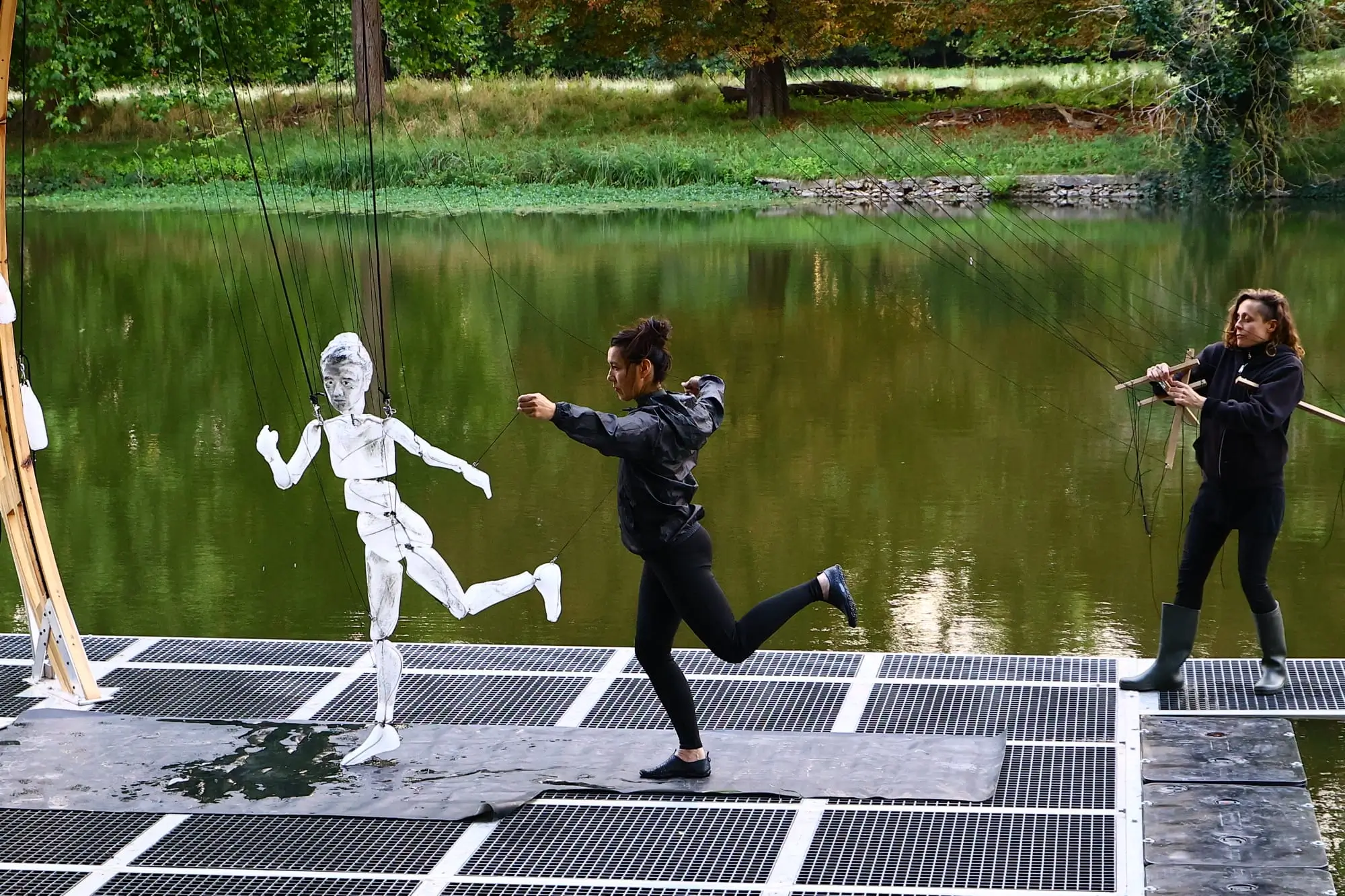
In the shimmering interplay of light on water, a dancer moves in shh communion with a figure of ice—her double, her reflection, her inevitable loss. “MIZU,” the Japanese word for water (水), is a mesmerizing performance that transforms the ephemeral into the eternal. Created by choreographer and circus artist Satchie Noro of Compagnie Furinkaï and puppeteer-director Élise Vigneron of Théâtre de l’Entrouvert, this 40-minute pas de trois unfolds as a profound meditation on fragility, transformation, and the human condition. As the ice puppet slowly melts under the gaze of its audience, it becomes a living metaphor for life’s impermanence, reminding us that every form eventually returns to formlessness.
Premiering in 2025 and touring actively through 2026—including recent and upcoming stops at festivals across Europe such as Tanec Praha in Prague and Bilboko Kalealdia in Bilbao—“MIZU” invites viewers into a dreamlike landscape where water is not merely backdrop but protagonist. Performed on a floating stage or near bodies of water, the piece blurs boundaries between dance, circus arts, puppetry, and environmental sculpture. It speaks with particular resonance in our current culture moment, one marked by ecological anxiety, digital ephemerality, and a renewed know interest in transience drawn from Buddhist thought, Romantic flow and contemporary eco-art.
stir
The connect between Noro and Vigneron merges two distinct yet complementary artistic languages. Noro, known for her boundary-pushing work that integrates circus apparatus, aerial elements, and deeply embodied choreography, brings a visceral physicality. Vigneron, a master puppeteer and sculptor, contributes her expertise in crafting evocative objects—here, a life-sized human figure molded from ice. Together, they have birthed a work that is equal parts tender dialogue and know inquiry.
“MIZU stages, on a body of water, the ephemeral existence of an ice puppet,” the creators explain. “During the brief time it melts, this wordless poem delicately conveys the fragility of our lives and the necessity of connecting them.” The performance draws inspiration from natural cycles, the flow of melting forms, and texts like Olivier Remaud’s reflections on thinking like an iceberg. A voiceover excerpt from Remaud’s Penser comme un iceberg adds a contemplative layer, while original music by Carlos Canales and sound design by Hans Kunze envelop the audience in an immersive sonic world of drips, creaks, and subtle resonances.
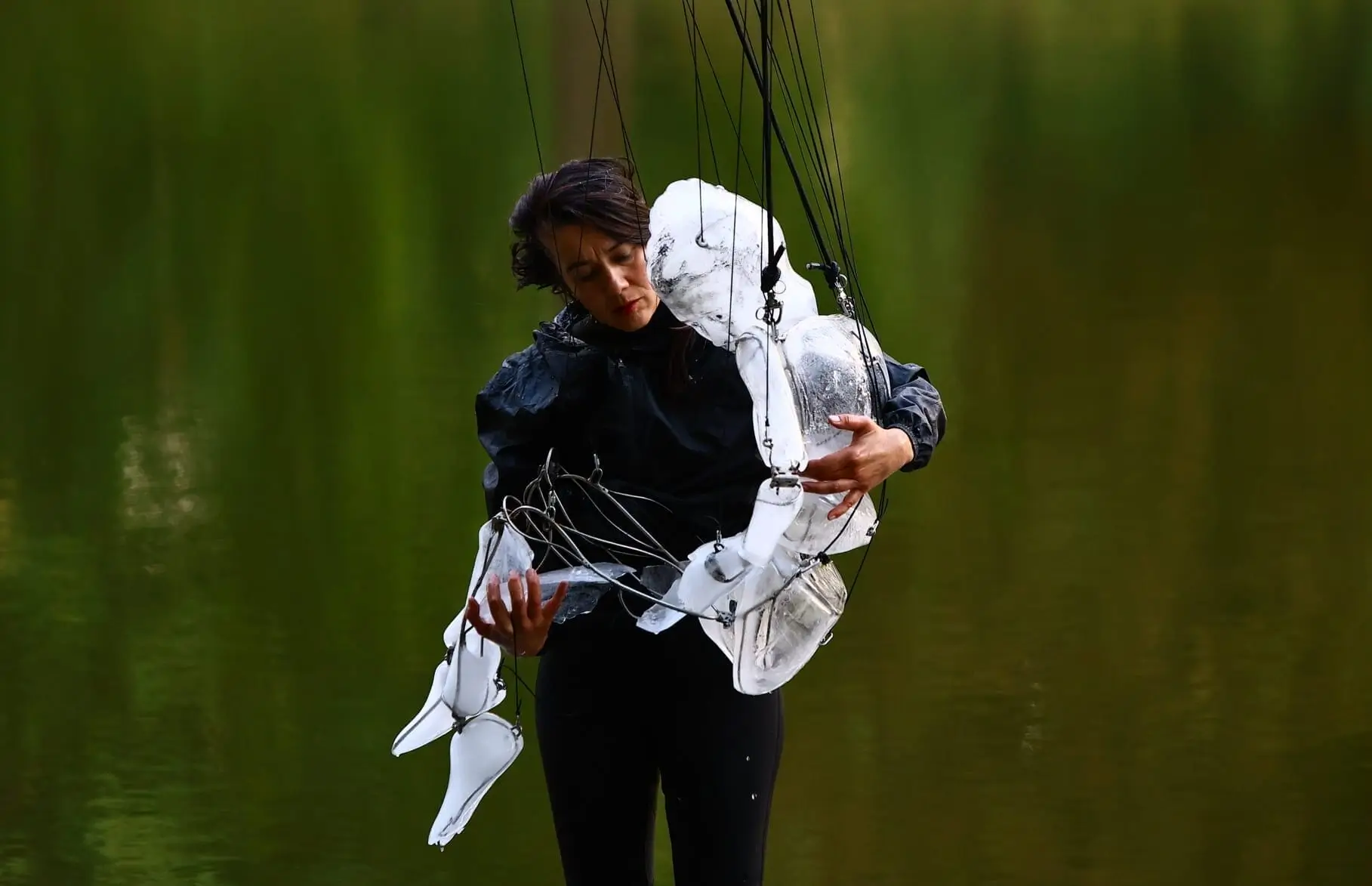
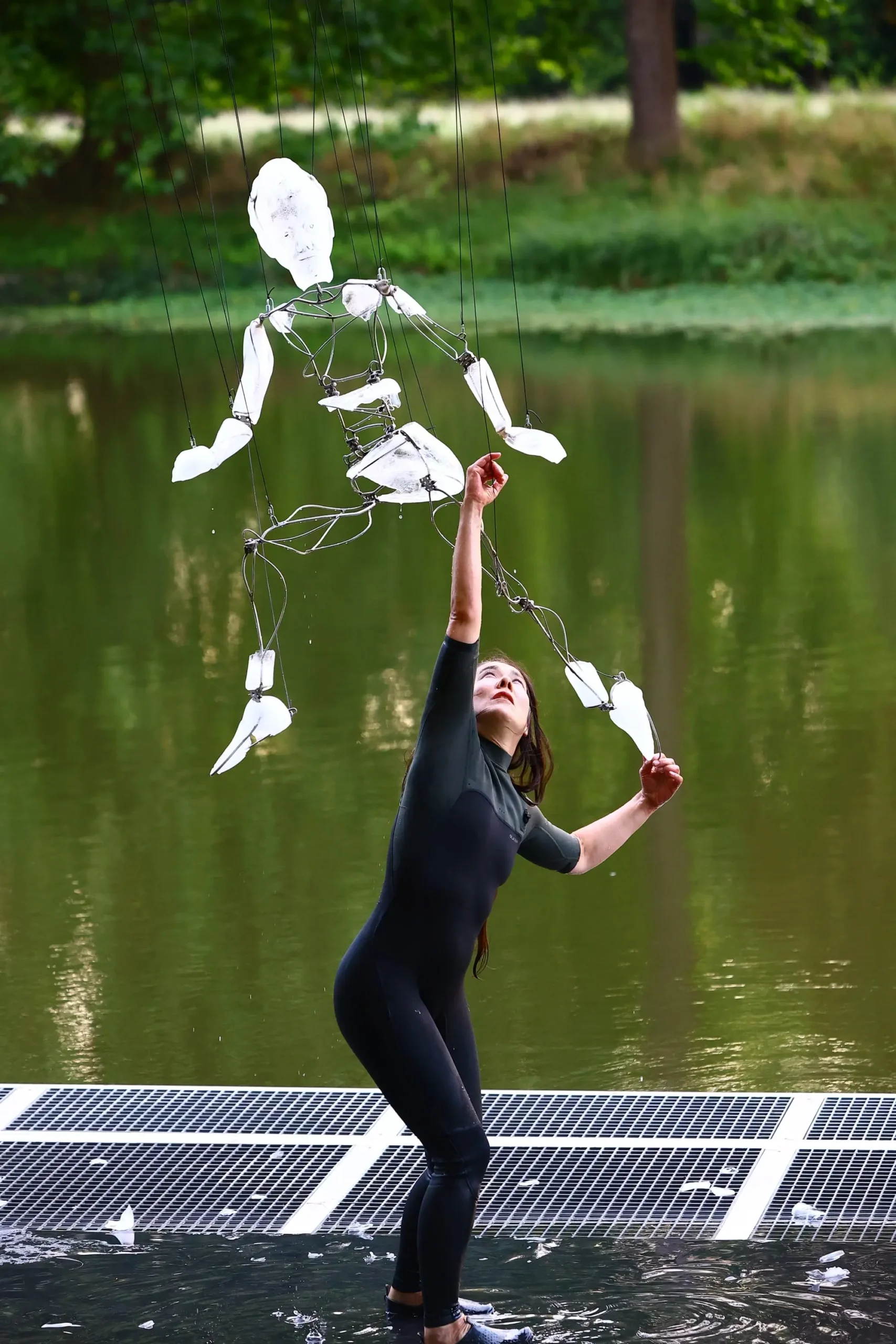
At its core, “MIZU” is a trio: Satchie Noro as dancer and choreographer, Sarah Lascar as puppeteer, and the ice figure itself—designed by Vigneron and constructed with a team including Vincent Debuire, Silvain Ohl, and others. Suspended from a wooden frame on a floating platform, the puppet is manipulated with precision and care, its movements echoing and responding to Noro’s dance. What begins as a mirrored duet evolves into something more intimate and maternal, then ultimately solitary as the ice yields to its fate.
flow
Ice, as both material and symbol, carries rich associations. It preserves yet destroys; it is beautiful in its clarity and devastating in its transience. As novelist Haruki Murakami has noted, ice holds the past “cleanly and clearly” but offers no future. In “MIZU,” this duality is embodied literally. The puppet starts as a solid, almost ghostly counterpart to the dancer—elegant, poised, full of potential. With each passing minute, drops of water trace its contours, softening limbs, eroding features, until it becomes brittle, fragmented, and finally absent.
This transformation is not passive spectacle but active choreography. Noro’s movements—fluid, grounded, at times acrobatic—interact with the puppet’s changing state. She supports it, leans into it, releases it, and ultimately dances amid its dissolution. The puppeteer’s hands guide these shifts with invisible labor, highlighting themes of care, control, and surrender. Every touch reshapes the form, underscoring how relationships and identities are constantly remade through interaction.
The human body, itself approximately 60% water, finds profound kinship here. “MIZU” celebrates the fusion with the element that constitutes us, tracing the passage “from form to formlessness, from the individual to the cosmos.” It echoes Japanese concepts of mono no aware—the gentle sadness and appreciation of impermanence—and broader know traditions that view change as the only constant. In an age of climate crisis, where melting ice caps signal planetary fragility, the exhibit gains urgent ecological undertones without didacticism.
imbue
Performed outdoors or in site-specific venues beside water, “MIZU” leverages its environment masterfully. The floating stage creates a liminal space—neither fully land nor sea—where reflections double the action and ambient sounds (lapping water, distant birds) integrate into the score. Lighting shifts with natural conditions or subtle design, catching glints off melting ice and casting long silhouette as evening falls during summer shows.
Technical elements are deceptively simple yet rigorously executed. The wooden suspension frame, designed by Éric Noël and Silvain Ohl, provides structural height, evoking both scaffolding and ritual apparatus. Textiles by Aurore Thibout drape the puppet with delicate sensitivity. The 40-minute duration is perfectly calibrated: long enough for deep immersion, short enough to maintain tension as the audience witnesses irreversible change. For audiences aged 4 and up, it offers accessibility through visual wonder while rewarding adult contemplation.
Critics have praised the work’s balance of gentleness and power. One review notes: “The audience holds its breath. Life and death play out over these 40 minutes in a philosophical and flow performance, balancing gentleness and a final surge of strength.” Another highlights the “intimate dialogue” that develops, at times feeling “almost maternal.” The piece exists only in the moment; no two performances are identical due to variables in temperature, humidity, and ice behavior.
scope
“MIZU” sits within a lineage of art engaging transience. It recalls Japanese ukiyo-e prints celebrating fleeting beauty, land art that succumbs to nature, and contemporary works like Néle Azevedo’s melting ice figures. In performance, it dialogues with butoh’s slow transformation, Pina Bausch’s emotional rawness, and modern circus innovations that treat the body as sculptural material.
Noro and Vigneron’s selection for Aerowaves Twenty26 underscores its innovation within European contemporary dance and circus. The co-production involves numerous French cultural institutions and international partners, reflecting strong support for interdisciplinary, eco-poetic work. In 2026, as it tours festivals from Prague to Bilbao to outdoor street arts events in Belgium and France, “MIZU” reaches diverse audiences, bridging high art with public space.
Thematically, it resonates with broader cultural conversations: mindfulness practices emphasizing presence, sustainability movements highlighting water’s preciousness, and existential reflections amplified by global uncertainties. In fashion and design parallels—think slow fashion’s appreciation for wear and patina, or architecture embracing natural decay—“MIZU” offers a performative counterpart to objects and garments designed with impermanence in mind.
emotive
Viewers describe “MIZU” as hypnotic and moving. The gradual disappearance elicits a spectrum of emotions—wonder at the beauty of melting forms, melancholy at inevitable loss, and ultimately acceptance or even celebration. Children often respond with pure fascination at the “magic ice person,” while adults project personal narratives of relationships, aging, and memory.
The maternal undertones—Noro nurturing the puppet as it weakens—evoke caregiving, parenthood, and the cycle of generations. Yet the work avoids sentimentality, grounding itself in physical reality: the sound of dripping water, the visible strain of support, the final quiet when only the frame remains. It is a reminder that bonds persist even after physical presence fades.
In our hyper-documented era, where digital permanence creates illusions of immortality, “MIZU” offers a corrective. It cannot be fully captured; videos convey technique but miss the live tension of watching something precious dissolve in real time. This ephemerality heightens its power, making each performance a unique shared ritual.
and
“MIZU” exemplifies how contemporary performance can address profound questions through minimal means. No grand narrative or heavy exposition—just bodies, ice, water, and time. In doing so, it models a kind of artistic sustainability: responsive to environment, resource-conscious (ice returns to water), and deeply human.
For creators in fashion, design, and culture, it inspires reflection on legacy and materiality. How do we design garments, objects, or experiences that embrace rather than deny decay? What beauty emerges when we accept limits? The ice puppet, with its wooden bones revealed as flesh melts away, parallels ideas in wabi-sabi or deconstruction—where structure and story lie in what remains.
As summer 2026 unfolds with performances continuing across Europe, “MIZU” stands as a timely artistic offering. In a world rushing toward an uncertain future, it slows us down, asking us to witness, to connect, and to find solace in the flow. Satchie Noro’s final dance amid remnants becomes an act of resilience—finding oneself again after loss.
fin
The continued tour schedule promises more opportunities to experience this singular work. Whether on the ponds of Ixelles, stages in Prague, or open-air venues in France and Spain, “MIZU” adapts while retaining its core poetry. Future iterations may evolve with new environments, further enriching its dialogue with place.
“MIZU” is more than performance; it is a philosophical encounter. It teaches that fragility is not weakness but the very essence of existence—that impermanence gives meaning to presence. In the dance between dancer and dissolving double, we see ourselves: transient beings seeking connection, beauty, and know before returning to the greater flow.
As the last drops fall and the stage falls silent, the audience carries away not just memory but a renewed appreciation for the liquid nature of life. Water shapes us, sustains us, and eventually reclaims us. In celebrating this truth with grace and artistry, Noro and Vigneron have created something enduring in its very evanescence.
From the DRIFT archive: Eric Stefanski and the Art of Selective Living: A 2025 Confession Painted in Plain Sight