DRIFT AUDIO
Listen to this story
Choose a voice, then press play.
A Pulitzer finalist reread a decade of her own reporting after having children, and noticed who she’d left out the first time.
Rachel Aviv has spent close to fifteen years at The New Yorker writing about people whose inner lives resist tidy explain: a woman who vanish into a New Hampshire farmhouse rather than accept a psychiatric diagnosis, a schoolteacher who periodic forgot who she was, patients misdiagnosed with schizophrenia who turned out to have a treatable autoimmune disease. That last story made her a Pulitzer Prize finalist in feature writing. Her first book, Strangers to Ourselves, was named one of the best books of 2022 by The New York Times. Her new one, published by Knopf in July, is called You Won’t Get Free of It: Stories of Mothers and Daughters, and it does something her earlier work never quite did: it turns Aviv’s own reporting back on itself.
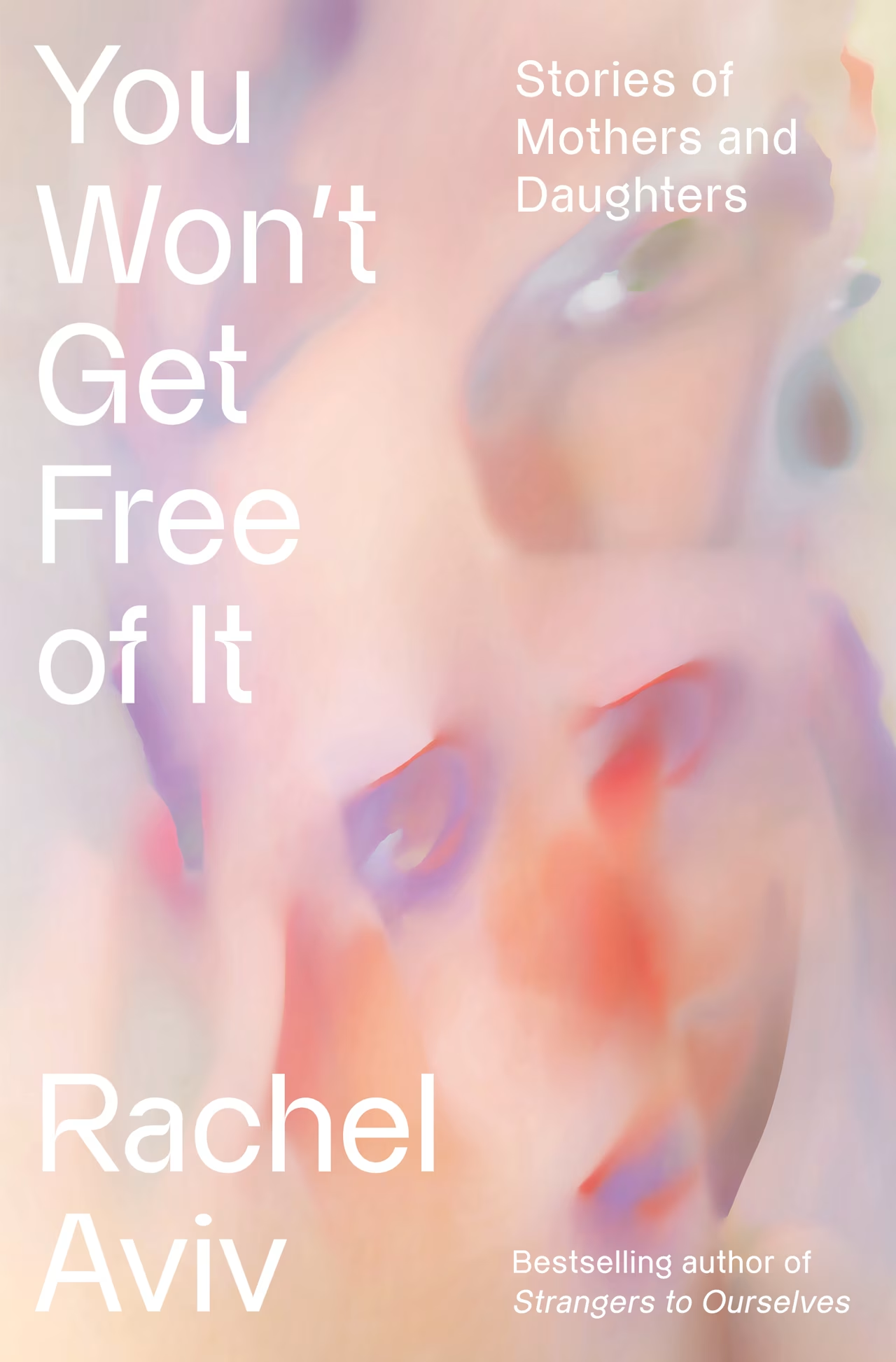
Book Cover For Rachel Aviv’s You Won’t Get Free Of It: Stories Of Mothers And Daughters, Featuring A Soft Abstract Portrait In Pastel Pink, Peach, Lavender, And Cream Tones With Large White Typography.
The book gathers seven essays, six of them expanded from pieces Aviv originally wrote for the magazine, alongside a new preface. What’s changed isn’t the reporting so much as who Aviv was when she went looking through it again. She wrote most of these stories, she has said, without children of her own, identify, half-conscious, with the daughters in them. Reread the material years later as a mother of two, she found herself notice a whole cast of women she’d essential written past the first time.
stir
The book’s preface, unpublished elsewhere, opens with Aviv’s own mother: a woman who sat down at her typewriter in 1980 hoping to write something like Madame Bovary while her infant daughter slept, and who mostly ended up folding laundry instead. That failed novel hangs over the whole collection. On NPR’s Fresh Air, Aviv described growing up believing her mother possessed some kind of unbounded, all-consuming devotion to her, a devotion Aviv felt she herself could never quite match. Becoming a parent complicated that story rather than resolve it.
She’s traced the shift to a specific afternoon: reread her interview notes for “God Knows Where I Am,” the first piece she wrote for the magazine, back in 2011, at 28. The story concerned Linda Bishop, a woman who left a psychiatric hospital against medical advice and was later found dead of starvation in an abandoned New Hampshire farmhouse, having survived for a time on apples from an overgrown orchard. Going back through her own notes, Aviv realized she’d been told, and had left out entirely, that Bishop had given birth as a teenager and been forced to surrender the baby for adoption. As Aviv put it to The New Republic, she hadn’t considered the loss of a child a biographical detail worth including, and hadn’t even thought to ask a follow-up question about it.
flow
That same blind spot shows up more than once. The collection’s opening essay follows Hannah Upp, a Harlem schoolteacher who disappear for weeks at a time during recur episode of dissociative fugue, a rare condition in which a person loses access to their own personal history, sometimes for months. Upp first vanished in 2008 and surfaced, disoriented, in the Hudson River after three weeks of searches. She had at least two further fugues over the following decade, the last of them during Hurricane Irma on St. Thomas, after which she was never found.
When Aviv first reported the story, she noted only lightly that Upp’s disappearances tended to cluster around a particular time of year. It was years later, rereading the piece as a mother herself, that she registered what her interview notes had actually contained: before Hannah was born, her mother Barbara had delivered another baby who died within a day. Hannah’s fugues kept recurring near that lost sibling’s birthday. Aviv has said she initially cut the detail because it felt too symbolic to include, almost too neat to be journalistically honest. Returning to it, she came to see the coincidence differently, less as a fact to be verified than as a kind of family myth that shaped both mother and daughter regardless of even if it was literal causal.
That instinct, to sit with an ambiguity rather than resolve it, runs through Aviv’s other reported subjects in the book as well: a Filipino domestic worker named Emma, who left nine children behind in the Philippines to work as a nanny for other people’s children in New York, and who described the emotional substitution involved as “displacement”; and a mother of two, the philosopher Martha Nussbaum, whom Aviv noticed she’d once described almost identically to psychologist Elizabeth Loftus, each woman insisting on working straight through labor and delivery as if motherhood might otherwise dissolve them.
huh
The book’s title essay, and by most accounts its centerpiece, is Aviv’s 2024 New Yorker investigation into Alice Munro, the Nobel laureate short-story writer, and Munro’s decades-long refusal to reckon with the sexual abuse of her youngest daughter, Andrea Skinner, at the hands of Munro’s second husband, Gerry Fremlin. The essay is difficult in ways Aviv’s other work generally isn’t: Munro not only failed to protect her daughter, she went on, over decades, to metabolize versions of the abuse into some of her most acclaimed fiction, a fact Andrea’s sister Jenny once described to Aviv as their mother running everything through a machine that turns things into gold.
Aviv reported that in one recorded conversation with her own biographer, unused at the time, Munro acknowledged the abuse plainly, then said she would be destroyed if it became known publicly. She stayed with Fremlin. In her own short fiction, one recurring phrase describes a mother who abandons her children for a man: you won’t get free of it. Aviv has said she was struck less by any justification Munro might have offered than by the total absence of one.
What makes the essay characteristic of the collection, rather than an outlier within it, is that Aviv resists using the revelation to simply cancel Munro’s literary standing. She’s said in interviews that rereading the stories after reporting out the abuse, she found herself with more respect for Munro’s craft, not less; the writing, if anything, grew more complex and psychological exacting in the years it was, in effect, being built out of her daughter’s pain. Aviv has been careful to separate that aesthetic judgment from a moral one, noting that admiration for the work and horror at what produced it aren’t mutually exclusive, however uncomfortable they are to hold at once.
fin
Aviv’s own mother, reading the Munro essay, wrote to her daughter convinced that she, too, must have somehow failed to protect Aviv from some unspoken harm of her own, an inference Aviv has called an overreach but not an implausible one, given how closely she and her mother have always read each other’s material. Aviv has a phrase for this kind of thing, borrowed loosely from psychiatry: a delusion of reference, the sense that everything a daughter writes must somehow be coded lang about the mother who raised her.
That same instability of authority is something Aviv has spoken about directly, describing the process of returning to a decade of her own notebooks as an exercise in confronting how unstable her authority as a narrator had always been, how much of what she’d chosen to include or cut had been shaped by where she stood in her own life at the time. It’s a rare thing for a working journalist to admit about her own archive, let alone build a second book around.
You Won’t Get Free of It arrives at a moment when motherhood memoirs are having something of a run, from Lena Dunham’s account of her relationship with her artist mother Laurie Simmons to Arundhati Roy’s reckon with her own mother’s cruel. What distinguishes Aviv’s book from most of that shelf, per The New Republic’s recent assessment, is its refusal to settle into a single point of view. Aviv keeps circle back to her subjects’ mothers as fully formed people with their own longings and failures, rather than treating them as obstacles the daughters had to survive.
Related Articles
Joël Andrianomearisoa Finds More Than One Black in a Square of Buttons
In La Guerre des Boutons I, a field of ordinary fasteners turns a modest textile […]