DRIFT AUDIO
Listen to this story
Choose a voice, then press play.
A stainless steel chair built like a piece of city architecture, from a Seoul designer who has spent two decades stacking material into memory.
The LSC 201803 does not look like it was upholstered, bent, or molded. It looks like it was constructed, the way a building is constructed: unit by unit, plane by plane, until a form emerges that could hold weight without apologizing for its bulk. That reading is not incidental. The chair is the work of Hyungshin Hwang, a Seoul based designer who has spent nearly two decades treating furniture as a kind of miniature architecture, and it belongs to a body of work he calls the Layered Series, a catalog of stools, seats, and desks built from stacked stainless steel and wood that share one governing idea: that a basic unit, repeated and combined, can generate an entire language of form.
LSC 201803 is a compact stainless steel chair, part of that Layered Series, and it is currently available through TRNK, the New York gallery and retailer that represents Hwang’s work in the United States and lists the piece at 3,500 dollars, made to order, shipping in ten to fourteen weeks via freight. It is not a mass produced object. Every surface is 100 percent hand sanded and finished in wax, a slow, additive process that stands in direct contrast to the chair’s blunt, geometric silhouette. The tension between the two, an almost brutalist form and an intensely handmade surface, is the entire point of the piece, and of the Layered Series more broadly.
stir
The series began, by his own account, with a childhood memory: growing up in a Seoul that was, in his words, an incessantly transforming city full of geometric architecture. Seoul in the decades of Hwang’s youth was a city under constant construction and demolition, a skyline that rewrote itself block by block. That experience, watching structures rise and disappear in stacked, repeating forms, became the conceptual root of everything he has made since.
The Layered Series formally premiered at KIAF, the Korea International Art Fair, in 2007, and has expanded steadily in the years since into dozens of individual pieces, each cataloged with an alphanumeric code rather than a proper name. LSC 201803 follows that same cataloging logic, a code rather than a title, which is itself consistent with the series’ architectural sensibility: these are treated less like individual artworks and more like model numbers in an ongoing structural study, the same way an architect might label a building’s iterations rather than name each one.
View this post on Instagram
transition
Hwang’s relationship to layering did not begin with steel. Early in his career, before the Layered Series had a name, he worked with what was on hand: piling up discarded bricks and pieces of broken concrete to build simple sculptural forms. That instinct, to take fragmentary, ordinary material and stack it into something with new structure, has carried through into his mature furniture practice almost unchanged, only the materials have gotten more refined. Where the earliest experiments used construction debris, the current Layered Series works in stainless steel, parkerized steel, and red oak, materials chosen for how their surfaces record process. Stainless steel, when hand sanded across dozens of stacked layers, holds a soft directional grain that shifts under light. Red oak, treated with a particular finishing process, develops a natural tannic reaction that produces a grey blue cast over time. In both cases, the finishing is not decoration applied after the fact. It is where the labor of the piece becomes visible.
This is also where LSC 201803 earns its place in the wider Layered catalog rather than standing as an isolated design exercise. TRNK’s own description of the Layered Steel pieces frames the process directly: the work of stacking materials to make them a basic unit, then developing various forms and functions by combining that unit. A chair, a stool, a desk, in this framework, are not separate design problems. They are different combinatorial outcomes of the same underlying module, scaled and reoriented for different functions, the way a single brick can build a wall, a column, or an arch depending on how it is repeated.
idea
Set beside the rest of the Layered Steel family (a group that on TRNK alone runs from LSC 201801 through pieces coded into the 2020s), LSC 201803 reads as one of the earlier, more compact studies in the chair format, dated to 2018 in its own model code. Its silhouette is close and architectural rather than expansive: stacked stainless steel planes forming a seat and back with almost no ornament, no visible joinery in the conventional sense, and no upholstery to soften the reading of the material. It is a chair designed to be looked at as a structure first and sat in second, though it is, notably, still functional seating rather than a purely sculptural object, a distinction Hwang has maintained across the Layered Series even as individual pieces get shown in gallery and fair contexts more associated with art than furniture.
That dual identity, functional object and sculptural study, is part of why the piece has found a home with a gallery like TRNK, which positions itself in the collectible design space rather than conventional retail. It also explains the production timeline: a ten to fourteen week freight lead time is not the cadence of furniture built for volume. It is the cadence of a piece that is hand finished to order, one at a time, by a process that resists shortcuts.
scope
Hwang was born in Seoul in 1981 and trained formally in woodworking and furniture design, earning both a BFA and an MFA from Hongik University, one of South Korea’s most established art and design schools. That academic grounding in woodworking is worth noting given how central steel has become to his public output. It suggests a designer whose method (built around modular, additive construction logic) transfers across materials more readily than it stays fixed to one, which tracks with how the Layered Series itself has expanded from wood and found materials into parkerized and stainless steel over time.
Hwang has also spent years on the teaching side of Korean design education, holding positions at Hongik University, Seoul National University, Kaywon University of Art and Design, and Chungnam National University. He currently works from a studio in Paju, on the outskirts of Seoul, a detail he has mentioned directly when discussing his practice: a workspace removed from the city center but still within reach of the skyline that shaped the Layered Series in the first place.
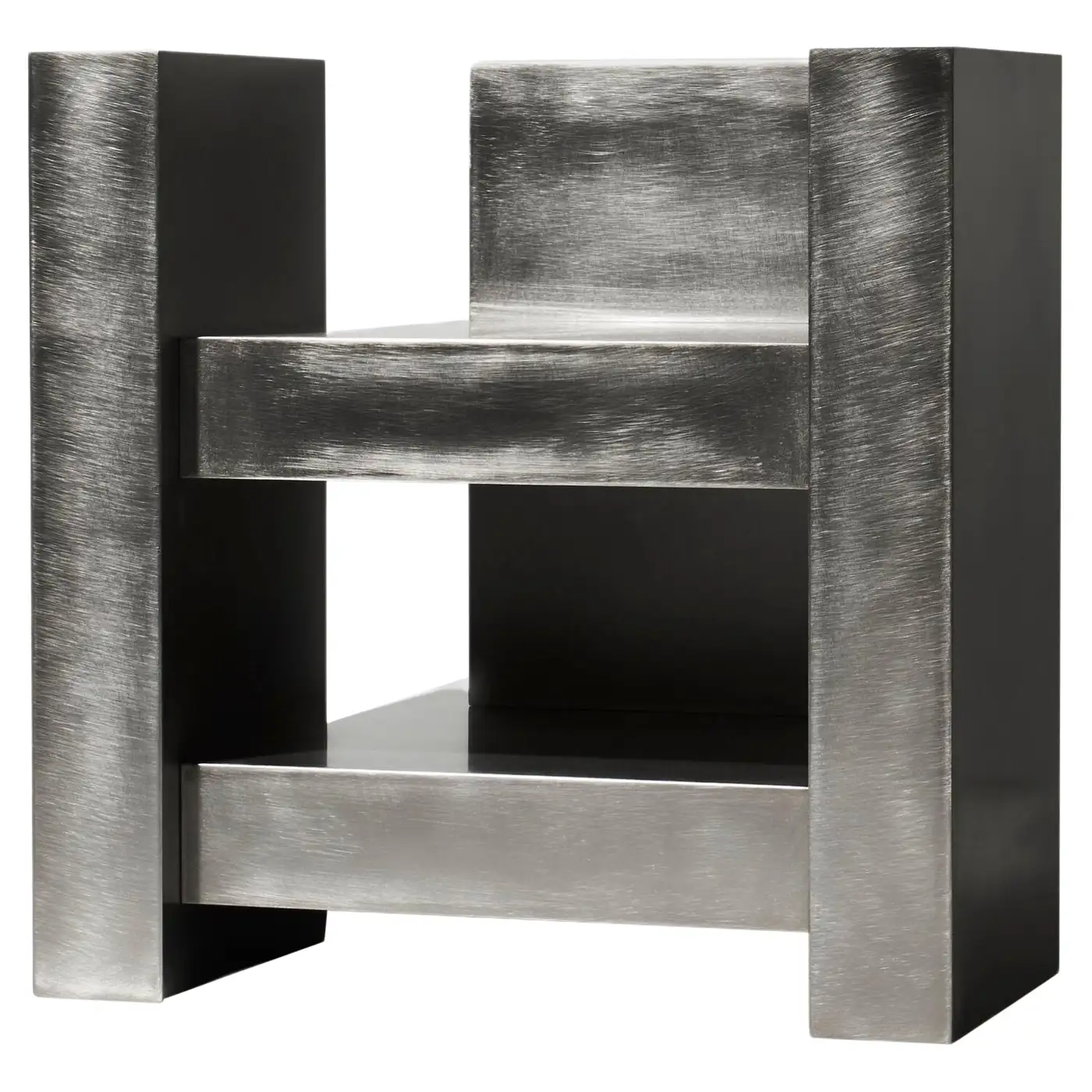
Layered Steel Seat by Hyungshin Hwang
show
Since its 2007 debut at KIAF, the Layered Series has moved through a fairly wide circuit of design and art platforms, both in Korea and internationally. Hwang’s work has appeared at DMY Berlin Design Festival, Milan Design Week, Design Days Dubai, and Art Beijing, as well as in more institutional settings including La Triennale di Milano, the Kumho Museum, the Korea Craft and Design Foundation, and the National Hangeul Museum’s Hangeul Design Project. He has also taken part in Amorepacific’s Sulhwa Cultural Exhibition at Gallery Hakgojae, placing his furniture practice in direct conversation with contemporary art and craft programming rather than treating it as a separate category.
That circuit matters for how a piece like LSC 201803 should be read. It is not a standalone product launch. It is one entry in a body of work that has been developed, shown, and refined across nearly two decades of gallery, fair, and museum contexts, with the individual chairs, stools, and desks functioning as variations within a single sustained architectural inquiry rather than discrete seasonal releases.
fin
LSC 201803 is currently listed through TRNK’s dedicated Hyungshin Hwang collection, sitting alongside dozens of other coded Layered Series pieces spanning steel seats, wood chairs, benches, and desks priced anywhere from roughly 2,500 to 25,000 dollars depending on scale and material. Hwang’s work has also been shown and sold through Galerie Philia, the Geneva, New York, and Singapore based gallery that represents a roster of contemporary collectible designers, and individual Layered Steel pieces have surfaced on secondary design marketplaces including 1stDibs.
The exact dimensions and precise material specification listed for LSC 201803 on TRNK’s own product page were not independently confirmed for this piece beyond what is reflected in Hwang’s broader Layered Steel documentation, and that gap is noted plainly here rather than filled in with an assumed figure. What is confirmed, across TRNK’s collection materials and Hwang’s own design statements, is the piece’s place in a coherent, long running practice: a Seoul designer translating the layered, ever rebuilding geometry of his home city into stacked steel, one hand sanded plane at a time.
Related Articles
Under Rue de Castiglione, Liaigre Gives Hôtel Costes a Spa With No Hard Corners
A 20-meter lap pool, eight treatment rooms and not one sharp angle: Studio Liaigre’s spa […]