DRIFT AUDIO
Listen to this story
Choose a voice, then press play.
Three separate Medicom release tracks are converging this cycle: a convenience store lottery, a standing Batman rotation, and a Star Wars blind box chasing one villain in black armor.
A ticket costs roughly 950 yen. What comes out of the sealed prize inside is the whole appeal of Happy Kuji, the lottery format Sunny Side Up runs in partnership with Medicom Toy at convenience store counters across Japan. Pay the flat price, pull a randomized prize, and work up through the tiers toward a single “Last One” bonus that goes to whoever buys the final ticket in a given shop’s box. Prize pools typically run into the dozens of designs, from single-figure commons up to statues and oversized BE@RBRICK pieces that never reach individual retail sale at all.
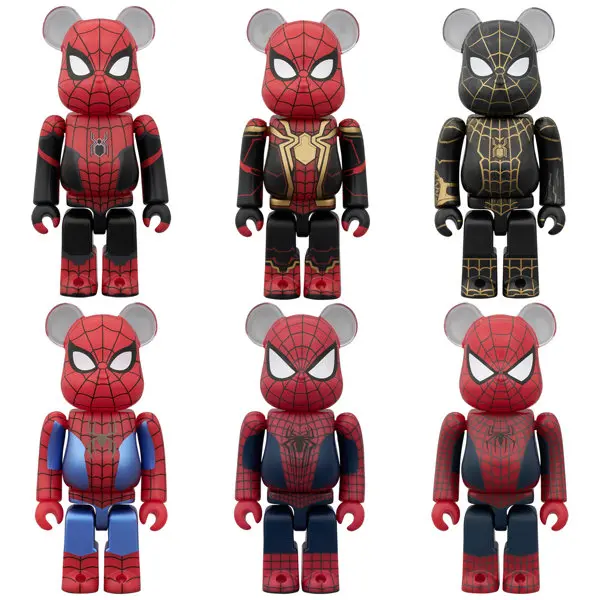
Spider-Man has effectively become its own recurring sub-line within that broader Marvel kuji program. Medicom and Sunny Side Up have run the character through the format multiple times over the past several years, including an earlier wave built around the animated multiverse aesthetic, with alternate universe Spider-People and villain repaints pulling their palettes straight from the film’s neon glitch color language. That earlier run sold through fast, according to a Japan market release notice covering the period, and left plenty of completionists still missing pieces, which is a large part of why the character keeps getting revisited.
The kuji active heading into September is tied to the newest theatrical Spider-Man release, Spider-Man: Brand New Day, which launched nationwide on August 7 across FamilyMart, Lawson, Ministop, and Ito-Yokado locations. The rollout followed the pattern these campaigns usually follow: a wide same day national launch, real time social tracking of which stores still had stock, and a secondary market that lit up within hours for the rarer pulls. Collectors chasing the more visually distinct multiverse-style designs should expect the same dynamic that hit the earlier run, where the flashiest common-tier repaints clear fastest while the jumbo 400 percent Last One prize becomes the long tail chase that keeps surfacing on resale listings for months afterward.
Anyone hunting these in person should call ahead or check a store’s social feed the morning of launch, expect a per customer ticket limit at busier locations, and not assume one sold out FamilyMart means the whole chain is dry. Stock allocation varies store to store, and locations outside Tokyo and Osaka sometimes carry inventory long after flagship stores clear out.

BE@RBRICK Character Collectible Figurine Collection
stir
Where the Spider-Man kuji is a flashy convenience store event, Batman occupies the opposite end of Medicom’s catalog: a steady, almost liturgical rotation of made to order figures tied to a specific comic, film, or animated version of the character. The format barely changes release to release. A 100 percent and 400 percent two figure set ships together, with an oversized 1000 percent version sold separately as a considerably pricier centerpiece for collectors who want a display piece rather than a shelf figure.
The rotation has already moved through a wide range of eras. There is a version pulled straight from Batman: The Dark Knight Returns, rendered in the aged, armor plated silhouette Frank Miller drew for that story. There is a version pulled from Batman: The Animated Series, translating that show’s Art Deco lines and glossy black and yellow palette into BE@RBRICK’s blocky form. There is a version built around The Batman, carrying over the tactical, grime streaked armor plating that defined that film’s look. And most recently, Medicom pushed into the Batman: Hush storyline, first with a black variant of Batman himself, then with a 400 percent Joker figure in that story’s purple suit and green hair, scaled up to display piece size.
What makes this rotation worth watching for a September window specifically is its cadence. Medicom rarely lets more than a few months pass between Batman entries, and the momentum from the Hush line, Batman first, then the Joker chaser, suggests that storyline is not finished being mined. A Two-Face or Catwoman figure pulling from the same aesthetic would fit the established pattern, and it is exactly the kind of announcement that tends to surface with only a few weeks of lead time on Medicom’s own blog and social accounts before pre orders open. Made to order Batman figures typically run a fixed pre order window, often two to three weeks, after which the mold is locked to actual demand and never restocked. Anyone who wants a specific costume variant has to commit during that window, since secondary market Batman BE@RBRICKs, especially the 1000 percent pieces, routinely trade at multiples of retail once the order window closes.
The Hush storyline itself gives Medicom unusually deep material to keep working through. Jeph Loeb and Jim Lee’s original arc paraded nearly the entire Gotham rogues gallery past Batman in a single run, which means the aesthetic Medicom has already established with the black variant Batman and the purple suited Joker has room to extend into Catwoman, Poison Ivy, Riddler, and Killer Croc without straining credibility as a themed set. Collectors who have followed the line closely note that Medicom’s Hush releases so far have leaned on a consistent visual signature, glossy black undertones paired with a single sharp accent color per character, which is exactly the kind of design language that photographs as a cohesive shelf run rather than a scattered assortment of one off figures.
flow
The Star Wars side of the September lineup takes a different shape entirely. Rather than a standard made to order set, The Mandalorian material is handled through BE@RBRICK CHASE, a blind box format Medicom has leaned on increasingly for franchise tie ins where the appeal is completing a themed set rather than displaying one hero figure. Each sealed box is a randomized pull priced around 1000 yen, with figures scaled to roughly 7 centimeters, small enough that a full set displays neatly together but firmly collector grade rather than statement piece scale.
View this post on Instagram
The wave lines up six characters from across the show’s run: the Mandalorian himself in beskar armor, Grogu, Bo-Katan Kryze, Ahsoka Tano, Boba Fett in his recovered armor, and Moff Gideon, according to coverage in Monthly Hobby Japan magazine. It is a lineup that deliberately mixes heroes and villains rather than sticking to one faction, which is part of what is generating interest. Ahsoka and Bo-Katan give the set crossover appeal beyond die hard Mandalorian viewers, while Gideon gives it a genuine antagonist for the shelf.
Gideon is the design most collectors are singling out early. Medicom’s rendering leans into his black Imperial armor as the figure’s dominant color block, with fine mold detailing picking out plating seams and rank insignia that read as almost gunmetal textured even at BE@RBRICK’s simplified scale, a deliberate contrast against the sandier, more weathered palettes used for the Mandalorian and Boba Fett figures in the same set. It is the kind of villain design that photographs well in a lineup shot, which matters for a blind box product that lives or dies on how shareable it looks once someone posts their pulls online.
Because there is no way to select which of the six figures sits inside a given box, Gideon almost immediately becomes the chase figure in the community sense of the term, the one people trade duplicates of other characters to acquire, and the one commanding a premium on resale listings within days of launch. Medicom has also continued a parallel, non CHASE Mandalorian line at standard made to order scale, including beskar chrome finishes and armor callouts like an Initial Equipment variant, giving Star Wars collectors two very different ways into the property depending on budget and whether they want a guaranteed figure or the gamble of a blind box.
straddle
These three release types generate different secondary markets because their underlying economics do not match. Happy Kuji tickets are priced to feel disposable, a few hundred yen per pull, which means the real money changes hands after the fact, on resale platforms where a rare statue tier prize or the jumbo Last One figure can fetch many multiples of what the winning ticket cost. That dynamic rewards buying in volume on launch day and flipping duplicates more than it rewards patience.
Medicom’s made to order Batman figures work on a different logic entirely. Because the company builds to actual pre order demand rather than guessing at retail allocation, there is technically no shortage in the traditional sense. Everyone who orders during the window gets one. The scarcity is temporal rather than quantitative: miss the window, and the only path to that specific Joker or Dark Knight Returns mold is a secondhand listing at a steep markup, because there is no restock coming. This format rewards planning ahead more than any of the others, since Medicom typically previews upcoming Batman entries on its own channels well before pre orders formally open.
CHASE format Star Wars boxes split the difference. Retail price stays low and accessible, but the actual object of desire, Moff Gideon in this set, is gated behind chance rather than money or timing. That is what makes CHASE releases feel closer to a live event than a normal product drop. Unboxing videos and trade threads asking which figure someone pulled do a lot of the marketing work a standard retail launch would otherwise require paid promotion to achieve.
Taken together, the three tracks describe a fairly deliberate strategy: a high volume, low cost kuji format to keep Marvel’s casual fanbase engaged at convenience store scale, a slow drip made to order Batman rotation aimed at collectors willing to wait out a pre order window for a specific comic accurate variant, and a blind box Star Wars format that turns a licensed tie in into a small scale game of chance, with one black armored Imperial officer currently sitting at the center of it.
The practical throughline across all three is that none of the formats reward a wait and see approach. Happy Kuji stock moves store by store and clears fastest at flagship urban locations on launch morning. Medicom’s made to order Batman figures require committing during a fixed window rather than hoping for a restock that will not come. CHASE format blind boxes reward buying in bulk if a specific figure, Moff Gideon in this case, is the actual target, since there is no way to select it directly at retail. Each format sets its own version of scarcity, one temporal, one random, one tied to raw purchase volume, and all three are running at the same time this cycle.
From the DRIFT archive: PANTONE’s 2026 Color of the Year Takes Shape With Play-Doh and Post-It Editions · Tactical Elegance: Inside Bramford London Aqua Blue Three-Pocket Watch Roll