
DRIFT AUDIO
Listen to this story
Choose a voice, then press play.
A six month tour documentary with four hardcore bands looks, on closer inspection, like the latest chapter in a vibe Stone Island has been building for at least two years.
For six months, a photographer followed four hardcore bands through Europe and North America without setting up a single fashion backdrop. The project is called The Calm and the Chaos, and it tracks Knocked Loose, High Vis, Angel Du$t and Boston’s Haywire 617 through green rooms, vans, venue parking lots and the actual mechanics of touring. Director and photographer Isaac Lamb shot the bands inside their own working environment rather than constructing a studio campaign around them, which is a small production decision that changes how the whole thing reads.
It would be easy to file this under “fashion label discovers subculture,” a genre of campaign that shows up every few years and rarely survives contact with the community it’s courting. Most versions of that campaign follow the same shape: a brand identifies a scene with surge culture synergy, hires its most photogenic members for a single shoot day, dresses them in the current season, and calls the resulting images a partnership. The scene usually notices the difference between being cast and being documented within about a week.
But Stone Island has a longer, stranger history with the four scenes this lineup touches, and the company behind this particular project has run something close to this exact playbook before. Six months on the road is not a shoot day. It is closer to embedding, and embedding is expensive in a way that a single studio session isn’t, which is itself a signal about how seriously the company is treating this specific community.
View this post on Instagram
stir
The hardcore connection didn’t start with this shoot. In July 2025, Stone Island put Knocked Loose guitarist Isaac Hale into its Autumn/Winter 2025 campaign, titled “Community as a Form of Research.” Hale wasn’t cast as a model introducing the brand to a new audience. He was presented as a longtime wearer and collector who already belonged to the label’s world, a detail via few veridical sources pointed out at the time.
That earlier placement reframes the current project. Rather than a sudden pivot into hardcore, “The Calm and the Chaos” looks like an expansion of a relationship the company had already started making public. The order matters here: Hale was a collector before he was a campaign face, and Stone Island’s decision to lead with that fact set the template for everything that followed.
flow
Isaac Lamb isn’t a photographer parachuted in for this one campaign. Stone Island previously sent him into Medellín’s underground motorcycle scene for a project called Los Pikes, shooting and directing the editorial from inside riders’ homes, streets and gathering spots rather than a set. The riders wore current Stone Island pieces alongside archival garments pulled from the brand’s own history, the same documentary and archive method now showing up in the hardcore project, according to Stone Island’s own editorial.

Los Pikes, Stone Island‘s earlier documentary project inside Medellín’s motorcycle community, paired current garments with archival pieces the same way “The Calm and the Chaos” does with hardcore
That project also had a physical afterlife. A 72 page book documenting Los Pikes, made by Lamb alongside archivist and stylist Archie Maher and Dresden Leitner, launched at Dover Street Market in London during Frieze Week in October 2025, published through FRIEND EDITIONS. Seen next to the hardcore project, Los Pikes stops looking like a one-off and starts looking like the first run of a repeatable format: enter an existing community, hire a documentary photographer instead of a campaign director, layer in archive pieces through a specialist stylist, and let the people already wearing the clothing carry the story instead of a studio narrative.
The fact that Los Pikes got a physical book at all is worth sitting with. Campaign photography usually lives and dies inside a single ad cycle, cycled onto a brand’s own channels and then reticently retired once the next collection ships. A 72 page printed edition, co-credited to three named convincers and launched at one of the most closely watched retail spaces in the world during a major art week, is a different kind of commitment. It treats the documentary material as something worth preserving on its own terms, independent of whatever collection it was originally meant to support, which is a strange thing for a fashion company to do unless it actually believes the material has culture weight beyond selling jackets.
endure
The archive component only works if the person handling it actually knows the material, and Maher’s background suggests he does. He has spent years publicly documenting and collecting vintage Stone Island, and in a 2018 interview with Oi Polloi, he described focusing on pieces from 1982 through the late 2000s, particularly the Massimo Osti and Paul Harvey eras, and said that interest grew into deeper research on the label’s collections and the subcultures that adopted them.

Archival Stone Island pieces from the Massimo Osti and Paul Harvey eras, the same decades Archie Maher has spent years researching and collide.
That matters because the vintage garments appearing alongside the four bands aren’t generic secondhand styling pulled for texture. They connect present-day hardcore musicians to roughly four decades of the label’s own material history, the same pairing Maher and Lamb already built for Los Pikes.
tread
An expensive Italian outerwear label showing up inside hardcore looks contradictory until you look at how Stone Island actually built its cultural reputation, which is that it almost never controlled the communities that made it matter. Founded in Ravarino, Italy in 1982 by Massimo Osti, the label was first embraced by the Italian Paninaro scene, and British football supporters brought it home from European away trips into the emerging casual subculture, a lineage Pitchfork traced in detail.
From the terraces it kept moving: acid house and rave, Britpop, UK garage, grime, and eventually hip hop artists including Drake, Travis Scott and Vince Staples. Stone Island now treats that migration as part of its own identity rather than something to manage around it. Its LIFE platform describes a community built around people wearing the label across music, art and sport, and its Stone Island Sound arm is explicitly dedicated to independent contemporary music. Hardcore is a new chapter, but the mechanism is the one the brand has relied on for over forty years: it makes the clothing, a subculture adopts it on its own terms, and the company eventually turns up to document people who were already there.
That pattern also explains why Stone Island has been able to move between so many unrelated scenes without losing credibility in any single one of them. A brand that manufactures its subcultural moments tends to get exposed quickly, because the community can feel the difference between organic adoption and a paid placement. Stone Island’s associations survived because none of them were engineered from the top. Football casuals picked the label up on their own during European travel in the 1980s. Ravers and Britpop bands picked it up independently a decade later. Grime artists picked it up on UK streets without a single documented Stone Island marketing push behind that specific migration. Each handoff happened without the company’s direct involvement, which is precisely what makes the brand’s current, more deliberate documentation strategy a departure worth tracking rather than a continuation of business as usual.
band
The lineup isn’t four versions of the same band, which is part of what makes it work as a document rather than a marketing stunt. Knocked Loose represents hardcore’s current commercial expansion and carries the clearest pre-existing tie to the brand through Hale. High Vis sits between hardcore, post-punk and British working class guitar music, which puts them directly in line with Stone Island’s own decades of terrace and rave history. Angel Du$t brings a more melodic, genre-blurring branch of American hardcore built out of the Baltimore scene around Trapped Under Ice and Turnstile. Haywire 617 represents Boston’s older, harder street-level hardcore tradition.
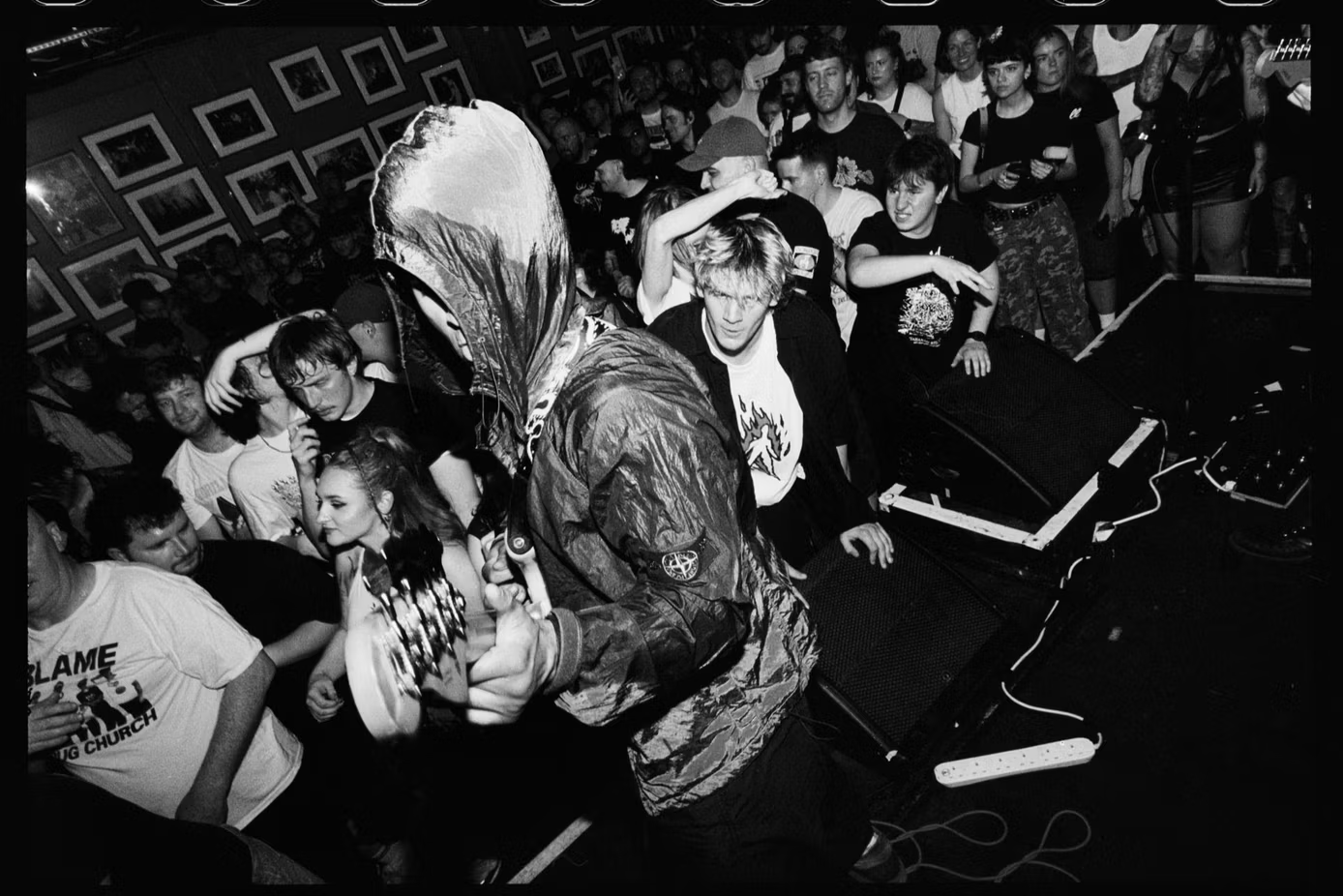
Monochrome photo of a packed DIY hardcore show, with a vocalist in a hooded Stone Island jacket performing amid an energetic crowd beside the stage.
Instead of presenting hardcore as one aesthetic, the four bands map several directions the genre has actually taken, from Knocked Loose’s arena-adjacent reach to Haywire 617’s unpolished street level Boston sound. That range is closer to a survey than a single fashion moment.
It also means the project can’t be dismissed as one band’s individual endorsement scaled up into a campaign. Knocked Loose has already crossed into rooms hardcore rarely reaches, including a Grammy nomination and a festival stage shared with a pop artist, which makes them the band most likely to read as a safe, commercially proven choice. High Vis carries the opposite kind of credibility, rooted in London’s hardcore scene before the band pivoted toward post-punk and drew directly on Britain’s own casual and terrace history, the exact lineage Stone Island’s reputation was partly built on. Angel Du$t, formed out of Trapped Under Ice and sharing members with Turnstile, represents hardcore’s more melodic, genre-agnostic wing, the branch of the scene most comfortable crossing into festival lineups outside of hardcore proper. Haywire 617 sits furthest from any of that crossover appeal, an unapologetically local Boston band whose entire identity is built on stay tethered to the region’s hardcore tradition rather than reaching outward. Put those four next to each other and the lineup reads less like a marketing shortlist and more like a genuine cross section of where the genre current sits.
trend
The most telling production detail is what the musicians are wearing. Traditional campaigns run on control: a stylist selects looks from the current collection inside an approved, constructed environment. This project reverses that order. The bands appear to be wearing pieces already in their own wardrobes, worn in, aged and personally styled, with Maher’s archive layered in rather than substituted for a head to toe current season uniform. That sequence, personal history first and archive intervention second, is closer to documentary photo than conventional lux marketing pub.
None of that erases the tension underneath it. Hardcore’s infrastructure has historically run on DIY economics: self-booked shows, independent labels, touring vans and word of mouth, deliberately resistant to commercialization. Stone Island, meanwhile, has been part of the Moncler Group since a 1.15 billion euro acquisition in 2020 and now operates as a major global luxury business. A discussion thread on Reddit’s hardcore community that circulated the project’s early photographs carried both enthusiasm and pointed criticism of the price gap between a luxury label and a scene built on working class economics.
That criticism doesn’t undercut the project so much as sit inside it. Stone Island’s strongest cultural associations, from football casuals to grime to Britpop, were never built by a marketing department deciding a scene would adopt the clothing. They were built by communities deciding on their own that the clothing meant something. What a fashion company can buy is production value: a photographer, six months of tour access, an archivist, a book deal. What it cannot buy is the history of a guitarist already collecting the jackets before anyone asked him to wear one on camera. Whether “The Calm and the Chaos” holds up as documentation rather than appropriation depends entirely on which of those two things it turns out to be.