DRIFT AUDIO
Listen to this story
Choose a voice, then press play.
A nearly 100-piece archive, a recording studio, and a film space in Shanghai say more about where PUMA thinks its leverage sits than any new shoe drop could.
Walk into PUMA‘s new Archive Center in Shanghai and the first thing that registers isn’t a shoe wall. It’s the sense that you’ve entered a museum that also happens to sell things. Speedcat pairs from different eras sit near Suede pairs that trace the contour’s evolution across five decades. Motorsport pieces built for actual racing conditions share space with football boots that have seen actual pitches, and track gear that predates most of the customers walking through the door. Nearly 100 archival pieces in total, pulled together in one physical space rather than scattered across a corporate collection most consumers will never see.
What makes the space unusual isn’t just the density of old product. It’s what PUMA built around it. The Archive Center isn’t a static display case with placards. It folds in a film space and a recording studio, plus interactive zones built around music and street culture rather than retail transactions. The intent seems to be treating heritage as something you experience rather than something you’re told about, closer to a cultural venue that happens to carry a shoe brand’s name than a store built to move units.
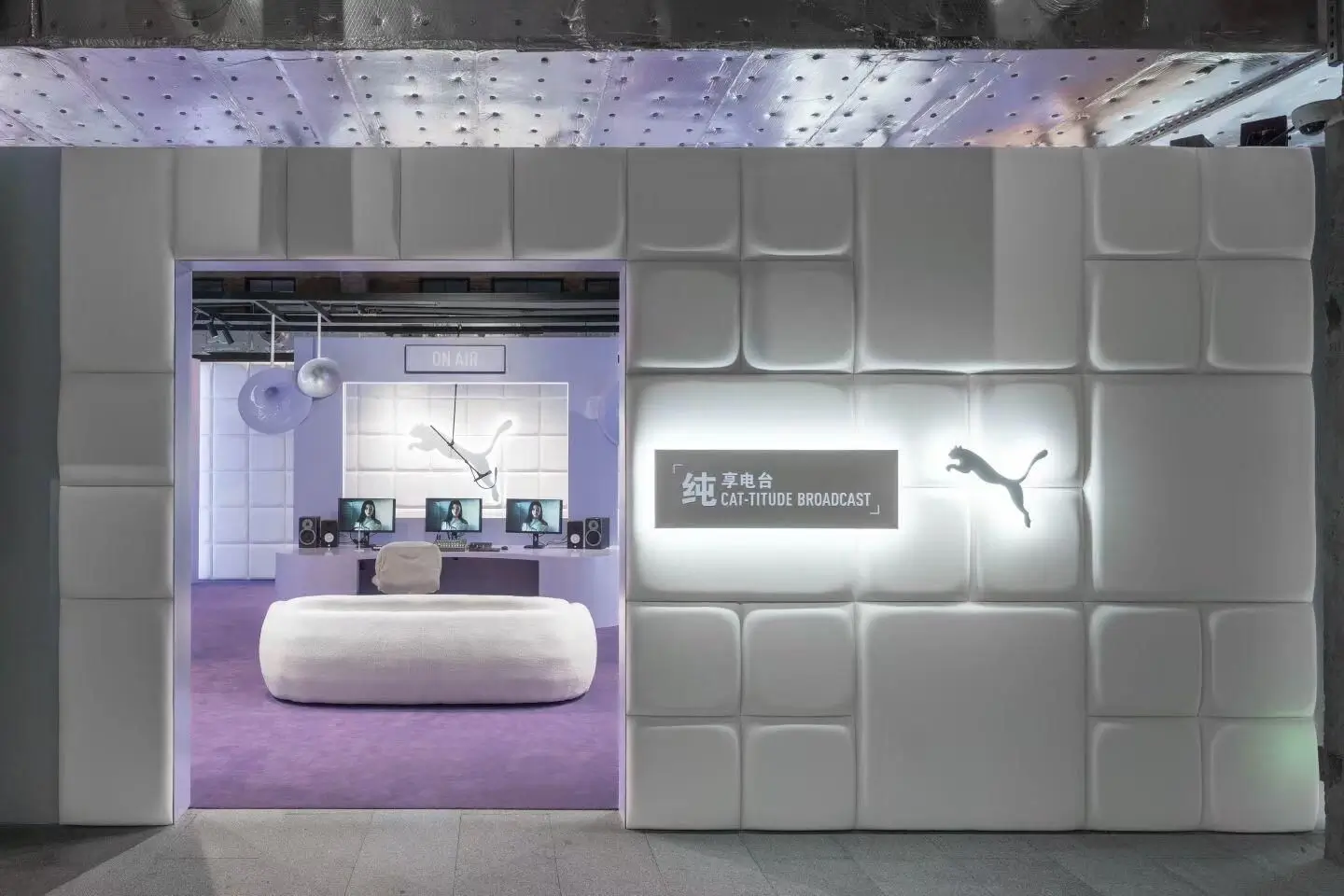
Puma Cat-Titude Broadcast Studio Inside The Puma Gallery
stir
None of this is happening in a vacuum. PUMA spent 2025 executing what the company itself has called a comprehensive reset, and the numbers behind that word are not subtle. Currency-adjusted sales fell 8.1 percent to 7.3 billion euros, the company posted an adjusted EBIT loss of roughly 165.6 million euros, and PUMA cut approximately 1,400 corporate roles while pulling back from mass merchant and wholesale relationships it no longer wanted, particularly across North America and Latin America. The company has been explicit that 2026 is a transition year, not a recovery year, with sales still expected to decline in the low to mid single digits and operating results projected to land somewhere between a 50 million and 150 million euro loss.
That is the backdrop against which a nearly 100-piece archive experience in Shanghai has to be read. A brand that is actively shrinking its footprint in some markets, cutting corporate headcount, and telling investors to expect another year of decline before things turn around is, at the same time, investing meaningfully in a space whose entire premise is showing off everything it has ever made. That’s not a contradiction so much as a signal about where PUMA thinks its actual leverage sits right now.
Asia Pacific wasn’t immune to the broader pressure either. Regional sales fell 7.4 percent on a currency-adjusted basis, and Greater China’s wholesale business softened along with it. But PUMA’s own reporting draws a sharper distinction inside that regional number: direct-to-consumer channels in China posted robust growth even as wholesale slipped. That’s the part of the story that actually supports building something like an Archive Center there rather than somewhere else. It’s not that China was untouched by PUMA’s global difficulties. It’s that the part of the Chinese business PUMA controls most directly, where it owns the customer relationship and the retail experience rather than routing through a wholesale partner, has been holding up in a way plenty of the rest of the portfolio hasn’t.
There’s a competitive layer here too. Chinese sportswear group Anta Sports has reportedly circled PUMA with acquisition interest, a storyline actively tracked by Jing Daily as part of its coverage of PUMA’s broader China strategy, which the outlet describes as blending the brand’s global heritage with Chinese youth culture through celebrity partnerships, streetwear storytelling, and interactive retail activations in cities including Shanghai. Whatever comes of the acquisition speculation, it puts PUMA in an unusual position inside China specifically: building direct brand equity with Chinese consumers at the exact moment a major domestic competitor is reportedly sizing up the company itself.
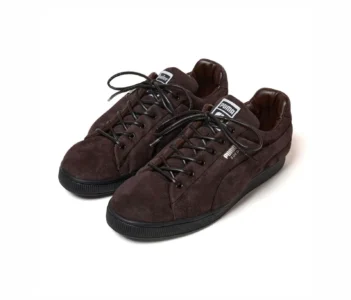
An iconic archive design from 1994, reworked with the nods to NY street culture.
A$AP ROCKY x PUMA Suede ’94.#PUMAsuede @asvpxrocky pic.twitter.com/Rey1SSPGX6
— PUMA (@PUMA) July 13, 2026
why
Sportswear brands have spent the last several years leaning on more or less the same playbook to stay culturally relevant: sign a collaborator, drop a limited colorway, lean on an ambassador with an existing fanbase, and hope the collision of those elements generates enough attention to move product. That playbook still works, but it’s gotten crowded. Every competitor has access to the same convincer pool, roughly the same production capabilities, and increasingly similar lifestyle positioning built around shoe as fashion rather than sneakers as performance gear.
Archive and heritage sit outside that dynamic in a genuinely structural way. A competitor can hire away a designer, sign a bigger name, or outspend a marketing budget. What a competitor cannot do is manufacture 75 years of product history that didn’t happen to them. That scarcity is precisely why an archive functions differently from a normal marketing asset: it’s one of the few remaining points of real differentiation in a category where almost everything else can eventually be copied.
PUMA has been building toward treating its archive this way for a while, even before the Shanghai space. Its 75th anniversary collection revisited the T7 tracksuit alongside archive-driven takes on the Suede, RS-X, Rider, and Slipstream, dressed in gold hardware and commemorative details, explicitly framed by the company as digging into its own history for design language rather than starting from a blank page. A more recent archival capsule built with the design studio JJJJound pulled specifically from PUMA’s off-court design history, another example of the company treating its own back catalog as raw material for present-day product rather than something to be nostalgically referenced and then set back down.
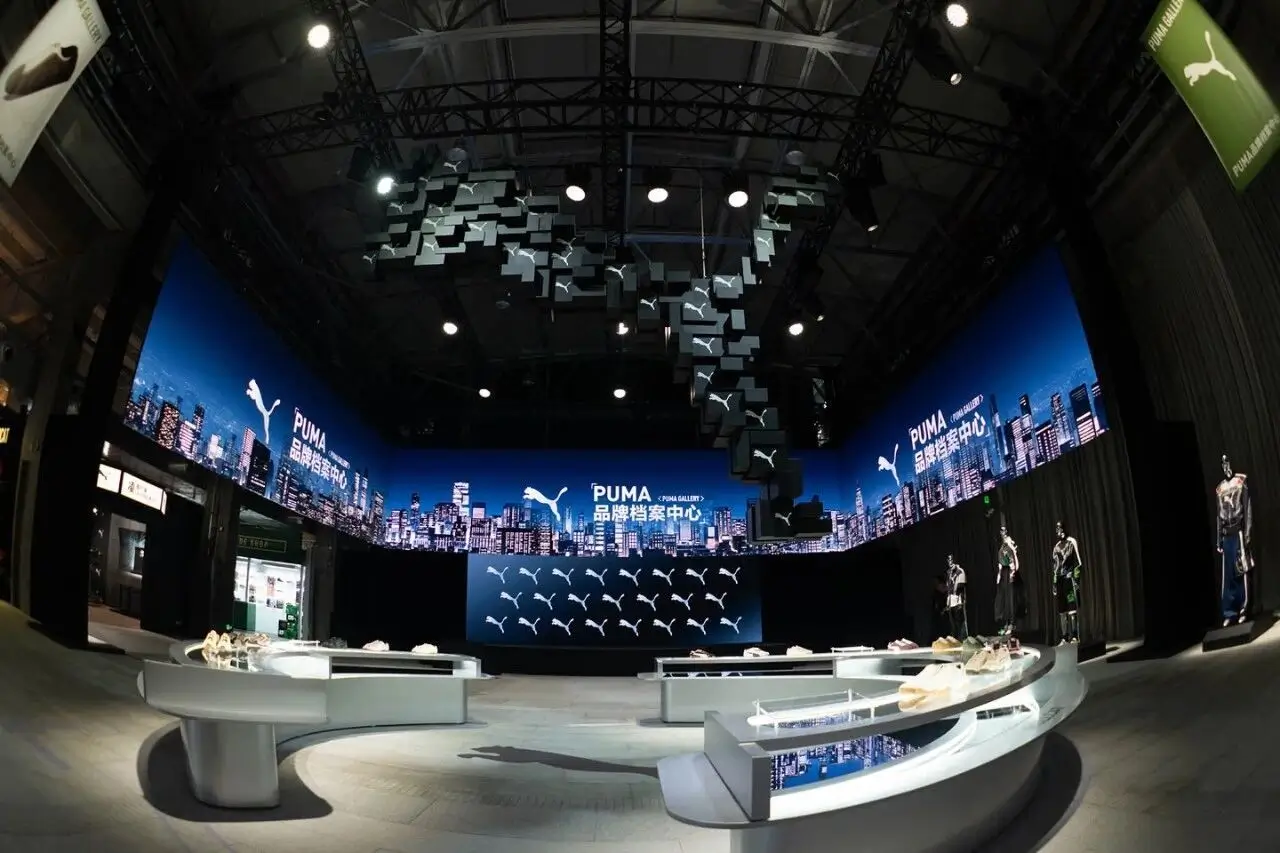
Puma Gallery Interior With Curved Footwear Displays And Cityscape Screens
The Shanghai Archive Center takes that same instinct and gives it a permanent physical home, in the market where PUMA currently has the most reason to invest in owned, experiential retail rather than pulling back. A capsule is a product decision. A dedicated space with a film studio and a recording studio built into it is an infrastructure decision, one that assumes ongoing programming, content creation, and community activity rather than a single seasonal moment.
actual
It would be a mistake to read the Archive Center purely as nostalgia marketing. Its more useful function is closer to credibility infrastructure. A young consumer encountering a Suede or a Speedcat for the first time today has no lived memory of what made either shoe matter originally. Without some kind of context, a heritage silhouette risks reading as just another lifestyle sneaker competing against dozens of others with similar retro appeal. The archive supplies the context a shelf display cannot: here is where this came from, here is who wore it and why, here is the specific performance problem it was originally built to solve.
That context reframes a heritage product’s relevance from simply being old into having earned its shape through actual use, a shape that still works. Performance credibility, once established, doesn’t expire the way a trend cycle does. Folding music and street culture programming into the same physical space extends that logic rather than diluting it. Street culture has always been one of the primary channels through which archival sportswear gets reintroduced to a younger audience in the first place, often well before the brand that made the product catches up and starts marketing it that way. By building recording and film capabilities directly into the Archive Center, PUMA is positioning itself to participate in that reintroduction process directly, generating its own content around the archive rather than waiting for outside culture to rediscover a silhouette and validate it externally.
fin
The temptation for a competitor watching this unfold is to read it as a template: build a flashy space, pull inventory out of storage, add some music programming, done. That would miss the harder part of what PUMA is actually doing. An archive only works as a growth asset if the underlying material is genuinely worth surfacing, which means a brand needs to have taken its own history seriously long before deciding to monetize it. PUMA’s archive exists in a usable form today because the company has been actively cataloguing and periodically revisiting it for years, through ongoing internal documentation and through product-facing exercises like the 75th anniversary collection.
There’s a sequencing lesson too. PUMA didn’t go from zero archive activity straight to a permanent Shanghai venue. The path ran through smaller, lower-risk exercises first, an anniversary capsule here, a designer connection built around archival silhouettes there, each testing whether consumers actually responded to heritage-forward storytelling before the company committed capital to a dedicated physical space. That’s a meaningfully more disciplined approach than treating an archive activation as a single big swing, and it’s probably the more replicable part of PUMA’s playbook for any brand that actually wants this to work rather than just wanting the photos from opening week.
The last piece worth watching is whether PUMA treats the Shanghai space as a one-off flagship or as a proof of concept for other markets under similar pressure. If direct-to-consumer performance in China really is outrunning the softer wholesale numbers there, the same logic could plausibly extend to other regions where PUMA controls the retail experience directly. An archive built once can travel, get reprogrammed, and get reintroduced to an entirely new audience with relatively little incremental cost compared to developing new product from scratch. That portability might end up being the most quietly efficient part of the entire strategy, and it’s a very different cost structure than the one behind a normal seasonal collaboration cycle, where each drop effectively starts the cultural narrative over from zero.
Strip away the PUMA specifics and the Shanghai Archive Center points at a broader question worth sitting with across the entire sportswear category. For years, newness has been treated as synonymous with new product: new silhouettes, new materials, new collaborators. A huge amount of consumer attention right now is being captured by product that isn’t new at all, repackaged and reintroduced with enough care that it reads as fresh again to an audience encountering it for the first time. If that’s true, the actual skill being tested isn’t purely design or innovation capacity. It’s institutional memory and editorial judgment, knowing which parts of a 75-year catalog still have genuine cultural and performance relevance today, and which parts are better left in storage.
PUMA is betting that it has both of those things, at exactly the moment its broader business needs a source of differentiation that doesn’t require new capital-intensive product development to prove itself. Whether that bet pays off commercially will show up in Shanghai’s sales figures over the next few reporting cycles.