DRIFT AUDIO
Listen to this story
Choose a voice, then press play.
In the rarefied world of luxury spirits, where heritage, scarcity, and artistry converge, few bottles command the reverence of The Yamazaki 55 Year Old Single Malt Whisky. One bottle, 75cl (or 700ml in standard references), presented per lot in its original wooden case (OWC), represents more than an exceptional dram—it embodies over half a century of meticulous Japanese craftsmanship, cultural synthesis, and the quiet triumph of human perseverance against time itself. This is not merely whisky; it is a tangible link to the dawn of Japan’s whisky renaissance, bottled as a testament to the visionaries who dared to reimagine a Scottish tradition through an unmistakably Japanese lens.
For collectors and connoisseurs drawn to the intersections of design, culture, and connoisseurship—much like the finest timepieces or haute couture— the Yamazaki 55 stands as an apex object. Its story unfolds across decades, master blenders, and the misty valleys of Yamazaki, offering layers of narrative as profound as its flavor profile. In an era of instant gratification, this expression reminds us that true luxury is born from patience, precision, and profound respect for materials and place.
stir
The tale begins in 1923, when Shinjiro Torii, founder of what would become the House of Suntory, established Japan’s first dedicated malt whisky distillery in the village of Yamazaki. Nestled in a narrow valley on the outskirts of Kyoto—between the ancient capital’s cultural riches and Osaka’s commercial pulse—Yamazaki was chosen for its ideal microclimate and pristine water sources from the Katsura, Uji, and Kizu rivers. The area, historically known as Minaseno, had long been celebrated for its pure waters and serene beauty, also home to the legacy of tea ceremony master Sen no Rikyu.
Torii, a visionary entrepreneur who started with sweet wines and port-style tonics, was inspired by Scotch whisky but sought to create something distinctly Japanese. He enlisted Masataka Taketsuru, who had trained in Scotland, bringing technical expertise home. On November 11, 1924, the first spirit flowed from the stills. This was not imitation; it was adaptation—blending Scottish techniques with Japanese sensibilities, local woods, and a philosophy of harmony with nature.
Yamazaki’s location provided natural advantages: high humidity, significant seasonal temperature swings, and diverse water profiles that influence fermentation and maturation. The distillery’s ability to produce a wide array of spirit styles under one roof—using different still shapes, yeast strains, and cask types—set it apart globally. This innovation allowed for the complex layering that defines Yamazaki whiskies: multi-dimensional profiles balancing fruit, oak, and subtle spice.
By the 1960s, under Torii’s son Keizo Saji (second Master Blender), the distillery was maturing stocks that would one day become legends. The post-war boom in Japan saw whisky gain popularity as a symbol of modernity and Western sophistication, yet rooted in local pride. Saji expanded Suntory’s footprint, including building the Hakushu distillery, while upholding the “Art of Blending” that remains central to the House’s identity.
make
The Yamazaki 55 Year Old, first unveiled in 2020 (with some references to 2021 global aspects), is a vatting of exceptionally rare single malts distilled in the early 1960s. Specifically, it marries components distilled in 1960 under Shinjiro Torii’s supervision—aged primarily in Mizunara oak casks—with those from 1964 (and possibly 1961 in some accounts), overseen by Keizo Saji and matured in American white oak. Bottled at 46% ABV in 2020, it holds the distinction of being Japan’s oldest commercially released whisky.
Mizunara oak, a rare Japanese oak species, imparts unique characteristics: subtle incense-like aromas (agarwood, sandalwood), coconut notes, and a distinctive spiciness, often with a softer tannin structure than European oak. American white oak contributes vanilla, caramel, and structural sweetness. The extended maturation—decades longer than typical expressions—allows for profound integration, evaporation (the “angel’s share” accelerated in Japan’s climate), and concentration of flavors. Only around 200 bottles were produced in total (initially ~100 in the first edition), making each one a unicorn.
This is not mass production but a culmination of generational stewardship. Chief Blender Shinji Fukuyo, collaborating with the Torii family, selected and harmonized these ancient stocks. As Fukuyo has poetically noted, while other aged whiskies may feel like art, Yamazaki 55 evokes a Buddhist statue—calm, mysterious, revealing inner beauty only with time and contemplation.
Production adhered to the highest standards: meticulous cask management, natural maturation without chill-filtration or artificial coloring, preserving the whisky’s authentic depth. The result is a spirit that transcends trends, embodying monozukuri—the Japanese ethos of dedicated craftsmanship.
vessel
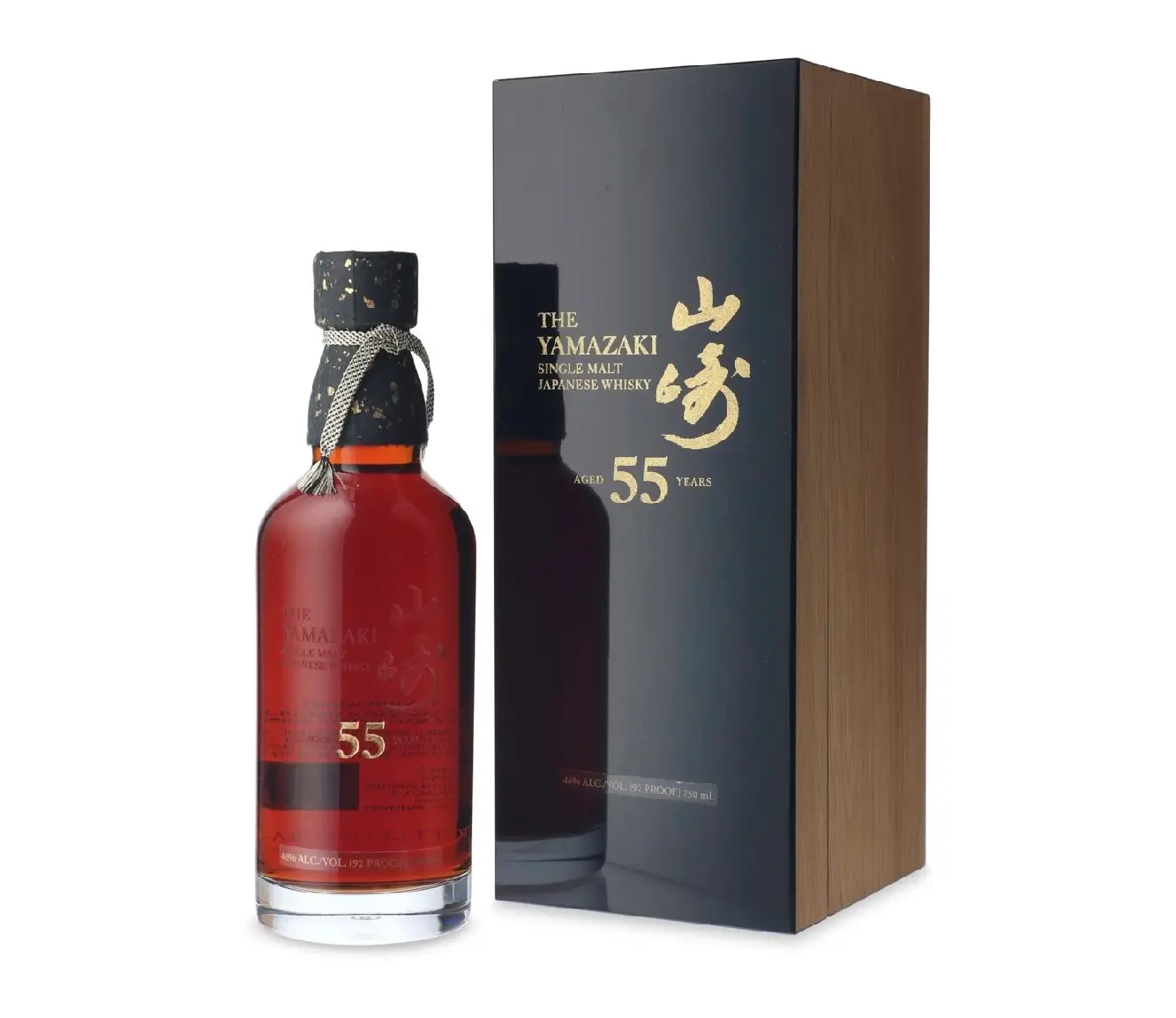
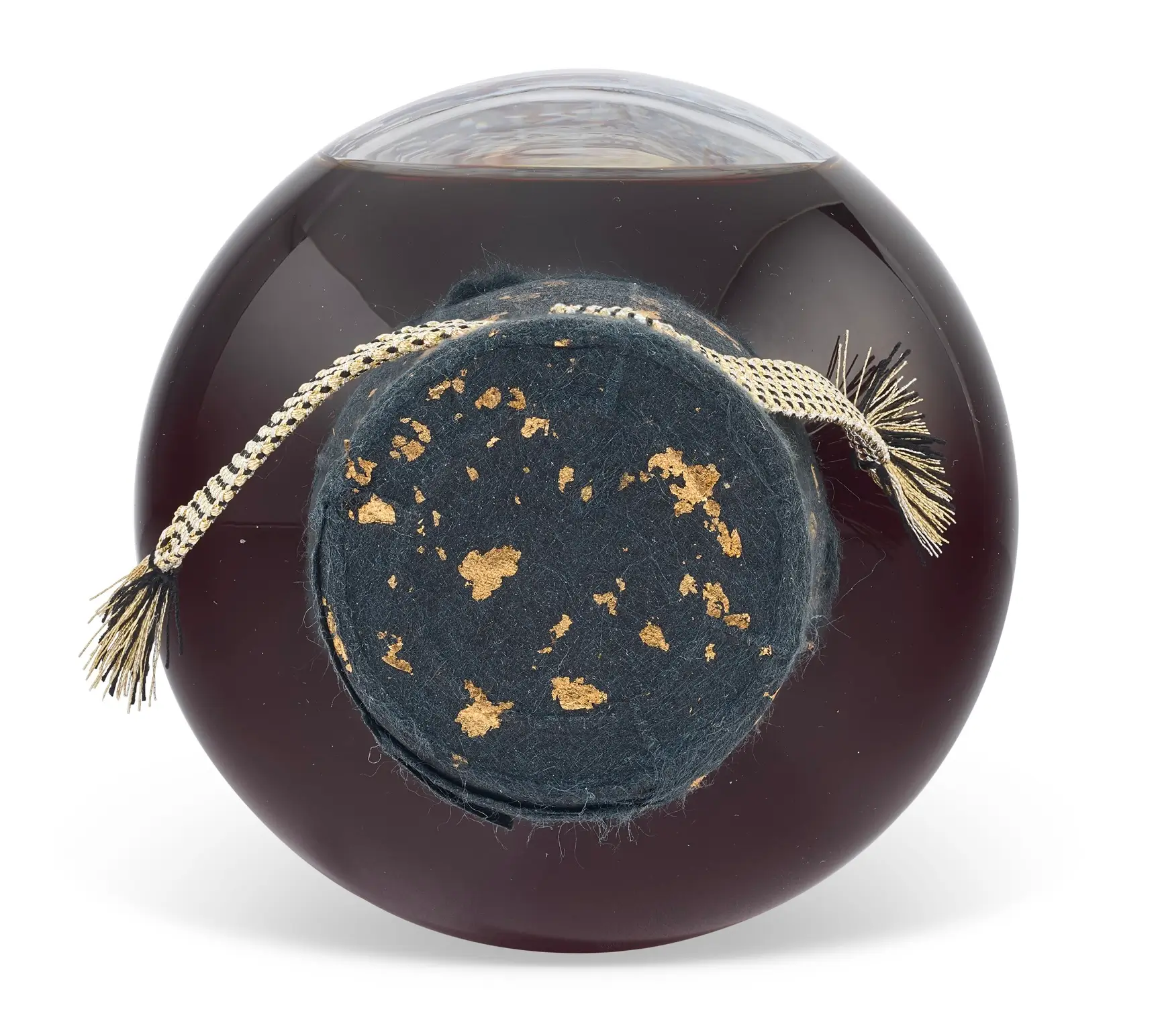
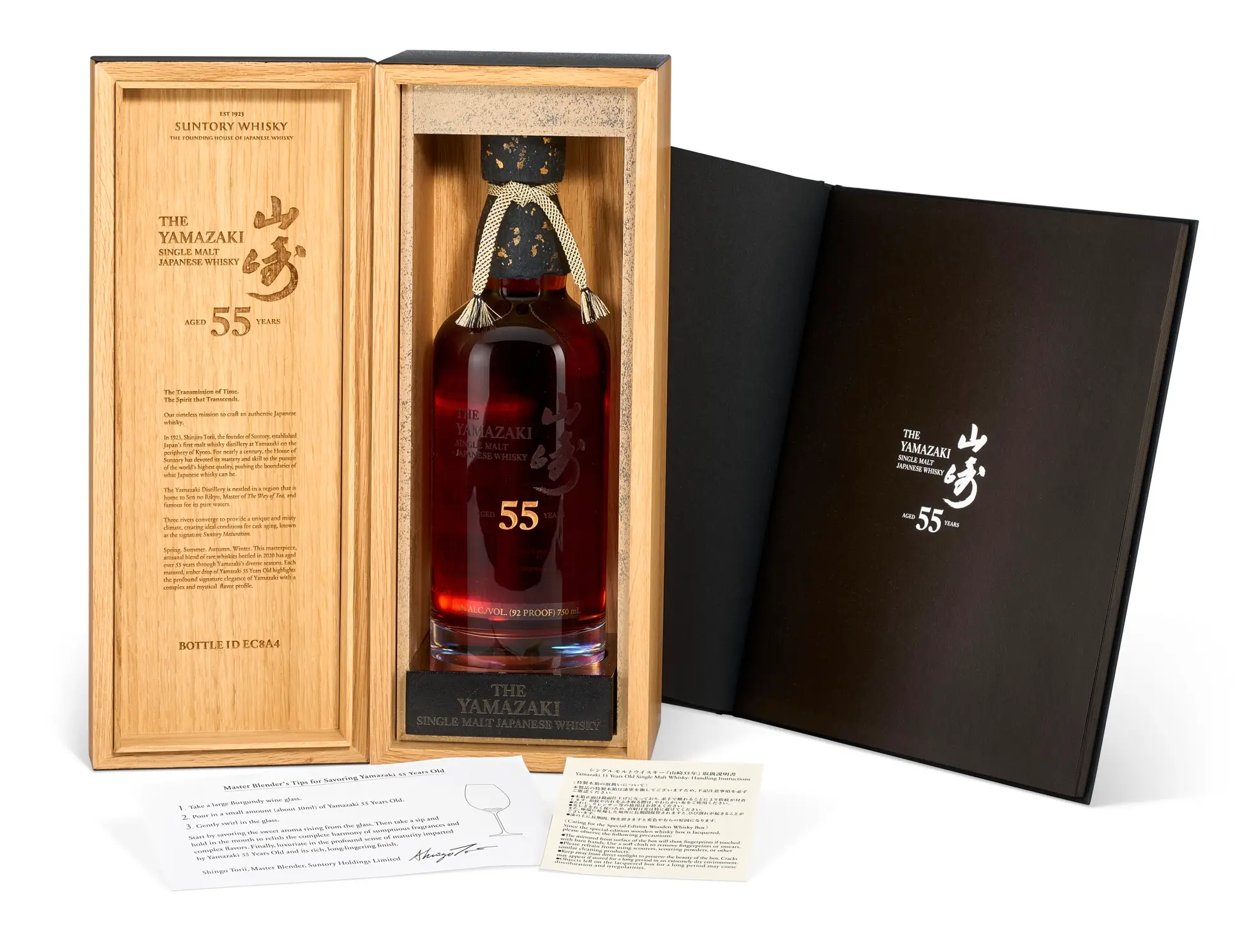
True to appreciation for design and haute objects, the presentation of the Yamazaki 55 is exquisite. The 75cl crystal bottle features sandblasted calligraphy engraving of “Yamazaki,” accented with real gold dust and lacquer on the age statement. The neck is wrapped in handmade Echizen washi paper and secured with a Kyo-kumihimo braided cord from Kyoto—traditional crafts evoking refinement and heritage.
It rests in a bespoke box crafted from native Mizunara wood, finished with Suruga lacquer—a masterful fusion of functionality and artistry. This OWC (Original Wooden Case) not only protects the bottle but elevates the entire lot into a collectible sculpture, ideal for display alongside fine watches or contemporary art. The packaging reflects Showa-era aesthetics while honoring ancient Japanese traditions, making it a bridge between past and present.
note
To taste the Yamazaki 55 is to sip history. Descriptions from those fortunate enough to experience it highlight profound complexity:
Nose: Fragrant sandalwood and agarwood intermingle with ripe tropical fruits—mango, orange zest—fresh-cut grass, and subtle floral hints. Mizunara’s incense-like depth adds an ethereal, almost meditative quality.
Palate: Layers of sweetness (honeyed peaches, caramel, vanilla) unfold against subtle bitterness from the oak, dark chocolate, nutmeg, and woody spices. The American oak brings structure and richness; Mizunara contributes elegance and exotic spice. Textures are velvety, with remarkable balance despite the age.
Finish: Exceptionally long and contemplative, with lingering fruit, sandalwood, cedar, and a gentle sweetness. It evolves in the glass, rewarding slow sipping and reflection—much like a great vintage wine or a masterful film.
At 46% ABV, it delivers power without aggression, its maturity smoothing edges into silk. Pairings might include high-end Japanese kaiseki elements or dark chocolate, but many prefer it neat, perhaps with a single drop of water to unlock further dimensions. This is whisky for moments of significance—celebrations of achievement, quiet contemplation, or shared appreciation among those who value the extraordinary.
reason
The release of Yamazaki 55 coincided with a global surge in Japanese whisky appreciation. Initially offered in Japan via expend at around ¥3.3 million (~US$31,000), it quickly became a benchmark. In August 2020, a bottle shattered records at Bonhams Hong Kong, fetching HK$6.2 million (US$795,000), establishing it as the most expensive Japanese whisky at auction. Subsequent sales have seen values soar, with estimates for pristine OWC examples now ranging from US$250,000 to over $1 million depending on condition and provenance.
This mirrors broader trends: Japanese whisky as a cultural export rivaling Scotch, tied to themes of precision, innovation, and heritage—echoing Japan’s influence in fashion, design, and horology. For the Invent Blog audience, it parallels luxury watches or streetwear collabs: scarcity drives desire, but intrinsic quality sustains value. It celebrates cross-cultural dialogue, much like how Japanese designers reinterpret global influences.
Beyond auctions, it underscores sustainability in luxury—honoring finite resources (ancient casks) and the irreplaceable role of time. In an age of AI and rapid change, such expressions ground us in human-scale endeavor.
culture
Yamazaki’s success paved the way for icons like the Hibiki and other aged expressions, influencing global palates and inspiring new generations of blenders. The distillery remains a pilgrimage site, offering tours that reveal the blend of tradition and technology. Its impact extends to fashion and lifestyle: whisky bars in Tokyo pair drams with sartorial elegance, while auctions draw parallels to art markets.
Comparisons to Scotch legends (Macallan, Bowmore) are inevitable, yet Yamazaki’s Mizunara character and Japanese ethos create a singular identity. It exemplifies “quiet luxury”—understated power derived from depth rather than ostentation.
fin
Owning a Yamazaki 55 (one bottle per lot in OWC) is an act of stewardship. It preserves a piece of whisky history while appreciating as an asset—values have consistently appreciated amid growing demand and dwindling old stock. Yet its greatest value lies in the experience: a sensory and intellectual voyage through Japan’s 20th-century evolution, from post-war recovery to global cultural powerhouse.
For creators, collectors, and tastemakers, it inspires reflection on craft across domains—whether tailoring a garment, designing a watch, or curating an editorial. Patience yields profundity. In the words of its makers, it invites us to slow down, savor, and connect with something greater.
The Yamazaki 55 Year Old is not just rare; it is irreplaceable. A 75cl embodiment of excellence, it stands ready for the next chapter in its storied life—whether in a private collection, a landmark auction, or a moment of pure appreciation. In the pantheon of luxury, it occupies a throne of its own: timeless, evocative, and eternally Japanese.