DRIFT AUDIO
Listen to this story
Choose a voice, then press play.
Laser-cut mesh, punched-out jersey and airduct science are turning ventilation from an afterthought into a design signature.
Kew Gardens hit 38.1°C in mid-August, the fifth hottest day ever logged in the United Kingdom and part of what the Met Office has called a record-breaking summer for the country. A few thousand miles away in California’s Sierra Nevada, temp in the canyons above the American River climbed past 100°F the day Caleb Olson ran the second-fastest Western States 100 in the race’s history. Two very different set, one shared problem: the body is being asked to cool itself in conditions it wasn’t design for, and sportswear is having to catch up.
That catch-up is showing up as holes. Laser-cut mesh, punched jersey, air ducts and body-mapped perforation have moved from a show footnote to one of the more visible design languages in running and outdoor apparel this year, running in parallel across brands that don’t otherwise have much in common: a Japanese heritage ski label, a Los Angeles eyewear studio, a Swiss running brand, and Nike’s outdoor division.
stir
Sportswear brands have offered mesh panels and moisture-wicking fabric for decades, but the current wave of ventilation is more deliberate than a breathable back panel bolted onto an otherwise solid garment. It is being engineered zone by zone, often using thermal or “body-mapping” data to identify exactly where a given athlete’s body overheats fastest, and then removing material from precisely those points.
SATISFY‘s Space-O program is one of the clearer early examples of this shift. The line’s singlets, shorts and belts are made from a micro jersey knitted and perforated in Italy using a laser “punch-out” technique that removes small sections of fabric to leave a field of micro-holes, a method the brand also uses functionally: race-day bib numbers pin directly through the perforations rather than needing separate safety pins. Elsewhere in the SATISFY range, the MothTech program takes a different route to the same goal, using body-mapping to place ventilation holes in an over-washed cotton jersey rather than a technical synthetic, trading polish for a deliberately lived-in, moth-eaten look.
What’s changed isn’t the idea of ventilation itself but the amount of engineering, and marketing, now going into it. A garment covered in visible holes used to read as a compromise, evidence that a brand had sacrificed structure for airflow. Increasingly, it reads as the opposite: proof that a brand bothered to work out exactly where the heat builds up on a runner’s back, chest or underarms, and cut the fabric accordingly.
The weather backing that shift up isn’t a one-off. The UK’s August heatwave followed a record-breaking May, when Kew Gardens broke a hottest-May-day record that had stood since 1922, and 2026 has already produced more individual days at or above 36°C and 37°C than any year on record for the country. Continental Europe saw a comparable pattern earlier in the year, with an unusually early and severe heat dome push temp well above 37°C in parts of France in late May. None of that guarantees every future summer will be this extreme, but it’s the kind of repeated, record-setting pattern that product teams plan around rather than treat as a one-season anomaly.
flow
Some of the clearest evidence that ventilation has become a design signature, not just a technical spec, comes from a running-eyewear collaboration rather than a garment. District Vision‘s Koharu Eclipse, developed with Korean label POST ARCHIVE FACTION (PAF), uses custom-cut lenses with integrated ventilation built specifically for the release, set into a six-base blade-style frame designed to widen the wearer’s field of vision. The lenses use a shatterproof polycarbonate compound with anti-reflective and oleophobic interior coatings, and the frame’s temple tips are reinforced with a grade 2 titanium core. It’s a small, unglamorous detail on paper, ventilated eyewear, but it lands squarely in the same conversation as perforated apparel: airflow engineered into a product’s structure rather than added as an afterthought.
View this post on Instagram
On‘s Zero Singlet sits in the same conversation but arrives at breathability through a different, more conventional route. Built from a recycled polyester and elastane blend with the brand’s DryTec moisture-wicking finish, it relies on a racerback cut and an open jacquard weave rather than laser-cut perforation to keep airflow moving through high-heat zones. It’s a useful reminder that this trend has more than one design language: some brands are cutting holes, others are simply refining the weave and cut of a garment to move air more efficiently, and both routes are being marketed as answers to the same problem.
Whichever method a brand reaches for, the underlying shift is the same one running through Goldwin’s and Nike’s work: ventilation, done well, earns its place twice. It changes how a garment performs on a hot run, and it changes how the garment looks doing it.
lang
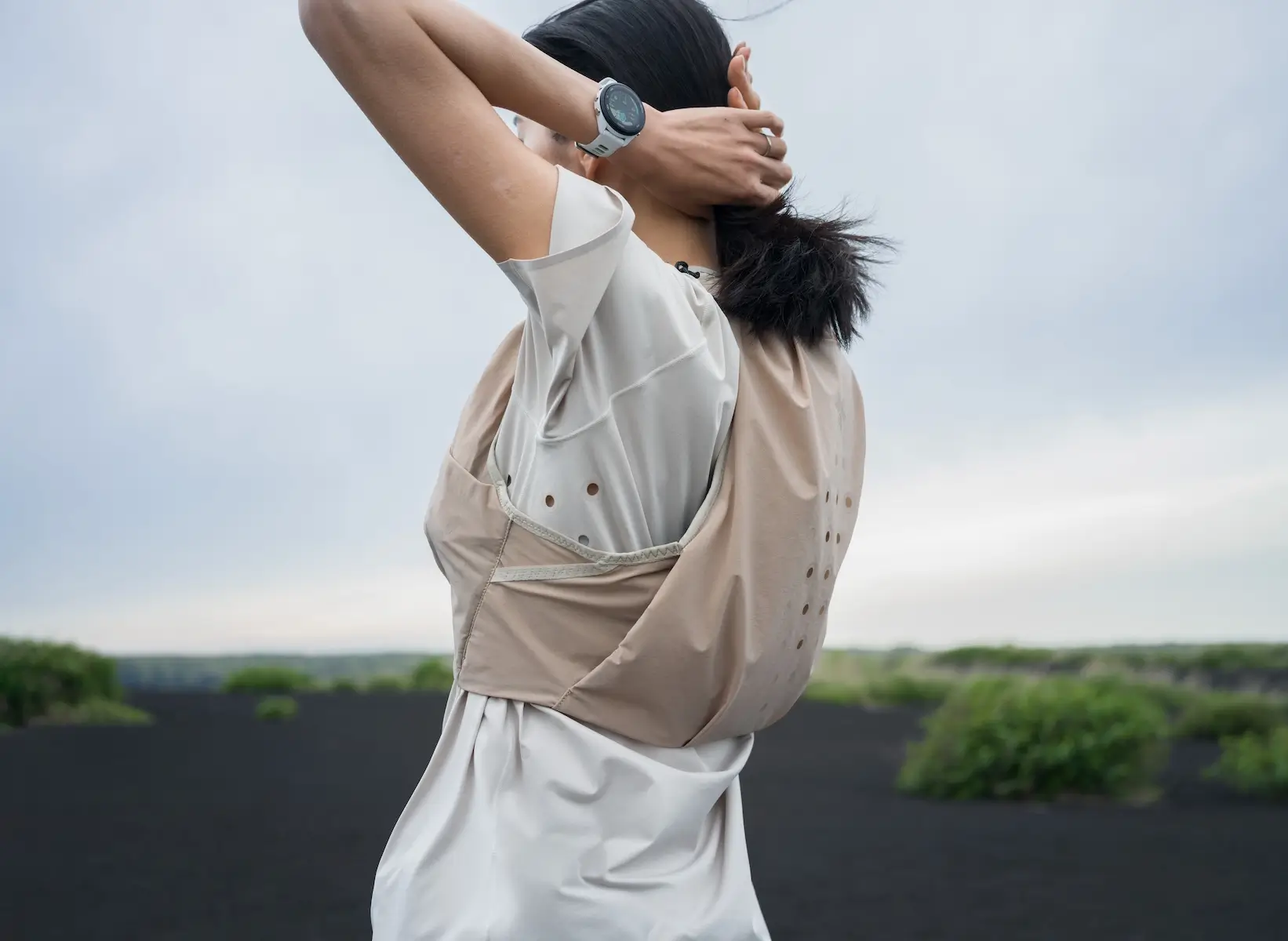
No brand has pushed perforation further into pure identity than Goldwin 0, the experimental show offshoot of the Japanese heritage label Goldwin. Its Performance Capsule, now in its second Spring/Summer installment under creative director Nur Abbas and Goldwin’s in-house TechLab, is built around a process the brand calls body mapping: identifying the parts of a runner’s body most exposed to sun and most prone to overheating, then laser-cutting reflective ventilation holes at exactly those points across tees, shorts, half-tights and a redesigned Star Trail Pack.
The scale of the perforation varies by piece. Reporting on the range has cited tees carrying dozens of individually placed ventilation holes and a trail pack redesigned with 26 holes for airflow, all arranged in the circular pattern that echoes the “0” in Goldwin 0’s own name. That’s the detail that separates this from a purely functional exercise: the circle used to ventilate the garments is also the label’s core visual signature, repeated across colorways and product categories until the ventilation holes function as a house code in their own right, the way a stripe or a logo might for another brand. As one recent overview of the category put it, several brands, including SATISFY, have leaned into similarly placed ventilation zones, but Goldwin 0’s laser-cut, reinforced hole is a distinct visual approach.
Lightweight Beige Running Vest And White Sports Watch Worn Outdoors
That fusion of function and aesthetics is the throughline for the whole capsule. The garments are cut from a sweat-wicking, quick-drying polyester-elastic blend in muted stone colorways, understated enough from a distance that the ventilation reads first as pattern and only on closer inspection as engineering. Goldwin’s own product materials describe the goal as achieving pinpoint breathability and enhanced visibility at once, folding thermoregulation and reflective safety detailing into a single design gesture rather than treating them as separate features bolted onto the same garment.
The capsule also sits at the higher end of the category on price, with pieces reported in the $160 to $320 range depending on the market and item, the trail pack sitting at the top of that scale. That positioning matters for how the perforation is being read: this isn’t a budget mesh tee cutting corners to save on fabric, it’s a premium technical piece where the holes are presented as the reason for the price, not a byproduct of keeping costs down.
nike
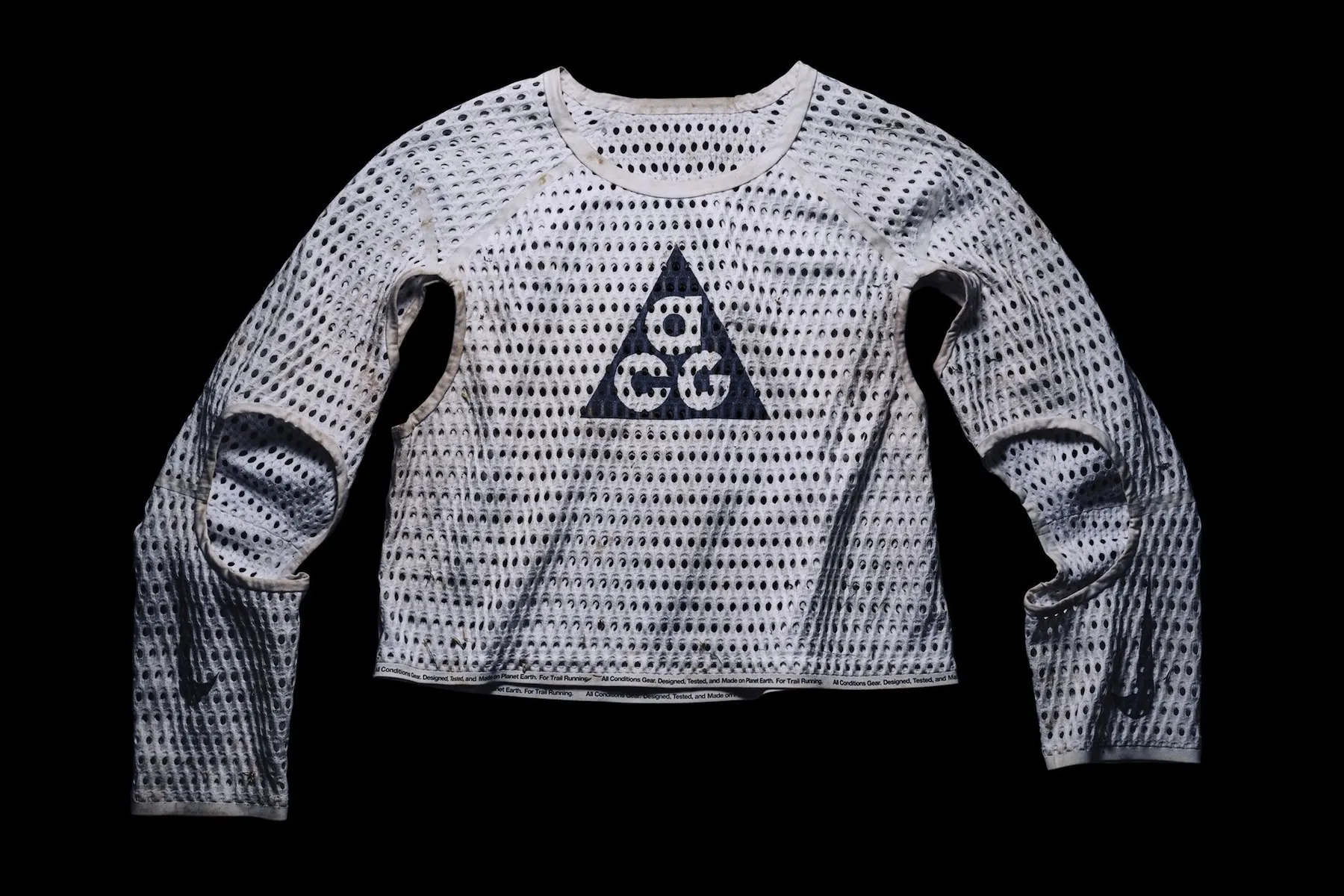
If Goldwin 0 represents perforation as identity, Nike ACG‘s Radical AirFlow is the clearest case yet of a brand treating ventilation as genuine material science. The fabric is built around engineered air ducts and funnel-shaped, cone-cut holes across the garment, a construction Nike’s own design team says was inspired by the Bernoulli principle and, more specifically, the Venturi effect: the physics phenomenon in which a fluid speeds up and drops in pressure as it moves through a narrowed opening. Applied to a running top, the idea is that as air passes through the engineered holes and constricted channels, it accelerates, speeding up sweat evaporation and the body’s own cooling response as the wearer moves.
Nike’s own testing, conducted with its Sport Research Lab, found that Radical AirFlow prototypes absorbed and retained roughly 50% less sweat than standard Dri-FIT after prolonged running in the heat, with additional thermal manikin testing showing the material was around 25% less resistant to sweat evaporation than Dri-FIT. Independent reviewers who have since worn production versions of the top have described feeling a genuine breeze effect during runs, even in relatively mild heat, though most note the cooling supplements rather than replaces other heat-management strategies like ice or hydration.
View this post on Instagram
The fabric’s public introduction came via Caleb Olson, who wore a Radical AirFlow prototype at the 2025 Western States 100, run on a day when canyon temperatures climbed above 100°F. Olson finished in 14 hours, 11 minutes and 25 seconds, the second-fastest time in the race’s history and just under two minutes off Jim Walmsley’s course record, before going on to place second in that year’s UltraRunner of the Year men’s voting. As one trail-running outlet later noted, photos of Olson’s mesh top from that race went viral among runners well before Nike’s first full Radical AirFlow collection reached retail in mid-2026. Nike ACG’s most recent Western States appearance, in 2026, ran under markedly cooler conditions and without Olson in the field, but the original heat-tested proof of concept remains the one the brand continues to point back to.
The timing lines up with a broader repositioning of Nike ACG itself, which has spent the past year pivoting from a fashion-first lifestyle label back toward being read as a genuine performance brand, absorbing Nike Trail in the process and sponsoring its first trail races outright, including China’s Ultra Trail Chongli 168. Radical AirFlow functions as a credibility play inside that shift: a fabric that can point to a specific, measurable result at a specific, brutally hot race does more for a relaunching performance division than a marketing campaign alone could.
where
Taken together, these products describe two distinct approaches converging on the same problem. SATISFY and Goldwin 0 use laser perforation as both a cooling mechanism and a visible signature, cutting patterns that double as brand identity. Nike ACG treats ventilation as an engineering problem to be solved with fluid dynamics, chasing measurable reductions in retained sweat rather than a particular look. District Vision and PAF apply the same logic to eyewear rather than fabric, while On’s Zero Singlet shows that a brand can chase the same performance outcome through weave and cut alone, without laser-cutting anything at all.
What connects all of them is a shift in how brands are talking about heat. Where breathability was once a spec sheet line item, it is now being framed, and photographed, as the headline feature of a release. With UK, US and European heatwaves setting new temperature records through 2026, apparel brands across running, trail and outdoor categories are treating airflow less as a summer-specific upgrade and more as a baseline expectation for warm-weather product going forward.
Whether the laser-cut hole itself becomes a lasting visual signature, the way a brand’s stripe or swoosh might, is a separate question from whether ventilation stays functionally necessary. The heat driving these releases isn’t going anywhere on its own, and that gives brands a straightforward incentive to keep refining where and how they cut into a garment, regardless of whether the resulting pattern ends up as recognisable as Goldwin 0’s circles or Nike’s cone-shaped ducts. For now, the clearest evidence of the trend’s staying power is that four separate brands, working in eyewear, running apparel and outdoor performance wear, converged on some version of engineered airflow inside the same twelve-month stretch.
Related Articles

Two Flagships and a Kojima Factory: John Elliott Rolls Out Fall/Winter 26 Delivery II
The second drop of John Elliott's Fall/Winter 26 season is live online and at the Melrose Avenue and Lafayette Street flagships, following a Delivery I…