DRIFT AUDIO
Listen to this story
Choose a voice, then press play.
Three pieces designed entirely from scratch, none replicated anywhere in Fred Perry’s own collection.
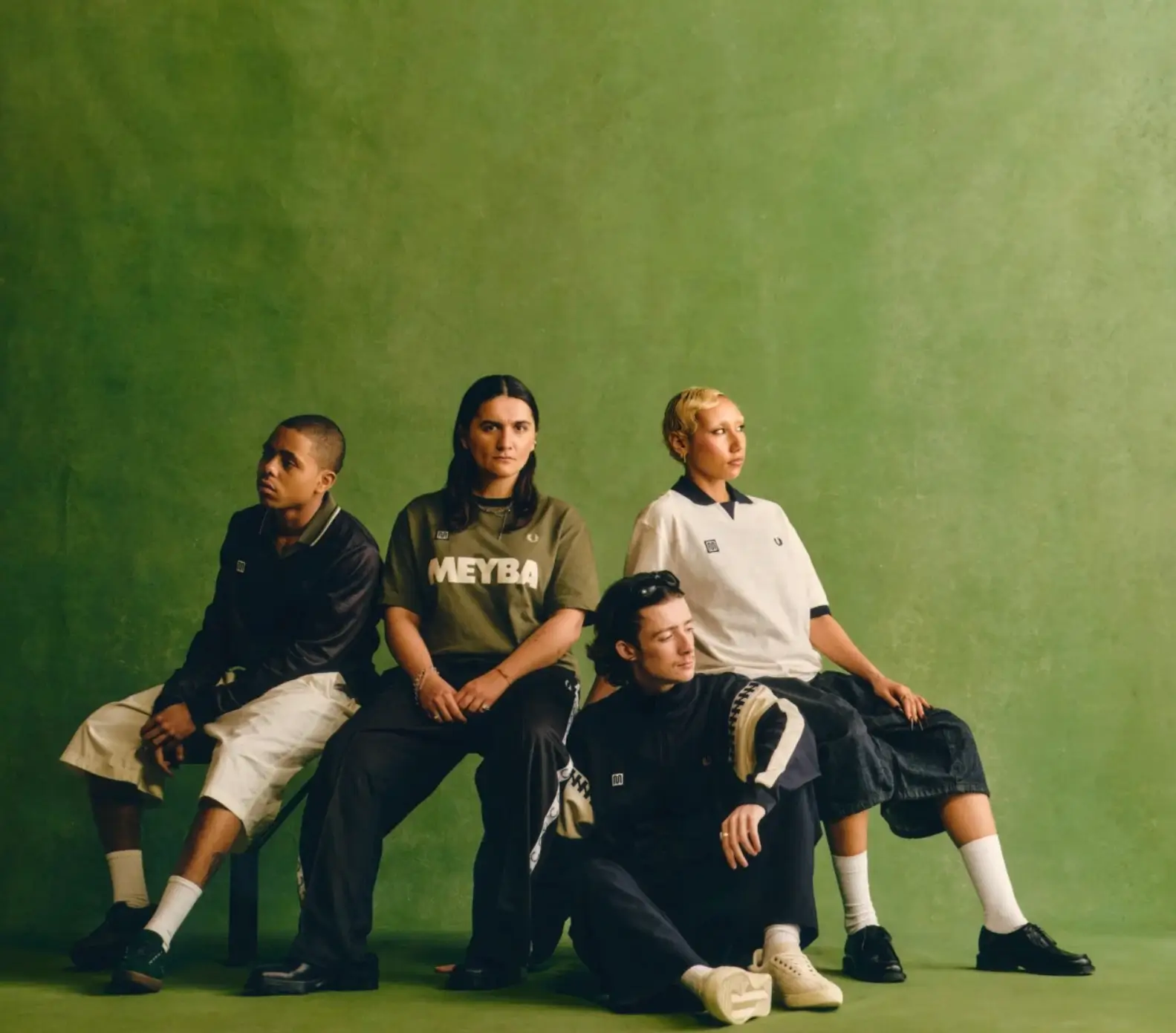
Every so often a brand collection skips the easy route of recoloring an archive piece and instead spends a season building something that has never been on a rack anywhere. That is the premise behind Fred Perry‘s newest capsule with Journal Standard, the Tokyo-based label operated by Baycrew’s, landing across three pieces this fall: a sweat track jacket, a football collar sweater, and a pair of trousers. All three carry the internal designation “EX CHIC,” and all three were, according to Journal Standard’s own product copy, made zero base, meaning none of the three silhouettes or fabrications exist inside Fred Perry’s own inline collection anywhere in the world.
That distinction matters more than it might first appear. Fred Perry union, include several of Journal Standard’s own past outings with the brand, have tended to work by taking an existing template, the polo, the track jacket, the tennis trouser, and adjusting fit, colorway, or trim. This time the starting point was raw yarn and fabric development rather than an existing pattern. The track jacket and trousers share a custom low-gauge jacquard terry sweat fabric knitted on jacquard machines in Japan; the sweater uses an organic-certified cotton yarn worked into a cable structure designed specifically for this rel. Construction, from material development through to sewing, was carried out entirely in Japan for the jacket and trousers, while the sweater was produced in China.

Fred Perry For JOURNAL STANDARD Collection
Pricing lands at ¥23,100 for the track jacket, ¥26,400 for the sweater, and ¥22,000 for the trousers, all tax included. The sweater is scheduled to ship in late September 2026, with the jacket and trousers following in early October, though Journal Standard notes that factory production schedules could push delivery earlier or later. All three are pre-order only through Baycrew’s Store, sold in a limited run that closes once the allotted quantity is reached, with in-store reservations available at Journal Standard’s Japan locations alongside the online release.
The price tags put the capsule a step above Fred Perry’s own inline pricing for comparable pieces, which is typical of the Journal Standard collaboration and reflects the added cost of developing bespoke fabrics rather than sourcing from an existing mill run. It also puts the collection roughly in line with what Journal Standard has charged for past Fred Perry outings, including the ¥24,200 track jacket and ¥26,400 tennis trouser from the 2024 “Northern Soul” release, suggesting the brand has held its price positioning steady even as the development process behind this particular capsule went further than before.
stir
The track jacket, officially named the FRED PERRY EX CHIC SWEAT TRACK JACKET MI (model FPM-26A-040JS), starts with a fabric decision rather than a design one. Journal Standard commissioned a low-gauge terry back-brushed sweat material, woven on jacquard knitting machines within Japan, chosen for a heavyweight hand that still keeps a clean face on both the outer and inner surfaces. According to the brand, that evenness in the knit structure is also what allows the fabric to hold color depth consistently, from pale shades through to the darkest colorway, without the patchiness that heavier terry sweats can show.
View this post on Instagram
Where the design breaks furthest from Fred Perry’s own track jacket, an item built around a sporty, performance-oriented form, is in how the silhouette was rethought as an extension of daily dress rather than as sportswear. The pattern was cut with a three-dimensional structure that lets the wearer control fit and layering by sizing choice alone, meant to work as a standalone piece through autumn and as a mid-layer once temperatures drop further into winter. Because the fabric’s weight and density made a standard front welt pocket difficult to finish cleanly, the design team added an extra side seam and moved the pocket into that seam instead, a workaround that also let them angle the neckline attachment for a sharper line whether the jacket is worn zipped or open. The two-piece sleeves are set with a slight forward pitch, and the body pattern curves in at the sides to keep the relaxed fit from reading as boxy.
The jacket comes in three colorways: Black (Fred Perry’s own 102 Black), a color Journal Standard sells as “Black D” but which Fred Perry designates 61C Anchor Grey, and Brown, corresponding to Fred Perry’s 33C Rich Brown. The body is 100 percent cotton, with the rib trim blended at 95 percent cotton and 5 percent polyurethane for stretch recovery. It is offered in M and L only.
flow
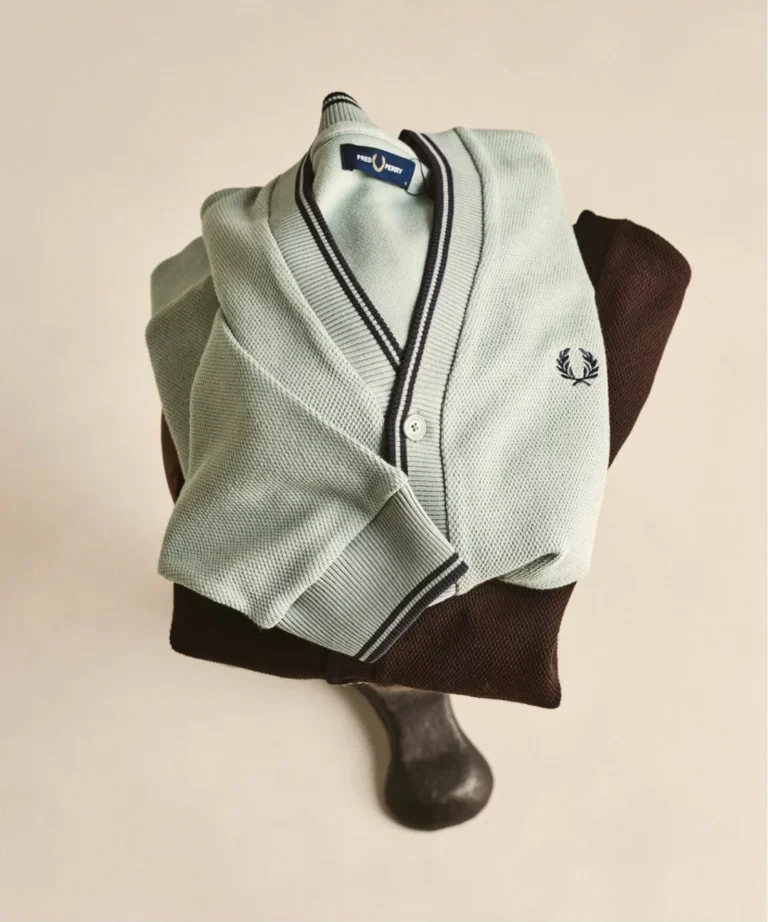
The sweater, FRED PERRY EX CHIC CABLE COTTON FOOTBALL (FPM-26A-042JS), takes the opposite approach to volume. Cable knits tend to run stiff by nature, a byproduct of the twisted stitch structure, so the team specified a middle-gauge, multi-ply cotton yarn and deliberately avoided over-tightening the knit’s gauge, aiming for a hand that stays soft without losing the sharp, structured neckline the design called for. The yarn itself is certified organic cotton, spun into an original cable pattern developed specifically for this piece rather than pulled from an existing knit library.
The football collar itself, the ribbed, buttonless neckline associated with rugby and football training knits rather than tennis whites, gives the sweater a cleaner, closed-off finish at the neck that Journal Standard frames as adding a sense of tidiness to what is otherwise a relaxed fit. The stated goal, echoed in the copy for all three pieces, was to read Fred Perry’s own archive without leaning fully into either its tennis-club formality or its terrace-casual side, landing instead on something the brand calls a neutral, everyday piece.
Colorways are limited to Black and Natural, corresponding to Fred Perry’s 68C Ecru. The body is 100 percent cotton, offered in M and L, and unlike the jacket and trousers, production was carried out in China rather than Japan.
and
The trousers, FRED PERRY EX CHIC SWEAT TROUSERS MIJ (FPM-26A-041JS), share the jacket’s custom low-gauge jacquard terry fabric and, with it, the same three colorways: Black, Black D (Anchor Grey), and Brown, all 100 percent cotton and made in Japan start to finish. Where Fred Perry’s own inline sweatpants typically use an elasticated hem and a heavily tapered leg, this pair takes a trouser-based approach instead, with a structured waistband that raises the starting point of the back hip panel. That adjustment is meant to give enough room through the seat and thigh for movement without adding excess fabric volume, landing on a straighter, more slacks-like leg line that Journal Standard says works against the low-slung, boxy default most sweatpants fall into.
The detail likely to draw the most attention from longtime Fred Perry watchers is where the logo sits. On the brand’s own tennis trousers, the laurel wreath sits front and center; here, that placement is dropped in favor of position the mark on the back right panel instead, a nod to the tennis trouser’s own construction but applied in reverse, keeping the front reading as unbranded. The knee position was also raised relative to a typical sweatpant pattern, another small adjustment aimed at avoiding the low-center-of-gravity look that heavier sweat fabrics tend to produce.
View this post on Instagram
extend
Journal Standard and Fred Perry’s collision has run in some form for several years, and the two most recent outings before this one help explain the direction this season takes. For fall/winter 2024, the pairing released a two-piece “Northern Soul” collection built around a track jacket and a tennis trouser, both designed to strip back Fred Perry’s more recognizable branding details, the tape trim, the front pockets, in favor of a minimal reading of the same silhouettes. That was followed for fall/winter 2025 by a full-button piqué polo, and then, for spring/summer 2026, by a capsule the two brands titled “Way Out,” a reference to the London Underground signage for a station exit.
That spring capsule marked an explicit shift in approach on Journal Standard’s own account of the project. Where earlier seasons had aimed to present, in the brand’s words, a new entry point into Fred Perry for people unfamiliar with the label, the “Way Out” collection instead turned toward re-examining Fred Perry’s own existing signatures and figuring out how to let them sit naturally inside everyday Japanese dress, accounting for local climate, skin tone, and body proportion in the pattern work. That spring release covered a polo shirt, knit cap, and tennis trouser, with the trouser alone priced at ¥28,600, and was framed under the tagline “変えすぎない。だから新しい。”, loosely translated as not changing too much, which is exactly why it reads as new.
Fall/winter 2026 continues that same logic but pushes it a step further, moving past silhouette and colorway adjustments into full fabric development, with all three pieces originating from custom materials rather than existing Fred Perry patterns. Where “Way Out” worked primarily by adjusting fit and proportion on top of Fred Perry’s existing piqué and knit bases, this season’s capsule required commissioning entirely new textiles before any pattern work could begin, a heavier lift that shows in the emphasis Journal Standard’s own product copy places on yarn sourcing, knitting gauge, and domestic manufacturing over styling details.
fin
Fred Perry was founded in 1952, taking its name from the British tennis champion Fred Perry, who spent the late 1920s and 1930s as one of the sport’s dominant players before the brand that carries his name grew far beyond the court. Its laurel wreath logo, drawn from the wreath awarded to Wimbledon champions, became one of menswear’s more quietly recognizable marks over the following decades, adopted by mod culture in 1960s Britain and later by a string of youth subcultures that followed. The company remains headquartered in London and has been under the ownership of Hit Union Co since 1995.
Though founded as sportswear, the brand’s association with 1960s mod subculture pulled it out of the tennis club and onto the street, and that dual identity, equal parts tennis pedigree and terrace culture, is what most collaborators, Journal Standard included, tend to lean on when reworking the brand’s archive. Fred Perry posted revenue of £154.1 million in 2024, according to public filings, and operates more than 200 stores worldwide under CEO John Flynn.
Journal Standard sits within Baycrew’s broader portfolio of Japanese select shops and original labels, known for pairing its own collections with a steady stream of collaborative capsules across denim, outerwear, and knitwear from both Japanese and international partners. The Fred Perry partnership has become one of its more consistent seasonal fixtures, running twice a year with each drop building on the design language of the one before it. Journal Standard’s menswear line carries the collaboration alongside its own house labels, including J.S.Homestead and Reflax, sold through Baycrew’s Store and at Journal Standard’s own retail locations across Japan.
For now, all three fall/winter 2026 pieces remain in the pre-order window through Baycrew’s Store, with the sweater arriving first in late September and the jacket and trousers following in early October. Whether the fully-custom fabric approach carries over into future seasons, or whether the collaboration swings back toward adjusting existing Fred Perry templates the way “Way Out” did, is something only the next drop will answer.
Related Articles
Kris Van Assche Reopens His Own House, on His Own Terms
Eleven years after shelving it at the height of his Dior Homme tenure, Kris Van […]